

Business
China plans strict AI rules to protect children and tackle suicide risks

Osmond ChiaBusiness reporter
 Getty Images
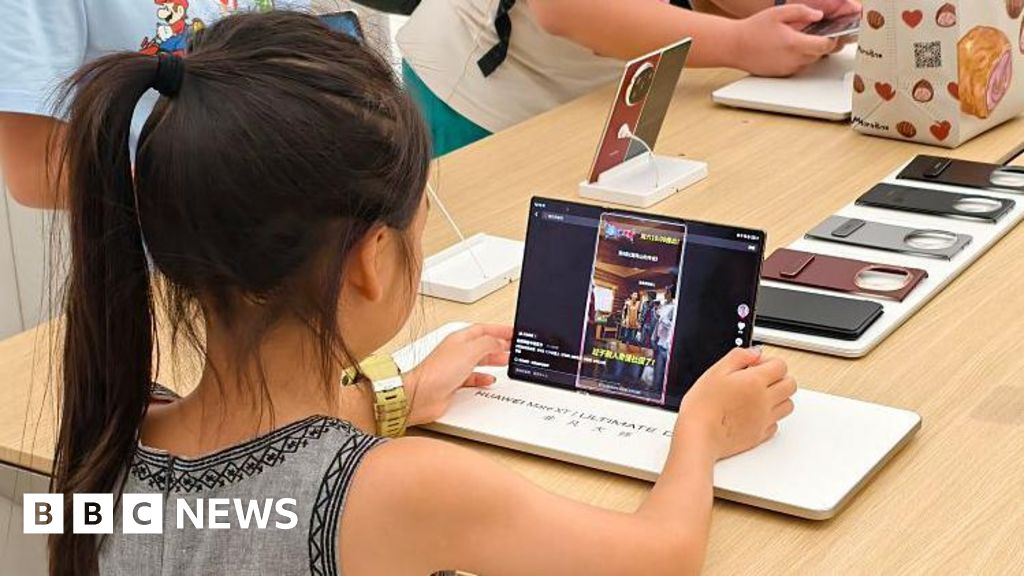
China has proposed strict new rules for artificial intelligence (AI) to provide safeguards for children and prevent chatbots from offering advice that could lead to self-harm or violence.
Under the planned regulations, developers will also need to ensure their AI models do not generate content that promotes gambling.
The announcement comes after a surge in the number of chatbots being launched in China and around the world.
Once finalised, the rules will apply to AI products and services in China, marking a major move to regulate the fast-growing technology, which has come under intense scrutiny over safety concerns this year.
The draft rules, which were published at the weekend by the Cyberspace Administration of China (CAC), include measures to protect children. They include requiring AI firms to offer personalised settings, have time limits on usage and getting consent from guardians before providing emotional companionship services.
Chatbot operators must have a human take over any conversation related to suicide or self-harm and immediately notify the user’s guardian or an emergency contact, the administration said.
AI providers must ensure that their services do not generate or share “content that endangers national security, damages national honour and interests [or] undermines national unity”, the statement said.
The CAC said it encourages the adoption of AI, such as to promote local culture and create tools for companionship for the elderly, provided that the technology is safe and reliable. It also called for feedback from the public.
Chinese AI firm DeepSeek made headlines worldwide this year after it topped app download charts.
This month, two Chinese startups Z.ai and Minimax, which together have tens of millions of users, announced plans to list on the stock market.
The technology has quickly gained huge numbers of subscribers with some using it for companionship or therapy.
The impact of AI on human behaviour has come under increased scrutiny in recent months.
Sam Altman, the head of ChatGPT-maker OpenAI, said this year that the way chatbots respond to conversations related to self-harm is among the company’s most difficult problems.
In August, a family in California sued OpenAI over the death of their 16-year-old son, alleging that ChatGPT encouraged him to take his own life. The lawsuit marked the first legal action accusing OpenAI of wrongful death.
This month, the company advertised for a “head of preparedness” who will be responsible for defending against risks from AI models to human mental health and cybersecurity.
The successful candidate will be responsible for tracking AI risks that could pose a harm to people. Mr Altman said: “This will be a stressful job, and you’ll jump into the deep end pretty much immediately.”
If you are suffering distress or despair and need support, you could speak to a health professional, or an organisation that offers support. Details of help available in many countries can be found at Befrienders Worldwide: www.befrienders.org.
In the UK, a list of organisations that can help is available at bbc.co.uk/actionline. Readers in the US and Canada can call the 988 suicide helpline or visit its website.

These highly skilled, highly educated foreign workers have been documenting the challenges of trying to build a career in the U.S. “If I don’t find a job, I have to leave the country.” “I sent out 907 applications.” “Have I ever truly relaxed in America?” They need an H-1B visa, which is given through a lottery system that allows U.S. companies to hire highly skilled international professionals for up to six years, in industries like tech and medicine. But the Trump administration has made changes to the program, requiring companies to pay a high fee and enforcing new rules that prioritize higher-paid foreign workers, in an effort to make more jobs available to Americans. This has forced some foreigners to rethink their career plans. “I think the U.S. is still the golden standard.” Wen-Hsing Huang came to the U.S. from Taiwan in 2022 for the tech scene, and was hired by Amazon on an H-1B visa. “I want to use my talents to change the world, and I think the United States was the best platform to do that.” Ananya Joshi came from India to attend a master’s program in Chicago in 2022. “So it was actually my my father’s dream that I had inherited because my father couldn’t go because of his financial situation.” Haina, a Chinese national, fell in love with the U.S. while studying in New York. She got her H-1B in 2022. “I remember there were a lot of companies, they would be able to sponsor.” Haina said she’s experienced a recent shift, where it has become harder to find companies that sponsor H-1B visas. “This time when I was job searching, I didn’t realize it could be a deal breaker. I just had my second interview of 2026, and it was a pretty short call.” (Recruiter) “I don’t think we’re eligible or able to do sponsorship for this role at the moment.” “They don’t even really get to know if I’m qualified, am I experienced, or anything. The decision is already made at that point.” “Please, please make sure that the company you’re about to work for has experience handling international hires.” Joshi said a start-up she interned with during grad school rescinded their promise to sponsor her H-1B visa. “Ask for everything in writing. And then there were jobs that were contract jobs. They would just reject me. They would only need people with a green card or a U.S. citizenship.” Even with an H-1B and a six-figure salary, Huang said he felt himself becoming anxious, as tech layoffs ramped up and Trump’s immigration policies kept changing. “I woke up every morning with this knot in my stomach, because my entire life depended on the policy I couldn’t control. The United States seems not very welcoming to immigrants that contribute to this country.” “The signals are, like, pretty clear at this point. They want to make this H-1B, is, like, risky and also, like, harder.” Hello, everyone.” Despite that, Haina says she’s determined to keep looking for a job until she’s forced to leave the country. “The pressure about where I’m going to be in the next of my career or, like, my life. I sort of like lost the ability to enjoy my life or just be happy.” “So I had to leave the U.S. Of course, I expanded my search beyond the U.S. Found a job in Germany.” Joshi packed up her life and started a new role with a European biotech firm in January. “I think I left at a good time, because there would have been more stress. I would have been stuck in a loop.” “It’s an endless cycle of anxiety.” After quitting his job at Amazon, Huang is now back in Taiwan, planning to launch his own company. “To bet on building an A.I. company that gives me complete control over my time, location and future. Staying in the United States is no longer the only way to achieve my American dream.”

Following the recent surge in petrol and diesel prices, the government has announced another increase in the price of kerosene, further adding to the financial burden on consumers.
According to an official notification, the price of kerosene has been increased by Rs 34.8 per liter. With this latest adjustment, the new price of kerosene has reached Rs 467.48 per liter.
The notification states that the revised price has come into effect from today. Prior to this increase, kerosene was being sold at Rs 433.40 per liter.
The continued rise in fuel prices, including kerosene, is expected to significantly impact low-income households, particularly in rural areas where kerosene is widely used for cooking and lighting.

Many readers have experienced the ordeal of cancelling a subscription.
Source link


Transfer rumors, news: Four Premier League clubs want Rogers
Video: Skilled Foreign Workers Think About Leaving the U.S.

US manufacturing performance improves in March 2026

-

 Fashion1 week ago
Ho Chi Minh City bizs adjust production plans, seek new supply chains
-

 Entertainment7 days ago
Lee Sang-bo dies at 45: Funeral details revealed
-

 Sports7 days ago
Illinois defense gets tough, ousts Houston to reach Elite Eight
-
 Fashion6 days ago
EU apparel imports slump 15.48% YoY in Jan; Bangladesh hardest hit
-

 Fashion1 week ago
India’s Gen Z to drive half of fashion market by 2030: Reedseer
-

 Sports5 days ago
2026 NCAA men’s hockey tournament: Schedule, results
-
 Business7 days ago
How do you spot a fake online review?
-

 Fashion7 days ago
China rolls out tariff cuts on Congo imports from April 1