

Business
China’s smaller manufacturers look to catch the automation wave – The Times of India


In a light-filled workshop in eastern China, a robotic arm moved a partially assembled autonomous vehicle as workers calibrated its cameras, typical of the incremental automation being adopted even across smaller factories in the world’s manufacturing powerhouse.China is already the world’s largest market for industrial robots, and the government is pouring billions of dollars into robotics and artificial intelligence to boost its presence in the sector.
The first essentially humanlessfactoriesare already in operation, even as widespread automation raises questions about job losses as well as the cost and difficulty of transition for smaller and medium-sized companies. The answer for many is a hybrid approach, experts and factory owners told AFP. At the autonomous vehicle workshop, manager Liu Jingyao told AFP that humans are still a crucial part of even technologically advanced manufacturing. “Many decisions require human judgement,” said Liu, whose company Neolix produces small van-like vehicles that transport parcels across Chinese cities. “These decisions involve certain skill-based elements that still need to be handled by people.”At the Neolix factory, 300 kilometres (186 miles) north of Shanghai, newly built driverless vehicles zoomed around a testing track simulating obstacles including puddles and bridges.In a closed-off room, workers assembled vehicles’ “brains”, testing their cameras and computer chips.“Automation… primarily serve(s) to assist humans, reducing labour intensity rather than replacing them,” Liu said.But Ni Jun, a mechanical engineering expert at Shanghai’s Jiaotong University, said China’s strategy of focusing on industrial applications for AI means full automation is already feasible in many sectors.Among others, tech giant Xiaomi operates a “dark factory” — where the absence of people means no need for lights — with robotic arms and sensors able to make smartphones without humans.– Digital divide –Ni described a “digital divide” between larger companies with the funds to invest heavily in modernisation, and smaller businesses struggling to keep up.For Zhu Yefeng’s Far East Precision Printing Company, part of China’s vast network of small independent factories employing up to a few dozen people each, full automation is a distant dream.At the company just outside Shanghai, workers in small rooms fed sheets of instruction manuals into folding machines and operated equipment that printed labels for electronic devices.The company used pen and paper to track its workflow until two years ago, with managers having to run around the factory to communicate order information.“Things were, to put it bluntly, a complete mess,” Zhu told AFP.The company has since adopted software that allows employees to scan QR codes that send updates to a factory-wide tracker.On a screen in his office, Zhu can see detailed charts breaking down each order’s completion level and individual employees’ productivity statistics.“This is a start,” Zhu told AFP. “We will move toward more advanced technology like automation, in order to receive even bigger orders from clients.”Financial constraints are a major barrier though. “As a small company, we can’t afford certain expenses,” said Zhu. His team is trying to develop its own robotic quality testing machine, but for now humans continue to check final products.– Employment pressures –The potential unemployment caused by widespread automation will be a challenge, said Jacob Gunter from the Berlin-based Mercator Institute for China Studies. “Companies will be quite happy to decrease their headcount… but the government will not like that and will be under a lot of pressure to navigate this,” Gunter told AFP.Beijing’s push to develop industrial robots will “intersect with the need for maintaining high employment at a time when employment pressure is considerable”, he added. Going forward, manufacturers must strike a balance “between the technical feasibility, social responsibility, and business necessity”, Jiaotong University’s Ni told AFP.Zhou Yuxiang, the CEO of Black Lake Technologies — the start-up that provided the software for Zhu’s factory — told AFP he thought factories would “always be hybrid”. “If you ask every owner of a factory, is a dark factory the goal? No, that’s just a superficial description,” Zhou said. “The goal for factories is to optimise production, deliver things that their end customers want, and also make money.”

Novo Nordisk is looking for deals more than ever before, the CEO of the Danish drugmaker said in an interview with CNBC on Wednesday.
“If our ambition is to help hundreds of millions of patients out there, then we need not just the best, but the broadest pipeline in the world,” said Novo Nordisk CEO Mike Doustdar. “So let’s go and see who else basically has assets that are complementary to what we have. And we are quite active with those [business development] talks and acquisitions, and you’ll see more of those as well going forward.”
Novo created the market for GLP-1 weight loss drugs with its weekly shots Ozempic and Wegovy. More recently, the company has faced concerns from analysts about whether Novo’s pipeline is robust enough for it to remain a leader in the increasingly competitive obesity drug space.
Mike Doustdar, chief executive officer of Novo Nordisk A/S, during an interview in New York, US, on Wednesday, Feb. 11, 2026.
Michael Nagle | Bloomberg | Getty Images
Rival Eli Lilly has already overtaken Novo in market share for weekly GLP-1 shots, though Novo has taken an early lead in the new category of GLP-1 pills for weight loss.
Doustdar said he disagrees with the concerns about Novo’s upcoming treatments, arguing the drugmaker has “one of the best pipelines in the industry.” He pointed to Novo’s CagriSema, a drug candidate that targets GLP-1 and amylin, that Novo hopes will be approved at the end of this year, and an experimental amylin-targeting drug called zenagamtide that Novo has accelerated development of, among other assets.
“Of course, there’s a lot of things in my pipeline that right now I have the privy to look into and get excited (about) but not have shared it yet with the world,” he said. “So I am incredibly excited about our pipeline, and I would just say to the investors who are a little bit skeptical, wait and see.”
Doustdar spoke to CNBC after the company said its Wegovy pill performed better than expected in the first quarter, and it raised its full-year profit guidance.

The stores were purchased by Modella Capital last year, and then rebranded under the name TGJones.
Source link
Business
US stock markets today (May 6, 2026): Wall Street rallies to record highs, crude oil tumbles on Strait of Hormuz reopening hopes – The Times of India
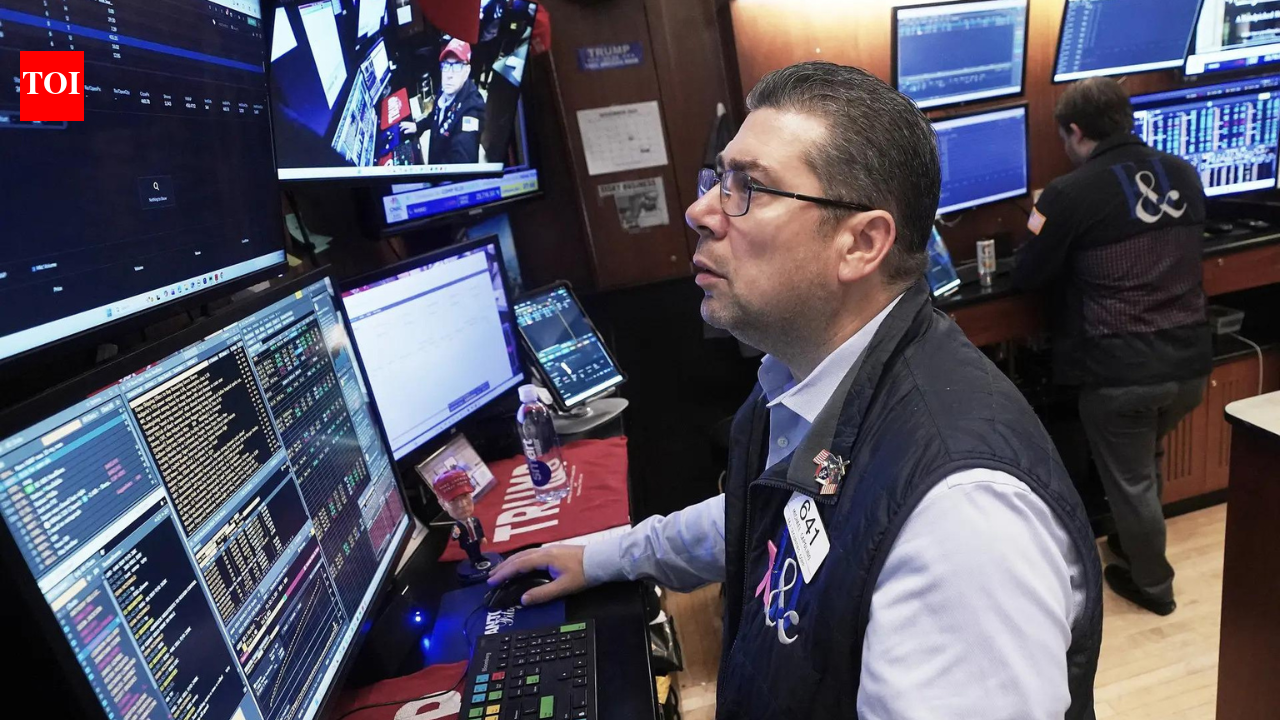
US stock markets surged on Wednesday while oil prices plunged sharply as investors bet on a possible breakthrough in US-Iran negotiations that could reopen the Strait of Hormuz and restore global crude supplies, AP reported.The S&P 500 climbed 0.8 per cent and headed towards another record close. The Dow Jones Industrial Average rose 487 points, or 1 per cent, while the Nasdaq Composite gained 0.8 per cent.Brent crude, the international oil benchmark, slumped 5.7 per cent to $103.61 per barrel after falling from levels above $115 earlier this week. At one point during the session, Brent briefly dropped below $97 before recovering some losses.The rally came after US President Donald Trump said the Strait of Hormuz could be “OPEN TO ALL” if Iran accepts a reported agreement, though he did not disclose details of the proposed deal.The Strait of Hormuz has remained at the centre of the global energy crisis since the Iran conflict disrupted oil tanker movement through the Persian Gulf, pushing crude prices sharply higher and stoking inflation fears worldwide.Markets also drew optimism from Trump’s indication that the US may scale back efforts to reopen the strait through military means, while China called for a comprehensive ceasefire after talks between Chinese and Iranian foreign ministers.Asian and European markets also rallied strongly. South Korea’s Kospi surged 6.5 per cent to cross the 7,000 mark for the first time, while Hong Kong’s Hang Seng rose 1.2 per cent. London’s FTSE 100 gained 2.2 per cent and France’s CAC 40 climbed 2.9 per cent.On Wall Street, technology and AI-linked stocks led gains after strong earnings reports.AMD jumped 19.3 per cent after reporting better-than-expected quarterly profit and revenue. CEO Lisa Su said continued growth in artificial intelligence demand had boosted the company’s performance.The chipmaker also projected revenue growth of around 46 per cent in the current quarter.Super Micro Computer rallied 14.2 per cent after posting earnings above analyst estimates.CVS Health gained 8.2 per cent after beating first-quarter expectations and raising its full-year forecasts.Stocks of companies with high fuel costs also rose sharply amid hopes of lower oil prices. United Airlines climbed 5.2 per cent, while Carnival and Royal Caribbean gained 5.5 per cent and 5.2 per cent, respectively.In the bond market, Treasury yields fell as easing oil prices reduced inflation concerns. The yield on the 10-year Treasury dropped to 4.35 per cent from 4.43 per cent a day earlier.Lower bond yields generally reduce borrowing costs for households and businesses and tend to support equity valuations.


Iran conflict may have motivated Trump dinner shooting suspect: report
Novo Nordisk CEO says the drugmaker is more active than ever in seeking out deals

NYCEDC unveils $1.7 mn to boost local fashion manufacturing

Pro wrestling star Steph De Lander reveals how colleague’s advice helped lead her to title triumph at ACW

‘I had £20,000 stolen and had to fight a 13-month fraud reporting rule to get it back’

Norway joins Type 26 Frigate Programme to boost NATO naval power

-
 Sports1 week ago
Pro wrestling star Steph De Lander reveals how colleague’s advice helped lead her to title triumph at ACW
-
Business1 week ago
‘I had £20,000 stolen and had to fight a 13-month fraud reporting rule to get it back’
-
 Entertainment1 week ago
Norway joins Type 26 Frigate Programme to boost NATO naval power
-
 Business7 days ago
PSX plunges over 4,800 points | The Express Tribune
-

 Tech1 week ago
This Ambitious Laptop Doesn’t Leave Much Room for Your Hands
-

 Tech6 days ago
Almost half of UK businesses hit by cyber attacks | Computer Weekly
-

 Tech6 days ago
Musk v. Altman Kicks Off, DOJ Guts Voting Rights Unit, and Is the AI Job Apocalypse Overhyped?
-
 Business1 week ago
BP profits more than double as oil trading booms amid Iran war