

Business
Chip policy push: Nvidia in talks with Trump administration on new B30A design for China; security concerns remain, Beijing flags ‘backdoor’ risk – Times of India

Nvidia chief executive Jensen Huang said the company is holding talks with the Trump administration over a potential new semiconductor for China, even as Washington maintains tight curbs on advanced chip sales citing national security.During a visit to Taiwan to meet Taiwan Semiconductor Manufacturing Corp (TSMC), Nvidia’s key manufacturing partner, Huang was asked about reports of a new “B30A” graphics processing unit (GPU) aimed at Chinese artificial intelligence data centres, AP reported. TSMC is the world’s largest chip maker.“I’m offering a new product to China for … AI data centres, the follow-on to H20,” Huang said. “But that’s not our decision to make. It’s up to, of course, the United States government. And we’re in dialogue with them, but it’s too soon to know.”The B30A would be based on Nvidia’s Blackwell technology and is said to run at about half the speed of the company’s flagship B300 chips. Top-end Nvidia processors remain barred from China under US restrictions that seek to limit Beijing’s access to advanced computing power for military and AI applications.Huang praised the Trump administration for recently clearing the sale of Nvidia’s H20 chips to China, which had been halted in April. Approval was granted with a condition that Nvidia pay a 15% tax to the US government on such sales. Rival Advanced Micro Devices (AMD) was asked to pay the same levy on exports of its MI380 chips to China.The approval was part of wider trade talks in which Washington and Beijing agreed to scale back some non-tariff measures. China granted additional permits for exports of rare earth magnets to the US, while Washington removed restrictions on chip design software and jet engines. Following Huang’s lobbying efforts, Nvidia was also allowed to resume H20 sales to Chinese customers.Asked about the tax condition, Huang declined to comment directly but said Nvidia valued the chance to sell H20 chips to China. He also rejected suggestions that such sales carried security risks for the US.“We have made very clear and put to rest that H20 has no security backdoors. There are no such things. There never has. And so hopefully the response that we’ve given to the Chinese government will be sufficient,” Huang said. He added that Nvidia was also in talks with Beijing to assure regulators about the product’s integrity.China’s Cyberspace Administration had recently posted a notice online raising what it called “serious security issues” in Nvidia’s chips. Citing US AI experts, it alleged the processors included “mature tracking and location and remote shutdown technologies.” Nvidia was asked to clarify these claims and provide documentation.Huang said the company was surprised by the accusations. “As you know, they requested and urged us to secure licenses for the H20s for some time. And I’ve worked quite hard to help them secure the licenses. And so hopefully this will be resolved,” he said.Reports in Chinese media have suggested authorities were also angered by comments from US Commerce Secretary Howard Lutnick, who argued that Washington’s policy was to limit China’s access to cutting-edge chips.“We don’t sell them our best stuff,” Lutnick told CNBC. “Not our second-best stuff. Not even our third best, but I think fourth best is where we’ve come out that we’re cool.”China’s ruling Communist Party has prioritised self-reliance in advanced technology but continues to rely heavily on foreign semiconductor know-how.
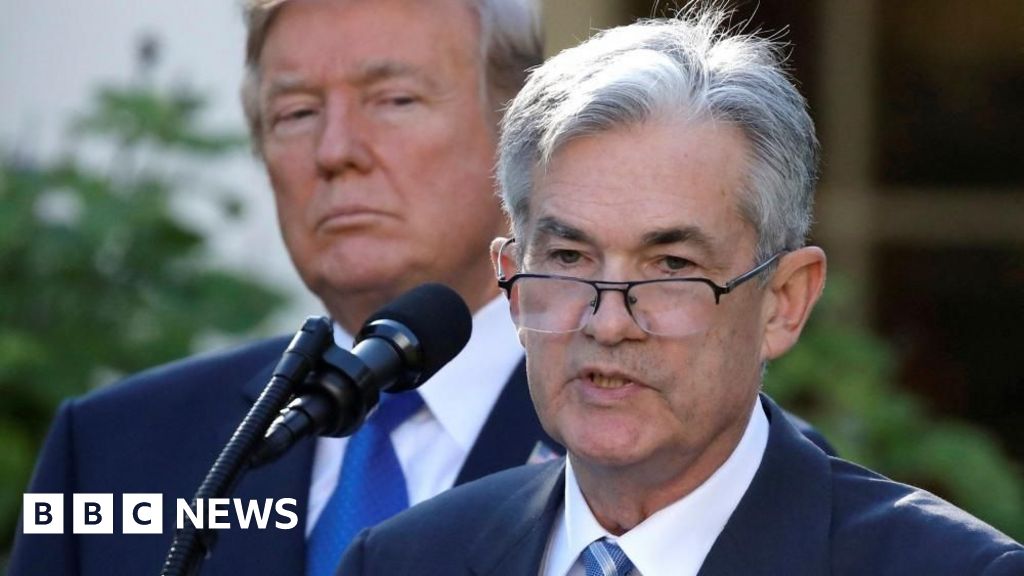
Powell’s term is nearing its end and the US Senate is considering Trump’s nominee for his replacement, Kevin Warsh. A key Republican, Thom Tillis, has withheld his support for Warsh unless the Trump administration would drop its investigation into Powell.
Business
Intel bags big gains! Chipmaker’s shares jump 26% on blockbuster results; how Trump admin benefits – The Times of India
Intel share price soared sharply on Friday after the chipmaker delivered a first-quarter performance that exceeded market expectations. And the win was not just for the chipmaker, but also the whole of US!The stock climbed 26.7% during trading on Friday, marking what could be its strongest single-day gain since 1987. Momentum continued after the closing bell, with shares rising a further 20% in after-hours trading as investors reacted to signs of a sustained turnaround driven by artificial intelligence.Intel reported revenue of $13.58 billion (€11.6bn) for the quarter, ahead of the $12.3 billion (€10.5 bn) forecast and up 7.2% from a year earlier. Adjusted earnings per share came in at $0.29, far exceeding expectations of $0.01.A key contributor to this performance was the company’s Data Centre and AI (DCAI) division, which delivered revenue of $5.05 billion (€4.2bn), up 22.4% year-on-year and well above analyst estimates of $4.41 billion (€3.77bn). The results indicate strong demand for Intel’s Xeon 6 processors and Gaudi 3 AI accelerators, particularly among enterprise clients and cloud service providers.Chief executive Lip-Bu Tan pointed to a broader shift in artificial intelligence usage as a major factor behind the growth. He said, “the next wave of AI will bring intelligence closer to the end user, moving from foundational models to inference to agentic.” He added, “This shift is significantly increasing the need for Intel’s CPUs and wafer and advanced packaging offerings.”The company also issued an upbeat outlook for the second quarter, forecasting revenue in the range of $13.8 billion (€11.8billion) to $14.8 billion (€12.6billion), surpassing investor expectations of $13 billion (€11.1billion).
But how is Washington winning?
The rally has had a direct impact on the US administration’s investment in Intel. In 2025, during a period of severe financial strain for the company, the administration of Donald Trump acquired a 9.9% stake in a move aimed at stabilising the business. The government invested $8.9 billion (€7.8bn) at a share price of $20.47 (€18.01), with $5.7 billion (€5bn) of that amount coming from previously approved but unpaid grants, according to the Euro News.At the time, Intel was facing multi-billion dollar losses and operational challenges, prompting concerns over its viability. As part of the intervention, the company cancelled planned factory projects in Germany and Poland, redirected focus towards US-based manufacturing, and reduced its global workforce by 25%, cutting around 25,000 jobs.Following the latest jump, Intel’s shares are now trading at $81.3 (€71.5), representing an increase of nearly 300% since the government first took its stake. The sharp rise highlights how the company’s improved financial performance has translated into substantial gains for the US administration.

Statistics Jersey says there have been “sharp increases” in some energy prices.
Source link


Charlie Sheen updates on relationship with old pal Jon Cryer

Iranian FM Abbas Araghchi lands in Pakistan ahead of renewed US talks

Mom’s Microwaved Coffee Won’t Stand a Chance With This Ember Smart Mug Deal

-

 Fashion1 week ago
France’s LVMH Q1 revenue falls 6%, shows resilience amid Iran war
-

 Tech1 week ago
CYBERUK ’26: UK lagging on legal protections for cyber pros | Computer Weekly
-

 Sports5 days ago
WWE WrestleMania 42 Night 2: Live match results and analysis
-

 Sports1 week ago
Faheem Ashraf backs Islamabad United’s push, calls league a ‘career-changing platform’
-

 Sports5 days ago
NCAA men’s gymnastics championship: All-time winners list
-
 Business1 week ago
PepsiCo earnings beat estimates as North American food business improves
-

 Tech1 week ago
Anthropic Plots Major London Expansion
-
 Business1 week ago
Oil prices fall again amid Middle East ceasefire hopes