

Sports
Cowboys acquire linebacker Logan Wilson from Bengals to help bolster struggling defense

NEWYou can now listen to Fox News articles!
The Dallas Cowboys are bringing reinforcements for one of the worst defenses in the NFL.
The team acquired linebacker Logan Wilson from the Cincinnati Bengals for a 2026 seventh-round pick, the Bengals announced Tuesday.
Wilson, 29, requested a trade amid a reduction in snaps. The linebacker is in the second year of a four-year contract extension he signed in July 2023. The deal was reportedly worth $36 million.
CLICK HERE FOR MORE SPORTS COVERAGE ON FOXNEWS.COM
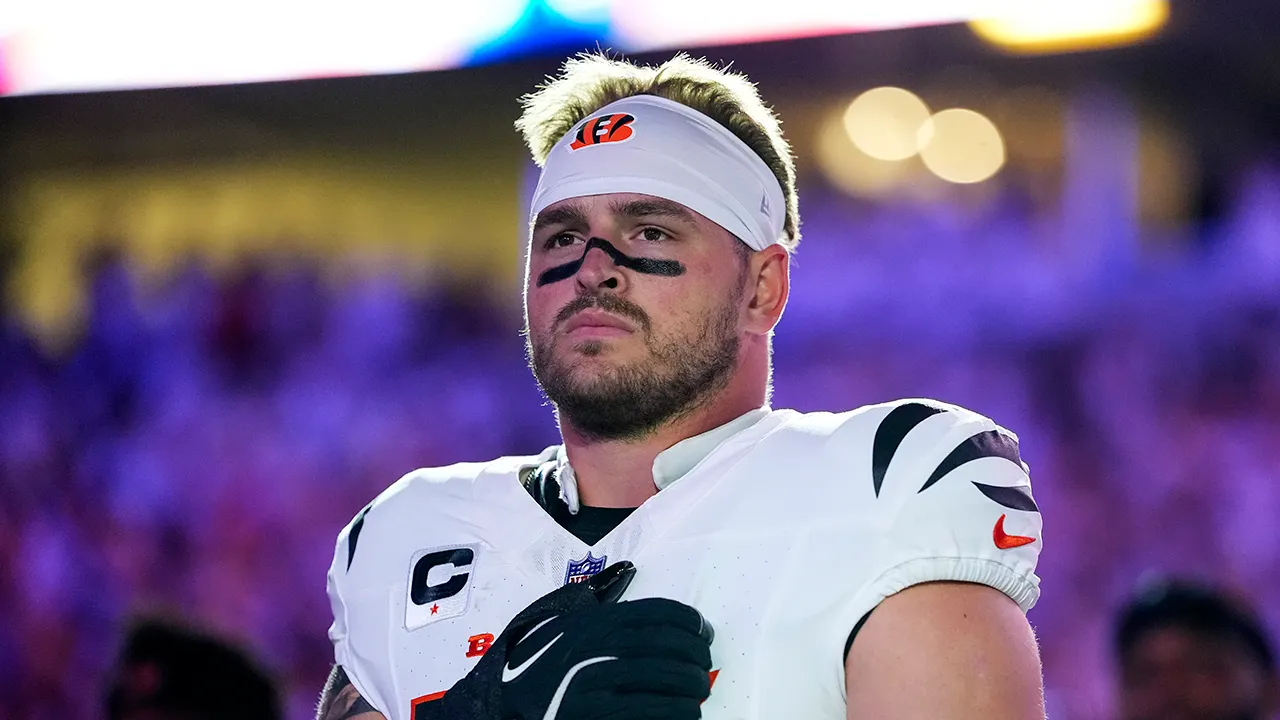
Logan Wilson (55) of the Cincinnati Bengals looks on from the sideline during the national anthem prior to an NFL football game against the Pittsburgh Steelers at Paycor Stadium in Cincinnati, Ohio, on Oct. 16, 2025. (Cooper Neill/Getty Images)
Wilson is in his sixth season in the NFL and has recorded more than 100 tackles in each of the last four seasons.
The linebacker goes from the Bengals, who allow the most yards per game in the NFL (426.6), to the Cowboys, who have allowed the second-most yards per game (397.4). The Cowboys are 3-5-1 despite having the fourth-highest scoring offense in football (29.2 points per game) because of their porous defense.
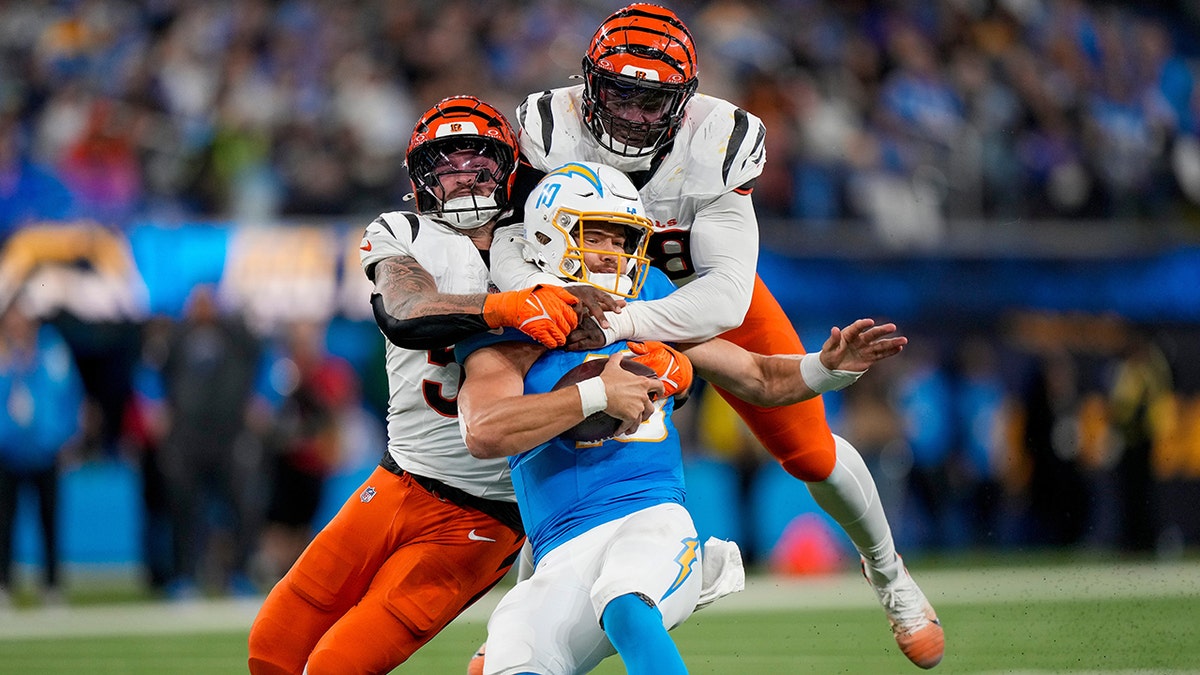
Cincinnati Bengals linebacker Akeem Davis-Gaither (59) and linebacker Logan Wilson (55) wrap up Los Angeles Chargers quarterback Justin Herbert (10) for a sack in the third quarter of the NFL Week 11 game between the Los Angeles Chargers and the Cincinnati Bengals at SoFi Stadium in Inglewood, California, on Nov. 17, 2024. (Sam Greene/The Enquirer / USA TODAY NETWORK via Imagn Images)
On Monday, the Cowboys lost to the Arizona Cardinals, 27-17, despite the team starting backup quarterback Jacoby Brissett. The veteran quarterback completed 21 of 31 passes for 261 yards and two touchdowns.
Cardinals running backs Emari Demercado and Bam Knight both ran well, combining for 19 carries for 106 yards.
CLICK HERE TO GET THE FOX NEWS APP
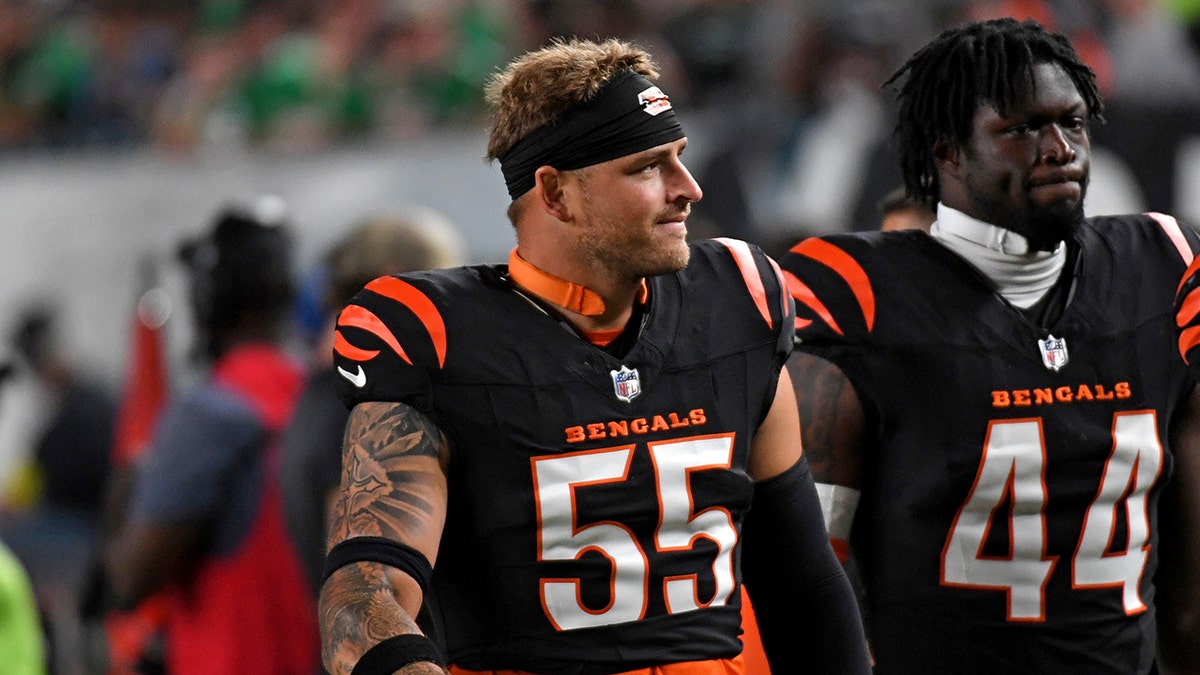
Cincinnati Bengals linebacker Logan Wilson (55) and linebacker Demetrius Knight Jr. (44) walk off the field at halftime against the Philadelphia Eagles at Lincoln Financial Field in Philadelphia, Pennsylvania, on Aug. 7, 2025. (Eric Hartline/Imagn Images)
Cowboys legend and ESPN broadcaster Troy Aikman wondered if one player could make a substantial difference for the struggling defense. Five different opponents have scored their season-high in points against the Cowboys this season.
The team will find out if Wilson can help make a difference in two weeks, as the Cowboys have a bye this week. Their next game is against the Las Vegas Raiders (2-6) on Nov. 17.
Follow Fox News Digital’s sports coverage on X, and subscribe to the Fox News Sports Huddle newsletter.






INDIANAPOLIS — The 2026 edition of the men’s Final Four features some of the most dominant teams of the season.
Arizona spent nine straight weeks atop the AP poll after opening the season on a program-best 23-0 start. The Wildcats will face Michigan, the team that unseated them from No. 1, which is averaging 95.3 points per game in the NCAA tournament, the most by a team en route to the semifinals since Kentucky averaged 97.0 in 1993.
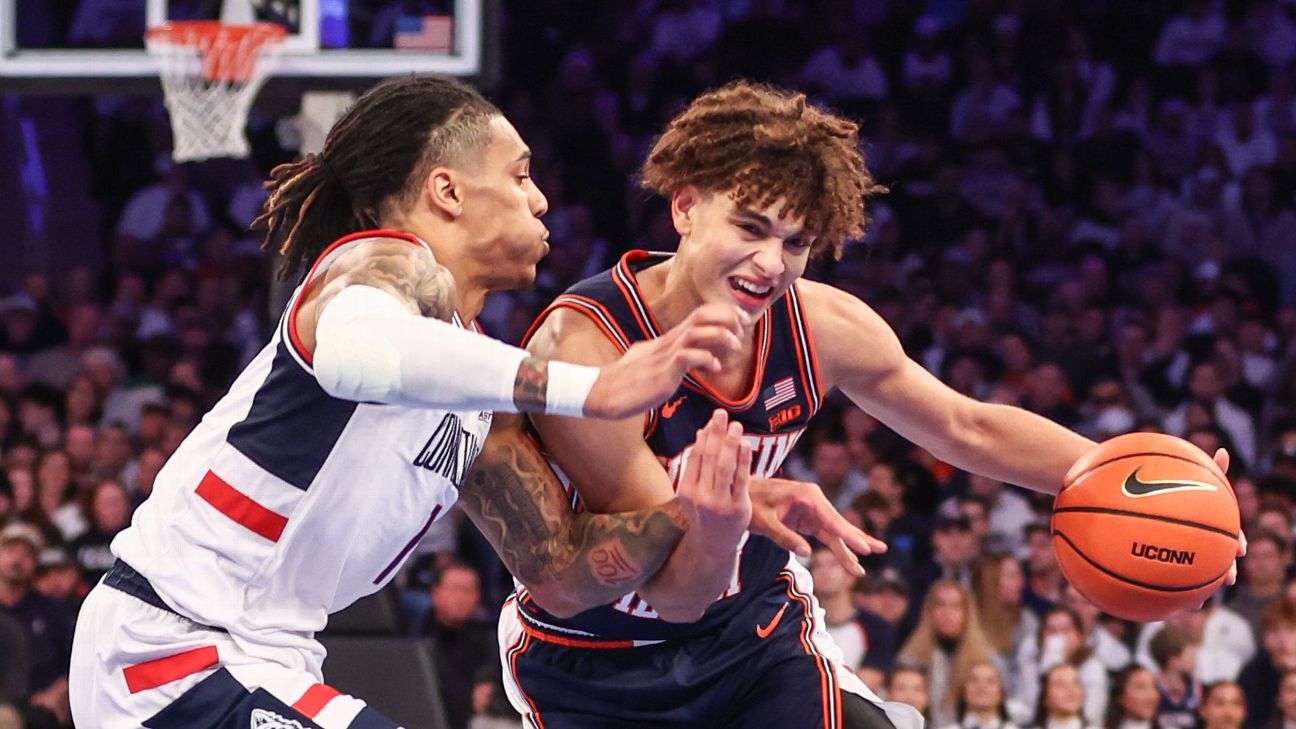
The two join Illinois in reaching the Final Four by winning every NCAA tournament game by double digits, marking the first time three teams have done that since 1973, per ESPN Research. The Fighting Illini will open the action Saturday against UConn, which is chasing its third national championship in four seasons. The Huskies have won their past two meetings with the Illini: in the Elite Eight during their 2024 title run and a nonconference meeting at Madison Square Garden in November.
Who will advance to Monday’s national championship? ESPN college basketball reporters Jeff Borzello and Myron Medcalf break down what — and whose performances — could decide both games.
Who is the most important player on the floor Saturday?
Borzello: Tarris Reed Jr.
Reed emerging as the modern-day Wilt Chamberlain in the NCAA tournament has transformed UConn. He has been the most dominant player in the field the past two weeks, bookended by a 31-point, 27-rebound performance against Furman in the first round and outperforming AP Player of the Year Cameron Boozer against Duke in the Elite Eight. Reed is averaging 21.8 points, 13.5 rebounds, 3.0 assists and 2.3 blocks in the tournament while shooting 60% from the field.
Reed will have to control the paint on offense and defense against Illinois. The Fighting Illini will look to contain his post scoring with 7-foot-1 Tomislav Ivisic and 7-2 Zvonimir Ivisic — the ability of both players to stretch the floor and make 3s could force Reed away from the rim defensively. He played just 15 minutes in the first meeting between the teams because of an ankle injury but went 0-for-3 from the floor and committed four fouls.
UConn can’t afford for that to happen again.
0:48
Tarris Reed Jr.’s massive 31-point, 27-rebound game propels UConn
Tarris Reed Jr. unleashes career highs with 31 points and 27 rebounds to lift the UConn Huskies to the second round.
Medcalf: Koa Peat
At 6-8 and 235 pounds, Arizona needs the freshman’s combination of size, talent and skill to beat Michigan. The good news for the Wildcats is that Peat is doing some of his best work as the season closes out, averaging 14.8 points and connecting on 53% of his shots inside the arc over the past 10 games. This game is a battle between two excellent teams with six projected first-round NBA draft picks between them.
Peat will have to be a defensive stopper against one of the biggest frontcourts in college basketball and create the production inside the paint the Wildcats will need to match an opponent that is prolific in the paint.
It’s difficult to imagine Michigan winning without All-American Yaxel Lendeborg playing well. You could make the same case about Arizona and Peat, who scored eight points combined in the team’s two losses.
What will determine UConn-Illinois?
Borzello: Perimeter shooting.
Illinois has been one of the country’s most 3-point-happy teams all season, although the Illini became less reliant on perimeter shots down the stretch. They still rank in the top 15 nationally in 3s made per game and 3-point attempt rate, but after making double digit 3s in 18 of their previous 22 games, they have done it just once since March 3 — and went 3-for-17 from 3 against Iowa in the Elite Eight.
For UConn, it’s less about volume and more about making shots. On paper, Solo Ball, Braylon Mullins and Alex Karaban are as fearsome a shooting trio as there is in college basketball. But in recent reality, Ball is 14.3% from 3 over his past six games, Mullins is 18.5% from 3 in his past eight games and Karaban went just 1-for-6 from 3 against Duke.
UConn doesn’t have to outshoot Illinois because of the edge it will have inside, but it’s a massive boost for UConn’s offense when it is making shots.
Medcalf: Illinois’ ability to corral Reed.
Mullins hit the winning 3 against Duke while UConn’s second-half defense and offensive execution fueled the comeback, but the Huskies’ win would not have been possible without Reed’s production: 26 points, nine rebounds and four blocks.
Illinois has length around the rim that few teams can match. But if Reed is as dominant as he has been throughout the NCAA tournament, it will create more opportunities for Mullins, Karaban and their backcourt mates to affect the game offensively — but the Huskies also need Reed to be a force in the paint defensively. Opposing players have made just 25% of their attempts around the rim against Reed during the NCAA tournament.
What will determine Arizona-Michigan?
Borzello: Points in the paint.
As college basketball trends more toward bigger lineups and dominance around the rim, Arizona and Michigan are leading the charge. Both teams have size, are physical and look to assert themselves on the offensive end through sheer aggression. Arizona ranks fifth in the country in paint points per game, second in 2-point attempts per game, third in free throw attempts per game and is top 10 in offensive rebound percentage. Michigan is second in 2-point field goal percentage, third in 2-point percentage defense and is top 20 in both paint points per game and second-chance points per game.
Against Arkansas in the Sweet 16, Arizona had 60 points in the paint and 30 from the free throw line. The Wildcats then outscored Purdue by a combined 28 points in those areas in the Elite Eight. On the other side, Michigan put on a transition exhibition against Tennessee, which is something a team with the Wolverines’ size is not typically capable of doing.
Can either team establish itself around the rim? That’ll be the key.
Medcalf: Perimeter pressure.
Both teams’ post attack will thrive according to what happens on the perimeter.
Jaden Bradley and Brayden Burries are each at their best when they’re driving downhill, drawing extra pressure and creating open looks for their teammates, so Michigan’s efforts to stall an Arizona team that’s excellent around the rim will have to start with the Wildcats’ offensive facilitators.
On the other side, Arizona won’t be able to send more help to mitigate Michigan’s paint threats if the Wolverines are a threat from the perimeter: Elliot Cadeau, Trey McKenney, Nimari Burnett and Yaxel Lendeborg have all made at least 37% of their 3-point attempts. If the Wolverines are off, though — they made just 28% of their 3-point attempts in their three losses this season — the Wildcats’ job will be easier.

Final Four predictions
UConn-Illinois
Borzello: UConn, 74-72
Medcalf: UConn, 77-73
Arizona-Michigan
Borzello: Arizona, 82-80
Medcalf: Michigan, 78-76
Editor’s note: This story first ran on Feb. 26, before the NCAA tournament began and Illinois punched its ticket to the Final Four.
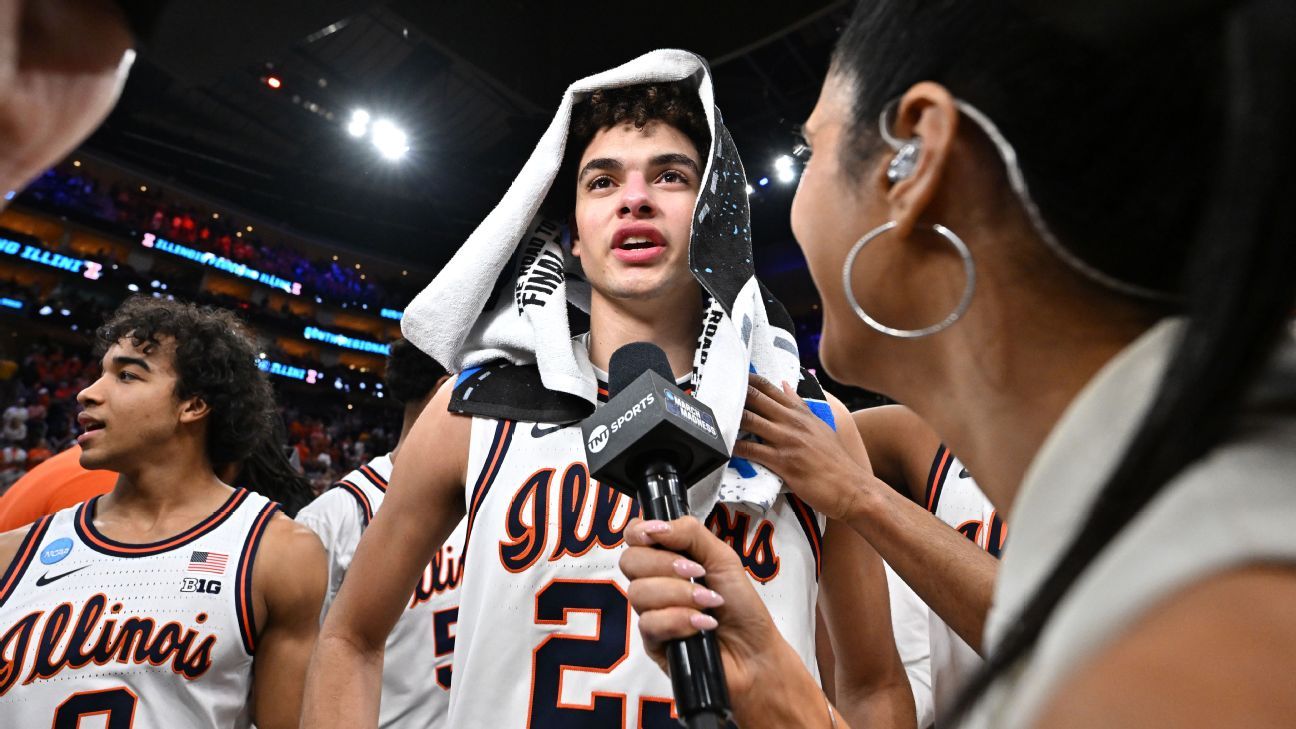
CHAMPAIGN, Ill. — There was a hint of exasperation in Brad Underwood’s voice as he ran through the well-worn tropes about Keaton Wagler. The Illinois coach is sensitive to minimizing Wagler’s journey, or separating him from the group of freshmen who have taken over the men’s college basketball season and will be the talk of the 2026 NBA draft.
“I’m tired of hearing about his high school [recruiting] ranking, I’m tired of hearing about he’s 170 pounds when he got here, and he’s physically skinny and weak,” Underwood told ESPN. “He’s none of those things anymore. If the story is that everybody missed on him, we didn’t. I’m tired of hearing that, too. We found him. He fit us.
“This is what college sports is all about, this type of situation.”
Wagler’s path to stardom didn’t start like that of Kansas’ Darryn Peterson, BYU’s AJ Dybantsa, Duke’s Cameron Boozer or North Carolina’s Caleb Wilson. They were top-five recruits. Wagler didn’t crack the SC Next 100. They were expected to make immediate impacts. Wagler joined an Illinois team that spent the offseason touting its European stars, not a wispy 6-foot-6 freshman guard from Kansas.
But four months into the season, Wagler has earned his way into the company of the nation’s elite players. He leads No. 10 Illinois in scoring (18.2 per game), assists (4.3), steals (0.9) and minutes (33.3) entering Friday’s home showdown against No. 3 Michigan. He delivered one of the best single-game performances in Big Ten history with a 46-point effort in the Jan. 24 road win against then-No. 4 Purdue — the most points by any Big Ten freshman over the past 30 seasons. He’s No. 6 on ESPN’s latest NBA draft big board, a potential lottery pick just like the other ballyhooed freshmen.
“Everyone has to run their own race,” said Illinois assistant coach Tyler Underwood, Brad’s son and Wagler’s primary recruiter. “It’s a very unique story.”
Wagler’s story is one of a youngest child who grew up in a basketball-obsessed family that sharpened his game. A story of an accelerated basketball mind with a late-blooming body that delayed interest from high-major programs. A story of loyalty to the teams and coaches who believed in him.
A story of proving he belongs.
“He’s just a good, wholesome Midwest kid,” Brad Underwood said. “He has the simplest values, loves life and loves basketball.”
OF COURSE KEATON loves basketball. He’s a Wagler (pronounced WAH-gler). He grew up in a home where the sport is a connective tissue.
Keaton’s parents, Logan and Jennifer, met while playing basketball at Hutch, or Hutchinson Community College in central Kansas. His older sister, Brooklyn, won a junior college national championship with Kansas City Kansas Community College then played at MidAmerica Nazarene University. His older brother, Landon, began his college career at Hutch and now plays for MidAmerica Nazarene.
The basketball bloodlines stretch back even further. Keaton’s great-grandfather played at Hutch and then TCU, and later ran the national junior college basketball tournament. His grandfather played at Hutch in the mid-1960s. His uncle helped Hutch to the juco national title in 1994.
“[Basketball] has a deep meaning in our family,” Keaton said.
The Wagler kids tried other sports, but as they each approached middle school, they all “just drifted towards basketball,” Landon said. Basketball hoops were placed in the living room and the driveway, where games between family members would get cranked up.
“Someone was always mad at someone else,” Brooklyn said. “We would all get out there. Sometimes it was boys versus girls. We’d play knockout, we’d play PIG. We’d get 2-on-2, and if you lost, you got subbed out.
“It was never not competitive.”
Keaton was the youngest, in age and appearance. As a high school freshman, he was just 5-foot-8 and weighed somewhere between 110 and 125 pounds. He “just kind of looked like a little kid,” Landon said.
Keaton’s stature belied a basketball savant, which showed up early while he watched Brooklyn — 10 years older — compete on the court.
“Jen and I have talked about this: He was always so observant,” Logan Wagler said. “Most kids can’t even pay attention. He would really watch. He’d ask questions and just had a good grasp for the game. Even, like, in first and second grade, he’d be on the court directing people.”
Keaton’s basketball education accelerated at the Lenexa Rec Center in Lenexa, Kansas, where his father worked and now serves as the city’s director of parks and recreation. Logan organized high-level pickup games once or twice a week with people he met through the basketball world, including coaches and former college players.
When he didn’t have enough, he’d pull in his kids.
“[Keaton] would shock everybody,” Logan said. “He could defend. He could stay in front of people. He was scrappy. He had that fire in him where he could still grab rebounds, and he could just flat-out score. I still get texts and calls from friends that played with him in those pickup days when he was just a tiny little kid. They just laugh, watching him now.”
David Birch, an NAIA All-America selection who suited up for the Washington Generals on the Harlem Globetrotters tour, played in those pickup games.
“If I was on the opposite team, you’re getting pissed off at people like, ‘Hey, why are you letting this 11-year-old score?'” Birch said. “‘We’re trying to win here, we’re trying to stay on the court, and you’re letting this guy get 3s off and make layups.’ But as he got older and as we started playing more, it wasn’t that people were taking it easy on him. He was just that good.”
When Keaton reached Shawnee Mission Northwest High School, where Birch went on to coach, he immediately put the 5-8 freshman on varsity alongside his brother Landon. Birch saw the size on both sides of Wagler’s family — Logan is 6-5 and his father is 6-8, while Jennifer is 5-11 with a brother who stands 6-9 — and projected Keaton to sprout. It happened quickly. He grew four inches before his sophomore year and went through another spurt later in high school.
Whatever size Keaton ended up being, though, Birch knew he could play.
“He just always finds a way to contribute to winning,” Birch said.
VICTOR WILLIALS STILL gets the calls, usually two per day, from college coaches at major programs. They share the same message about Keaton Wagler.
“They apologize,” said Williams, a former Oklahoma State player who runs the Victor Williams Basketball Academy Elite program in Kansas City. “A who’s who of college basketball has called me at some point and said, ‘V, I should have listened to you. We missed that one, for sure.'”
Wagler played for VWBA Elite throughout high school. An independent AAU program, VWBA Elite participates in showcase events around the country and faces top competition, including teams affiliated with major shoe brands and circuits such as Nike’s Elite Youth Basketball League or Adidas’ 3Stripes Select Basketball.
Most five-star prospects play for affiliated clubs, such as Dybantsa (Oakland Soldiers of EYBL) and Peterson (Phenom United of 3SSB). The recruiting spotlight is directed there, but Wagler wasn’t an unknown.
“The narrative was he was playing basketball in some back gym, a box somewhere, but that’s not true,” Williams said. “We played a lot of high-level teams, and he’s dominated in those. People have seen Keaton Wagler play. They just didn’t trust what they’ve seen.”
Similar things happened in high school. Shawnee Mission Northwest annually made the state tournament, went undefeated and won a state title in Keaton’s junior season (2023-24), and it repeated as champ in his senior season (2024-25).
Keaton played his final three high school seasons with Ethan Taylor, a top-50 recruit in the 2026 class who signed with Michigan State and was courted by other high-major programs, including Kansas. The same attention didn’t come Keaton’s way.
“Everyone in the United States saw us play,” Birch said. “Most of the feedback [was], they pegged [Keaton] as a mid-major kid. They didn’t think he was quite strong enough, and they didn’t think he was an elite athlete, so they weren’t sure he was a Power 5 player.”
Wagler’s success did open potential alternative paths. Several prep schools reached out, but he never thought of leaving home. He considered shoe-brand-affiliated AAU teams in the area but stuck with VWBA Elite.
Loyalty is baked in for Wagler, who has had the same girlfriend since his freshman year of high school.
“That’s really what life is, building good relationships,” he said. “There’s no really better way of showing that you like someone other than staying loyal. I just believed in my AAU coach, knowing that I trust him and everything will work out fine. If you can play, the coaches are going to find you.”
Wagler didn’t appear on Illinois’ radar until the summer before his senior year. The Underwoods knew the area — Brad grew up in Kansas and finished college at Kansas State — and Tyler’s Kansas City-area contacts began blowing up his phone about Wagler after Shawnee Mission Northwest’s undefeated season.
Illinois scouts players through four pillars: positional size, basketball IQ, basketball character and no skill deficiencies.
“We thought he was 4-of-4, which is very rare,” Tyler Underwood said.
The first element had long been a hangup. Tyler Underwood told Wagler that he would need to add mass to play early on, but at 6-6, Wagler had the height to hold up in the Big Ten.
He had many other assets, too: a sparkling assist-to-turnover ratio, the ability to shoot over bigs who switched onto him and a knack for avoiding superman passes in favor of sensible ones.
“If you get wrapped up in numbers, then you probably could miss him,” Brad Underwood said. “If you get wrapped up in the context and the content of how he plays, you probably liked him a lot.”
Until his senior year of high school, Wagler had fielded offers from only mid-major programs such as Colorado State and Drake — until he received two high-major offers on the same day in August 2024, from Minnesota and Illinois. He committed to the Illini a month later.
“I was seen by the right people, the people that I wanted to be seen by,” Wagler said. “If this was my only high-major offer, I would be happy, because this is where I’m happy.”
ON THE MORNING of Feb. 13, Wagler achieved a milestone that rivaled his 46 points at Purdue and six Big Ten Freshman of the Week selections.
He ate a full pancake.
After avoiding robust breakfasts for much of his life — or any breakfast, outside of the occasional mid-morning Pop-Tart — the pancake signified progress.
“Keaton’s biggest hurdle was to just consume the amount of calories that he needed to,” said Adam Fletcher, Illinois’ strength and conditioning coach. “You go from half a pancake to a full pancake. To us, that’s the exact same thing as going from bench-pressing 95 pounds to 115 pounds. You have to train your stomach like you train your muscles.”
Wagler arrived at Illinois as a developmental prospect. The team had spent the offseason promoting its European standouts: 7-foot centers and twin brothers Tomislav Ivisic and Zvonimir Ivisic; forward David Mirkovic, guard Mihailo Petrovic and transfer guard Andrej Stojakovic, son of NBA All-Star Peja Stojakovic. The Ivisic twins, Mirkovic and Petrovic had played professionally overseas.
Underwood embraced the campaign, even briefly changing his X avatar to a meme showing him in an orange tracksuit, crouching before Balkanized apartment slabs.
Without a clear immediate need to fill, Wagler said he had “no clue” what his role would be, so he viewed the summer as a platform to prove himself. By mid-July, senior guard Kylan Boswell was sitting in Underwood’s office, praising Wagler.
“He used the term ‘cold,'” Underwood said. “He goes, ‘Coach, he’s really cold. There’s nothing he doesn’t have.'”
Boswell’s endorsement resonated, but Underwood needed to see more. Before the season, Illinois met Florida, the defending national champion, for a closed scrimmage in Orlando.
“The most physical [scrimmage], just brutal,” Underwood said. “He didn’t flinch. He was as good a player as there was on the court. Then it became: How do I trust him enough to use him in the right way?”
Illinois knew Wagler would need to add mass to hold up for the season. Fletcher had charted similar plans for other players, most recently Will Riley, a 2025 NBA first-round draft pick who spent one season with the Illini. Wagler went through weigh-ins multiple times per day, before and after meals. Breakfast wasn’t over until he weighed 2.5 pounds more than he did walking in.
Fletcher set small, incremental goals for Wagler, who went from 168 pounds to 182 when he returned home following the summer session. Illinois wanted Wagler to play the season around 185 pounds, accounting for five-pound fluctuations either way. Fletcher used a force plate system to assess how weight gain impacted Wagler’s vertical jump and overall explosiveness.
Despite the added mass, Wagler has increased his vertical by nearly three inches.
“My teammates are like, ‘Man, I can’t wait ’til you get up to 195,'” Wagler said. “‘Unstoppable,’ is what they say. That just boosts me to want to continue to get better.”
Wagler’s development continued on the court. He started Illinois’ opener, not even telling his family beforehand, and scored in double figures in each of his first four games. But he struggled in two of his next three outings, shooting well below his 45.6% season average, then played only 14 minutes in a loss to UConn at New York’s Madison Square Garden.
“I wasn’t using him right,” Brad Underwood said. “We had to get him on the ball.”
With more opportunities, Wagler went from averaging 13.5 points on 8.8 field goal attempts through his first eight games to 20.1 points on 12.9 attempts over the past 20.
BEFORE GAMES, Wagler’s teammates always check on him.
“They’ll be like, ‘Are you ready? Are you locked in?’ I’m just sitting there smiling, making jokes, having fun,” Wagler said. “I don’t like being too locked in. I try to stay loose, just keep my mind free.”
When the games begin, Wagler tries to remove emotion from his play. Williams, his AAU coach, calls it an “unbothered mentality,” regardless of setting or opponent.
“I’ve never been around a player who is as stoic, emotionless, and yet is just that silent killer,” Brad Underwood said.
The approach helped Wagler after his move to point guard in December. He recorded his first 10-assist performance against Nebraska, and then matched the mark two games later against Southern. Since the switch, Wagler has scored in double figures in all 21 games, while recording five or more assists 11 times and two or fewer turnovers 15 times.
He had four 20-point games before the Jan. 24 visit to Purdue, but nothing resembling what would happen in West Lafayette. Wagler opened with a layup then hit four consecutive 3s, including one from 28 feet, scoring Illinois’ first 14 points.
“I was like, ‘OK, I’m not missing right now. Like, this is really happening,'” he said.
Wagler finished with 24 first-half points, singlehandedly keeping Illinois in a game Purdue would lead by 10. He opened the second half with a 3-pointer and had four points in the final 20 seconds as Illinois rallied for an 88-82 upset.
“When people talk about magical performances, that’s what they’re referring to,” Tyler Underwood said.
Keaton’s 46 points marked the most scored in a road win over an AP top-10 opponent, the most scored in a single game by a Big Ten freshman and the most by a visiting player at Mackey Arena. The performance cemented his status as a National Player of the Year candidate and top NBA prospect.
Pro scouts have mentioned to Brad Underwood some of the game’s top names when evaluating Wagler: Shai Gilgeous-Alexander, Tyrese Haliburton, even Stephen Curry. The Illini coach sees elements of those stars in Wagler’s game, but his path — especially how quickly he has risen — doesn’t have many comps.
“He’s one of the greatest stories in a long, long time,” Underwood said. “I had some guy tell me Tracy McGrady, 30 years ago, kind of showed up at a camp and blew up. That’s what this is about.”
There are several examples of one-and-done international players who weren’t rated as SC Next 100 recruits and became NBA lottery picks because they didn’t go to high school in the United States, but few Americans who weren’t on that top-100 radar went on to crack the lottery. Since the 2008 draft, Dennis Smith Jr. (2017) and Bub Carrington (2024) are the only U.S.-born players to have made the jump, according to ESPN Research.
“Everyone has their own past, no matter if you’re the best player growing up or you’re not, if you’re a late bloomer,” Wagler said. “You work hard, you get better, and then you get to the point where you know you’re as good as these players.
“It just shows that there’s not one path. There’s not a set way for you to go.”
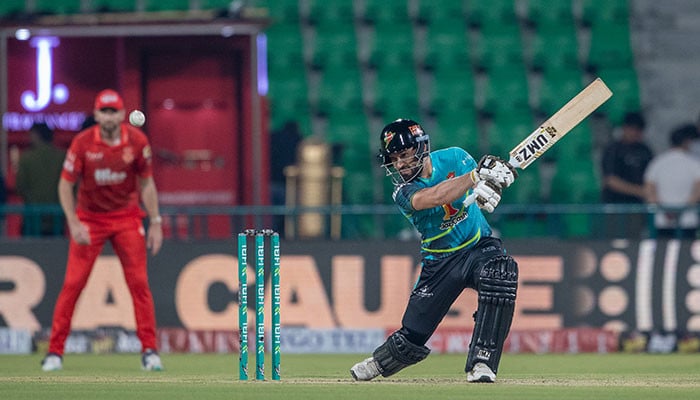
Mohammad Rizwan-led RawalPindiz posted a modest target of 157 runs for Islamabad United with Kamran Ghulam’s fifty and Dian Forrester’s late-innings blitz in the 12th match of the Pakistan Super League (PSL) 11 at Lahore’s Gaddafi Stadium on Saturday.
United captain Shadab Khan’s decision to field first proved beneficial as the Pindiz could accumulate 156/7 in their 20 overs despite Kamran Ghulam’s anchoring half-century.
The Pindiz got off to a dismal start to their innings as Richard Gleeson dismissed both their openers, Yasir Khan and captain Mohammad Rizwan, two each, inside four overs with just 15 runs on the board.
Meanwhile, Ghulam, who walked out to bat at No.3, took the reins of Pindiz’s batting charge and attempted to launch a recovery by putting together a 51-run partnership for the third wicket with Daryl Mitchell, who contributed 19 off 15 deliveries.
The right-handed batter continued his grit following Mitchell’s dismissal and brought up his third PSL half-century off 37 balls by hitting United captain Shadab for a six on the final delivery of the 11th over.
He, however, failed to convert his half-century into a big knock as Faheem Ashraf got him caught behind on the fourth delivery of the subsequent over and thus walked back after top-scoring for the Pindiz with a 39-ball 50, comprising six fours and two sixes.
Following his dismissal, the Pindiz continued to lose wickets at regular intervals and ultimately settled for a below-par total despite handy contributions by Abdullah Fazal and Dian Forrester, who made 23 and 44 not out, respectively.
The pace trio of Salman Irshad, Gleeson and Faheem jointly led the United’s bowling charge with two wickets each, while experienced all-rounder Imad Wasim chipped in with one scalp.


How UConn-Illinois, Arizona-Michigan will be decided in men’s Final Four

Prince Harry gives up UK dream: What happened?
[CinePlex360] Please moderate: “Gold Loan Tips:

-

 Entertainment1 week ago
Lee Sang-bo dies at 45: Funeral details revealed
-
 Business1 week ago
How do you spot a fake online review?
-
 Sports1 week ago
Illinois defense gets tough, ousts Houston to reach Elite Eight
-
 Sports7 days ago
USMNT handed reality check by Doku, Belgium ahead of World Cup
-
 Sports7 days ago
2026 NCAA men’s hockey tournament: Schedule, results
-

 Fashion1 week ago
China rolls out tariff cuts on Congo imports from April 1
-

 Fashion1 week ago
EU apparel imports slump 15.48% YoY in Jan; Bangladesh hardest hit
-
 Sports7 days ago
Man City show why they are worthy WSL title winners as tired United wilt