

Fashion
Davii and Pé de Chumbo present catwalk shows at a decommissioned former metro station in Milan

Published
September 29, 2025
On Saturday, September 27, the Luso-Brazilian label Davii and Pé de Chumbo—the brand of Portuguese designer Alexandra Oliveira, who handcrafts unique textiles for her exclusive pieces—unveiled their spring-summer 2026 collections at the Major Virtual Tunnel, a decommissioned metro station that is establishing itself as an avant-garde venue and, for the first time, hosted presentations connected to Milan Fashion Week.
Davii and Pé de Chumbo presented their collections at the invitation of Portugal Fashion, as part of the official calendar of presentations in the Italian capital of fashion and design, thus marking “the second stop on Portugal Fashion’s international calendar, after London and before the debut of its own showroom in Paris, confirming the consistency of the project’s internationalisation strategy,” the Porto runway organisation explained in a statement.
“Between Davii’s architectural and conceptual precision and Pé de Chumbo’s artisanal identity, Portugal Fashion presented two complementary visions that attested to the richness of the national ecosystem,”

As part of the official Milan calendar, the two labels, representative of the excellence of Made in Portugal, staged different moments of ‘catwalk performance’, with Davii showing its proposals at 3:15 pm and 4:30 pm, and Pé de Chumbo performing at 4:00 pm and 5:15 pm, “creating a dynamic in which Portuguese fashion asserted itself in an immersive register and in direct dialogue with journalists, buyers and industry professionals,” the note continued.
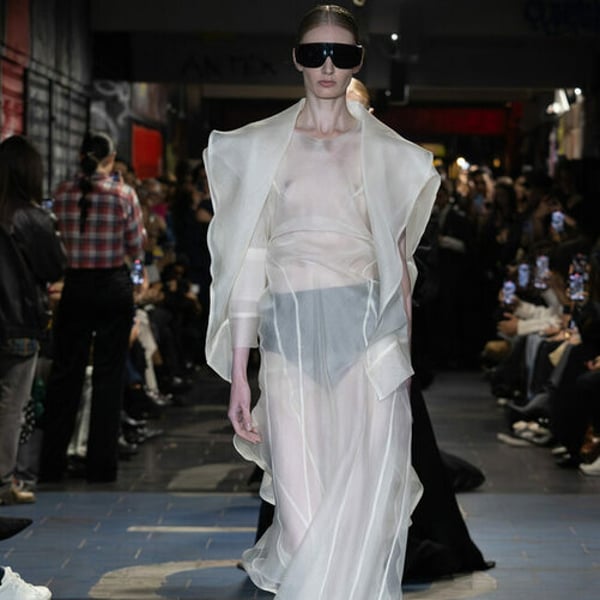
Davii opted for black and white in veiled monochrome looks, cut in light, diaphanous fabrics that evoked, at once, the bittersweet aura of Vestal Virgins from Classical Antiquity, intertwined with medieval warriors and contemporary Amazons, and asserted that women’s power goes far beyond the femininity and sensuality imposed by male-dominated societies.

The Brazilian designer based in Portugal—now with a foothold in Italy and China, where he divides his time—brought to his work the beauty and strong character of those thoughtful, ancestral women with clear ideas who acted discreetly, in silence and almost anonymously, echoing figures such as “Lady with an Ermine” and “La Belle Ferronière”, masterpieces by Leonardo da Vinci that mark the dawn of the Renaissance in Italy.
Entitled “Reimagined Forms”, his new collection explores a contemporary avant-garde with deep roots—the most forward-thinking of every era—through an aesthetic that merges with the organic, fluid forms of nature. Davii combines neoprene, silk organza and leather in these sculptural, ethereal pieces that define the brand, reaffirming its position in the realm of contemporary conceptual experimentation.

Pé de Chumbo, for its part, makes its debut on the official Milan calendar with the “Femme” collection, also in
tribute to this “feminine duality that has balanced power and fragility, courage and sensuality”, the press release noted.
The collection favoured “intricate lace worked in robust yarns, references to corsets and daring cuts” in pieces that “evoke memory and tradition”, while also unfolding into bold silhouettes suggested by these singular, novel materials—without neglecting the dictates of fashion, especially those of the 1980s and 1990s—and the aesthetics, legacy and savoir-faire of northern Portugal, while drawing on a broader palette of neutral tones and vibrant, metallic colours.

“True to its identity, the brand asserted itself through the artisanal manipulation of raw materials and by controlling the entire production process in its own factory, a distinctive element on the international scene,” show notes continued.
According to Mónica Neto, director of Portugal Fashion: “Milan has been a strategic platform for Portugal fashion to assert itself. This edition reinforced that role, with Davii and Pé de Chumbo underlining the consistency of our presence on the official calendar and demonstrating the creative and productive vitality that makes Made in Portugal a trusted reference in the global market,” she concluded.

This article is an automatic translation.
Click here to read the original article.
Copyright © 2025 FashionNetwork.com All rights reserved.











Wholesale revenue dropped 12.8 per cent on a currency-adjusted basis to €4.9 billion, while direct-to-consumer (DTC) sales increased 3.4 per cent, lifting the DTC share to 32.4 per cent from 28.9 per cent.
Regionally, sales fell 6.9 per cent in Europe, Middle East and Africa (EMEA), 7.4 per cent in Asia-Pacific and 10 per cent in the Americas, with North America driving much of the decline.
Puma has reported sales of €7.3 billion (~$8.61 billion) in FY25, with currency-adjusted revenue down 8.1 per cent amid strategic reset actions.
Wholesale declined while DTC share increased.
Margins contracted and EBIT turned negative, leading to a net loss.
Q4 saw sharper declines across regions and categories.
Puma expects further sales softness and negative EBIT in FY26.
By product segment, footwear sales decreased 7.1 per cent, apparel declined 9.7 per cent and accessories fell 8.5 per cent, although selective growth was observed in running, training and premium sport style lines, Puma said in a press release.
Profitability weakened significantly during the year. Gross margin contracted 260 basis points to 45.0 per cent, impacted by promotional activity, inventory reserves, unfavourable mix and currency effects. Adjusted EBIT turned negative at €165.6 million, while reported EBIT declined to -€357.2 million after €191.6 million in one-off costs related mainly to the cost efficiency programme and goodwill impairments.
Loss from continuing operations widened to -€643.6 million, translating to earnings per share of -€4.37 versus €1.88 in the prior year.
From a balance sheet perspective, inventories rose 2.3 per cent to €2.06 billion as inventory takebacks from wholesale partners supported distribution clean-up. Working capital increased 20.2 per cent, while trade receivables and payables declined sharply in line with reduced sales and purchasing activity. Puma ended the year with additional financing capacity, including €1,202.2 million in unutilised credit lines.
Fourth quarter (Q4) performance reflected the peak impact of the strategic reset. Currency-adjusted sales declined 20.7 per cent to €1,564.9 million, with reported revenue down 27.2 per cent due to currency headwinds. The decline was driven by deliberate reductions in wholesale exposure, inventory clearance actions and lower promotional intensity.
Wholesale sales fell 27.7 per cent in Q4, while DTC revenue decreased 8.0 per cent, although DTC share increased to 41.1 per cent from 35.5 per cent. Regionally, sales dropped 12.6 per cent in Asia-Pacific, 22.2 per cent in the Americas and 24.3 per cent in EMEA.
Across product divisions, footwear sales declined 25.4 per cent, apparel fell 13.7 per cent and accessories dropped 18.2 per cent, with selective resilience in training and performance running categories.
Profitability deteriorated sharply. Gross margin declined to 40.2 per cent from 47.7 per cent due to promotions, inventory provisions and currency effects. Adjusted EBIT fell to -€228.8 million, while reported EBIT reached -€307.7 million following one-off costs linked to restructuring and impairment charges. The quarter ended with a loss from continuing operations of -€335 million.
Arthur Hoeld, CEO of Puma, said: “2025 was a reset year for us. We want to establish Puma as a top 3 sports brand globally, return to above-industry growth and generate healthy profits in the medium term. It is crucial to make the Puma brand less commercial and ensure we once again excite our consumers with attractive products, compelling storytelling and distribution in the right channels. I am satisfied with the progress we have made so far. We cleaned up most of our distribution by reducing promotions in our own channels and cutting our exposure to those wholesale channels that damage our brand’s desirability. To better position our product icons and our performance offering and tell more engaging product stories, we created the right structures inside our company. We also addressed operational inefficiencies and further optimised our cost base.”
Looking ahead, Puma expects currency-adjusted sales in fiscal 2026 to decline in the low- to mid-single-digit percentage range, with EBIT projected between -€50 million and -€150 million. Capital expenditure of around €200 million is planned as the company continues investments in brand repositioning and digital capabilities, added the release.
Fibre2Fashion News Desk (SG)
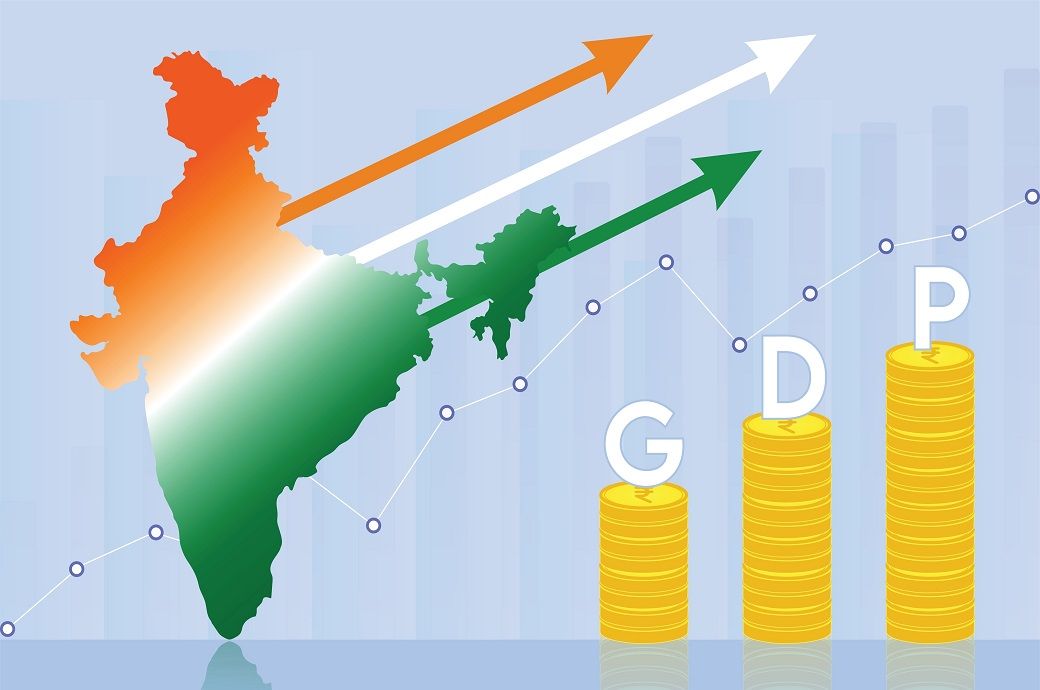
Nominal GDP, or GDP at current prices, is estimated to grow at 8.6 per cent to reach ₹345.47 trillion in FY26 against ₹318.07 trillion in 2024-25.
India’s real GDP is estimated to grow at 7.6 per cent to ₹322.58 trillion (~$3.54 billion) in FY26 compared to the first revised GDP estimate of ₹299.89 trillion for FY25 (7.1 per cent growth).
It released the new series of annual and quarterly national accounts estimates with FY23 base.
Real GVA is projected to grow at 7.7 per cent to reach ₹294.40 trillion in FY26 against ₹273.36 trillion in FY25.
Real gross value added (GVA) is projected to grow at 7.7 per cent to reach ₹294.40 trillion in FY26 against ₹273.36 trillion in FY25 (a 7.3-per cent growth rate).
Nominal GVA is estimated to grow at 8.7 per cent to hit ₹313.61 trillion during FY26, against ₹288.54 lakh crore in 2024-25.
Robust economic performance in FY26 is primarily on account of robust real growth observed in the second quarter (8.4 per cent) and third quarter (7.8 per cent).
The manufacturing sector has been the major driver of resilient performance of the economy the consecutive three fiscals after rebasing, a release from the ministry said.
Both private final consumption expenditure and grossed fixed capital formation exhibited more than 7-per cent growth rate in FY26.
Fibre2Fashion News Desk (DS)


NAACP Image Award host Deon Cole issues Tourette warning after BAFTAs

Late to set-piece party, Liverpool are making up for lost time

World reacts to martyrdom of Iran’s Supreme Leader Khamenei

Pakistan carries out precision strikes on seven militant hideouts in Afghanistan

Eye-popping rise in one year: Betting on just gold and silver for long-term wealth creation? Think again! – The Times of India

Kansas’ Darryn Peterson misses most of 2nd half with cramping

-
 Politics1 week ago
Pakistan carries out precision strikes on seven militant hideouts in Afghanistan
-
Business1 week ago
Eye-popping rise in one year: Betting on just gold and silver for long-term wealth creation? Think again! – The Times of India
-
 Sports1 week ago
Kansas’ Darryn Peterson misses most of 2nd half with cramping
-

 Tech1 week ago
The Supreme Court’s Tariff Ruling Won’t Bring Car Prices Back to Earth
-

 Entertainment1 week ago
Viral monkey Punch makes IKEA toy global sensation: Here’s what it costs
-

 Tech1 week ago
These Cheap Noise-Cancelling Sony Headphones Are Even Cheaper Right Now
-

 Entertainment1 week ago
Saturday Sessions: Say She She performs "Under the Sun"
-

 Sports1 week ago
Floyd Mayweather to come out of retirement again