

Fashion
Elisabetta Franchi reports €171 million revenue in 2024, sees accessories as growth driver

Translated by
Nicola Mira
Published
November 13, 2025
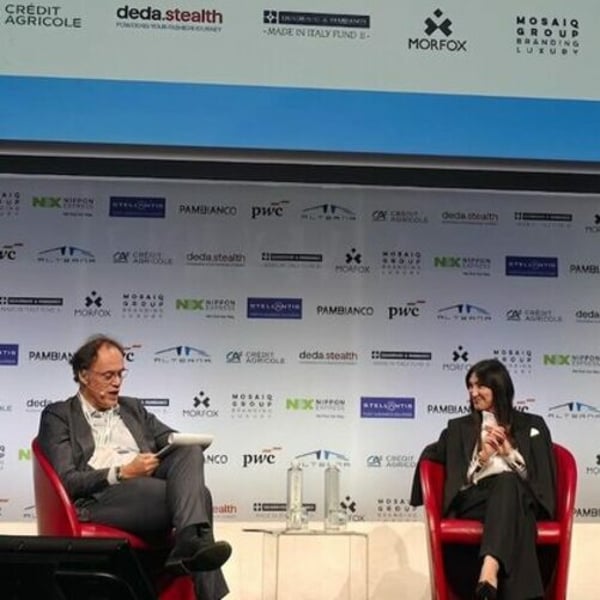
Elisabetta Franchi, boss and designer of the eponymous Italian ready-to-wear label owned by Betty Blue Spa, talked about the industry at the 30th Pambianco Fashion Summit in Milan. “There’s so much confusion in the fashion world today,” she said. “Creative directors are hopping about like popcorn. Labels are putting their brand identity at risk. When customers enter a store, they no longer know what they’re buying. Some CEOs have no clue what a button or a sewing machine is. They are finance people who have only eyes for data,” added Franchi.
The Bologna-based businesswoman has taken back control of her label after parting ways with Marco Bizzarri (who had bought a stake about two years ago) and the departure of its CEO Gabriele Maggio. “Marco and I are like twins separated at birth. We’ve always had a very similar way of thinking. But at some point, the Betty Blue machine was starting to slow down. His way of working was no longer in sync with my reactivity. I took back full control to drive the company at a thousand miles per hour. Speed is my strength,” said Franchi.
In fiscal 2024, Elisabetta Franchi generated a revenue of €171 million, and EBITDA of €40 million. “Revenue is not the key. I’m not competing with anyone. I try to work properly, with an old-fashioned approach. A healthy company must be liquid. In the last decade, we’ve doubled [our revenue] and we’ve always self-financed, without bank loans. EBITDA is the metric to watch, if it’s low, I’ve done badly,” said Franchi.
Elisabetta Franchi generates 90% of sales through ready-to-wear, without product licenses (except for childrenswear) or accessories. “These are the growth drivers we’re working on,” said Franchi. “I’ve always pushed to realise one dream, with great consistency and true, powerful storytelling. Women who come into my stores always enjoy the same experience. Some labels decided to increase prices because they were no longer growing. Instead, we’ve made no changes, thanks also to our strategic positioning,” she added.
Retail-wise, in 2025 Elisabetta Franchi opened its first US store in Miami. “In February 2026, it will be Houston’s turn. The USA is very rewarding, but one must work slowly and sensibly there. We also have South America in our sights. E-tail accounts for a 14% share of our revenue, and we don’t just sell t-shirts online, but jackets and shirts too,” said Franchi.
For the future, “I see a company that can do without me, but I’ll be working to the very last. In five years I see myself far away, maybe on my own. Fashion is a business that makes you question yourself every six months. I’m lucky to have a winning team, otherwise I wouldn’t still be here after 30 years,” concluded Franchi.
Copyright © 2025 FashionNetwork.com All rights reserved.









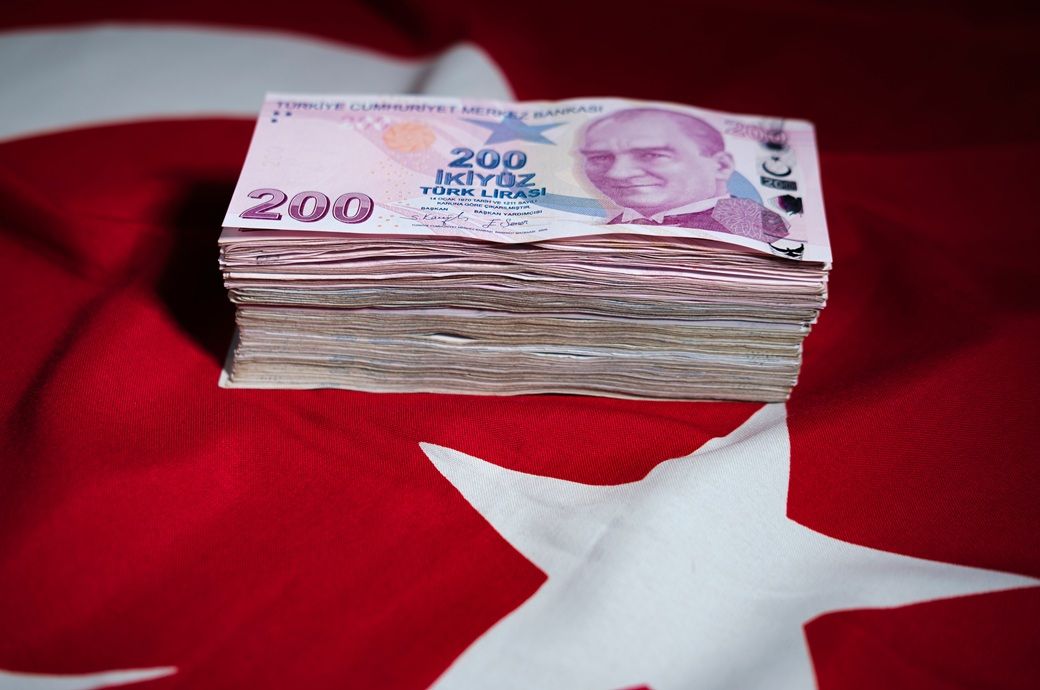
Current account excluding gold and energy indicated net deficit of $3.9 billion, while goods saw a deficit of $9.5 billion.
Turkiye recorded a current account deficit (CAD) of $9.6 billion in March, the country’s central bank said.
Treasury and Finance Minister Mehmet Simsek said the CAD is expected to widen this year, due to high energy and non-energy commodity prices.
Simsek said the deterioration is likely to remain temporary and manageable, thanks to stronger macroeconomic fundamentals and policy gains.
According to annualised data, current account deficit recorded as $39.7 billion (2.6 per cent of gross domestic product) in March, while the goods deficit recorded as $77.8 billion.
Simsek said the deterioration is likely to remain temporary and manageable thanks to stronger macroeconomic fundamentals and policy gains, domestic media outlets reported.
Turkiye is heavily reliant on imported energy, whose prices spiralled due to the Middle East conflict.
Simsek said elevated global commodity prices would put pressure on the external balance, but emphasised that the government’s economic programme had improved resilience against such shocks.
He said foreign direct investment (FDI) inflows totalled $1 billion in March, bringing annualised foreign direct investment to $12.6 billion.
The new investment incentive package under discussion in parliament now is expected to strengthen the country’s financing structure and support long-term capital inflows, he added.
Fibre2Fashion News Desk (DS)
During the first quarter of ****, the UK’s imports of textile fabrics eased down *.** to £*,*** million (~$*,*** million), against £*,*** million in January-March **** but slightly higher from £*,*** million in the fourth quarter of ****. Its imports of fibre were noted at £** million (~$***.** million) steady as £** million in Q*, **** but slightly lower than £** million in Q*, ****.
During the third month of this year, the country’s clothing imports declined *.** per cent to £*.*** billion (~$*.*** billion), compared with £*.*** billion in March ****. But the inbound shipment was slightly higher month on month compared with £*.*** billion in February ****.

Higher rents, utility bills and fuel prices are eating away at already thin profit margins, it found.
High inflation is cutting deep into Bangladesh consumer spending, with weak demand turning one of the biggest concerns for businesses, DCCI said.
Higher rents, utility bills and fuel prices are eating away at already thin profit margins.
DCCI’s economic position index revealed that consumers have sharply reduced spending as the cost of living continues to rise.
SMEs are feeling the pressure the most.
The chamber’s economic position index (EPI) revealed that consumers have sharply reduced spending as the cost of living continues to rise, putting pressure on retailers, transport operators and other service providers.
Small and medium enterprises (SMEs) are feeling the pressure the most as they struggle to manage higher operating costs without losing customers.
Businesses also cited difficulties in obtaining bank loans, while delays in licensing and other regulatory procedures are adding to costs.
The DCCI report identified a shortage of skilled workers, particularly in technical and customer service roles, as another challenge for the sector.
The country’s inflation rose to 9.04 per cent in April from 8.71 per cent in March, according to official statistics.
Fibre2Fashion News Desk (DS)


CDC says American tests positive for Ebola in Africa, risk in the U.S. remains low
Elon Musk just lost another lawsuit. Will he keep fighting?

India will become history if it attempts any future misadventure, warns defence czar

-

 Entertainment6 days ago
Conan O’Brien hat tricks as Oscar host
-

 Tech1 week ago
Could Contact-Tracing Apps Help With the Hantavirus? Not Really
-

 Fashion5 days ago
Italy’s Zegna Group’s Q1 growth boosted by strong organic performance
-

 Entertainment1 week ago
Martin Short: Facing tragedy with joy
-

 Entertainment1 week ago
Tom Brady gets back at Kevin Hart during Netflix roast
-

 Sports1 week ago
Jacob Fatu unleashes vicious assault on Roman Reigns after World Heavyweight Championship loss at WWE Backlash
-

 Entertainment1 week ago
Martha Stewart: How to make an omelet
-

 Tech1 week ago
Papa Johns Is Getting Into Drone Delivery—but Not for Pizza