

Business
Energy bills: What is happening to gas and electricity prices?


 Getty Images
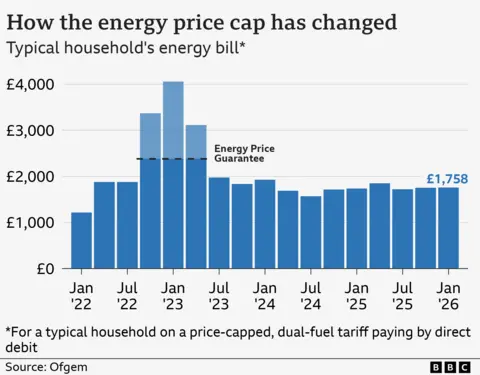
Typical household energy costs will increase slightly on Thursday when the new energy price cap takes effect.
Separately, the regulator Ofgem has said customer bills will rise by around £30 a year over the next six years to help fund a major investment in the UK’s energy network.
However, that announcement followed an earlier government pledge in the Budget to remove some other costs from annual energy bills, worth about £150 to a typical household.
What is the energy cap and how is it changing?
The energy cap covers around 19 million households in England, Wales and Scotland and is set by Ofgem every three months.
It fixes the maximum amount customers can be charged for each unit of gas and electricity on a standard – or default – variable tariff for a typical dual-fuel household which pays by direct debit.
Actual bills depend on the amount of energy used.

What is a typical household?
The price cap sets the unit prices for gas and electricity, but your household’s actual bill depends on the overall amount you use, and how you pay for it.
The type of property you live in, how energy efficient it is, how many people live there and the weather all make a difference.
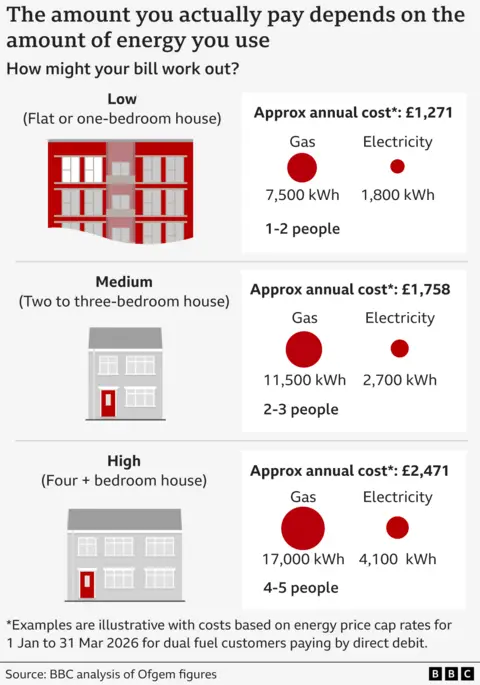
The Ofgem cap is based on a “typical household” using 11,500 kWh of gas and 2,700 kWh of electricity a year with a single bill for gas and electricity, settled by direct debit.
The vast majority of people pay their bill this way to help spread payments across the year. Those who pay every three months by cash or cheque are charged more.
Why has Ofgem said energy bills will rise?
In December, Ofgem said it had approved a £28bn investment to improve the electricity and gas grids in Great Britain.
It says this will strengthen the energy supply, and better shield customers from volatile energy prices. It will also reduce Britain’s dependence on gas.
Customers will foot part of the cost, through an additional £108 added to energy bills by 2031. Bills will start to rise from April 2026.
However, Ofgem says the investment will make wholesale energy cheaper overall, saving households about £80 a year, leading to a net energy bill rise of about £30 a year.
What did the government say about energy costs in the Budget?
In the November Budget, Chancellor Rachel Reeves announced measures to cut energy costs from April 2026.
At the moment, energy bills in England, Scotland and Wales already include additional charges to help fund insulation for low-income households, and subsidise green energy projects such as wind farms and solar panels.
Reeves said the insulation scheme – called the Energy Company Obligation – would be scrapped, and for three years, renewable energy projects will be 75%-funded by general taxation instead of a levy on energy bills.
She said this would take £150 off average annual dual-fuel bills.
After taking into account the increase as a result of the Ofgem announcement, it means average energy bills should fall by about £120 a year.
Should I take a meter reading when the energy cap changes?
Submitting a meter reading when the cap changes means you are not charged for estimated usage at the wrong rate.
This is especially important when prices go up.
Customers with working smart meters do not need to submit a reading as their bill is calculated automatically.
What is happening to prepayment customers?
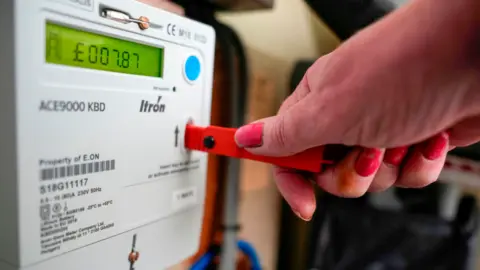
About six million households have prepayment meters, according to the latest Ofgem figures.
Prepayment customers were previously charged more than those who settle their bill by direct debit, but now pay slightly less.
Between 1 January and 31 March 2026, the typical annual bill for prepayment customers is £1,711.
 Getty Images
Many pre-payment meters have been in place for years, but some were installed more recently after customers struggled to pay higher bills.
Rules introduced in November 2023 mean suppliers must give customers more opportunity to clear their debts before switching them to a meter. They cannot be installed at all in certain households.
Can I fix my energy prices?
Fixed-price deals are not affected by the energy price cap, which changes every three months and can rise and fall.
They offer certainty for a set period – often a year, or longer – but if energy prices drop when you are on the deal, you could be stuck at a higher price. You may also have to pay a penalty to leave a fixed deal early if you change your mind.
Ofgem, the energy regulator, says customers who want the security of knowing what their bill will be should consider moving to a fixed deal. However, it says they should make sure they understand all the costs.
Martin Lewis, founder of Money Saving Expert, recommends checking whole-of-market energy price comparison sites to help find the best deal.
What are standing charges and how are they changing?
Ofgem also controls standing charges, which are a fixed daily fee to cover the costs of connecting households to gas and electricity supplies. These vary slightly by region.
Between 1 January and 31 March 2026, standing charges will typically be 55.75p a day for electricity and 35.09p a day for gas.
Campaigners have long argued that standing charges are unfair because they make up a bigger proportion of the bill of low energy users.
In response, Ofgem said that by the end of January 2026, it wants all energy firms to offer at least one tariff that has a low standing charge but higher cost per unit of energy.
The regulator said this would give some customers more choice and control, but acknowledged it would not be suitable for everyone.
Charities, campaigners and the suppliers’ trade body criticised the proposal for just shifting the cost from one part of the bill to another rather than cutting it.
What help can I get with energy bills?
Suppliers must offer customers affordable payment plans or repayment holidays if necessary. Most also offer hardship grants.
Under plans Ofgem hopes to introduce in early 2026, nearly 200,000 people on benefits could have their debts to their energy supplier cancelled – as long as they have made some effort to pay what is owed.
The scheme could see up to £500m knocked off the £4.4bn currently owed to suppliers. But covering the cost will require an extra £5 being added to everyone’s gas and electricity bill.
A number of existing government schemes also help people on low incomes with their energy bills.
The Household Support Fund, which was introduced in September 2021 to help vulnerable customers, has been extended until March 2026.
The Warm Home Discount scheme is also being overhauled.
From winter 2025, anyone on means-tested benefits in Great Britain will get £150 taken off their bills, no matter what size of property they live in.
The discount will be applied automatically for people in England or Wales and some in Scotland. However, those on a low income in Scotland will need to apply via their energy supplier. Letters are being sent to people with information on the discount.
The Fuel Direct Scheme lets people repay an energy debt directly from their benefit payments.
About nine million pensioners will also get the Winter Fuel Payment in 2025/2026, worth £200 or £300, after a government U-turn over eligibility.

But Spencer says his business is being squeezed from every angle – as well as minimum wage, he has had increases in business rates, national insurance, and statutory sick pay. He also expects energy bills to go up because of the war in the Middle East.

Visa Inc. signage on the floor of the New York Stock Exchange (NYSE) in New York, US, on Wednesday, Jan. 28, 2026.
Michael Nagle | Bloomberg | Getty Images
Visa is launching six new tools using artificial intelligence to modernize the process of disputing credit card charges, the company told CNBC exclusively.
The digital payments company said the tools are designed to reduce the costs and frustration of “outdated” dispute processes for multiple entities involved in the payments process: merchants, issuers and acquirers.
“Some of the challenges are these back-office systems are still largely manual,” Andrew Torre, Visa’s president of value-added services, told CNBC. “We really had to think differently about how we approach this at scale.”
In 2025, Torre said, Visa processed more than 103 million charge disputes globally, marking a 35% increase since 2019.
“Our goal is to streamline this as much as possible,” Torre said. “We’d love to be able to see that growth rate come down.”
Visa’s new tools are part of a larger push by major banks and financial institutions to incorporate AI into their businesses — both internally and in consumer-facing applications. JPMorgan Chase and Goldman Sachs have both said they’re already using AI to hire fewer people. BNY spent $3.8 billion on technology in 2025, or about 19% of its revenue.
Visa said three of its six new tools focus on merchants, allowing them to address potential disputes before they escalate, managing disputes with generative AI responses and providing a deeper level of detail on order insights to manage confusion over unfamiliar charges.
For example, Torre said, many disputes are borne out of cardholders not recognizing a specific charge on their statements. With the new tool, Visa will be able to provide further details to financial institutions to show cardholders that data at a deeper level, according to the company.
The other three tools are built for issuers and acquirers, using predictive AI models to aid in case-by-case analysis, analyzing documents for summaries and auto fill and establishing an AI-powered dispute platform to manage the entire process in one location, Visa said.
“We’ll be able to get them insights and data so they can move from being reactive to proactive,” Torre said.
Torre said Visa’s new AI tools are part of a broader host of solutions for consumers, including a subscription manager announced last week that allows cardholders to cancel unnecessary subscriptions directly on the manager.
The automation will save time, money and unnecessary confusion for both parties, he added. Most of the tools will be generally available later this year, the company said.
“We really believe that disputes in this solution makes it much easier to manage and resolve,” Torre said. “We think it has better outcomes for everyone.”
Business
Stock market today (April 1, 2026): Which are the top gainers and losers in Nifty50 and BSE Sensex today? Check list – The Times of India

Benchmark equity indices Sensex and Nifty ended nearly 2 per cent higher on Wednesday, starting the new financial year on a firm footing as global markets rallied on hopes of a potential de-escalation in the ongoing West Asia conflict.The 30-share BSE Sensex jumped 1,186.77 points or 1.65 per cent to settle at 73,134.32. During intra-day trade, it surged 2,017.03 points or 2.80 per cent to 73,964.58.The broader NSE Nifty rose 348 points or 1.56 per cent to close at 22,679.40. A decline in crude oil prices also supported investor sentiment.
Nifty50 top gainers
- Trent (+7.00%)
- InterGlobe Aviation (+6.02%)
- Kwality Wall’s (+5.79%)
- Adani Ports SEZ (+5.55%)
- BEL (+4.51%)
- SBI (+3.93%)
- Eicher Motors (+3.64%)
- Jio Financial Services (+3.50%)
- Eternal (+3.30%)
Nifty50 top losers
- Dr Reddy’s (-3.61%)
- HDFC Life (-2.99%)
- Cipla (-2.32%)
- Sun Pharma (-1.64%)
- NTPC (-1.62%)
- Apollo Hospitals (-1.53%)
- Power Grid (-1.12%)
- Max Healthcare (-0.36%)
- UltraTech Cement (-0.29%)
Sensex top gainers
- Trent (+7.00%)
- InterGlobe Aviation (+6.02%)
- Adani Ports SEZ (+5.55%)
- BEL (+4.51%)
- SBI (+3.93%)
- Eternal (+3.30%)
- L&T (+2.96%)
- Titan Company (+2.89%)
Sensex top losers
- Sun Pharma (-1.64%)
- NTPC (-1.62%)
- Power Grid (-1.12%)
- UltraTech Cement (-0.29%)
- Bharti Airtel (-0.03%)
“Indian equity markets opened the new financial year on a positive note, with stocks soaring on fresh optimism surrounding a potential de-escalation of the Middle East conflict and easing of energy supply disruptions,” said Ponmudi R, CEO of Enrich Money.He added that US President Donald Trump’s remarks suggesting the US could withdraw from Iran “whether we have a deal or not” within the next two to three weeks provided the trigger for a broad rally in global risk assets.“Indian equity markets opened FY27 on a strong note, driven by improving risk appetite following US President Donald Trump’s remarks hinting at a potential resolution to the West Asia conflict,” said Vinod Nair, Head of Research at Geojit Investments Limited.In the US, markets ended significantly higher on Tuesday, with the Nasdaq Composite surging 3.83 per cent, the S&P 500 rising 2.91 per cent and the Dow Jones Industrial Average gaining 2.49 per cent.Brent crude, the global oil benchmark, declined 0.22 per cent to USD 103.7 per barrel.Stock markets were closed on Tuesday on account of Shri Mahavir Jayanti.Foreign Institutional Investors (FIIs) offloaded equities worth Rs 11,163.06 crore on Monday, while Domestic Institutional Investors (DIIs) bought shares worth Rs 14,894.72 crore, according to exchange data.


Taylor Swift, Travis Kelce wedding planning comes to life: Details

Lulus expands wholesale reach with Amazon, Victoria’s Secret
Minimum wage rises to £12.71 an hour as firms warn of impact

-

 Politics1 week ago
Afghanistan announces release of detained US citizen
-

 Tech1 week ago
Can a Home Appliance Fix the Problem of Soft-Plastic Waste?
-

 Sports1 week ago
Broadcast industry CEO says consolidation is ‘essential’ to compete for NFL soaring media rights prices
-
 Business1 week ago
Property Play: Home flippers see smallest profits since the Great Recession, real estate data firm says
-

 Entertainment1 week ago
UN warns migratory freshwater fish numbers are spiralling
-
 Business1 week ago
Gold prices soar in Pakistan – SUCH TV
-

 Fashion1 week ago
ICE cotton slips on weaker crude, profit booking
-
 Business1 week ago
More women are entering wealth management, but few are in advisory roles, study finds