

Business
Energy price cap: Gas and electricity prices to rise by 2% in October


Gas and electricity bills will rise by 2% for millions of households under the latest price cap announced by energy regulator Ofgem.
The increase, which is slightly more than expected, means a household using a typical amount of energy will pay £1,755 a year, up £35 a year on the current cap.
The increase will kick in at the start of October, which campaigners say will mean another winter of relatively high energy bills.
Ofgem’s cap sets the maximum price that can be charged for each unit of gas and electricity for about 20 million households in England, Scotland and Wales.
Individual households can calculate their estimated specific change by adding £2 onto every £100 they spend at the moment on energy each year.
The cap sets the price for each unit, but not the total bill which depends on how much energy you use.
The change comes into force at the start of October and lasts for three months.
Ofgem changes the cap, largely based on the cost of energy on wholesale markets.
However, the rise in bills this time is partly the result of extra support measures, previously announced by the government and in place this winter.
Anyone on means-tested benefits will automatically receive the £150 Warm Home Discount on their bills. Some previously did not qualify owing to the size of their property, but that condition will be scrapped.
All billpayers will chip in to fund this extra support, which is on top of the government’s U-turn on winter fuel payments.
Campaigners say many households are still struggling to pay bills, as well as repay energy debt that built up during a period of high prices.
Simon Francis, coordinator of the End Fuel Poverty Coalition, said this would mean another winter of high prices.
“The average family still paying hundreds of pounds more than they did just a few years ago,” he said.
Families enjoying chips at New Brighton, Merseyside, may have been making the most of the sunshine, but the cost of living still looms large.
“At the moment, it’s been ok, but I think the winter might be a different story,” said Elisha, who has an 11-week-old baby, Theo.
The consumer group Which? said it could be a good time to shop around for a fixed-price deal, but billpayers should be alert to exit fees.
“Some contracts charge large fees to leave early, which would cancel out any savings,” said Emily Seymour, from Which?.
The company brought in consultants AlixPartners last month, after failing to make a profit in recent years.
Source link
Business
Defence stocks surge on Middle East tensions! HAL, BEL, Paras Defence rise up to 13% even as stock market crashes – The Times of India
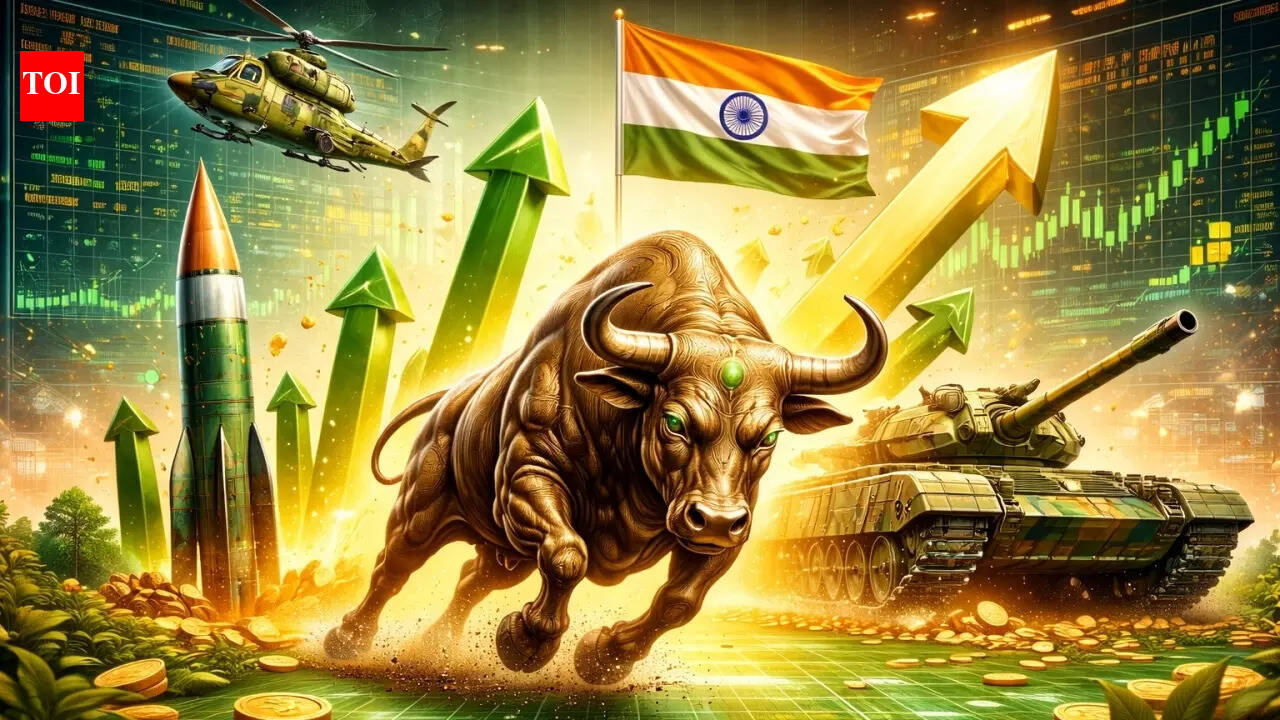
Defence stocks today: Contrary to the crash in Nifty50 and BSE Sensex, defence stocks on Monday moved up in trade as rising Middle East tensions brought focus back on them. Shares of defence companies such as Hindustan Aeronautics, Bharat Dynamics, BEL and Paras Defence surged by as much as 13.5% as tensions in the Middle East intensified following the death of Iran’s supreme leader, Ayatollah Ali Khamenei. The escalation has raised expectations of increased export opportunities and strengthened investor sentiment toward the sector. Paras Defence led the gains, climbing 13.5%. Meanwhile, HAL, BEL and Bharat Dynamics advanced by up to 3.5% on the BSE.During his recent visit to Israel, Prime Minister Narendra Modi said that the two countries would move ahead with joint development, production and technology transfer in the defence sector.A joint statement issued after the visit noted that India and Israel would collaborate on the co-development and manufacturing of defence equipment to deepen strategic ties. The two sides also agreed to work toward concluding a bilateral trade agreement soon, broaden cooperation under the UPI digital payments framework, and partner on space projects and emerging technologies, among other areas.Brokerage house JM Financial said Indian defence companies such as Hindustan Aeronautics Limited and Bharat Electronics Limited may receive sentiment support despite continued volatility in domestic equities amid a broader global risk-off environment, according to an ET report.Defence counters have seen significant fluctuations in recent months. The sector saw a robust rally last year after Indian armed forces conducted targeted strikes against terrorist groups in Pakistan and Pakistan-occupied Kashmir. However, the uptrend later lost steam in the absence of new catalysts.Even as defence counters could witness a strong rally amid the escalating conflict, the wider equity market is expected to stay subdued.(Disclaimer: Recommendations and views on the stock market, other asset classes or personal finance management tips given by experts are their own. These opinions do not represent the views of The Times of India)
Business
Stock Market News Live Updates: Sensex Down Over 1,000 Points, Nifty Below 24,900; India VIX Jumps Nearly 20%

Nifty, Sensex Stock Market Today Live Updates: Indian benchmark indices continued their downward trajectory on Monday, tracking weak global cues as geopolitical tensions between the US and Iran escalated.
As of 11:00 AM, the Sensex was trading 1.34 per cent, or 1,086.02 points, lower at 80,201.17, while the Nifty50 declined 1.31 per cent, or 350.55 points, to 24,828.10. Shares of Larsen & Toubro, InterGlobe Aviation and Adani Ports and Special Economic Zone were among the biggest laggards in the Nifty 50 index.
Broader market indices also traded in the red, with the Nifty MidCap and Nifty SmallCap indices falling 0.93 per cent and 1.3 per cent, respectively. Among sectoral indices, the Nifty Auto was the worst performer, sliding more than 2 per cent as shares of Maruti Suzuki India and Mahindra & Mahindra came under pressure.
On the other hand, the Nifty Metal index declined the least, making it the relatively best-performing sectoral index in early trade despite the overall weak market sentiment.
Global Cues
Over the weekend, Iran’s Supreme Leader Ayatollah Ali Khamenei and several senior officials were killed in a joint US-Israel military operation. The conflict appears set to intensify, with US President Donald Trump vowing to retaliate after American servicemen were killed in Iran’s counterattacks, according to agency reports.
Asian markets tumbled in early Monday trade. Japan’s Nikkei 225 and South Korea’s Kospi dropped as much as 2.7% and 2.43%, respectively.
On Sunday, US stock futures declined more than 1% after the strikes on Iran. Both the S&P 500 and the Dow Jones Industrial Average were reported to have fallen 1.11% each.
During the Asia session, Dow Jones Industrial Average futures and S&P 500 futures were down 0.6% and 0.54%, respectively.
In commodities, oil prices surged amid rising concerns over supply disruptions in the key producing region. Brent crude futures jumped 13.76% to $82.37 per barrel — the highest level since January 2025 — according to Bloomberg data.
Gold and silver futures rose more than 1% as investors turned to safe-haven assets.


US cotton acreage seen falling to decade low in 2026: CoBank

Transfer rumors, news: Will Kane, Vinícius extend their contracts?

Kornit Digital launches footwear solution at ITMA Asia + CITME 2025

Eye-popping rise in one year: Betting on just gold and silver for long-term wealth creation? Think again! – The Times of India

These Cheap Noise-Cancelling Sony Headphones Are Even Cheaper Right Now

Pakistan carries out precision strikes on seven militant hideouts in Afghanistan

-
Business1 week ago
Eye-popping rise in one year: Betting on just gold and silver for long-term wealth creation? Think again! – The Times of India
-
 Tech1 week ago
These Cheap Noise-Cancelling Sony Headphones Are Even Cheaper Right Now
-
 Politics1 week ago
Pakistan carries out precision strikes on seven militant hideouts in Afghanistan
-

 Sports1 week ago
Kansas’ Darryn Peterson misses most of 2nd half with cramping
-

 Sports1 week ago
How James Milner broke Premier League’s appearances record
-

 Entertainment1 week ago
Viral monkey Punch makes IKEA toy global sensation: Here’s what it costs
-

 Entertainment1 week ago
Saturday Sessions: Say She She performs "Under the Sun"
-
Sports1 week ago
Mike Eruzione and the ‘Miracle on Ice’ team are looking for some company