

Sports
England’s Brook gains redemption after ‘hardest winter of my life’ | The Express Tribune

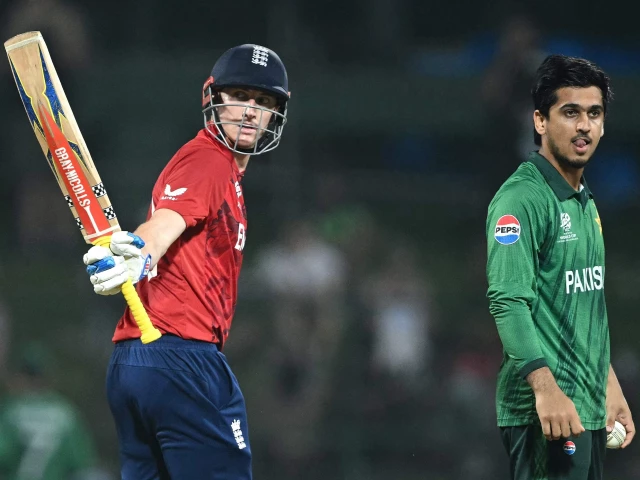
England captain Harry Brook (L) celebrates his half-century (50 runs) as Pakistan’s Saim Ayub (R) looks on during the 2026 ICC Men’s T20 Cricket World Cup Super Eights match between England and Pakistan at the Pallekele International Cricket Stadium in Kandy on February 24, 2026. Photo: AFP
COLOMBO:
Richly talented but much maligned, England captain Harry Brook finally achieved redemption at Pallekele stadium in Kandy after a torrid few months — and came of age as a leader.
His match-winning century against Pakistan on Tuesday will go down as the finest innings of the 27-year-old’s white-ball career because it single-handedly took his side into a fifth successive T20 World Cup semi-final.
Facing a tricky chase of 165 against Pakistan at the Pallekele stadium in Kandy, England could have been in dire straits when they lost Phil Salt first ball of the innings.
But Brooks, who normally bats at number five, strode to the wicket first drop in a massive statement of intent that said “leave it to me, lads”.
He embarked on a majestic innings — the second fastest century in the history of T20 World Cup and first by a captain — in an extraordinary demonstration of leadership from a man who had copped more than his fair share of flak.
Before the tournament there had been calls for Brook’s resignation after he had to apologise for a Halloween incident on the white-ball tour of New Zealand, where he was punched by a nightclub bouncer — in his own words “a terrible mistake”.
On the eve of the T20 World Cup Brook admitted lying about being on his own that night to protect his teammates at the time.
‘A captain’s innings’
All this had emerged after an Ashes debacle where Brook failed to score a century and was castigated in the English press — and mocked in Australia — for throwing his wicket away with reckless shots time and again.
A mid-Ashes beach break had fuelled accusations of a drinking culture in the England camp, as he was photographed with teammates in bars, the beers seemingly flowing.
Brook answered all the critics in wonderful fashion on Tuesday night, demonstrating an intelligent cricketing brain to go with his unquestioned batting talent.
He judged perfectly when to attack and when to hold back, working singles and twos instead against a potent Pakistan attack who were taking regular wickets at the other end.
“It’s probably been the hardest winter of my life to be honest,” Brook told reporters after the match.
“There’s been a lot of stuff behind the scenes. It’s just nice to see some rewards from my hard work away from the ground.”
An awestruck Pakistan quick bowler Shaheen Shah Afridi pronounced Brook’s performance: “The best innings of his life. A captain’s innings.”
Brook was more modest, saying his one-day international century against Sri Lanka last month had been better.
“I actually think I preferred the Sri Lanka ODI to be honest,” said Brook.
But that was in a bilateral series; this one was in a World Cup.
“It’s certainly up there in the context of the game and the situation that we found ourselves.”
Not many people gave the 2010 and 2022 champions England a chance of becoming the first team to win the trophy three times when they stumbled through their group, losing to the West Indies and being given an almighty scare by Nepal.
Brook’s team are now just two knockout wins from the title and have repeatedly talked about preferring to “win ugly” than lose entertainingly.
“It’s just cricket isn’t it? We’re winning games, we’re not winning them perfectly,” Brook said.
“We haven’t had the perfect game yet and hopefully that’s just around the corner.”




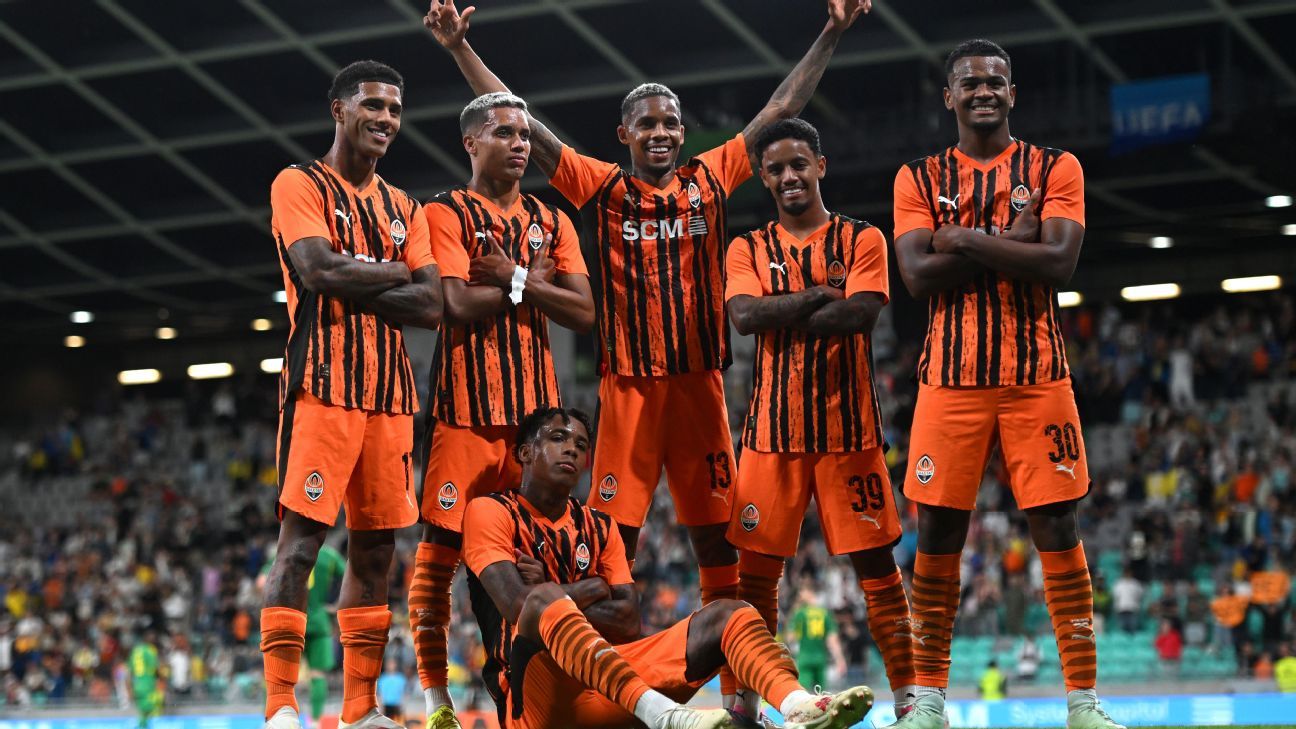
Shakhtar Donetsk sporting director Darijo Srna recalls “a couple of times” when the Ukrainian club’s players and staff had to huddle together in their hotel reception, alerted to an incoming drone strike and waiting for the call to head for the air-raid shelter. It happened once on matchday. “We were all in reception together until 6 a.m. but did not go and afterwards we slept until 12, then we had a meeting at 2 and a game at 4 p.m.,” Srna tells ESPN. “We lost, but this is part of our life.”
Tuesday marks four years of this reality. Russia’s full-scale invasion of Ukraine began on Feb. 24, 2022 and The Center for Strategic International Studies (CSIS) believes it is the deadliest conflict since World War II. Estimates vary, but the CSIS states as many as 140,000 Ukrainians have been killed in addition to 325,000 Russians. The UN High Commissioner for Refugees believes 5.9 million Ukrainians have left the country.
It is all the more remarkable that against this backdrop, Shakhtar’s strategy for survival as a club remains heavily reliant on the transfer market outside Ukraine, specifically signing young players from Brazil.
– Shakhtar Stalevi: The ‘made of steel’ soccer team in Ukraine
– Story of Shakhtar Donetsk to be made into Hollywood movie
– Ukraine chief blasts FIFA president Infantino for Russia remark
The policy began more than 20 years ago, a product of Shakhtar president Rinat Akhmetov’s fondness for the country’s flamboyant football style. The club established an extensive network of contacts in Brazil and over time, created a lineage of players who would join Shakhtar and then, later, an elite European side.
Willian (Chelsea), Fernandinho (Manchester City), Douglas Costa (Juventus), Fred (Manchester United) and Luiz Adriano (AC Milan) are among the big names to tread this path. Most recently, winger Kevin joined Fulham last September in a €40 million transfer, a record fee for the Premier League side.
In total, club sources told ESPN that Shakhtar have signed 47 Brazilian players, who have scored more than 1,000 goals combined, since 2002. (Luiz Adriano, who played between 2007 and 2015, is still the club’s all-time top scorer with 128 goals.) But the money generated through outgoing transfers has become vitally important. Club officials suggest the transfer of Brazilian players has raised in excess of €350m and that revenue stream is more vital than ever in wartime.
“The biggest two sources of income now are UEFA competitions and player sales,” Shakhtar chief executive Sergei Palkin tells ESPN. “That’s it. We have almost zero sponsorship, no matchday revenue, no TV revenue, nothing. To survive here, you have to change the ways to develop the club.”
Shakhtar’s story is a reminder that the conflict has been going on for much longer. Russia occupied and annexed Crimea in 2014, forcing the club’s displacement from their home in Donetsk. They have played European ‘home’ games in six different cities — Krakow, Poland is their base for this season’s UEFA Conference League campaign — and complete domestic fixtures in Lviv, which lies in western Ukraine. The team cannot fly to Poland due to airspace restrictions, and so European away games involve bus rides to the border, with journeys taking up to 16 hours, depending on the destination: in last season’s Champions League, they made trips right across Europe for fixtures at Arsenal and PSV Eindhoven.
Ukraine is experiencing one of the harshest winters on record, exacerbating the debilitating effects of Russian attacks targeting the country’s infrastructure which have left more than a million citizens without electricity, water and heating. The European Union has sent Ukraine almost 10,000 generators since the invasion began in 2022.
“If anybody would tell me at the beginning of 2022 that the war would continue four years, I wouldn’t believe it,” Palkin says. “Four years is a big part of your life.
“Our players, they live in a hotel and opposite the hotel, we have a pitch to train. In Europe, you can easily maintain the level of pitch but in Ukraine it is not possible because of one issue: light. When you have blackouts for one, two, three days, how can pitches survive in these conditions, especially after this severe winter when we had temperatures like -25 [Celsius, -13 Fahrenheit]?
“For my life, I don’t remember these kind of temperatures. We have a training camp in Kyiv and we maintain pitches there because they need a chance to train before games. You need to completely restructure the management of pitches because nobody had experience of doing it in wartime.
“And in modern medical history, you will not find experience like this where you can fully recover players after 16 hours of travel to play again.”
And yet, Brazilian players still join Shakhtar in large numbers. There are 12 listed in their first-team squad, the majority of whom joined the club within the last four years. Says Palkin: “You know why they come? Because they understand, here we create an unbelievable platform for the development of those players to build a bridge to top European football.
“They see all examples. The last one is Kevin. When the war started, we sold David Neres [for €15m]. He didn’t play one game for our club but we sold him to Benfica for more than we paid [€12m]. Even if it is risky for life, to reach something in top European football, they should come to us.
“We are signing a lot of deals now. I spend 70% of my time in negotiations convincing players to come in this very hard time because we have war. I need to show where a player lives, what happens for example when we have air raid sirens, all the security issues.
“I need to be open and explain, but the biggest explanations come when players call our existing players. They explain everything and it helps.”
Marlon Gomes was able to go one better. The 22-year-old joined Shakhtar from Vasco da Gama in January 2024 and consulted his veteran teammate Alex Teixeira, who made the same move in 2010. Teixeira spent six years in Ukraine and later returned to Vasco in 2022 before joining Greek side Panserraikos last month.
“Shakhtar always was a famous club, especially in Brazil,” Gomes tells ESPN. “Among young players with a promising talent, it is really known as a platform you can use to pass to the higher tier leagues.
“Alex Teixeira is a good friend of mine. In my career at Vasco, we speak a lot. Also he told me a bunch of things about Shakhtar — the way they are interested in young Brazilian players.
“When I discovered the history [of Brazilian players who have moved to Shakhtar], I have been thinking and dreaming about the same [journey and] the trophies they won. I was really inspired by those examples. Alex advised me that Shakhtar would be a beautiful option. There is not a single day I regret that decision.”
Gomes’ family, including his seven-year-old daughter Maite, remains in Brazil, where his mother anxiously watches news reports of the ongoing conflict.
“She watches TV and reads all the articles as well and she is getting really worried,” Gomes says. “For my side, I try to keep her calm and explain that in fact not everything is as terrible as can be displayed in the media. Yes, some attacks may occur even in the western part of Lviv where we currently stay but even despite that, the club is doing everything possible to keep us safe.
“During the season, we spent some time in Lviv and some in Kyiv. Whenever people from Brazil ask me something about Ukraine, I only reply with positive things. I really love the city of Kyiv, I believe it is one of the most beautiful cities I have ever seen and even despite all those terrible moments, I enjoy my life in Ukraine.
“Sometimes you can hear or see the drones attacking Ukrainian cities unfortunately and in fact all the TV, all the media shows part of living in Ukraine but they cannot represent what is going on inside the country. Of course, those events are completely terrible and I am deeply concerned about that but the country keeps living, keeps moving on for day to day and that can be the true inspiration for everybody.”
The adaptation process is vital, Palkin says: “When a new Brazilian player comes, we connect them with each other, they explain everything that is going on here, how we treat everybody, what’s going on, where we live, how we travel.
“When they move here, they can have any personal issues, especially in wartime, and so we have special people involved in all processes of adaptation and they understand what they want, they are always in contact with players and in a position to help any time.
“We create a structure that allows them to adapt very quickly and in wartime, this adaptation is even accelerated because we have no time. Fifteen years ago, we could wait two years for Brazilian players to arrive at the top level. Today, we have one or two months adaptation, and they go straight to the main squad.”
But Shakhtar’s established model of attracting promising players from Brazil and then transferring some of them to Europe’s elite is being squeezed by those top clubs being more willing and able to go direct to the source. Chelsea, for example, agreed a deal to sign Estêvão from Palmeiras in 2024 and Andrey Santos from Vasco a year earlier, while Denner will arrive from Corinthians this summer.
“Chelsea have changed the market in Brazil,” says Srna. “They are buying players not just in Brazil, but Argentina and Ecuador who are 16 or 17 years. Manchester City look too.
“For us it is more difficult than before, but there is still a lot of talent in Brazil. Estêvão for example, was on our list, but it is difficult to fight with Chelsea.”
Palkin explains how Shakhtar have adapted. “What it means for us is if before we signed players who were 18, 19, 20 years old, we need to pay attention to 16-, 17-year-olds,” he says. “And we need to be very quick. If you are not quick, you lose. Speed is the most important condition of how to be successful in the Brazilian market.
“Our president makes decisions very quick. He is not afraid to invest big money into young Brazilian players. He believes in his strategy and therefore even taking into account the war, we are still competitive in this market. Chelsea, City and other clubs are there and they could destroy the Brazilian market for clubs like Shakhtar, Benfica and Porto etc. for financial issues. They pay big money and it is difficult to compete with them.”
Money is a bigger issue when Shakhtar are not competing in the Champions League this season. Revenues are much smaller in the Conference League, but at the same time, there is something bigger at stake: the pride of a nation.
“It is a critical humanitarian platform to keep international attention on Ukraine and provide positive emotions for the people of Ukraine and our fans,” says Palkin. “People living in Ukraine, 90% of all news is negative. Every day, morning, evening, daytime. Emotionally, it is a very big pressure on our people. When we play European competitions and we win, it brings positive emotions.
“All our coaches who stayed during the four years, every time when they prepare a team for Ukrainian or European competitions, in all their speeches, they have words about the people living in Ukraine.”
Srna puts it in even starker terms. “When you play in Europe, you beat someone, the people feel happy because you are sending a message to the whole world: we are here, we fight until the end,” he says.
2:06
Vitali Klitschko honored to receive Arthur Ashe Courage Award
Vitali Klitschko is appreciative to receive the Arthur Ashe Courage Award and stresses the importance of bringing peace to Ukraine.
Shakhtar continue to feel left behind by FIFA. The row over Article 7 — an annex to the game’s regulations that allowed foreign players in Russia and Ukraine to unilaterally suspend their contracts following the outbreak of war in the region. The club estimates this cost around €60m in lost income. And, earlier this month, FIFA president Gianni Infantino claimed that he favours the lifting of a ban preventing Russia from competing in international sport.
“I suggest Infantino visits Ukraine to witness the destruction first hand rather than making this kind of irresponsible statement from a distance,” says Palkin. “Reintegrating Russia while Ukraine suffers from this war, it is a betrayal of the sport’s ‘one family’ claim.
“He should not think about reintegrating Russia: he should think how to create a fund that will finance a rebuild of sport infrastructure in Ukraine. We have unbelievable conditions. Our football is in a very, very critical situation. Infantino should think about this, and not about integrating a country that fully invaded Ukraine and tried to kill our people, our children.”
Shakhtar, like the rest of Ukraine, just keep going. Akhmetov has donated more than $300m to the government since the beginning of the war. He has provided 13 million food kits since 2014 and 700,000 units of medicine to Ukrainians affected. The club provides treatment and rehabilitation of severely injured soldiers, started an amputee team for veterans and opened a shelter for refugees. Shakhtar matches are 90 minutes of escapism.
“Each time we have a domestic game, we are happy to see people in the stand enjoying the game,” says Gomes. “That’s a chance for them to be distracted for those two hours from the cruel reality that they are currently surrounded by.
“If I leave Ukraine, either to another club or back to my homeland, I will keep all the experiences and lessons I have learned here. I will always keep them in my heart and bring them everywhere I go in my future.”
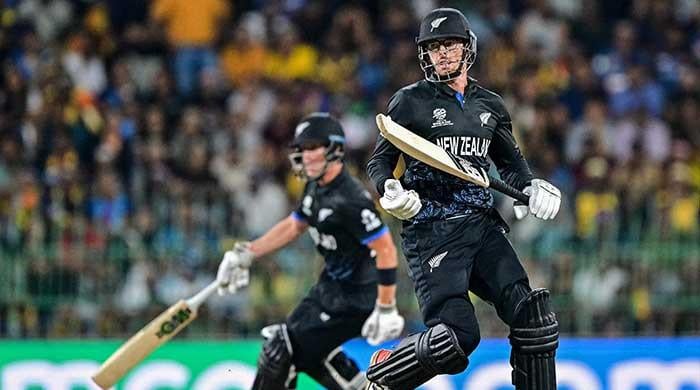
A commanding batting effort from Mitchell Santner and Cole McConchie propelled New Zealand to a competitive 168-run total against Sri Lanka in the Super Eight clash of the ICC Men’s T20 World Cup 2026 at R Premadasa Cricket Stadium on Wednesday.
Batting first, New Zealand scored 168-7 in their allotted 20 overs, getting off to a steady start as openers Tim Seifert and Finn Allen looked positive from the outset, finding boundaries early in their 30-run partnership.
However, Maheesh Theekshana provided the breakthrough by dismissing Allen, who scored 23 off 13 deliveries, including three fours and a six. The wicket ended the opening stand and shifted momentum towards the hosts.
New Zealand suffered another blow in the following over when Dushmantha Chameera removed Seifert for eight off nine balls, which featured a single boundary. The visitors were reduced to 34-2 in 4.2 overs.
Glenn Phillips and Rachin Ravindra then attempted to rebuild the innings, rotating the strike effectively and accelerating the scoring to take the total past 50.
Chameera struck again to claim his second wicket, dismissing Phillips for 18 off 18 balls, an innings that included one four. At 75-3 in 9.3 overs, New Zealand were once again under pressure.
The situation worsened when Ravindra, who had looked well set, fell to Theekshana for a brisk 32 off 21 deliveries, laced with three fours and a six.
Theekshana struck again in the same over to remove Mark Chapman for a second-ball duck, leaving New Zealand struggling at 84-5 after 11.4 overs.
Sri Lanka’s spinners continued to tighten their grip as Dunith Wellalage dismissed Daryl Mitchell for a modest three off seven balls, deepening the visitors’ troubles.
Cole McConchie and captain Mitchell Santner then attempted to stabilise the innings.
The pair guided the total beyond the 100-run mark in the 17th over and brought up a valuable half-century partnership in the closing stages, providing some late impetus after a middle-order collapse.
Santner and McConchie eased the pressure and accelerated in the closing overs, attacking the bowlers to pile on runs and guide New Zealand past the 150-run mark in the 19th over.
The Blackcaps concluded their innings with Santner dismissed on the final delivery for 47 off 26 balls, comprising two fours and four sixes, while McConchie notched up 31 off 23 deliveries, hitting three boundaries and two sixes.
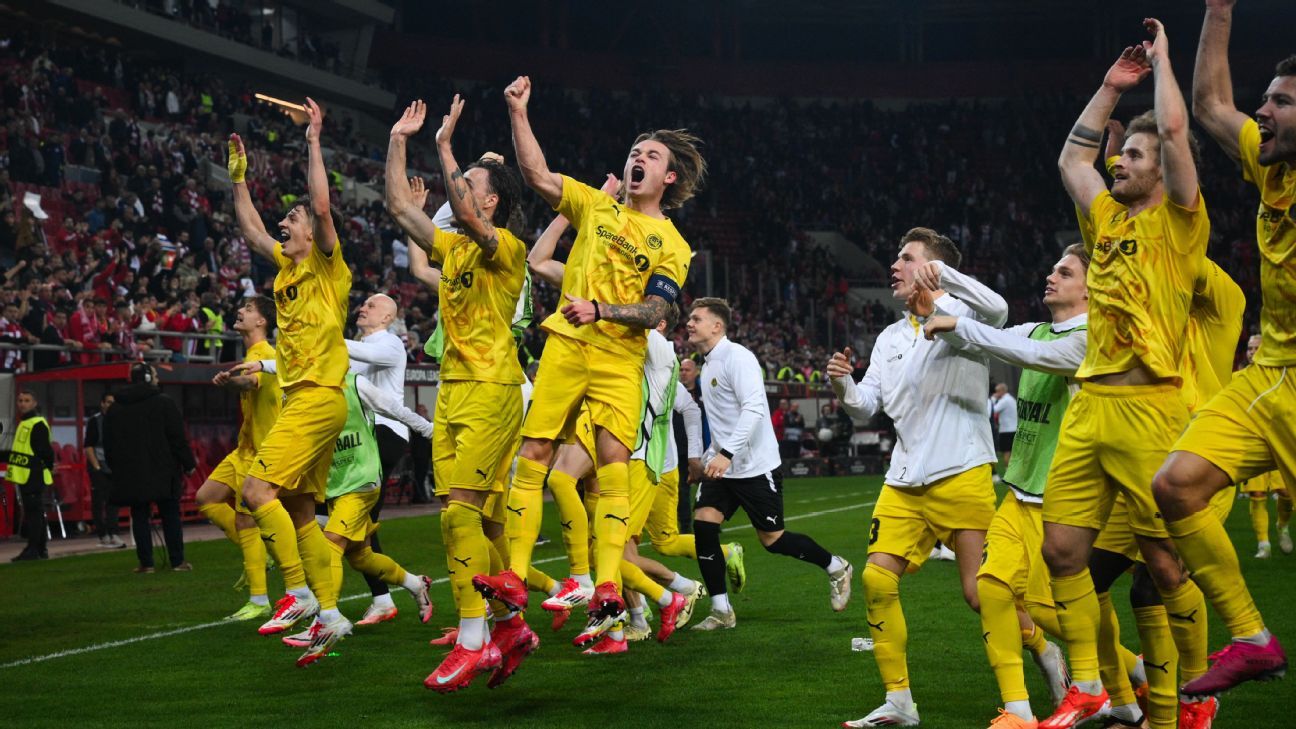
Editor’s note: On Tuesday, Norwegian minnows Bodo/Glimt pulled off one of the biggest upsets in Champions League history by eliminating last season’s finalists, Inter Milan. But the roots of that success can be traced back to their Europea League run last season. This story first ran in May 2025, before Bodo/Glimt faced Tottenham Hotspur in the semifinal.
Bodo/Glimt, European football’s biggest underdogs, meditate before training, huddle around for a chat when they concede a goal and decide amongst the squad who should be captain for each game. Their core principle is that they won’t ever talk about winning or look at a league table. There is not a single clichéd comment uttered about needing to pick up three points.
Those techniques are just a small part of explaining why a tiny team from Norway, so far north they’re in the Arctic Circle, are facing Tottenham Hotspur on Thursday in the UEFA Europa League semifinals, just a couple of games from lifting a European trophy and winning a place in next season’s UEFA Champions League.
Nobody in the town of Bodo needs to be told that this is a David vs. Goliath story. They know that you could fit the entire town’s population (42,831) into the Spurs’ stadium and still have 22,000 empty seats, and that their annual transfer budget is the same as a Spurs player could expect to earn in a season. They know they’re still not quite on the map of European football, that their opponents this season will all check to see where they are travelling to: they’ll scan their finger north, then further north, until they find a place that is a 16-hour drive from Oslo where daily sunlight lasts for just 56 minutes in December and nearly 24 hours in July.
And yet, nobody at Bodo/Glimt is surprised to have gotten this far. Maybe this is not really an underdog story at all. Bodo/Glimt won their first Norwegian league title in 2020. They’ve now won it in four of the past five seasons. In that time they’ve made it to the knockout rounds of European football and taken down some huge clubs including AS Roma, Celtic and Besiktas.
This season, they beat FC Porto in the league phase before running Manchester United close. In their last game, the quarterfinals, they knocked out Lazio across two legs, the first of which was played amid deep Arctic snow. The idea of adding Tottenham to that list of victims, then, seems manageable, even if it remains a little unlikely.
There are a number of reasons why the club has reached the final four. It has a lot to do with a golden generation of players coming through their youth ranks, such as Jens Hauge and Patrick Berg, who graduated to the first team just before their first title win in 2020. It is partly because of the icy conditions that any travelling European side meets, as well as being confronted by an acclimated squad made up almost entirely of players who come from northern Norway, many from Bodo itself. It is also due to an attractive style of play instilled by a coaching staff spearheaded by manager Kjetil Knutsen, now linked with jobs in the Premier League.
But any story about Bodo/Glimt’s emergence usually begins in 2017, with relegation to the Norwegian second division, and the arrival of a Norwegian fighter pilot named Bjørn Mannsverk.
It was eight years ago that Mannsverk arrived at the club, having recently given up active tours of duty that included missions over Afghanistan and Libya. A colleague in his squadron had spoken to someone at Bodo/Glimt and wondered if he could help. It was in the months after they had been relegated, and the club’s front office was adamant that their players were good enough, but that it was a mental collapse at the end of the season that had cost them. So they invited Mannsverk, a man who had little interest in football, and asked if he would work with the players. He agreed.
“Bjørn has brainwashed us now for six years now,” Ørjan Berg, who once played for the club and now works in its youth department, told ESPN. His son, Patrick, is the club’s official captain.
Mannsverk would only work with the club on two conditions: players would have to see him voluntarily — he would not speak to anyone that was told to see him — and he would not be their agent. “I said I won’t go out and push decisions on the players in favor of the club [like signing a new contract or adopting a style in training],” Mannsverk told ESPN. “I will be there for the player.”
Mannsverk, who was not being paid and later said it was more like a “hobby” at first, also had a question for the bosses. “What if a player tells me they do not want to play football anymore?” he asked. “What if they want to leave the club? I will support them in those decisions. Are you ready for that risk?”
It’s a big danger for a club to take on a man they do not even pay. Yet, they jumped on board, sensing it might help. It did not take long before that fear became a reality.
One of the first players through Mannsverk’s door was midfielder Ulrik Saltnes. “A super clever player,” Mannsverk said. “Great in training, s—-y in matches.” Saltnes was struggling with stomach issues during matches that would cause diarrhea. It limited him to being able to play just half a game at a time and once ruled him out of training for a week. Club medical staff performed any tests they could and found nothing. Saltnes was sure it must be a mental issue. Maybe Mannsverk could help, he thought.
“He said, I’m so tired of failing when it comes to playing games, and I’m so tired of being in pain,” Mannsverk said, adding that Saltnes revealed he planned to quit football in the coming months and begin his university studies.
“I said, ‘Okay, that’s good,'” Mannsverk said. “We started to discuss: ‘Why do you love football? This is your dream, but now you are leaving?'”
Saltnes spoke about the mental pressure he puts himself under.
“When you put your ambition too high or you limit your time to fix it, then it’s going to be hard,” Mannsverk said. “If the only solution when you failed is to use more force [pressure], that will not be sustainable. I think that was the situation with Ulrik, [he] has been doing that for so many years. So yes, his skills went up, but the stress was too high. His body was sending signals for years. Then it was telling him\, ‘You’re not going to play.’
“I said, ‘Okay, but since you’re leaving, why don’t you just enjoy the last few months, go with the flow, don’t give a damn and just have fun?'”
Saltnes thought that was a great idea, but then he counteracted; that sounded like being on autopilot. He wasn’t performing when at maximum intensity, so how could this help him? “Can you get less playing time than you have today?” Mannsverk said. “No. And will they fire you? Nope. So there is no risk.”
Saltnes couldn’t argue with that. He agreed to try it. “He managed not to give a damn, to take away all the pressure, and then it just kicked off his performances,” he said. “I think it was 1½ months later the stomach pain was more or less gone. It is almost a miracle, but it is just telling me how much the mental pressure over time can do to you.”
To say it continued to work out well would be an understatement. Just look at that snowy Europa League quarterfinal first leg against Lazio earlier this month. Bodo/Glimt ended as 2-0 winners. Saltnes scored both goals.
Mannsverk, with the full support of the coaches and boardroom, had other ideas, too. He suggested players meditate, wearing their kits, every morning before training.
“You see all the time when I go into organizations that there might be a stigma and some resistance, but I think the way we do it is hardcore performance,” Mannsverk said. “It’s not wishy-washy. It’s not being naked and having a lot of smoke and so on. It is hardcore performance. [As fighter pilots] we do it in our flight suits, we sit down in the chairs that we normally use and we meditate.”
After holding 30-minute meetings with a number of the players, he held group meetings with all of them. They were open-air talks, a safe place to share thoughts and ideas, to be brutally honest with each other about their performances. Those thoughts are then presented by players to their coaches. As Mannsverk puts it: “That creates friction.”
The biggest part of the club’s philosophy now is not to view everything through the prism of a scoreboard — league tables, points and cup runs no longer define their success. Instead, they focus solely on “process,” on what they can control. Anyone who has played or watched football knows that the better team doesn’t always win; the scoreline only adds needless pressure.
It sounds simple, but it takes club-wide commitment and open-mindedness to achieve. The topic of conversation then is always about their performance. What can they improve? It has led to some interesting places.
For example, the idea to huddle after each goal came from a talk Mannsverk had with the players. It was noted that their communication on the pitch was limited compared to the full team talks before matches and at halftime. “It’s a shame there isn’t a timeout clock like in handball,” Mannsverk told them, drawing giggles from among the players.
Then in a subsequent game, during a halt in play, one player noted how each time a goal is scored the match stops for a brief time. Why don’t they speak then? That led to what they call “The Ring,” where they come together to talk quickly about what went wrong and how to fix it.
“It is one way of caring for each other, to stand together, to say, ‘Hey, s— happens, let’s focus,'” Mannsverk said. Around 18 months later, before a European match, another player noted that their performance often drops for a few minutes after they score a goal. Why not do “The Ring” when they score, too?
Those meetings and techniques have had a relaxing effect on the team and brought confidence that they can execute manager Knutsen’s attacking style of play built on high-pressing and high-risk passes.
“I don’t think it would be possible to play like that without Bjørn and the mental work we do,” Saltnes told the New York Times in 2020. “No, I don’t think that would end very well at all.”
The outcome has been multiple league titles and, this season, their deepest run in Europe ever. According to Ørjan Berg: “I think that today’s team is playing the best football ever played in Norway.”
Bodo/Glimt may refuse to dream of Europa League glory inside of the club, but no one seems to have told their fans. The club’s stadium seats little more than 8,000 supporters, meaning the majority of the town will miss out on attending next Thursday’s semifinal second leg.
“Every person you meet, if you go outside, if the person is 2 years old or 102 years old, everything is about Tottenham and 99% is about tickets for the match,” Runar Berg, Ørjan’s brother, who also played for the club before retiring and working in the marketing department, told ESPN.
Fans will be worrying about whether the team can stand up to the test of Ange Postecoglou’s team. Their task is made tougher by a number of suspensions: midfielders Patrick Berg and Hakon Evjen are suspended for the first leg, while striker Andreas Helmersen is out for the whole tie. Starting winger Ole Blomberg and first-choice center back Odin Bjørtuft are also doubtful.
Still, those fears are not a hot topic inside the club. “We have more players,” Mannsverk said. It is an almost inspiringly misplaced confidence to have in a single team.
Mannsverk’s work has not gone unnoticed. Other clubs have approached Bodo/Glimt to ask about the secret to their success. Mannsverk, who prefers the title “culture builder” rather than “mental coach,” has been offered jobs at other teams.
“I tell them, ‘No I can’t. I’m with Bodo,'” he says. “They sometimes say, ‘Okay, do you have another fighter pilot or a military guy?’ It’s like, OK, you didn’t get it. That’s why we are not afraid of sharing what we do because we know it’s so hard to actually do it.”


Israel’s Delta Galil posts record $2.12 bn sales in 2025 on DTC push

Jason Bateman makes rare red carpet outing with wife Amanda Anka
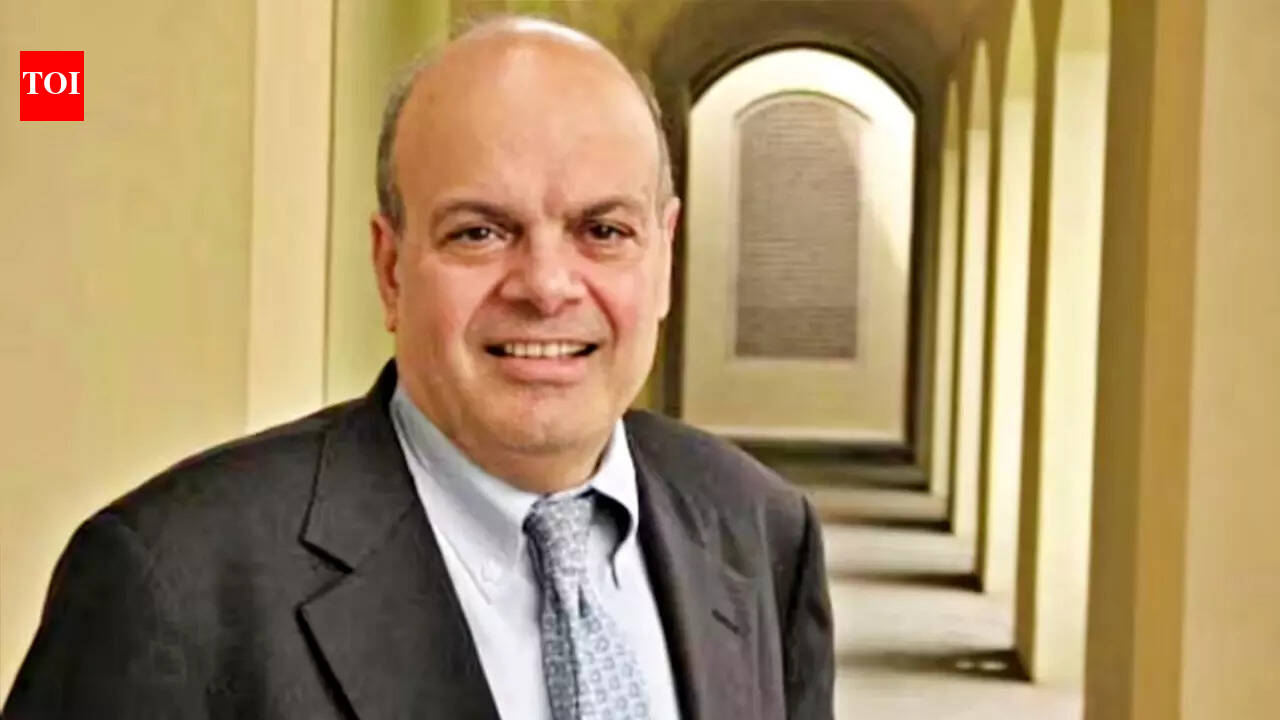
Ajit Jain: Warren Buffett’s trusted executive Ajit Jain buys apartment in Gurugram for Rs 85 crore – The Times of India

-

 Entertainment1 week ago
Queen Camilla reveals her sister’s connection to Princess Diana
-

 Tech1 week ago
Rakuten Mobile proposal selected for Jaxa space strategy | Computer Weekly
-

 Politics1 week ago
Ramadan moon sighted in Saudi Arabia, other Gulf countries
-

 Entertainment1 week ago
Robert Duvall, known for his roles in "The Godfather" and "Apocalypse Now," dies at 95
-
 Business1 week ago
Tax Saving FD: This Simple Investment Can Help You Earn And Save More
-

 Politics1 week ago
Tarique Rahman Takes Oath as Bangladesh’s Prime Minister Following Decisive BNP Triumph
-

 Tech1 week ago
Businesses may be caught by government proposals to restrict VPN use | Computer Weekly
-

 Fashion1 week ago
Australia’s GDP projected to grow 2.1% in 2026: IMF