

Fashion
EU Parl panel clears changes to report sustainability, due diligence


The voting saw 17 votes for the amendment, six against and two abstentions.
The European Parliament’s legal affairs committee has approved its position on a series of changes to sustainability reporting and due diligence requirements for firms.
Fewer companies are required to report on sustainability and comply with due diligence obligations.
No civil liability exists at the EU level, but victims to receive full compensation from companies breaching due diligence obligations.
The European Commission originally proposed cutting the number of companies required to carry out social and environmental reporting by 80 per cent, whereas Parliament members (MEPs) want to reduce the scope further to cover only those companies with over 1,000 employees on an average and a net annual turnover above €450 million. This would also apply to sustainability reporting under taxonomy rules, i.e. a classification of sustainable investments.
For firms no longer covered by the rules, reporting would be voluntary, in line with Commission guidelines. To prevent large companies from shifting their reporting duties onto their smaller business partners, these would not be allowed to request information beyond the voluntary standards.
Sector-specific reporting would also become voluntary and existing sustainability reporting standards would be further simplified with a focus on quantitative information and on reducing the administrative and financial burden, an official release said.
The Commission would also establish a digital portal for companies with free access to templates, guidelines and information on all European Union (EU) reporting requirements complementing the European Single Access Point.
According to MEPs, due diligence rules requiring companies to prevent and limit their adverse impact on human rights and the environment should only apply to large EU businesses with more than 5,000 employees and a net yearly turnover above €1.5 billion, and to foreign businesses with a net turnover in the EU above the same threshold.
Instead of systematically asking for information required for their due diligence assessments from their business partners, MEPs want these companies to adopt a risk-based approach, whereby they only ask for the necessary information where there is a prospect of an adverse impact in their business partners’ activities.
In the case of firms outside the scope of the rules, this would be possible only as a last resort. Companies would still be required to prepare a transition plan aligning their strategy to a sustainable economy and the Paris Agreement.
Businesses should be liable for damages caused by breaches of due diligence obligations under national law, rather than at the EU level. The maximum fine level for offending companies would be at 5 per cent of their global turnover, and the Commission and EU member states should provide guidance for national authorities on these penalties.
Should the Parliament approve the committee mandate at the next plenary session, MEPs and EU governments should start negotiations on the final text of the legislation on 24 October.
The Commission presented its Omnibus I simplification package on 26 February. Besides rules simplifying due diligence requirements and sustainability reporting, it also contained file delaying application of these rules for some companies, which was approved by the European Parliament via urgent procedure in April this year.
Fibre2Fashion News Desk (DS)










Activewear sales rose 9 per cent to $3,088 million, while Innerwear sales increased 21 per cent largely due to the acquisition. International sales declined 5 per cent to $240 million.
Gildan Activewear has reported full-year 2025 net sales of $3,619 million, up 11 per cent, supported by HanesBrands integration and growth in Activewear and Innerwear.
Adjusted EPS rose 17 per cent to $3.51, while free cash flow reached $493 million.
The company targets $250 million synergies by 2028, plans Bangladesh Phase 2 expansion, and forecasts 2026 revenue of $6-6.2 billion.
The gross profit increased to $1,130 million and gross margin improved 50 basis points to 31.2 per cent, supported by lower manufacturing and raw material costs alongside favourable pricing, partly offset by tariff pass-through. Adjusted for a $35.4 million inventory fair value step-up related to the transaction, adjusted gross profit reached $1,165 million with adjusted gross margin of 32.2 per cent; the remaining $237 million step-up is expected to flow through cost of sales in 2026, Gildan said in a press release.
Selling, general and administrative (SG&A) expenses were $389 million, while adjusted SG&A rose to $387 million (10.7 per cent of sales) from $308 million (9.4 per cent), reflecting consolidation effects and higher variable compensation. Operating income stood at $620 million (17.1 per cent margin) versus $618 million (18.9 per cent) in 2024, while adjusted operating income increased to $779 million, lifting adjusted operating margin to 21.5 per cent.
Net financial expenses climbed $45 million to $149 million due to acquisition-related borrowing. GAAP diluted EPS from continuing operations was $2.57 compared with $2.46, while adjusted diluted EPS rose 17 per cent to $3.51, benefiting from a lower diluted share base.
Operating cash flow increased to $606 million from $501 million, and free cash flow reached $493 million after capex of $114 million. Year-end net debt was $4,417 million, with leverage at 3.0x net debt to trailing 12-month proforma adjusted EBITDA.
In the fourth quarter (Q4), net sales from continuing operations rose 31.3 per cent to $1,078 million, with operating margin at 9.2 per cent and adjusted operating margin at 20.7 per cent. GAAP diluted EPS declined to $0.32, while adjusted diluted EPS increased to $0.96. Quarterly operating cash flow rose to $336 million and free cash flow to $304 million.
Integration progress is ahead of plan, with expected annual run-rate cost synergies of about $250 million by end-2028, up from the earlier $200 million target. The company plans to close two HanesBrands textile facilities in early 2026 as part of footprint optimisation.
Gildan has initiated a formal sale process for the HanesBrands Australian business, expected to generate approximately $675 million in net sales and $0.21 in diluted EPS in 2026, with proceeds earmarked for debt reduction.
For 2026, excluding HanesBrands Australia, Gildan forecasts revenue of $6-6.2 billion and adjusted diluted EPS of $4.2-4.4, alongside adjusted operating margin of about 20 per cent and free cash flow above $850 million. The company also approved a 10 per cent dividend increase, declaring a quarterly dividend of $0.249 per share.
Looking ahead, Gildan plans to develop a second textile facility within its Bangladesh complex, with initial production targeted for late 2027. From Q1 2026, segment reporting will shift from product categories to Retail and Wholesale to align with its go-to-market structure.
“Our results underscore the impressive execution by our global team whose focus is now on fully capturing the value of our expanded platform. As we look ahead to 2026, we are very excited about the HanesBrands acquisition which doubles our scale, combines iconic brands with our world-class, low-cost, vertically integrated platform, and unlocks a powerful engine for innovation and growth. The integration is well underway, and we now expect to deliver higher than initially targeted run-rate cost synergies reaching approximately $250 million by the end of 2028 with approximately $100 million in 2026,” said Glenn J Chamandy, president and CEO at Gildan Activewear.
Fibre2Fashion News Desk (SG)

CCPIT has approved 119 activities for Chinese enterprises to participate in US-based exhibitions this year; 30 are over by February, CCPIT spokesperson Wang Wenshuai told in a press conference.
It will also utilise its dedicated working group for foreign-funded enterprises, ensuring that the reasonable demands of US-funded enterprises are met, Wang was cited as saying by a state-controlled media outlet.
The China Council for the Promotion of International Trade will facilitate exchanges and collaboration between Chinese and US firms in investment, trade and technology.
It has approved 119 activities for Chinese enterprises to participate in US-based exhibitions this year; 30 are over by February.
It will also utilise its dedicated working group for foreign-funded enterprises to address US firms’ demand.
CCPIT will use events like the Asia-Pacific Economic Co-operation CEO Summit and the B20 business activities during the December G20 Leaders’ Summit as an opportunity to work with all parties, including the US business community, to build consensus, deepen co-operation and promote inclusive, strong and sustainable growth of the Asia-Pacific and global economies, Wang added.
Fibre2Fashion News Desk (DS)

The package establishes a modern framework for both sides, enabling frictionless access to a market of 460 million consumers in key sectors, delivering economic benefits to both parties.
European Commission President Ursula von der Leyen and Swiss President Guy Parmelin yesterday signed a broad package of agreements aimed at deepening and expanding EU-Switzerland ties.
By aligning standards and rules in closely integrated areas, it will provide legal certainty, simplify trade in goods like medical devices and food products, and ease cross-border supply for businesses on both sides.
By aligning standards and rules in closely integrated areas, it will provide legal certainty, simplify trade in goods like medical devices and food products, and ease cross-border supply for businesses on both sides of the border.
Additionally, it will ensure more consistent rules for individuals who live, work or study across the EU-Swiss border. Switzerland will contribute to the development of legislation in the areas covered by the package and will have the opportunity to influence these rules as they are being designed.
“By modernising and deepening our ties across key sectors, from trade and transport to health and energy—we are strengthening legal certainty, fostering innovation and creating new opportunities for our citizens and businesses,” von der Leyen said in a release from the Commission.
The package includes updates to four already existing agreements, which already give Switzerland access to the EU internal market, regarding air transport, land transport, the free movement of persons and mutual recognition of conformity assessment.
New agreements on food safety, electricity, health and Switzerland’s participation in the EU Agency for the Space Programme were signed. A new agreement introduced a permanent and fair financial contribution by Switzerland to economic and social cohesion within the EU.
Apart from a protocol on parliamentary cooperation, the package includes also a joint declaration on the establishment of a high-level dialogue on the broad bilateral package.
Fibre2Fashion News Desk (DS)


Canada’s Gildan posts $3.6 bn 2025 sales, growth supported by Hanes

Harry Styles shares marriage plans amid rumoured romance with Zoe Kravitz

China to build ‘birth-friendly society’, refine social security system

India Us Trade Deal: Fresh look at India-US trade deal? May be ‘rebalanced’ if circumstances change, says Piyush Goyal – The Times of India

What are Iran’s ballistic missile capabilities?

Households set for lower energy bills amid price cap shake-up

-
Business6 days ago
India Us Trade Deal: Fresh look at India-US trade deal? May be ‘rebalanced’ if circumstances change, says Piyush Goyal – The Times of India
-
 Politics7 days ago
What are Iran’s ballistic missile capabilities?
-

 Politics1 week ago
US arrests ex-Air Force pilot for ‘training’ Chinese military
-
Business1 week ago
Households set for lower energy bills amid price cap shake-up
-
 Business6 days ago
Attock Cement’s acquisition approved | The Express Tribune
-
 Fashion1 week ago
OECD GDP growth slows to 0.3% in Q4 amid mixed trends
-

 Fashion6 days ago
Policy easing drives Argentina’s garment import surge in 2025
-
 Fashion6 days ago
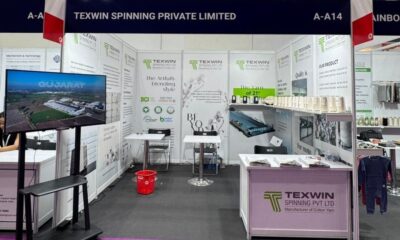
Texwin Spinning showcasing premium cotton yarn range at VIATT 2026