

Business
‘Exhili-Rating’ For India: How S&P Upgrade Strengthens Negotiating Power In Trade Talks

Last Updated:
The agency has raised India’s long-term unsolicited sovereign credit ratings to ‘BBB’ from ‘BBB-‘, and its short-term ratings to ‘A-2’ from ‘A-3’

This is seen as a significant acknowledgement of India’s growth story, especially given the cynicism within the Congress and Rahul Gandhi endorsing American President Donald Trump’s comment that India was a dead economy.
Representational image
The mood is upbeat with the S&P rating system upgrading India. They have raised India’s long-term unsolicited sovereign credit ratings to “BBB” from “BBB-“, and its short-term ratings to “A-2″ from “A-3″. The outlook on the long-term rating is stable. This is seen as a significant acknowledgement of India’s growth story, especially given the cynicism within the Congress and Rahul Gandhi endorsing American President Donald Trump’s comment that India was a dead economy.
The global ratings agency stated, “The stable outlook reflects our view that continued policy stability and high infrastructure investment will support India’s long-term growth prospects. That, along with cautious fiscal and monetary policy that moderates the government’s elevated debt and interest burden, will underpin the rating over the next 24 months.”
This is significant considering the uncertainty over the Indian market and trade, given the face-off between India and the US. There is concern that high tariffs could impact India’s economy. However, the agency acknowledged these apprehensions and said, “Though the U.S. is India’s largest trading partner, we do not expect the 50% tariffs (if imposed) to pose a material drag on growth. India’s exports to the U.S. constitute about 2% of GDP. Factoring in sectoral exemptions on pharmaceuticals and consumer electronics, the exposure of Indian exports subjected to tariffs is lower at 1.2% of GDP. Though this may eventually result in a one-off hit to growth, we envisage the overall impact to be marginal and will not derail India’s long-term growth prospects.”
The Indian government has been appreciated for its political stability. The agency mentioned that with the BJP having a majority in Parliament, the formulation of laws and schemes becomes easier. It has predicted a GDP growth of about 6.5%. Many government schemes and initiatives by Prime Minister Narendra Modi, like Jan Dhan, push to MSMEs, Ayushman Bharat, to name a few, have helped the economy.
Additionally, the commerce ministry has released data showing that this quarter alone, trade has increased in many critical sectors like gems, mechanical goods, and auto parts. While there is concern about trade ties between the US and India, the ministry remains hopeful. The ministry stated, “Commerce ministry—negotiations with US are ongoing… talks are on… BTA talks are engaged… the US is an important trade partner for us just as we are for them.”
These ratings are also important as India is poised to sign several bilateral trade agreements with other countries. A good rating will give India more power to negotiate.

Pallavi Ghosh has covered politics and Parliament for 15 years, and has reported extensively on Congress, UPA-I and UPA-II, and has now included the Finance Ministry and Niti Aayog in her reportage. She has als…Read More
Pallavi Ghosh has covered politics and Parliament for 15 years, and has reported extensively on Congress, UPA-I and UPA-II, and has now included the Finance Ministry and Niti Aayog in her reportage. She has als… Read More
view comments
Read More







Business
Rs 20,000 crore gold, silver rush: What will people buy this Akshaya Tritiya? – The Times of India
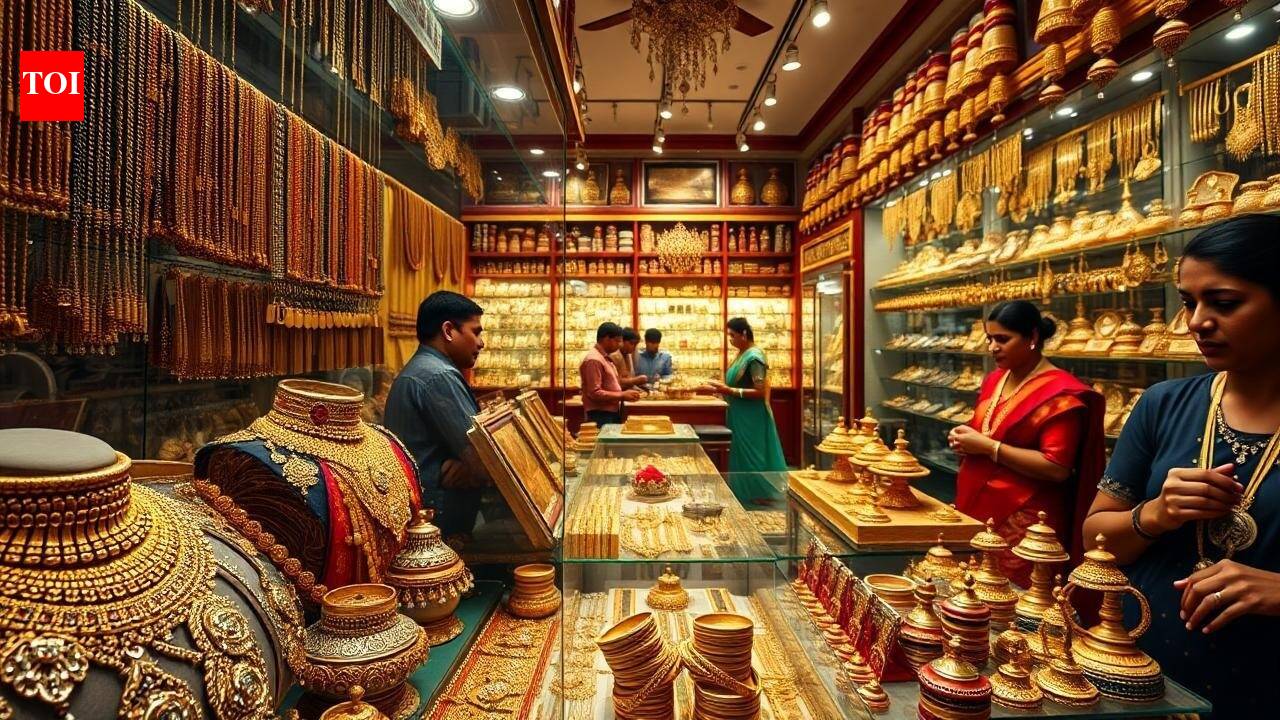
This Akshaya Tritiya, India’s gold and silver markets are heading for bumper purchases, with overall trade likely to cross Rs 20,000 crore even as record-high prices reshape buying patterns. The estimate, shared by the Confederation of All India Traders (CAIT), is higher than last year’s Rs 16,000 crore, signalling growth in value despite a sharp rise in bullion rates.Prices for the yellow metal have surged sharply over the past year, going from Rs 1,00,000 per 10 grams, to Rs 1.58 lakh. Meanwhile, silver has shown a steeper rally, jumping from Rs 85,000 per kilogram to Rs 2.55 lakh per kilogram. According to CAIT, this sharp escalation has not weakened demand, but is instead prompting consumers to make more deliberate and value-oriented purchases.Praveen Khandelwal, member of parliament from Chandni Chowk and secretary general of CAIT told ANI, “Akshaya Tritiya has traditionally been one of India’s most auspicious occasions for purchasing gold… While gold continues to dominate, the nature of purchasing is evolving significantly in response to steep price escalation.”Commenting on customer preference, CAIT national president BC Bhartia highlighted, “There is a clear shift towards lightweight, wearable jewellery, alongside a stronger focus on silver and diamond products. Attractive incentives such as reduced making charges and complimentary gold coins are also helping sustain consumer interest.”Despite the increase in overall trade value, the quantity of metals being sold tells a different story. Pankaj Arora, National President of the All India Jewellers and Goldsmith Federation (AIJGF), an associate of CAIT, explained that the projected Rs 16,000 crore gold trade amounts to nearly 10,000 kilograms (10 tonnes) at current rates. The value, spread across an estimated 2 to 4 lakh jewellers, translates to average sales of only 25 to 50 grams per jeweller, “clearly indicating a sharp decline in volume”.Meanwhile for silver, the estimated Rs 4,000 crore trade corresponds to around 1,56,800 kilograms (157 tonnes), resulting in average sales of about 400 to 800 grams per jeweller during the festival period. “These figures underline a critical shift: while the value of business is expanding due to rising prices, actual consumption is contracting,” Khandelwal said.This gap between value and volume is also reshaping consumer’s buying pattern, with smaller items and lightweight jewellery gaining popularity. At the same time, jewellers are facing challenges due to fluctuating prices, especially when it comes to managing inventory.Even so, festive demand remains steady, with markets witnessing healthy footfall. “Consumers are now adopting a more cautious and pragmatic approach, balancing traditional beliefs with financial discipline,” Khandelwal added.At the same time, it’s not just about physical gold anymore as consumers are increasingly exploring alternatives like digital gold, Sovereign Gold Bonds and gold ETFs, drawn by the promise of liquidity, safety and flexibility when prices are volatile.CAIT and AIJGF have urged jewellers to comply with mandatory hallmarking standards, including HUID certification, and advised buyers to verify the purity and authenticity of their purchases.

Lauren Elcock is among the young Londoners who say rising rents are forcing them to quit the capital.
Source link

As governments across the world restricted the movements of their citizens during Covid lockdowns from 2020, people spent more time online. We bought more online and socialised more online, and this brought us closer to the people who want to scam us. At the same time, realistic video impersonations, voices, websites, and texts became more commonplace, and scammers increased their use of social media including WhatsApp.


2026 NFL draft: Louis Riddick’s favorite prospects, sleepers

Karachi Kings win toss, opt to bowl first against Multan Sultans

As Iran war strains ties with Trump’s US, UK looks to Europe

-

 Sports6 days ago
The case for Man United’s Fernandes as Premier League’s best
-

 Entertainment6 days ago
Palace left in shock as Prince William cancels grand ceremony
-

 Politics1 week ago
Chinese, Taiwanese will unite, Xi tells Taiwan opposition leader
-
 Business1 week ago
100% road tax waiver for electric cars, new rules for 2, 3 and 4 wheelers – what Delhi govt’s draft EV policy says – The Times of India
-

 Entertainment1 week ago
Dua Lipa hits major career high ahead of wedding with Callum Turner
-
 Business6 days ago
UK could adopt EU single market rules under new legislation
-
 Business1 week ago
The FAA wants gamers to apply for air traffic control jobs
-

 Fashion6 days ago
Energy emerges as biggest cost driver in textile margins