

Business
FAA lets Boeing increase 737 Max production almost two years after near-catastrophic accident


Boeing 737 Max aircraft are assembled at the company’s plant in Renton, Washington, U.S. June 25, 2024.
Jennifer Buchanan | Via Reuters
Boeing has won regulator approval to ramp up production of its best-selling 737 Max jetliners to 42 a month, a milestone for the manufacturer nearly two years after the Federal Aviation Administration capped its output after a midair near-catastrophe.
In January 2024, the FAA restricted Boeing to building the planes at a rate of no more than 38 a month — though it had been below that level at the time — after a door plug from a nearly new 737 Max 9 blew off from an Alaska Airlines flight as it climbed out of Portland, Oregon.
Boeing failed to reinstall key bolts on the door plug before it left the factory, a National Transportation Safety Board report found. The 737 Max returned and landed safely, but it put the company back into crisis mode just as leaders were expecting a turnaround year.
The FAA said Friday that it would still oversee Boeing’s production. “FAA safety inspectors conducted extensive reviews of Boeing’s production lines to ensure that this small production rate increase will be done safely,” the agency said in a statement.
Boeing said it would work with its suppliers to increase production.
“We appreciate the work by our team, our suppliers and the FAA to ensure we are prepared to increase production with safety and quality at the forefront,” Boeing said Friday in a statement.
An increase in output is key to the company’s turnaround after years of problems, since airlines and other customers pay for the bulk of an aircraft when they receive it. CEO Kelly Ortberg, named last year to stabilize the top U.S. manufacturer, said last month he expected to soon win FAA approval to raise output to 42, with other increases planned for down the line.
“We’ll go from 42 and then we’ll go up another five, and we’ll go up another five,” Ortberg told a Morgan Stanley investor conference in September. “We’ll get to where that inventory is more balanced with the supply chain, probably around the 47 a month production rate.”
The change shows the FAA’s softening tone and increased confidence in Boeing after years of restrictions. Last month, the agency said it would allow Boeing to again sign off on some of its aircraft itself before they’re handed over to customers, instead of that responsibility falling solely with the FAA.
The Max program was crippled following two crashes of the planes in 2018 and 2019, which killed all 346 people on the two flights. The aircraft was grounded for nearly two years. Covid also hurt production, followed by supply chain problems and, last year, a labor strike at Boeing’s main factories in the Seattle area.
Boeing hasn’t posted an annual profit since 2018. But it has increased output, and its deliveries of new planes are on track to hit the highest rate since that year.
Boeing is scheduled to release quarterly results on Oct. 29.
— CNBC’s Phil LeBeau and Meghan Reeder contributed to this report.





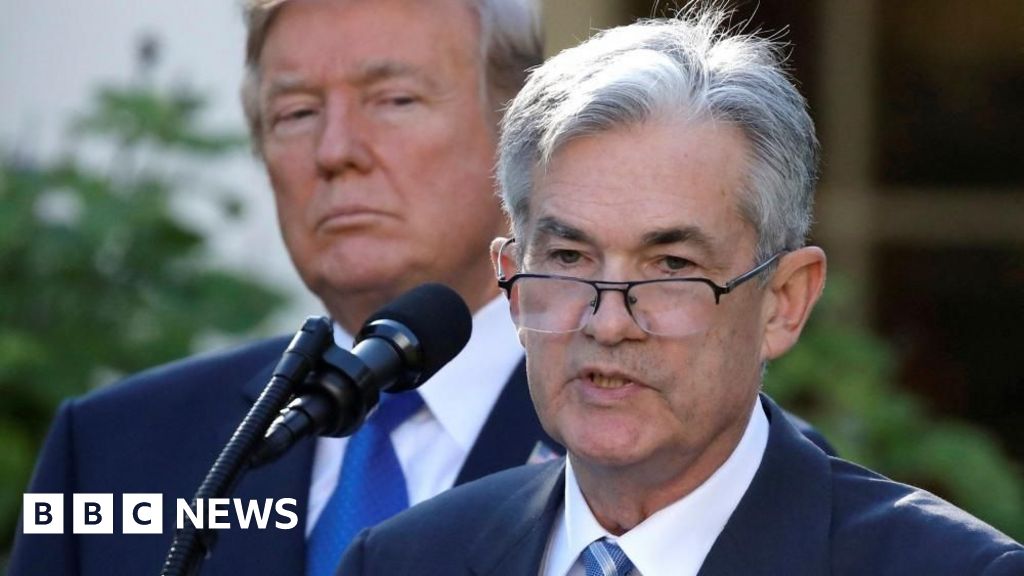
Powell’s term is nearing its end and the US Senate is considering Trump’s nominee for his replacement, Kevin Warsh. A key Republican, Thom Tillis, has withheld his support for Warsh unless the Trump administration would drop its investigation into Powell.
Business
Intel bags big gains! Chipmaker’s shares jump 26% on blockbuster results; how Trump admin benefits – The Times of India
Intel share price soared sharply on Friday after the chipmaker delivered a first-quarter performance that exceeded market expectations. And the win was not just for the chipmaker, but also the whole of US!The stock climbed 26.7% during trading on Friday, marking what could be its strongest single-day gain since 1987. Momentum continued after the closing bell, with shares rising a further 20% in after-hours trading as investors reacted to signs of a sustained turnaround driven by artificial intelligence.Intel reported revenue of $13.58 billion (€11.6bn) for the quarter, ahead of the $12.3 billion (€10.5 bn) forecast and up 7.2% from a year earlier. Adjusted earnings per share came in at $0.29, far exceeding expectations of $0.01.A key contributor to this performance was the company’s Data Centre and AI (DCAI) division, which delivered revenue of $5.05 billion (€4.2bn), up 22.4% year-on-year and well above analyst estimates of $4.41 billion (€3.77bn). The results indicate strong demand for Intel’s Xeon 6 processors and Gaudi 3 AI accelerators, particularly among enterprise clients and cloud service providers.Chief executive Lip-Bu Tan pointed to a broader shift in artificial intelligence usage as a major factor behind the growth. He said, “the next wave of AI will bring intelligence closer to the end user, moving from foundational models to inference to agentic.” He added, “This shift is significantly increasing the need for Intel’s CPUs and wafer and advanced packaging offerings.”The company also issued an upbeat outlook for the second quarter, forecasting revenue in the range of $13.8 billion (€11.8billion) to $14.8 billion (€12.6billion), surpassing investor expectations of $13 billion (€11.1billion).
But how is Washington winning?
The rally has had a direct impact on the US administration’s investment in Intel. In 2025, during a period of severe financial strain for the company, the administration of Donald Trump acquired a 9.9% stake in a move aimed at stabilising the business. The government invested $8.9 billion (€7.8bn) at a share price of $20.47 (€18.01), with $5.7 billion (€5bn) of that amount coming from previously approved but unpaid grants, according to the Euro News.At the time, Intel was facing multi-billion dollar losses and operational challenges, prompting concerns over its viability. As part of the intervention, the company cancelled planned factory projects in Germany and Poland, redirected focus towards US-based manufacturing, and reduced its global workforce by 25%, cutting around 25,000 jobs.Following the latest jump, Intel’s shares are now trading at $81.3 (€71.5), representing an increase of nearly 300% since the government first took its stake. The sharp rise highlights how the company’s improved financial performance has translated into substantial gains for the US administration.

Statistics Jersey says there have been “sharp increases” in some energy prices.
Source link


Iranian FM Abbas Araghchi lands in Pakistan ahead of renewed US talks

Mom’s Microwaved Coffee Won’t Stand a Chance With This Ember Smart Mug Deal

Giants legend Lawrence Taylor, 67, hospitalized after medical emergency: report

-

 Fashion1 week ago
France’s LVMH Q1 revenue falls 6%, shows resilience amid Iran war
-

 Tech1 week ago
CYBERUK ’26: UK lagging on legal protections for cyber pros | Computer Weekly
-

 Sports5 days ago
WWE WrestleMania 42 Night 2: Live match results and analysis
-

 Sports1 week ago
Faheem Ashraf backs Islamabad United’s push, calls league a ‘career-changing platform’
-

 Sports5 days ago
NCAA men’s gymnastics championship: All-time winners list
-
 Business1 week ago
PepsiCo earnings beat estimates as North American food business improves
-

 Tech1 week ago
Anthropic Plots Major London Expansion
-
 Business1 week ago
Oil prices fall again amid Middle East ceasefire hopes