

Business
FM asks banks to ensure staff speak local language – The Times of India

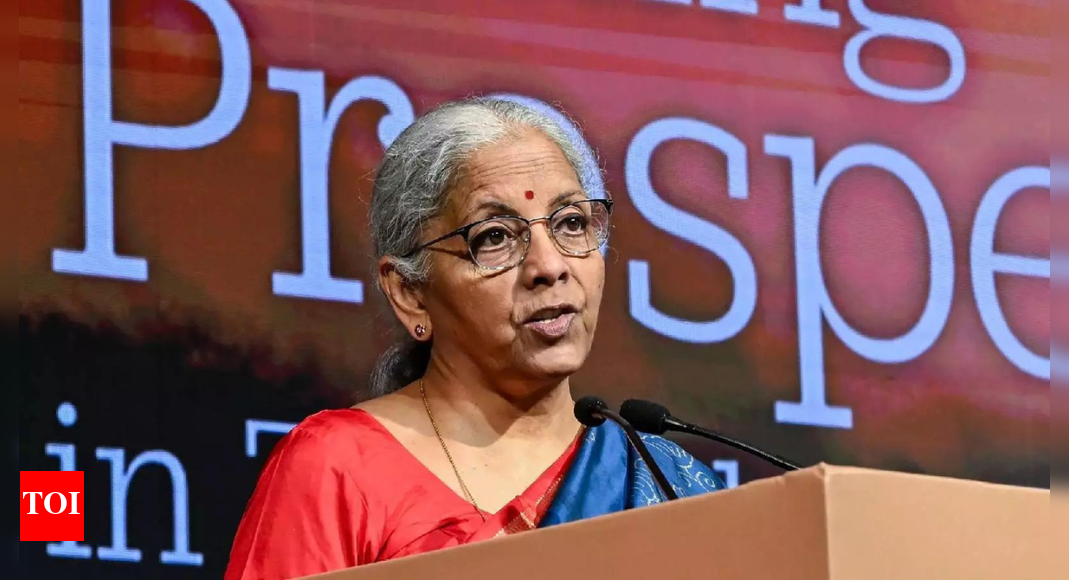
MUMBAI: Finance Minister Nirmala Sitharaman has urged banks to ensure that customers are able to get their work done in branches speaking in the local language. She also called upon banks to tweak HR policies to give weightage to local language proficiency during appraisals. She asked banks to restore the human connect in customer service, insisting that technology must complement—not replace—personal interaction.Language friction between PSU bank staff has come to the fore, particularly in Maharashtra and southern India, especially Karnataka. There was recent outrage after a public sector bank manager in Bengaluru refused to speak Kannada with a customer. The incident prompted condemnation from the chief minister, a transfer of the official, and an apology from the bank. Similar cases have exposed ongoing tensions as staff from other states struggle with local languages, causing communication gaps and customer resentment.In a Q&A session with SBI chairman CS Setty at the bank’s 12th Banking and Economic Conclave, she said the sector must rethink its approach to customer engagement, especially at the branch level. “You cannot say you will do everything digitally and reach customers only online. Person-to-person contact was the strength of Indian banks, even before technology, and it helped you make big strides.” A key part of this human touch, she stressed, is language.Calling it “basic etiquette,” Sitharaman said banks must ensure customers can converse in their own tongue at branches. “Language is an important way to communicate with your customers. Even if they know Hindi or English, it gives a nice touch when you speak their language,” she said. “We Indians go abroad and say a few words in French or Spanish to please people—but in our own country, because of HR policies, staff are posted without knowing the local language. That human touch gets lost.”The finance minister linked customer service to HR policy, asking banks to incentivise linguistic and cultural familiarity. “HR policies must ensure that every staff member posted at a branch understands the customer and speaks the local language. Performance appraisal should also factor in proficiency in the local language,” she said.While acknowledging the gains of digitisation, she cautioned banks against becoming impersonal. “Technology can bring advantages, efficiency, productivity, and profit—but that human touch is what many earlier private banks had before they were nationalised. You don’t have to struggle like the old bankers who travelled to villages, but you still need that connection. Please don’t be carried away only by technology.”Sitharaman also called for restoring accountability in credit assessment, especially for small businesses. “Credit rating of a customer—particularly MSMEs—has to be your own. You should not outsource it,” she said. “Earlier, you knew your customers because the staff posted there understood who was reliable and who was not. That has gone, and it needs to be restored.” She urged banks to simplify paperwork and reduce the burden on borrowers. “Paperwork has to be simple. You cannot keep putting the onus on the borrower to keep proving and providing documents endlessly. If you simplify processes, you will be among the most appreciated institutions.”Bankers said that the language issue largely arose because the response to recruitment drives was not uniform across states. While in some states like Gujarat, young candidates were more inclined towards business, youngsters in Karnataka got more opportunities in private IT sector and preferred these jobs which were non-transferrable. In some northern states however the priority was for government jobs leading to differences in language skills.




The Iran war continues to push up prices at the pump for US motorists.
Source link

Millions of motorists could be entitled to compensation with the financial regulator setting out how to apply
Source link
Business
Could oil hit $200 a barrel? Experts warn of risks if Iran war drags on – The Times of India

As the Middle East crisis escalates, crude oil prices could surge to $150 or $200 a barrel if the near-closure of the Strait of Hormuz continues over the next six to eight weeks. The disruption is a result of the ongoing war involving the US, Israel, and Iran, which has already prompted Persian Gulf producers to cut millions of barrels of daily supply.According to energy-market consultancy FGE NexantECA, the impact on the global oil market could be enormous. “Every week, 100 million barrels of oil is not going through, and every month, 400 million barrels are not going through,” Chairman Emeritus Fereidun Fesharaki told Bloomberg on Tuesday. “So, within a period of time, these losses to the market will be astronomical,” he said. Fesharaki highlighted that the physical reality of supply disruptions would determine oil prices, rather than political statements.“The market will choke, and the prices will go up. It doesn’t matter what the president says on the political front,” he added. His statement comes as US President Donald Trump has earlier suggested possibility to end the conflict. Oil prices have already surged sharply this month amid the conflict, with Brent crude climbing above $110 per barrel and US West Texas Intermediate (WTI) crude trading above $100. Brent crude rose $2.26, or about 2 per cent, to $115.04 a barrel in early trade, after hitting its highest level since March 19 in the previous session. US WTI crude gained $3.10, or around 3 per cent to $105.96 a barrel, marking its highest level since March 9.Analysts warn that if the Strait of Hormuz remains effectively closed, the global oil market could face further shocks, potentially pushing prices even higher.


Charleston hires Akron’s John Groce as men’s basketball coach

The $1 Million Aston Martin Valhalla Makes You Drive Better Than You Thought Possible
US gas price tops $4 for first time since 2022

-

 Politics1 week ago
Afghanistan announces release of detained US citizen
-

 Sports1 week ago
Broadcast industry CEO says consolidation is ‘essential’ to compete for NFL soaring media rights prices
-

 Entertainment1 week ago
UN warns migratory freshwater fish numbers are spiralling
-
 Business1 week ago
Property Play: Home flippers see smallest profits since the Great Recession, real estate data firm says
-

 Tech1 week ago
Can a Home Appliance Fix the Problem of Soft-Plastic Waste?
-
 Business1 week ago
Gold prices soar in Pakistan – SUCH TV
-

 Fashion1 week ago
ICE cotton slips on weaker crude, profit booking
-
 Business1 week ago
More women are entering wealth management, but few are in advisory roles, study finds