

Business
FTSE 100 up as Fed sounds softer tone than feared

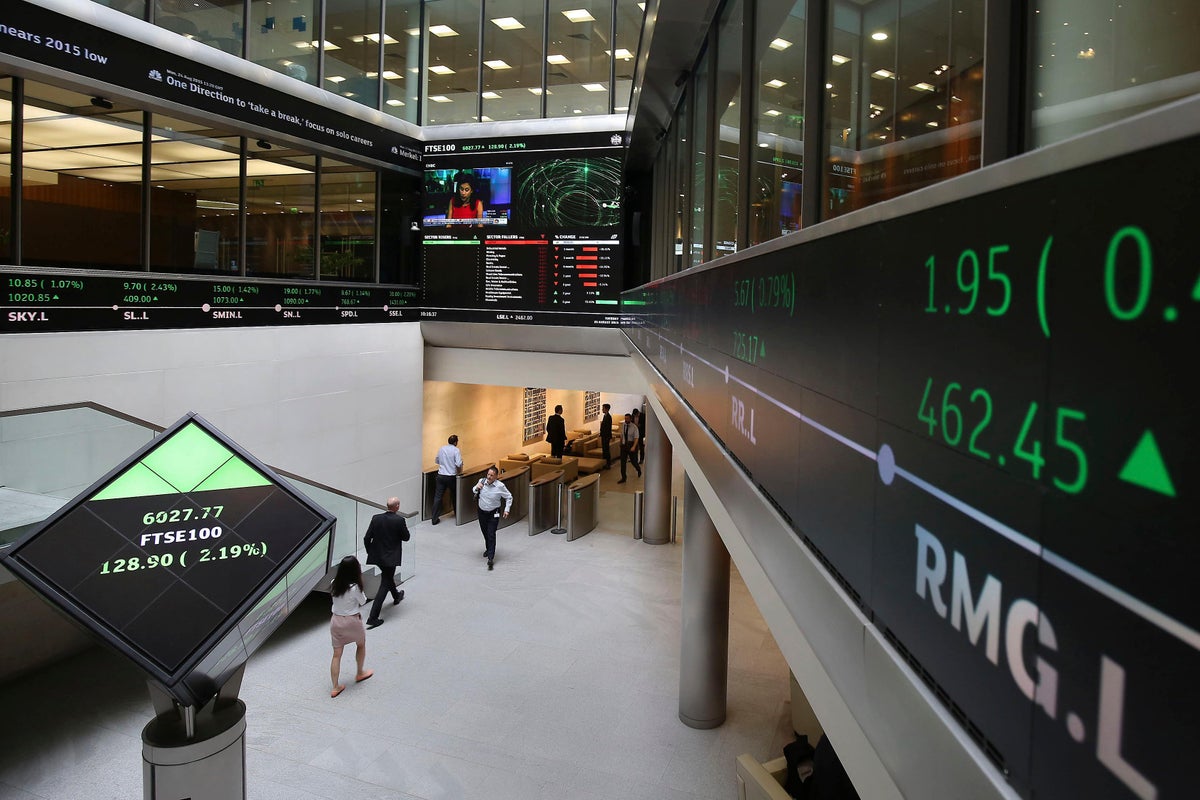
The FTSE 100 forged ahead on Thursday as a less “hawkish” than feared rate cut by the US Federal Reserve and a brighter US economic outlook spurred stocks, despite some fresh AI worry.
The FTSE 100 index closed up 47.63 points, 0.5%, at 9,703.16. The FTSE 250 ended 21.13 points higher, 0.1%, at 21,852.10, and the AIM All-Share ended up 1.04 points, 0.1%, at 747.66.
In Europe on Thursday, the CAC 40 in Paris closed up 0.8%, while the DAX 40 in Frankfurt ended 0.7% higher.
After Europe’s close on Wednesday, the US central bank cut interest rates by 25 basis points as expected and chairman Jerome Powell struck a softer tone than some had feared.
Bank of America called it an “unintentionally dovish cut”, Citi said markets “had overestimated how hawkish Mr Powell would sound,” while JPMorgan noted Mr Powell’s opening remarks were “less forceful than those used in October”.
“Relative to markets that were looking for Powell to push back more strongly at the potential for further cuts, this was a dovish outcome,” Citi said.
Goldman Sachs said “dovish labour market comments” and the “lack of a stronger lean toward a January pause led to a dovish market reaction”.
In addition, the Federal Reserve raised expectations for economic growth in the US for 2026 through to 2028, expecting a bounce back after the government shutdown.
Sarah House, analyst at Wells Fargo, said: “Our base case remains that the current easing cycle is not over yet but rather that it is entering a slower phase.”
Stocks in New York were mixed at the time of the London equity close after rising sharply on Wednesday in the wake of the Fed’s rate call.
The Dow Jones Industrial Average was up 1.0%, the S&P 500 index was 0.4% lower, while the Nasdaq Composite was down 1.1%.
Oracle knocked the more optimistic market mood after hours on Wednesday by warning of higher capital expenditure as it grapples with buoyant artificial intelligence demand.
Shares in the Texas-based cloud technologies-focused company were 14% lower in New York on Thursday around the time of the London close.
Stifel noted shares are being hit by “continued uncertainty around exactly how Oracle is going to fund its data centre build-out requirements”.
The Fed rate call saw bond yields drop and the dollar fade.
The yield on the US 10-year Treasury was quoted at 4.12%, down from 4.18% on Wednesday. The yield on the US 30-year Treasury was at 4.77%, trimmed from 4.78%.
The pound was quoted higher at 1.3416 dollars at the time of the London equities close on Thursday, compared with 1.3332 dollars on Wednesday.
The euro stood at 1.1746 dollars, up against 1.1647 dollars. Against the yen, the dollar was trading lower at 155.24 yen compared with 156.36 yen.
Figures showed the US trade deficit unexpectedly decreased markedly in September.
According to data published by the US Census Bureau and the US Bureau of Economic Analysis the country’s trade deficit narrowed by 11% monthly in September to 52.8 billion dollars, from 59.3 billion dollars in August.
The FXStreet-cited consensus was for the trade deficit to increase to 63.3 billion dollars in September.
The last time the US’s trade deficit was lower was in June 2020, when it was at 49.16 billion dollars.
US exports climbed 3.0% to 289.3 billion dollars, while imports edged up 0.6% to 342.1 billion dollars.
In London, renewed strength in the gold price lifted Endeavour Mining, up 3.2%, and Fresnillo, up 3.0%.
Magnum Ice Cream continued its strong first week of trading, rising a further 5.6%, while an AI collaboration with IBM supported Pearson, up 2.0%.
Grocer J Sainsbury was lifted 2.1% by an upgrade by Citi to “buy” but the same broker reiterated a “sell” rating on Primark owner Associated British Foods, helping push shares down 1.6%.
Also on the wane, betting operator Entain, which fell 2.2% after stating Rob Wood, its chief financial officer and deputy chief executive, will step down in 2026 after 13 years at the firm.
On the FTSE 250, RS Group took the spoils, up 6.2%, after netting an upgrade to “overweight” from JPMorgan.
But Ceres Power slid 11% after a scathing attack from activist short-seller Grizzly Research.
In a report, Grizzly Research said Ceres is “hiding a flawed business model with abysmally small revenue potential behind a facade of big-name announcements and lofty projections”.
Grizzly said its research shows that Ceres has a history of “ambitious partnerships and unrealistic projections that keeps repeating”.
Faring better, Drax Group advanced 1.4% after stating it expects full-year adjusted earnings before interest, tax, depreciation and amortisation to be at the top end of the consensus forecast range of £892 million to £909 million.
In addition, the electricity generator said it is looking at opportunities to maximise value from the Drax Power Station site, which covers 1,000 acres in North Yorkshire.
Brent oil was quoted at 60.91 dollars a barrel at the time of the London equities close on Thursday, down from 61.42 dollars late Wednesday.
The biggest risers on the FTSE 100 were Magnum Ice Cream, up 63.20 pence at 1,186.20p, Ashtead Group, up 225.00p at 5,010.00p, JD Sports Fashion, up 2.80p at 81.72p, Endeavour Mining, up 110.00p at 3,544.00p and IAG, up 12.00p at 397.60p.
The biggest fallers on the FTSE 100 were Informa, down 30.60p at 899.00p, Smith & Nephew, down 34.50p at 1,214.50p, Entain, down 16.60p at 743.20p, AB Foods, down 33.00p at 2,097.50p and Centrica, down 2.20p at 165.30p.
Friday’s economic calendar has CPI prints in France and Germany and UK GDP and industrial production figures.
Friday’s UK corporate calendar has half-year results from Taylor Maritime.
– Contributed by Alliance News
Heineken has announced a substantial investment exceeding £44 million into hundreds of its pubs across the UK, a move expected to create approximately 850 jobs.
The Dutch brewing giant’s Star Pubs operation, which manages 2,350 sites nationwide, is undertaking this significant financial commitment despite a challenging period for the pub sector.
The industry has faced considerable pressure over the past year, grappling with escalating labour costs and increases in national insurance contributions.
Concurrently, consumer spending has been constrained by concerns over inflation and rising unemployment, further impacting pub revenues. However, pubs did receive additional business rates support from the government last month, aimed at alleviating some of these financial burdens.
Lawson Mountstevens, managing director of Star Pubs, indicated that the investment strategy is partly designed to bolster revenues and help the group navigate the recent “sustained increases in running costs”.
This year, £44.5 million will be allocated to upgrades for 647 pubs. A notable 108 of these venues are earmarked for particularly significant cash injections, with each transformation costing at least £145,000.
Heineken clarified that while the majority of its pubs are group-owned, they are independently operated by local licensees. A key focus for this investment, particularly in the lead-up to the 2026 football World Cup, will be on sports-focused venues.
The pub firm and brewer has a history of significant investment in British pubs, having pumped £328 million into the sector since 2018. Work has already commenced at 52 locations, including eight projects dedicated to reopening boarded-up pubs that have endured lengthy closures.
Mr Mountstevens also urged the government to reduce the tax burden on pubs, arguing it would ease cost pressures and foster further job creation within the industry.
He stated: “We can only do so much; the root-and-branch reform of business rates that the industry has been calling for over many years is urgently required, as well as a lowering of the burden of taxation on pubs, including VAT and beer duty.”
He concluded with a direct appeal: “We are calling on the Government to support us in bringing out the best in the Great British pub.”
GameStop’s boss Ryan Cohen says he sees potential to make eBay a much bigger rival to Amazon.
Source link
It comes as the US said on Monday it will begin to help “guide” vessels out of the Strait of Hormuz.
Source link


Met Gala 2026 “Costume Art” red carpet pictures from New York City

Jack Brooksbank opts for intimate celebration as new baby brings fresh focus

White House briefly locked down after Secret Service shooting in Washington

-
 Tech1 week ago
A Brain Implant for Depression Is About to Be Tested in Humans
-
 Business1 week ago
Pakistan’s oil market is fuelling the crisis | The Express Tribune
-

 Tech1 week ago
Almost 90% of women leave tech industry within 10 years | Computer Weekly
-
 Business1 week ago
‘I had £20,000 stolen and had to fight a 13-month fraud reporting rule to get it back’
-

 Sports6 days ago
Pro wrestling star Steph De Lander reveals how colleague’s advice helped lead her to title triumph at ACW
-
 Entertainment1 week ago
Norway joins Type 26 Frigate Programme to boost NATO naval power
-
 Entertainment1 week ago
Melania Trump says ABC should ‘take a stand’ on late-night host Kimmel
-
 Tech7 days ago
This Ambitious Laptop Doesn’t Leave Much Room for Your Hands