

Sports
Goals remain MIA for Capitals, who drop their third straight

The Caps managed a three-game losing streak just once all of last season. They have their first of this season after just 11 games.
Source link
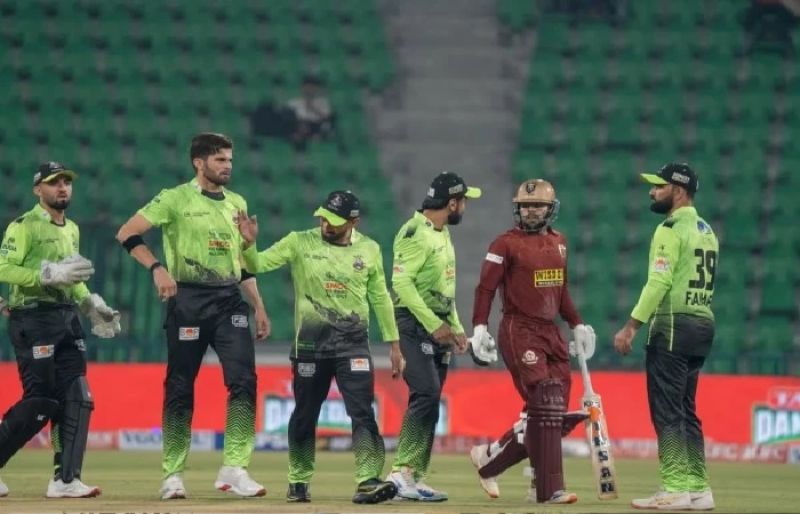
Defending champions Lahore Qalandars secured a commanding 69-run victory over Hyderabad Kingsmen in the Pakistan Super League’s (PSL) opener, powered by Fakhar Zaman’s fluent fifty and a disciplined bowling performance at Lahore’s Gaddafi Stadium on Thursday.
Set to chase a daunting 200-run target in their maiden PSL appearance, the Kingsmen’s batting unit faltered and could accumulate 130 before getting bowled out in 20 overs.
Captain Marnus Labuschagne remained the top-scorer for the Kingsmen with a cautious 26 off 22 deliveries, followed by No.9 batter Riley Meredith, who made an unbeaten 19 off 25 deliveries.
Besides them, opener Saim Ayub (17), experienced all-rounder Hammad Azam, and tailender Mohammad Ali, 10 each, were the only other batters to amass double figures.
For the Qalandars, Haris Rauf, Sikandar Raza and Ubaid Shah bagged two wickets each, while Mustafizur Rahman and captain Shaheen Shah Afridi chipped in with one scalp apiece.
Qalandars captain Shaheen Shah Afridi’s decision to bat first paid dividends as the holders racked up 199/6 in their 20 overs despite a brief top-order collapse.
The three-time champions made a flamboyant start to their innings, courtesy of an 84-run partnership between their openers, Fakhar and Mohammad Naeem.
The crucial partnership was eventually broken by Hassan Khan on the second delivery of the ninth over when he got Naeem caught at long-on by Rizwan Mehmood. The right-handed opener walked back after scoring a 19-ball 30, comprising four fours and a six.
Qalandars then lost two more wickets in the next two overs as top-order batter Abdullah Shafique (four) got run out, while Fakhar fell victim to Hassan shortly after bringing up his half-century.
The left-handed opener remained the top-scorer for the Qalandars with 53 off 39 deliveries, studded with nine fours.
Following the back-to-back setbacks, Haseebullah Khan and Parvez Hossain Emon (14) put together an anchoring 37-run partnership for the fourth wicket, which culminated with the latter’s dismissal in the 16th over.
Haseebullah was then involved in a brisk 45-run partnership with all-rounder Sikandar Raza, who played a quickfire 24-run cameo off just 10 deliveries, featuring two sixes and as many fours.
The wicketkeeper batter remained unbeaten with a 28-ball 40, while Asif Ali and captain Shaheen made handy contributions at the backend, scoring nine and 12 not out, respectively.
For the Kingsmen, Riley Meredith and Hassan picked up two wickets each, while Mohammad Ali made one scalp.
MORGAN PRICE STANDS at the kitchen table next to older sister Frankie, trailing her fingertips over the front panel of a well-worn leather vest. The faded, black material is dotted with colorful patches that offer a glimpse at the life of its owner: their father, Chris.
“I mean, shoot, this was the real him,” Morgan said after spotting a particularly playful patch, which read Bad Ass Brother. Seconds later, Frankie swallows a laugh as she finds another.
Chris Price played for the Kansas City Royals in the late 1990s. But when the sisters reach for memories of their dad, he’s often driving off on one of his custom Harley-Davidson motorcycles. Morgan remembers watching from the laundry room. Frankie is closer, in the garage.
“He would always look back and wave and have the biggest smile on his face,” she said.
But both agree the roaring rumble of the exhaust is a sound they’ll never forget. It punctuates one of the few memories the Prices have of their dad, who died after a 2009 motorcycle accident at age 36. Frankie was 6 years old, Morgan was 4, and their sister Kristin, 2.
Frankie and Morgan say it took several years before they truly understood the impact of the loss. By then, gymnastics had become the outlet through which they honored their father’s memory.
“Chris was very much behind that,” Marsha Price said of the girls’ interest in the sport, “making sure that every day it was, ‘What are you going to do to be better tomorrow?'”
The mantra is a lodestar, left by Chris for his daughters.
“My ‘why’ is representing my last name,” said Frankie, who spent the last four years overcoming injuries and honing her resilience as an Arkansas Razorback. Morgan, meanwhile, repeatedly made history in her three years with Fisk University, which launched the first HBCU gymnastics team in 2023.
But at the end of last season, the sisters came to a crossroads. With a final year of college eligibility left, they each questioned whether or where to spend it.
Individual reflection ultimately led them to the same place: Frankie and Morgan would finish their careers together in Fayetteville.
“We hold it with a lot of pride to be a Price Girl,” Morgan said.
IT’S NINE HOURS before Arkansas’ home meet against fellow SEC foe Kentucky. The Gymbacks warm up on the floor of an empty Bud Walton Arena, sliding over foam rollers as a group before breaking off to perform their own pre-meet rituals.
Frankie heads to a corner of the floor where she will later begin her routine for thousands of Arkansas faithful. For now, she only marks the moves. But her eyes hold an intensity that helps bring to mind the iconic notes of Dr. Dre’s “The Next Episode,” featuring Snoop Dogg — a song that has been part of Frankie’s floor routines her entire Razorbacks career.
“I am Frank Dogg,” she said. “Like, I got that dog in me, you know what I mean?”
Frankie Price’s @SnoopDogg floor routine never disappoints 🤩 @RazorbackGym pic.twitter.com/LEyDt00pLh
— SEC Network (@SECNetwork) January 25, 2025
Frankie verbally committed to Arkansas at age 14. She spent high school dreaming of her collegiate debut. But in 2021, just before arriving on campus, she tore her ACL. The 18-month-long recovery process meant she would have to redshirt her freshman season, putting off competition for yet another year.
When she finally entered the Razorbacks vault and floor lineups — with a brace on her right knee, worn ever since — she brought big skills, and an even bigger personality.
“Frankie has this way of just captivating fans and captivating people, even her teammates,” said head coach Jordyn Wieber, who has spent the past seven seasons building Arkansas into a top-10 program. And Frankie has helped make it happen.
In 2023, during her redshirt freshman season, Frankie became the fourth Razorbacks gymnast to tally a 9.975 on floor, good for Arkansas’ highest score since 2014. The following year, she helped Arkansas earn its first 198-plus team score in program history, as well as a spot in the NCAA championship.
Last season, the Gymbacks were in pursuit of a repeat championship appearance. They had already qualified for the regional final when Frankie took the floor in the last routine of the last rotation. But at the end of her first pass, she landed her double layout short and immediately collapsed.
“It was the worst pain I’ve ever felt in my life,” she said.
Frankie was carried off the floor, later learning she had ruptured her Achilles tendon. Two days later, she cheered from the sideline as Arkansas competed in the regional final — “for Frankie,” Wieber said after the injury. But the Razorbacks finished in the fourth spot, failing to progress to the national championship.
A few weeks later, Frankie, then a senior, found herself in Wieber’s office. “What do you think about one more year?” her coach asked.
“After my injuries that I’ve been through, I had to just kind of take a step back and focus on my ‘why,'” Frankie said. “My ‘why’ is representing my last name. And that goes back to my dad, because I know that he would want me to push through the hard times and do what I can to represent being a Price Girl.”
The answer to Wieber’s question was simple. She would return to Arkansas to spend her fifth and final season as a Gymback.
IT’S THREE HOURS before the meet begins, and the Razorbacks have returned to the arena floor.
This time, however, the subdued mood of the morning has given way to a lighter energy, as teammates pose for photos and recruit each other to record TikToks.
Amid the activity, Morgan pulls Frankie aside for pictures. For a few moments, they stand hip to hip, an arm around the other’s waist, before breaking off once again.
“If you walked in the gym, you wouldn’t be able to tell they’re sisters,” Wieber said, “because in the gym, they’re teammates.”
The separation is subtle. Yet the Price Girls know each has been destined to chart their own path.
In 2021, shortly after Frankie began her freshman year, Morgan also committed to Arkansas. She says her sister did not factor into her decision, citing instead an excitement to be part of a growing program. The following year, however, Fisk announced it was launching a gymnastics team. Morgan saw this as an even greater opportunity to contribute. She decommitted to Arkansas in favor of Fisk.
“I knew that the decision that I was making was bigger than just gymnastics,” she said.
By becoming a Bulldog, Morgan was making history. In 2024, as a sophomore, she won the all-around title at the Women’s Collegiate Gymnastics National Invitation Championship (then known as the USA Gymnastics Women’s Collegiate National Championships), an end-of-season tournament for limited-scholarship teams. And in 2025, she became the first HBCU gymnast to score a perfect 10.0, before taking home a second WCGNIC all-around title.
After climbing to such heights, she couldn’t help but hear the echoes of her father’s ethos.
“I know my dad would want me to strive to be the best,” she said. “I set and reached all my goals that I wanted to at Fisk, and so I was like, ‘You know what? For my last year, I really want to challenge myself.'”
Several weeks after Wieber asked Frankie about another season in Fayetteville, the head coach received a similar question from her sister.
Morgan says she never forgot how supportive Wieber was of her decision to attend Fisk.
“She cares about us as a person first, and then an athlete,” Morgan said. So Morgan decided to reach out and see how the Razorbacks staff would receive a second commitment. “They were just super excited, fully open arms, and so I knew it was the right decision.”
Morgan would transfer to Arkansas to spend her fourth and final season as a Gymback. In May, the sisters shared the news on social media with a photo in which they stood back-to-back, arms crossed and faces focused. It would be the first of many they’d take in matching cardinal leotards. The following month, Fisk announced it was discontinuing its gymnastics program after the 2026 season, a move that shocked members of the inaugural team.
“I think the fact that we’re able to be together, train together, live together, go through our last year of college together,” Frankie said, “is just a great chance for us to bond even more and just stay connected through life.”
IN THE MINUTES before the meet begins, many of the Gymbacks have already taken the floor, their silhouettes outlined by roving spotlights and the jumbotron’s gentle glow. The voice of the PA announcer fills the darkened arena as he begins to name Arkansas’ upperclassmen.
When Morgan, then Frankie, is introduced, they each take a turn atop the podium in the center of the floor, waving back at the swell of cheers.
“They just carry this swagger about them.” Wieber said. “When we walk into an arena with Frankie and Morgan on our team, that gives the whole program, the whole team, just an extra level of confidence.”
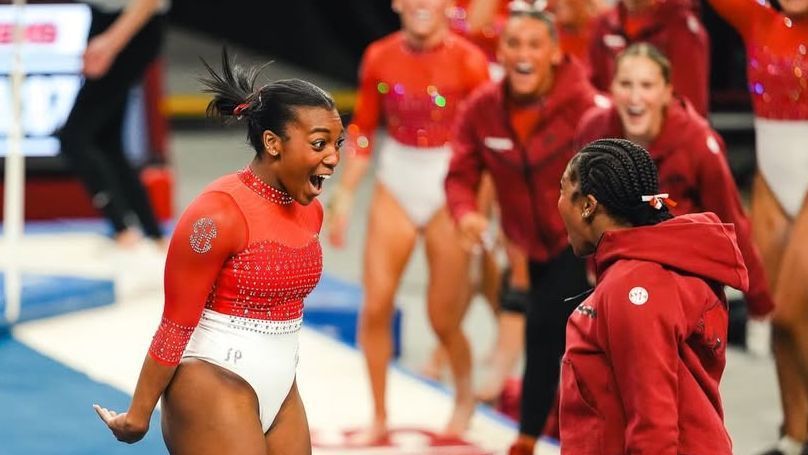
This couldn’t have been more evident in Arkansas’ performance against Kentucky. The Razorbacks began on vault, Morgan in the anchor position. With Frankie, Marsha and Kristin cheering her on, Morgan executed a flawless Yurchenko 1.5, scoring the first perfect 10.0 in Arkansas history. Seconds after the score was announced, Frankie wrapped Morgan in an embrace.
THE FIRST PERFECT 10 IN ARKANSAS HISTORY ON VAULT GOES TO MORGAN PRICE‼️🔥#NCAAGYM x 🎥 SECN+ / @RazorbackGym
— NCAA Women’s Gymnastics (@NCAA_Gymnastics) February 21, 2026
Several Gymback sticks followed on the uneven bars, balance beam and floor, where Frankie scored a 9.925, tying her season high. Morgan was the first to congratulate her, bounding onto the floor to share an enthusiastic double high-five.
Though the regular season meet ended in a tie, Arkansas finished ahead of Kentucky at the SEC championship, placing seventh. The performance helped the Razorbacks secure the No. 9 seed in the postseason, automatically qualifying them for the second round of the NCAA tournament.
The Price Girls have spent their entire gymnastics careers in pursuit of “being better tomorrow.” As they reach the close of their final collegiate season, both say they hope it culminates with Arkansas at the NCAA championship.
“The end of it all is that we’re a family,” Frankie said of the team. “No one’s doing it alone — we’re doing it together.”

Whether you are trying fantasy baseball for the first time or are an experienced vet, the 2026 ESPN fantasy baseball draft guide has everything you need to help you crush your drafts.
From rankings and mock drafts to sleepers, breakouts and who you should — or should not — draft, we’ve got you covered from every angle, all in one convenient place.
This draft guide will be updated frequently, so keep checking in for more insight, analysis, and projections.
Other resources: Sign up! | Projections | Rankings | Depth charts | Eligibility Rules
Rankings, cheat sheets, mock drafts
ESPN expert rankings: Points leagues | Head-to-head categories/rotisserie
Cheat sheet central: Printable PDFs to take to your draft
The 2026 ESPN Cheat Sheet: You’ve read their names all preseason long, it’d be a shame to forget them now
Dynasty rankings: Top 300 players for 2026 and beyond
Prospect rankings: Kiley McDaniel ranks rookies for 2026 fantasy value
“The Perfect Draft” — Our experts reveal the ideal outcome for the first two rounds of a 10-teamer from each slot’s POV
Mock draft No. 1 (ESPN points leagues)
Round-by-round picks and a roster snapshot of all 10 teams from our Feb. 10 mock
Mock draft No. 2 (ESPN category-based leagues)
Round-by-round picks and a roster snapshot of all 10 teams from our March 3 mock
Mock draft No. 3 (ESPN points leagues)
Round-by-round picks and a roster snapshot of all 10 teams from our March 16 mock
Fantasy baseball 101
A lapsed fan’s guide to fantasy baseball in 2026
Haven’t been paying attention this offseason? Eric Karabell catches you up
Nine tips to help you win your league
Tristan H. Cockcroft with strategies and angles that will make you a more competitive player
Everything you need to play, draft and run a league
Tristan H. Cockcroft lists the players he wants on as many fantasy teams as possible
Tools of the trade: How to use the ESPN fantasy app to your advantage
Tips for newcomers on how to best use the tools available in ESPN’s fantasy baseball game
Advice and expert intel
Read the warning label before drafting these guys
Who does Tristan H. Cockcroft think will underachieve in 2026? We have the names
20 must-have fantasy baseball draft picks for 2026
Tristan H. Cockcroft’s list of overlooked pitchers with the skills to shine in 2026
2026’s ‘Do Draft’ list: Go get Webb, Freeman and more
Eric Karabell wants these guys on his 2026 fantasy teams. You should too
Kings of Command: Nine fantasy breakout pitchers to draft late
Tristan H. Cockcroft’s list of overlooked pitchers with the skills to shine in 2026
Do NOT Draft: Why PCA, Seager and others could ruin your season
Eric Karabell warns you to steer clear of these players in 2026
Bold predictions for every team: American League | National League
Eric Karabell plants his flag with some bold fantasy-relevant predictions
Jeff Passan’s MLB season preview: Predictions, fantasy tips, more
From Vladdy to Arraez: 33 players who jump out for 2026
Tristan H. Cockcroft highlights the players — and stats — that have grabbed his attention
Should you avoid drafting players taking part in the WBC?
Tristan H. Cockcroft looks at the history of the WBC and how it has impacted fantasy
Don’t forget these injured players on draft day
Eric Karabell’s list of guys to keep on your radar for the last few rounds of your drafts
News or noise: What’s the fantasy baseball impact from news around MLB?
Hearing a lot of buzz, but don’t know what to make of it? Here’s where you should turn
Park factors: What is the true fantasy impact of where MLB teams call home?
Todd Zola breaks down what makes MLB stadiums favor pitching versus hitting
Fantasy baseball’s $100 man: Why you need to break the bank for Ohtani
Tristan H. Cockcroft discusses how much should you bid on fantasy’s top player
Top players to watch this spring: Acuna, Strider lead list
Eric Karabell outlines players in interesting new situations most likely to have fantasy impact in 2026
What to expect from Murakami, Okamoto, Imai and others
Todd Zola dives into the statistics to set expectations
Hot stove: fantasy impact of offseason trades and signings
Expectations for all of the players who have changed teams this winter
MLB betting info: World Series odds | AL futures | NL futures | 2026 Betting guide
Prospect watch
2026 fantasy baseball picks: MLB rookie, prospect rankings
Kiley McDaniel ranks rookie-eligible players for their potential 2026 fantasy contributions
Karabell’s top 10 prospects to consider drafting for 2026 leagues
A gaggle of shortstops leads the list of alluring fantasy newcomers
Ten names to know from the Arizona Fall League
Check out Eric Karabell’s eyewitness account of AFL action
Download the ESPN Fantasy Sports app, have every player at your fingertips.
Available on the App Store and Google Play.
Looking back on 2025
Which pitchers are MVPs, LVPs of 2025?
The best and the worst fantasy hurlers from last season
Which hitters are MVPs, LVPs of 2025?
Some of the top bats that surprised, for better or worse


How Trump’s Plot to Grab Iran’s Nuclear Fuel Would Actually Work

MLB faces a historic shift as potential lockout, media rights and other league changes loom

Tom Felton exhibits shock over fans reaction to ‘Potter’ pronunciation

-

 Fashion1 week ago
Sales at US apparel, clothing accessories stores up 4% YoY in Jan 2026
-

 Tech1 week ago
Justice Department Says Anthropic Can’t Be Trusted With Warfighting Systems
-

 Fashion1 week ago
Spain’s Inditex FY25 sales rise 3.2% to $46.28 bn amid strong demand
-

 Politics1 week ago
Iran strikes Tel Aviv with cluster-warhead missiles in retaliation of Larijani’s martyrdom
-

 Sports1 week ago
March Madness 2026 – How to watch in SA, start time, schedule, TV channel for NCAA championship basketball tournament
-

 Entertainment1 week ago
Val Kilmer revived 1 year after death through AI
-
 Entertainment1 week ago
With few new leads 45 days after Nancy Guthrie’s disappearance, investigation “becomes much harder,” expert says
-
 Business1 week ago
Brits cashing in jewellery as gold price hits record high