

Business
Gold price soars to new record as US Federal Reserve faces fresh threats

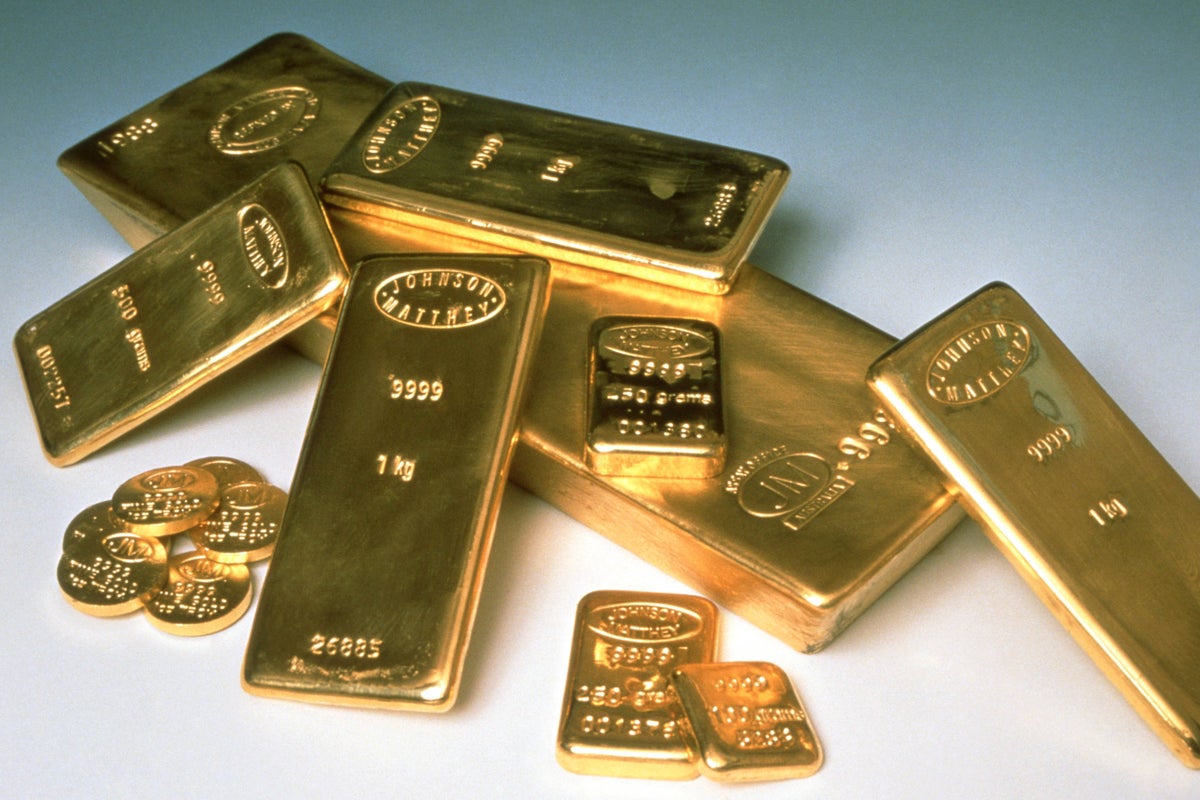
The price of gold has soared to a new record high as concerns about fresh threats to the independence of the US central bank fuel demand for the asset.
The metal climbed by around 2% on Monday morning to a high of 4,600 US dollars (£3,415) per ounce, beating a previous record set in late December.
Rising gold prices typically indicate that investors are seeking out so-called safe haven assets.
These tend to carry less risk than other investments, such as stocks and shares, and often outperform financial markets during periods of turbulence.
Gold prices have shot up by about 70% over the past year, strengthening against broader economic and political uncertainty.
The latest rush to the precious metal came after US central bank chairman Jerome Powell said it was being threatened with a criminal indictment over his testimony about renovations at Federal Reserve office buildings.
It represents a significant escalation in President Donald Trump’s criticism of the Federal Reserve and its decisions not to cut interest rates as quickly as he would prefer.
Mr Powell said in a video statement that the threat of criminal charges undermined the Fed’s role and questioned whether monetary policy will in future be “directed by political pressure or intimidation”.
The news stoked fears that threats to the independence of the central bank were becoming more severe.
While gold prices soared, the US dollar was weakening against key currencies.
The pound was up by nearly 0.5% against the US dollar on Monday morning, to 1.346.
The euro was also up by about 0.4% against the US dollar, at 1.168.
Susannah Streeter, chief investment strategist at Wealth Club, said Wall Street has been “rattled by what’s being viewed as another assault on the independence of the US Federal Reserve”.
“It certainly marks a sharp escalation in the Trump administration’s criticism of the Fed and is unnerving investors given that an independent central bank is considered to be crucial to maintaining sound monetary policy, especially at a time when the mounting US debt pile is coming under scrutiny,” she said.
Chris Beauchamp, chief market analyst at IG, said the dispute “represents a major crisis for markets and has the potential to restart worries about the dollar and US monetary policy”.
The UK’s FTSE 100 took a step back after enjoying a run in recent weeks, having hit new record highs and surpassing the milestone 10,000 mark for the first time.
It was more or less flat by mid-morning on Monday at about 10,123 points.
Barclays was among the biggest fallers on the FTSE 100 on Monday, with its share price down by about 2.5%.
The UK-listed bank has been caught up in the reaction to Mr Trump calling for a one-year cap of 10% on credit card interest rates.
The president said Americans were being “ripped off” by high interest rates on credit and they should be limited from January 20.
Russ Mould, investment director at AJ Bell, said Barclays was one of the largest issuers of credit cards in the US.
“While consumers would love to see lower rates on credit cards, Trump may not be able to enact such a move without approval from Congress,” he said.
“It also raises questions about the knock-on effect of a cap on credit and whether a drop in associated earnings for lenders could lead to reduced availability of credit in general, forcing some consumers and businesses to seek more costly alternatives.”
Business
Gudhi Padwa, Eid-Ul-Fitr And Weekend Holidays Next Week: Banks Closed On These Days Between March 16-22

Last Updated:
Banks across India will observe several public and regional holidays next week in March 2026 under the RBI holiday calendar.




Bank Holiday This Week: Full RBI Holiday List
Bank Holiday In February 2026: Banks across India will observe several public and regional holidays next week in March 2026 under the RBI holiday calendar. These holidays are not uniform nationwide and vary from state to state. That means on some dates, banks in certain states will remain closed, while in others, they will function normally.
During bank holidays, customers can continue to access services through net banking, mobile banking, UPI, and ATMs. However, cheque clearing and other over-the-counter services under the Negotiable Instruments Act will not be available.
March 17: Shab-I-Qadr
Banks will be closed in Imphal, Jammu, and Srinagar.
March 19: Gudhi Padwa / Ugadi Festival / Telugu New Year’s Day / Sajibu Nongmapanba (Cheiraoba) / 1st Navratra
Banks will be closed in Belapur, Bengaluru, Chennai, Hyderabad, Imphal, Jammu, Mumbai, Nagpur, Panaji, Srinagar, and Vijayawada.
March 20: Eid-Ul-Fitr (Ramzan) / Jumat-ul-Vida
Banks will be closed in Agartala, Ahmedabad, Aizawl, Belapur, Bengaluru, Bhopal, Bhubaneswar, Chandigarh, Dehradun, Gangtok, Guwahati, Hyderabad, Imphal, Itanagar, Jaipur, Kanpur, Kochi, Kohima, Kolkata, Lucknow, Mumbai, Nagpur, New Delhi, Panaji, Patna, Raipur, Ranchi, Shillong, Shimla, Srinagar, Thiruvananthapuram, and Vijayawada.
March 21: Ramzan-Id (Id-Ul-Fitr) (Shawal-1) / Khutub-E-Ramzan / Sarhul
Banks will be closed in Ahmedabad, Aizawl, Belapur, Bhopal, Chandigarh, Dehradun, Jaipur, Kanpur, Kolkata, Lucknow, Mumbai, Nagpur, Patna, and Ranchi.
March 22: Sunday
Bank branches across India will be closed for the weekend.
Upcoming Bank Holidays In March 2026
March 26: Shree Ram Navami
Banks will be closed in Ahmedabad, Bhopal, Bhubaneswar, Belapur, Hyderabad, Jaipur, Kanpur, Kolkata, Lucknow, Mumbai, Nagpur, Patna, Ranchi, and Shimla.
March 27: Shree Ram Navami (Chaite Dasain)
Banks will be closed in Ahmedabad, Bhopal, Dehradun, Jaipur, Kanpur, Kolkata, Lucknow, Mumbai, Nagpur, Patna, Ranchi, and Gangtok.
March 31: Mahavir Janmakalyanak / Mahavir Jayanti
Banks will be closed in Ahmedabad, Belapur, Bengaluru, Chennai, Hyderabad, Jaipur, Kanpur, Kolkata, Lucknow, Mumbai, Nagpur, New Delhi, Patna, Raipur, Ranchi, and Vijayawada.
| Holiday Description | Day |
|---|---|
| Holika Dahan | 2 |
| Holi (Second Day)/Dol Jatra/Dhulandi/Holika Dahan | 3 |
| Holi/Holi 2nd Day – Dhuleti/Yaosang 2nd Day | 4 |
| Chapchar Kut | 13 |
| Shab-I-Qadr | 17 |
| Gudhi Padwa/Ugadi Festival/Telugu New Year’s Day/Sajibu Nongmapanba (Cheiraoba)/1st Navratra | 19 |
| Eid-Ul-Fitr (Ramzan)/Jumat-ul-Vida | 20 |
| Ramzan-Id (Id-Ul-Fitr) (Shawal-1)/Khutub-E-Ramzan/Sarhul | 21 |
| Shree Ram Navami | 26 |
| Shree Ram Navami (Chaite Dasain) | 27 |
| Mahavir Janmakalyanak/Mahavir Jayanti | 31 |
March 15, 2026, 09:13 IST
Read More
Politicians are furious Churchill will be replaced on banknotes. The RSPCA wants rats and pigeons to feature.
Source link
Trump says he hopes China, France, Japan and South Korea will also send ships to defend the key oil shipping route.
Source link


St. John’s routs UConn for 2nd straight Big East tourney title

Gulf conflict could disrupt India’s trade, energy supplies: ASSOCHAM

US, China economic chiefs to meet in Paris to clear path to Trump-Xi summit

-

 Politics1 week ago
India let Iran warship dock the day US sank another off Sri Lanka, say officials
-

 Sports1 week ago
Pakistan set for FIH Pro League debut | The Express Tribune
-

 Entertainment1 week ago
Harry Styles kicks off new era with ‘One Night Only’ comeback show
-
 Business1 week ago
Restaurant group changes name after bid to buys pubs across the UK
-
 Business3 days ago
Stock market crash today (March 12, 2026): Nifty50 opens below 23,600; BSE Sensex down over 900 points on continuing US-Iran war – The Times of India
-
 Business1 week ago
Home heating oil: ‘Most of my pension has gone on home heating oil’
-

 Sports1 week ago
Winners and losers of the 2026 NHL trade deadline
-

 Entertainment1 week ago
Kanye ‘Ye’ West trips during trial: ‘Is he asleep?’