

Business
Heathrow’s plan for longer third runway chosen by government

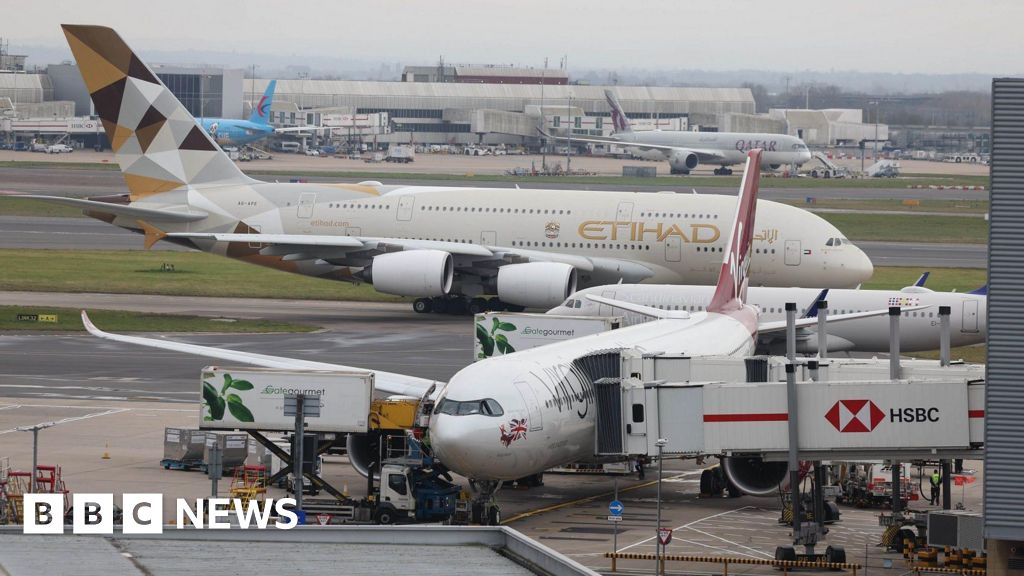
Heathrow Airport’s plan for a third runway, which involves moving the M25 motorway, has been chosen by the government.
Two plans had been under consideration – one from the airport itself, and another from Arora Group, led by hotel tycoon Surinder Arora.
Heathrow had proposed a new runway which would be up to 3.5km (2.2 miles) long and require a new road tunnel under the airport. The rival bid from Arora Group would have involved a shorter runway at a lower cost, and did not require altering the M25.
A final decision on whether a third runway will get the green light is still years away.
Last month, the government asked for further information to help choose between the Heathrow and Arora schemes.
The Department for Transport said Heathrow’s own proposal offered the most deliverable option, and the “greatest likelihood” of getting a decision on planning approval within this parliament.
The plan that has been backed will inform the government’s review of the Airports National Policy Statement.
Once that is complete, Heathrow is expected to apply for planning permission. The government then hopes for a decision by 2029.
But any company will be able to submit an application to build the new runway and terminals at the site.
Heathrow had set out its plans for expansion in the summer. The whole project, which is expected to cost £49bn, includes:
- the new runway, which Heathrow says will increase capacity to 756,000 flights and 150 million passengers a year. It currently serves about 84 million
- a new terminal called T5X, expanding Terminal 2 and three new satellite terminals. It would close Terminal 3
- enhancement of local rail connections and improvements to Heathrow’s bus and coach stations
- diversion of the M25, which would involve a new road tunnel under the airport, and widening the motorway between junctions 14-15
The Arora Group said it accepted the government’s choice, adding it welcomed the decision to leave the option open for other firms to bid for the work.
“It’s imperative there is a clear and transparent process for selecting a promoter to ensure it best serves the interests of consumers,” the group said.
Transport Secretary Heidi Alexander said Heathrow was the UK’s only hub airport that supported trade, tourism and jobs.
“Today is another important step to enable a third runway and build on these benefits, setting the direction for the remainder of our work to get the policy framework in place for airport expansion,” she said.
“This will allow a decision on a third runway plan this parliament which meets our key tests including on the environment and economic growth.”
When Heathrow had set out its plans in the summer, it said expansion was urgently needed as the airport was working at capacity, “to the detriment of trade and connectivity”.
Business groups had also backed the expansion, saying it would bring benefits for businesses and exporters, by opening up access to markets and encouraging investment.
The government has already approved a string of other airport expansion plans, including a second runway at Gatwick Airport.
However, the Heathrow plans face opposition from environmental groups, politicians, and local residents.
Tony Bosworth, climate campaigner at Friends of the Earth, said the plan would mean “more noise and air pollution for local communities”.
“Expanding Heathrow simply isn’t compatible with our legally binding climate targets, even if the government meets its hugely optimistic assumptions for emerging technologies, such as sustainable aviation fuels,” he said
Justine Bayley, who lives in Harmondsworth, says her house would be 50 paces from the boundary of the new airport, making her home effectively uninhabitable.
“Unless both Heathrow and the government say black is white, I don’t believe they can actually demonstrate that the benefits of this and the lack of pollution and greenhouse gases and all the rest of it are within acceptable limits,” she told the BBC.
The Mayor of London, Sir Sadiq Khan, said he thought the government’s backing of a new runway was a mistake.
“I want a better Heathrow, not a bigger one… I’m unclear how you get a new runway at Heathrow and it doesn’t cause environmental damage, noise pollution, air pollution being exacerbated.”
In reaching its decision, the government said that Heathrow’s runway plan was better developed and, while it required “major works” to the M25, the rival Arora scheme would also have had a “considerable impact” on the motorway.
It added that while the Heathrow proposal requires more land, it involves the acquisition of fewer houses around the airport than Arora’s plan.
The government also said the longer runway would provide “greater resilience and potential futureproofing for next-generation aircraft”.
A spokesperson for Heathrow welcomed the decision but said it needed “clarity as to how the crucial next phase of the project will be regulated”.
The airport is seeking reassurance that it will be allowed to increase its fees by enough to cover the cost of the planning application, which it says it will have to start very soon to meet the government’s timetable.
Earlier this month, the chief executive of British Airways, Sean Doyle, told industry members and MPs that Heathrow should be expanded without moving the M25.
“I think we should look at ways of potentially building a shorter runway,” he said.
Some airlines are concerned that the cost of building the third runway will make the airport more expensive for them, and ultimately for customers.

The supply chain risk designation of the artificial intelligence firm is a first for a US company.
Source link

Thomas Fuller | SOPA Images | Lightrocket | Getty Images
UniQure needs to run another study to prove that its gene therapy “actually helps people with Huntington’s disease,” a senior U.S. Food and Drug Administration official said on a call with reporters Thursday.
The official, who requested anonymity before discussing sensitive information, confirmed the agency has asked the company to run a placebo controlled trial of its treatment, which is administered directly into the brain. UniQure has said that type of study isn’t ethical because it would require putting people under general anesthesia for hours, a characterization the official disputed.
“So what is really going on? UniQure is the latest company to make a failed therapy for Huntington’s patients,” the official said. “They likely acknowledge or understand at some deep level that their trial failed years ago, and instead of doing the right thing and running the correct clinical study, UniQure is performing a distorted or manipulated comparison in the mind of FDA.”
The comments mark the latest development in a messy public spat between UniQure and the FDA, and as the agency comes under fire for a number of recent drug approval application rejections, including some where companies have accused it of going back on previous guidance. FDA Commissioner Marty Makary in an interview with CNBC’s Becky Quick last week seemingly criticized UniQure’s gene therapy for Huntington’s disease. Makary didn’t name UniQure but described its treatment.
UniQure then accused the FDA of reversing its stance that the company’s clinical trial data would be sufficient to seek approval. UniQure’s study used an outside database to measure how patients with Huntington’s disease might decline without treatment, known as an external control. UniQure has said it wouldn’t be feasible to run a true randomized, double-blind placebo-controlled study, considered the gold standard, because it wouldn’t be ethical to make people undergo a sham hours-long brain surgery.
The FDA official said the agency “never agreed to accept this distorted comparison” and the FDA “never makes such assurances.” Instead, the “FDA will always say, ‘Well, we have to see the data when we get it.'”
UniQure didn’t immediately comment.
The company’s stock rose more than 10% on Thursday and has fallen 58% this year as of Thursday afternoon.

The Oil and Gas Regulatory Authority (Ogra) on Thursday warned of strict action against any individual or entity found involved in the illegal hoarding of petroleum products at unauthorised locations, particularly at places other than duly licensed oil depots and retail outlets of Oil Marketing Companies (OMCs).
In a statement, an Ogra spokesperson said: “Any premises found involved in the illegal storage of petroleum products will be sealed.”
The spokesperson assured the public that the country currently holds sufficient stocks of petroleum products to meet national demand and that there is no need for panic buying or hoarding.
In view of the prevailing geopolitical situation, the official said that the authorities are closely monitoring the petroleum supply chain to ensure the uninterrupted availability of products across the country.
“The existing stock position remains comfortable and well within the prescribed requirements,” read the statement.
Reports have indicated that certain elements may attempt to hoard petroleum products for profiteering under such circumstances, the spokesperson said, adding: “To curb such practices, all provincial chief secretaries have been requested to direct deputy commissioners (DCs) to conduct inspections within their respective jurisdictions.”
Meanwhile, teams of Ogra are actively monitoring the situation in the field, the official added.
Inspections are being carried out at oil depots and retail outlets to ensure the smooth supply of petroleum products and to prevent any malpractice, read the statement.
Ogra advised the public not to pay attention to rumours and to maintain normal consumption patterns, as the petroleum supply situation in the country remains stable.
Uninterrupted petroleum supply top priority: FinMin
Separately, Finance Minister Muhammad Aurangzeb has said that ensuring uninterrupted availability of petroleum products across the country is the government’s top priority.
The finance czar made the remarks while chairing a meeting of the committee to Monitor Petrol Prices in the Wake of the Emerging Situation in the region, constituted by Prime Minister Shehbaz Sharif, in Islamabad today.
The committee was briefed that national reserves remain at comfortable levels, with sufficient cover available for key products, and that there is no immediate cause for concern regarding the availability of petroleum products.
It reviewed multiple supply and pricing scenarios to ensure preparedness under different contingencies and to maintain stability in domestic energy supplies.
The committee will finalise its recommendations by tomorrow for onward submission to the prime minister.
It will continue to meet on a daily basis to monitor developments, review stock positions and supply chain movements, and ensure timely execution across all stakeholders.
The committee also noted that “war premium” dynamics and intensified competition for energy cargoes, particularly in Asian markets, could raise external account pressures if volatility persists.
The body reviewed ongoing efforts to strengthen supply assurance through diversified sourcing and logistics arrangements.
The committee also considered shipping and operational measures to reduce time lags, including facilitation of timely berthing and the use of available national shipping capacity where feasible.
To safeguard orderly market conditions, the committee discussed measures to deter hoarding, illegal storage, and diversion, including coordinated enforcement actions by provincial administrations in close collaboration with the Ogra and relevant agencies.
The committee emphasised that preventing outward smuggling and ensuring uninterrupted domestic distribution will remain a top operational priority, and that real-time field intelligence and strict action against violations will be maintained.


Jayson Tatum, 10 months after Achilles injury, expected to return to Celtics Friday vs Mavericks: report

Maisie Peters surprises fans in Australia with Ed Sheeran

Trump pays tribute to Lou Holtz after legendary football coach’s death

Policy easing drives Argentina’s garment import surge in 2025

What are Iran’s ballistic missile capabilities?

India Us Trade Deal: Fresh look at India-US trade deal? May be ‘rebalanced’ if circumstances change, says Piyush Goyal – The Times of India

-
 Fashion1 week ago
Policy easing drives Argentina’s garment import surge in 2025
-
 Politics1 week ago
What are Iran’s ballistic missile capabilities?
-
Business7 days ago
India Us Trade Deal: Fresh look at India-US trade deal? May be ‘rebalanced’ if circumstances change, says Piyush Goyal – The Times of India
-
 Business1 week ago
Attock Cement’s acquisition approved | The Express Tribune
-

 Politics1 week ago
US arrests ex-Air Force pilot for ‘training’ Chinese military
-
 Business6 days ago
Greggs to reveal trading amid pressure from cost of living and weight loss drugs
-

 Sports1 week ago
Sri Lanka’s Shanaka says constant criticism has affected players’ mental health
-

 Sports6 days ago
LPGA legend shares her feelings about US women’s Olympic wins: ‘Gets me really emotional’