

Business
High-Level Panel On Banking Reforms Soon? Here’s What FM Nirmala Sitharaman Says

Last Updated:
When asked whether the panel would recommend mergers among public sector banks, the finance minister cautions against narrowing the scope of the exercise.




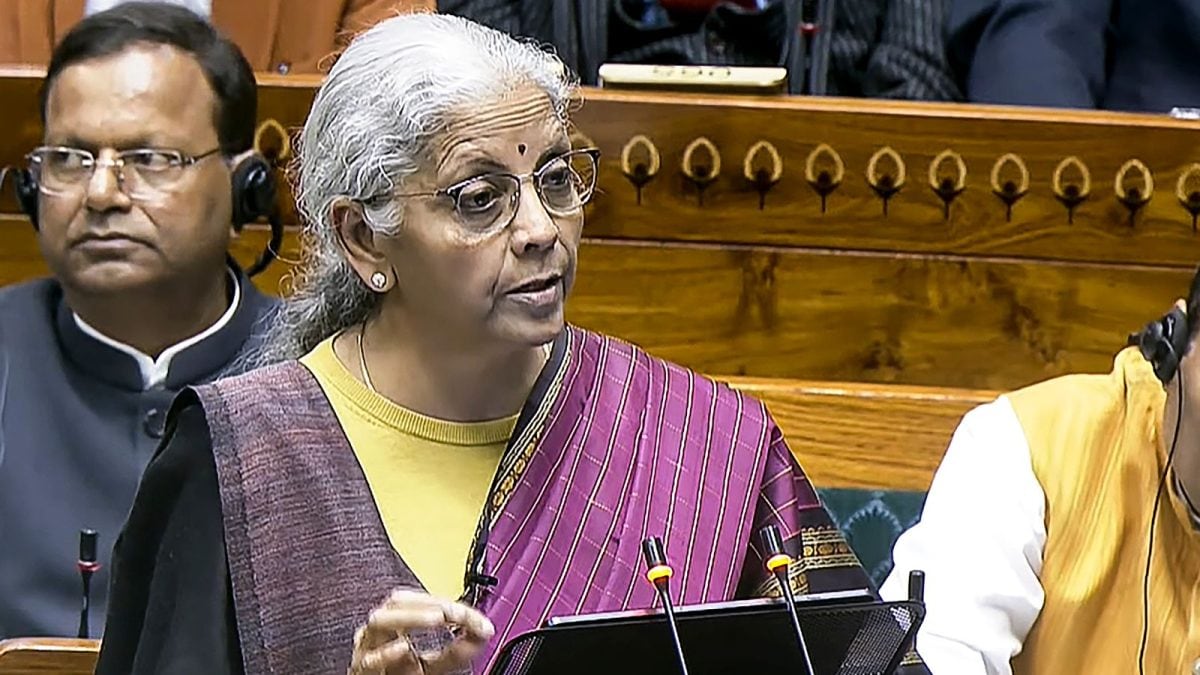
Union Finance Minister Nirmala Sitharaman presents Union Budget 2026-27. (File Photo)
The government will soon set up a high-level committee to review India’s banking sector and chart out reforms needed to create large, globally competitive lenders capable of financing a developed India, Finance Minister Nirmala Sitharaman has said.
In an interview with PTI Videos, Sitharaman said the proposed panel will focus on preparing the banking system to meet the funding needs of Viksit Bharat. “We want the committee to tell us what kind of things we need to do so that banking is made available for funding Viksit Bharat,” she said.
When asked whether the panel would recommend mergers among public sector banks, the finance minister cautioned against narrowing the scope of the exercise. “It is for India’s banking sector to be made big enough, big enough in the sense, made or primed to take care of Viksit Bharat funding. You have to reach Viksit Bharat destination…it needs money, it needs financing, it needs credit, it needs banking facility to reach the common man,” she said.
On the timeline for setting up the committee, Sitharaman said the government would move quickly. “We will do it at the earliest,” she noted.
The proposal was formally announced in the Union Budget on February 1. “I propose setting up a ‘High Level Committee on Banking for Viksit Bharat’ to comprehensively review the sector and align it with India’s next phase of growth, while safeguarding financial stability, inclusion and consumer protection,” she had said in her Budget speech.
As part of broader efforts to achieve scale and efficiency in public sector non-banking financial companies (NBFCs), the Budget also proposed restructuring of Power Finance Corporation (PFC) and Rural Electrification Corporation (REC). Responding to questions on whether a merger between the two is likely, Sitharaman said, “A lot of work has happened in the ministry concerned. They have come up with this expectation. Let’s see how they play it out.”
REC is already a subsidiary of PFC. In March 2019, PFC acquired a 52.63 per cent stake in REC from the government for about Rs 14,500 crore, gaining management control. Both entities are Navratna central public sector enterprises and play a crucial role in financing power generation, transmission and distribution projects.
Last week, the PFC board gave in-principle approval for the merger of REC with itself, following the Budget announcement. The government has positioned this move as part of a larger consolidation strategy in the financial sector, even as the proposed high-level committee prepares to take a comprehensive look at banking reforms needed for India’s next phase of growth.
 Click here to add News18 as your preferred news source on Google.
February 08, 2026, 13:04 IST
Read More
The platforms have grown in popularity, with some users making bets on global events.
Source link

TV channels for dogs are multiplying but research is mixed on whether dogs are watching.
Source link

The rise in energy prices has hit Asia particularly hard as many nations are heavily reliant on Gulf oil.
Source link


Bangladesh garment exports down, March sees steeper drop

South Korea’s apparel imports rise slightly to $1.9 bn in Jan-Feb

Khamenei says Iran does not want war but ‘criminal agressors’ won’t go unpunished

-
 Business1 week ago
Jaguar Land Rover sees sales recover after cyber attack
-
Uncategorized1 week ago
[CinePlex360] Please moderate: “Trump signals p
-

 Entertainment6 days ago
Joe Jonas shares candid glimpse into parenthood with Sophie Turner
-

 Tech6 days ago
Our Favorite iPad Is $50 Off
-

 Sports6 days ago
UConn Final Four run could trigger a $50M furniture giveaway for Massachusetts-based Jordan’s Furniture
-

 Entertainment6 days ago
Blake Lively reacts to harassment claims dismissal against Justin Baldoni
-

 Fashion1 week ago
China’s Anta Sports posts record $11.62 bn revenue in 2025
-
 Business7 days ago
Video: Why Is the Labor Market Stuck?