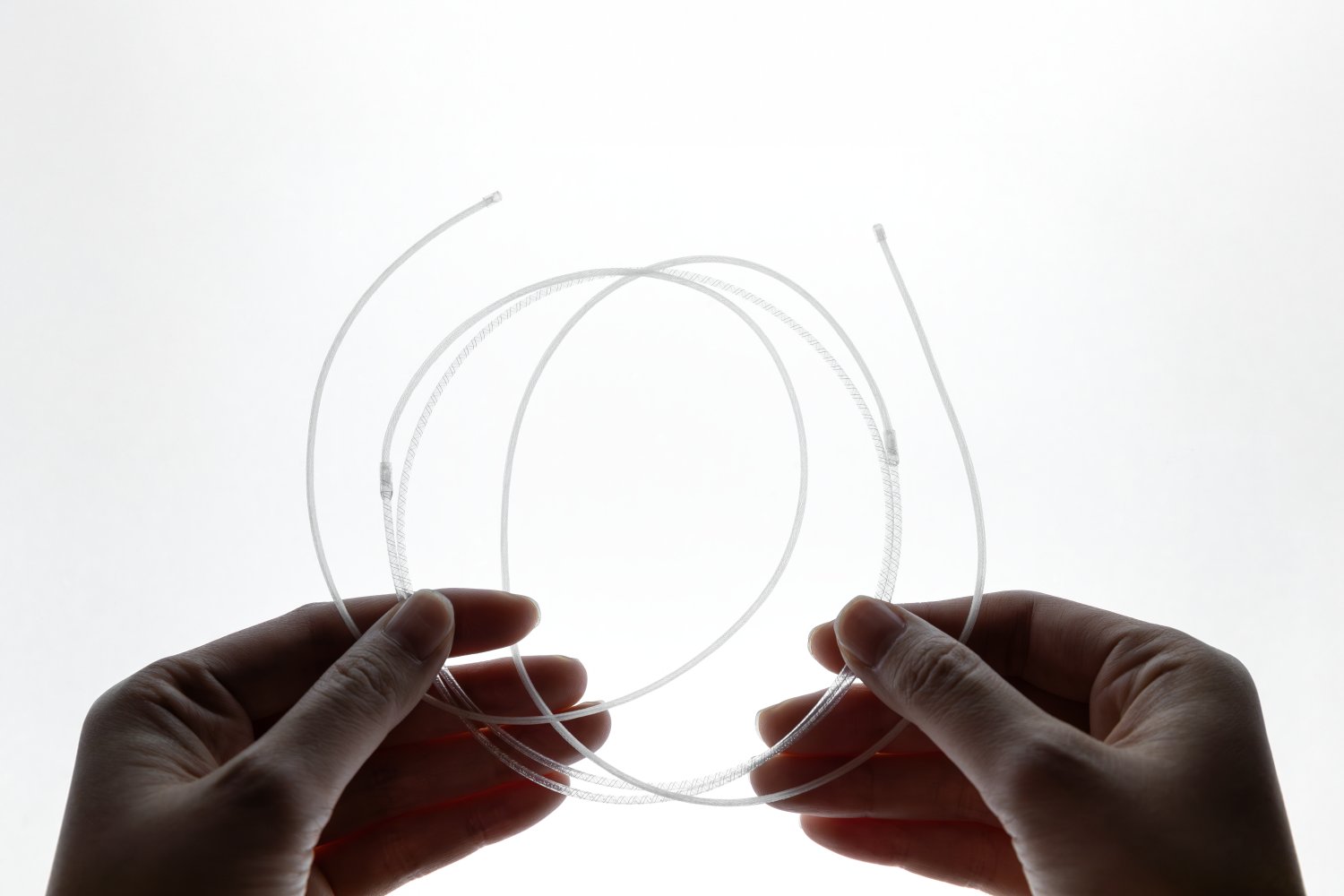
Muscles are remarkably effective systems for generating controlled force, and engineers developing hardware for robots or prosthetics have long struggled to create analogs that can approach their unique combination of strength, rapid response, scalability, and control. But now, researchers at the MIT Media Lab and Politecnico di Bari in Italy have developed artificial muscle fibers that come closer to matching many of these qualities.
Like the fibers that bundle together to form biological muscles, these fibers can be arranged in different configurations to meet the demands of a given task. Unlike conventional robotic actuation systems, they are compliant enough to interface comfortably with the human body and operate silently without motors, external pumps, or other bulky supporting hardware.
The new electrofluidic fiber muscles — electrically driven actuators built in fiber format — are described in a recent paper published in Science Robotics. The work is led by Media Lab PhD candidate Ozgun Kilic Afsar; Vito Cacucciolo, a professor at the Politecnico di Bari; and four co-authors.
The new system brings together two technologies, Afsar explains. One is a fluidically driven artificial muscle known as a thin McKibben actuator, and the other is a miniaturized solid-state pump based on electrohydrodynamics (EHD), which can generate pressure inside a sealed fluid compartment without moving parts or an external fluid supply.
Until now, most fluid-driven soft actuators have relied on external “heavy, bulky, oftentimes noisy hydraulic infrastructure,” Afsar says, “which makes them difficult to integrate into systems where mobility or compact, lightweight design is important.” This has created a fundamental bottleneck in the practical use of fluidic actuators in real-world applications.
The key to breaking through that bottleneck was the use of integrated pumps based on electrohydrodynamic principles. These millimeter-scale, electrically driven pumps generate pressure and flow by injecting charge into a dielectric fluid, creating ions that drag the fluid along with them. Weighing just a few grams each and not much thicker than a toothpick, they can be fabricated continuously and scaled easily. “We integrated these fiber pumps into a closed fluidic circuit with the thin McKibben actuators,” Afsar says, noting that this was not a simple task given the different dynamics of the two components.
A key design strategy was to pair these fibers in what are known as antagonistic configurations. Cacucciolo explains that this is where “one muscle contracts while another elongates,” as when you bend your arm and your biceps contract while your triceps stretch. In their system, a millimeter-scale fiber pump sits between two similarly scaled McKibben actuators, driving fluid into one actuator to contract it while simultaneously relaxing the other.
“This is very much reminiscent of how biological muscles are configured and organized,” Afsar says. “We didn’t choose this configuration simply for the sake of biomimicry, but because we needed a way to store the fluid within the muscle design.” The need for an external reservoir open to the atmosphere has been one of the main factors limiting the practical use of EHD pumps in robotic systems outside the lab. By pairing two McKibben fibers in line, with a fiber pump between them to form a closed circuit, the team eliminated that need entirely.
Another key finding was that the muscle fibers needed to be pre-pressurized, rather than simply filled. “There is a minimum internal system pressure that the system can tolerate,” Afsar says, “below which the pump can degrade or temporarily stop working.” This happens because of cavitation, in which vapor bubbles form when the pressure at the pump inlet drops below the vapor pressure of the liquid, eventually leading to dielectric breakdown.
To prevent cavitation, they applied a “bias” pressure from the outset so that the pressure at the fiber pump inlet never falls below the liquid’s vapor pressure. The magnitude of this bias pressure can be adjusted depending on the application. “To achieve the maximum contraction the muscle can generate, we found there is a specific bias pressure range that is optimal,” she says. “If you want to configure the system for faster response, you might increase that bias pressure, though with some reduction in maximum contraction.”
Cacucciolo adds that most of today’s robotic limbs and hands are built around electric servo motors, whose configuration differs fundamentally from that of natural muscles. Servo motors generate rotational motion on a shaft that must be converted into linear movement, whereas muscle fibers naturally contract and extend linearly, as do these electrofluidic fibers.
“Most robotic arms and humanoid robots are designed around the servo motors that drive them,” he says. “That creates integration constraints, because servo motors are hard to package densely and tend to concentrate mass near the joints they drive. By contrast, artificial muscles in fiber form can be packed tightly inside a robot or exoskeleton and distributed throughout the structure, rather than concentrated near a joint.”
These electrofluidic muscles may be especially useful for wearable applications, such as exoskeletons that help a person lift heavier loads or assistive devices that restore or augment dexterity. But the underlying principles could also apply more broadly. “Our findings extend to fluid-driven robotic systems in general,” Cacucciolo says. “Wherever fluidic actuators are used, or where engineers want to replace external pumps with internal ones, these design principles could apply across a wide range of fluid-driven robotic systems.”
This work “presents a major advancement in fiber-format soft actuation,” which “addresses several long-standing hurdles in the field, particularly regarding portability and power density,” says Herbert Shea, a professor in the Soft Transducers Laboratory at Ecole Polytechnique Federale de Lausanne in Switzerland, who was not associated with this research. “The lack of moving parts in the pump makes these muscles silent, a major advantage for prosthetic devices and assistive clothing,” he says.
Shea adds that “this high-quality and rigorous work bridges the gap between fundamental fluid dynamics and practical robotic applications. The authors provide a complete system-level solution — characterizing the individual components, developing a predictive physical model, and validating it through a range of demonstrators.”
In addition to Afsar and Cacucciolo, the team also included Gabriele Pupillo and Gennaro Vitucci at Politecnico di Bari and Wedyan Babatain and Professor Hiroshi Ishii at the MIT Media Lab. The work was supported by the European Research Council and the Media Lab’s multi-sponsored consortium.
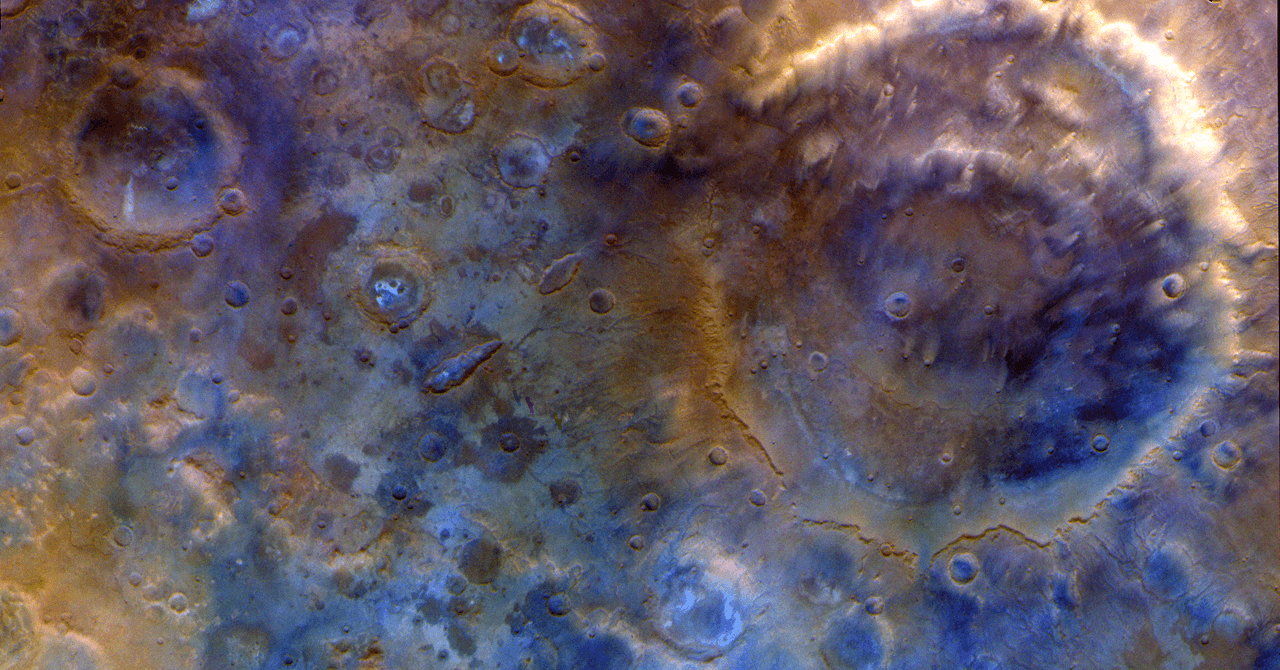
The Psyche probe, launched in October 2023 on its way to the metallic asteroid it studies, recently performed a flyby of Mars to take advantage of its gravitational pull and continue its trajectory toward the asteroid belt. During the maneuver, the spacecraft obtained new images of the red planet.
Psyche passed within 4,609 kilometers, or 2,864 miles, of the Martian surface, and was boosted to a higher velocity after completing the gravity assist. On the approach, NASA activated onboard cameras, magnetometers, and gamma ray and neutron spectrometers to calibrate each instrument using the planet’s atmosphere and terrain.
In recent images released by the space agency, the rugged Martian surface can be seen in detail, along with traces of the solar wind that, around craters and the south polar cap, is rich in water ice.
“We’ve captured thousands of images of the approach to Mars and of the planet’s surface and atmosphere at close approach. This dataset provides unique and important opportunities for us to calibrate and characterize the performance of the cameras, as well as test the early versions of our image processing tools being developed for use at the asteroid Psyche,” said Jim Bell, Psyche’s imager instrument lead at Arizona State University.
One of the first pictures taken by the Psyche mission.
Photograph: NASA/JPL-Caltech/ASU
According to the mission scientists, after its flyby of Mars, the probe reached a speed of 1,600 kilometers (or 994 miles) per hour while moving its orbit by one degree. The goal is to reach Psyche in the summer of 2029.
Close approach to the south polar cap of Mars, where it is likely that water can be extracted.
Last year, analyst Forrester reported that while IT departments manage billion-dollar portfolios, their internal operations lag in automation, coordination and visibility. The complexity of managing a modern IT architecture means network management must evolve. This is not something that is entirely new.
Automation is part of the functionality available in modern network management tools. Big data analysis of network log files is used in security information and event management (SIEM), and machine learning (ML) is helping network administrators identify potential issues before they affect the business.
Phil Huang, business development and field application manager at D-Link, explains: “We have been offering a pure cloud management platform for networks for a number of years and the AI [artificial intelligence] assistance behind such network management gives us the ability to monitor in real time and also proactively try to alert of any potential problems that may arise.”
Advances in tooling potentially reduce the complexity of network management. Matt Stava, CEO and chairman of third-party support firm Spinnaker Support, says this changes the role of IT administrators and programmers. Looking specifically at network skills, he says: “The need for a Cisco-certified expert is getting less and less right now.”
Modern networking skills
Modern IT infrastructure means that having an industry-certified network specialist is becoming less relevant. In a March 2026 blog post, Amit Katz, vice-president of ethernet switch at Nvidia, highlights the shifts occurring in network management.
In the post, Katz points out that while the value of a new network administrator may have previously been measured by their level of expertise in a particular networking command line interface (CLI), the advent of hybrid cloud and DevOps means there is a growing shift towards application programming interfaces (APIs).
“Skills in Ansible, Salt [the open source automation framework] and Python now have more value than a Cisco certification,” he says.
Now, Katz believes the tasks network administrators need to do are very different from the way they used to monitor and manage networks.
Skills in Ansible, Salt and Python now have more value than a Cisco certification Amit Katz, Nvidia
“You’ve moved from tools that polled devices across the datacentre using SNMP [Simple Network Management Protocol] and NetFlow [which monitors IP traffic] to new switch-based telemetry models where the switches proactively stream flow-based diagnostic details,” he notes in the blog post.
And according to Katz, while network administrators have a lot of experience introducing new workloads into datacentres – some of which have unique networking requirements – building an AI cluster is actually very different.
He writes: “It is tempting to think that AI is just a bigger and faster big data application. But AI is different, and AI can be hard without the right tools.”
AI also has a role to play in helping network administrators manage this complexity more easily. Information Services Group (ISG), a research and advisory firm, says organisations are taking advantage of the enhanced capabilities of AI and ML to automate configuration changes and optimisation across the network.
In an ISG article about how AI is transforming network operations, Marc Herren, a director at ISG, notes that AI can analyse network data and identify patterns to automatically generate configurations that optimise performance.
He says Cisco and Juniper Networks, the latter now being part of Hewlett Packard Enterprise, are developing intent-based networking products that use AI to understand an administrator’s intent and automatically configure the network accordingly. Such technology is essential to keep on top of ever-more-complex network management.
Network complexity
In a presentation at Microsoft Build 2025, Phil Gervasi, director of technical evangelism at Kentik, spoke about how networks are growing in complexity. They now span different clouds, datacentres, edge computing and hybrid IT infrastructure, all of which introduce new challenges for network management.
“The volume of telemetry, events and logs has exploded beyond human capacity to analyse in real time,” he told attendees. At the same time, as Gervasi noted, network teams are under pressure to improve the mean time to resolution of an issue, and maintain uptime without expanding headcount.
The volume of telemetry, events and logs has exploded beyond human capacity to analyse in real time Phil Gervasi, Kentik
“What AI offers is not magic, but a better way to correlate data, forecast performance and understand network behaviour in context. So, in short, AI helps operators move from reacting to predicting,” he added.
While ML is being used in networking for capacity planning, anomaly detection and baselining, Gervasi said that large language models (LLMs) offer a different approach to network management. “Unlike classical data models, which rely on structured data, LLMs operate on unstructured information like documentation, configuration files and tickets,” he told Build 2025 delegates. However, LLMs are probabilistic, which means they can produce inconsistent and different answers to the same prompts.
They also hallucinate. To get around these limitations, Gervasi stressed the need to ensure quality of training data, proper evaluation and controlled model behaviour. These are key to keeping LLM responses honest.
Privacy and regulation are also issues for LLMs, especially when handling network data that could contain sensitive information. Some IT operations challenges are inherent to AI use. For Gervasi, IT decision-makers need to be aware of the difficulties that may arise when integrating real-time telemetry, dealing with diverse data types, and managing compute costs for AI workloads.
But, despite these caveats, Gervasi believes the real power of LLMs lies in their ability to synthesise vast volumes of data into information that can then be used by people to make better decisions.
The starting point in using AI for network management is collecting network telemetry logs, helpdesk ticket and configuration files. Those then need to be cleaned up and stored in a format that can be accessed by the AI system.
Gervasi told delegates that one of the most effective ways to use this information is through retrieval augmented generation (RAG). As an example, he said when a user submits a query, the system converts the question into a mathematical representation, which searches a vector database for semantically related data, such as telemetry, past incidents or documentation.
“The LLM then synthesises an answer, using both its general knowledge and the retrieved context,” he explained.
Another use for LLMs is in text-to-structured query language (SQL), which, as Gervasi noted, enables network engineers to use natural language, where their queries are converted by the LLM into an SQL query and then, where relevant, provide a graphical representation of the data.
Once the data is in a format the AI model can process, agentic AI is a natural progression. “An LLM doesn’t just respond to prompts, but acts kind of like the brain, coordinating multiple tools,” he says.
During the presentation, Gervasi spoke about how with agentic AI powering network management, an agent could run a trace route, collect network telemetry, consult a knowledge base, and then generate a remediation plan, all autonomously, but with human oversight.
This is something that is likely to provide autonomous operations behind commercial network provider services. Analyst Gartner expects that AI will be embedded into managed network services (MNS) by 2028, to increase and enhance operational efficiency and enable more informed decision-making.
According to Gartner, AI will be used to ensure that networks are robust and agile enough to adapt to changing demands and traffic patterns. “Looking ahead three to five years from now, we anticipate significant transformation in MNS due to extensive use of AI and automation,” the analyst firm stated in its AI will transform managed network services in the next three years report.
For Stava and other industry watchers, the hot skill is agentic AI and the ability to integrate AI agents into workflows to achieve a business outcome. And these outcomes are increasingly IT-focused, especially as IT teams are being asked to do more with fewer resources and being put under increasing strain to support companies’ appetites for all things relating to AI.
But AI also has a big role to play in making networks more manageable. As network management becomes more automated and networks become self-healing, network engineers will need to learn how to integrate the latest tooling with agentic technology to provide the data stream for AI-powered network management.
As we get out of the house, the gear-obsessed WIRED Reviews team is writing about our favorite bags and EDCs. Today, reviewer Martin Cizmarraves about his Topo Designs backpack. You can also check out other Bag Check stories where WIRED writers share their carryall of choice.
Topo Designs may just make the best bags in the world. The Denver-based gorpcore brand sells gear that looks cool, lasts forever, and has every feature a sensible person desires in a bag without making the product feel overbuilt. If I ever win the lottery, I won’t tell anyone, but there will be signs—like me hauling groceries from Trader Joe’s in two Mountain Gear bags. (I currently use blue polypropylene Ikea bags and shop at Aldi.)
In March, I took a spring break trip to Ireland and Scotland with a carry-on-sized roller bag and the Topo Designs Rover Trail pack as my personal item. I am frequently testing new bags, and I didn’t think much about the decision to commit to the Rover for a week. I quickly learned that you get to know a bag pretty well when you take it on seven flights and stay at eight different hotels in 10 days. By the time I landed back home, I was fully convinced the Rover is the best backpack I have ever used.
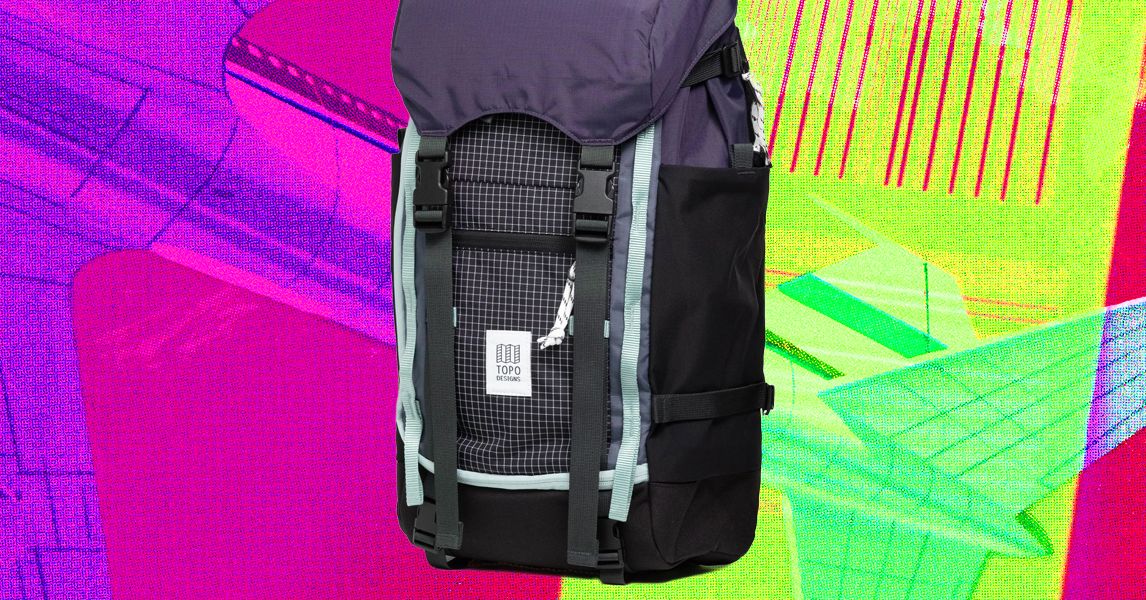
Photograph: Martin Cizmar
Topo Designs
Rover Trail Pack
Like the six or seven other models of Topo Designs bags I’ve tested—and maybe more extensively than any of the others—the Rover manages to artfully incorporate all the thoughtful little features I appreciated in other backpacks without even a hint of showiness.
At the top of the bag, there’s a zipped compartment that flips open to reveal the rucksack-style opening, which closes with a drawstring. This is where I like to put my keys, any important paperwork I may have on me, and sometimes my wallet. Typically, I find myself double- and triple-checking the zipper to make sure nothing is falling out. No need with the Rover, because inside that zipped compartment, there’s also a clip for keys and an additional zipped mesh sleeve. This feature lets you double-bag anything you don’t want to risk falling out—in my case, passports for myself and my daughter. When I got through the TSA line at the airport, I clipped in my car keys for the week, zipped the passports into the mesh sleeve, and never worried about losing either.













 Entertainment1 week ago
 Politics1 week ago
 Tech1 week ago
 Tech1 week ago
 Fashion7 days ago
 Fashion6 days ago
 Fashion5 days ago
 Entertainment1 week ago