

Politics
historic Moon mission set for lift-off



- Crew includes three Americans, one Canadian member.
- First woman, non-American, person of colour onboard.
- Mission mirrors Apollo 8’s historic 1968 lunar flyby.
WASHINGTOM: More than half a century after the groundbreaking Apollo programme’s last crewed flight to the Moon, three men and one woman are preparing for a lunar journey set to turn a new page in American space exploration.
The long-delayed Nasa mission dubbed Artemis II is slated to lift off from Florida and venture to Earth’s natural satellite as early as April 1.
They won’t land but are instead on a mission to fly by, much as Apollo 8 did in 1968.
Americans Reid Wiseman, Victor Glober, and Christina Koch — along with Canadian Jeremy Hansen — will carry out the approximately 10-day trip.
The odyssey will mark a series of firsts: the first time a woman, a person of colour, and a non-American will venture on a Moon mission.
It’s also the inaugural crewed flight of Nasa’s new lunar rocket, dubbed SLS.
The mammoth orange-and-white rocket is designed to allow the United States to repeatedly return to the Moon in years to come, with the goal of establishing a permanent base that will offer a stepping stone for further exploration.
“We’re going back to the Moon because it’s the next step in our journey to Mars,” said Wiseman, the Artemis II commander, on a Nasa podcast.
Space Race 2.0?
The Artemis program — named in honour of Apollo’s goddess twin — aims to test technologies needed to one day send humans to Mars, a far more distant journey.
That ambition presents an immense challenge, which is compounded by pressure to achieve it before China does.
China is currently aiming to land humans on the Moon by 2030.
Beijing is also targeting the lunar South Pole, not least for its rich natural resource potential.
The competition recalls the 1960s-era Space Race between the US and the Soviet Union — but Harvard professor Matthew Hersch said that rivalry was “unique” and “will not be repeated anytime soon.”
He told AFP the Chinese are “not really competing with anyone but themselves.”
Washington’s lunar program investment is significantly lower now than during the Cold War era — but the technology has changed dramatically.
“The computer technology that supports the Artemis 2 crew would be almost unimaginable to the Apollo 8 crew, which went to the Moon in a spacecraft with the electronics of a modern high-end toaster oven,” Hersch said.
And yet the Artemis 2 mission will not be without risks, even by Nasa’s own admission.
The crew will board a spacecraft that has never once carried humans or travelled to the Moon, which is more than 384,000 kilometres (238,855 miles) from Earth — or roughly 1,000 times further away than the International Space Station.
“We don’t accept anything less than perfect, otherwise we’re accepting greater risk,” Nasa’s former chief astronaut Peggy Whitson told AFP.
“That is an important process that everyone has to embrace in order for us to be really successful, because we have to live with that knowledge, because of our space flight history, that when accidents happen, people will die,” she said.
Minimising risks and preventing disaster will involve the crew performing a series of checks and manoeuvres while still in Earth’s vicinity.
If all goes well, they’ll set forth for the Moon.
Ambitious timeline
The crew’s objective will be to verify that both the rocket and the spacecraft are in working order, in the hopes of paving the way for a return and Moon landing in 2028 — the final year of President Donald Trump’s term.
That deadline has raised eyebrows among experts, in part because Washington is relying on the private sector’s technological headway.
The astronauts will require a second vehicle to descend to the moon’s surface, a lunar lander that remains under development by rival space companies owned by billionaires Elon Musk and Jeff Bezos.
The Artemis program has also been plagued by delays and massive cost overruns.
Still, Nasa hopes that Artemis 2 can succeed in recreating the rare moment of unity and hope that Apollo 8, when a crew flew by the Moon on Christmas Eve 1968, allowed for.
In the shadow of a tumultuous year, approximately one billion people worldwide tuned in to their flickering television sets to follow the monumental journey of Frank Borman, Jim Lovell, and Bill Anders.
The astronauts — who immortalised the famous “Earthrise” photograph taken from lunar orbit — were credited with having “saved 1968.”
Nearly 60 years later, the country is once again mired in deep division and uncertainty, and the crew of Artemis 2 will soon have their chance to inspire.


The Iranian foreign minister has called on the United Nations to condemn the US and the Israeli regime for waging an illegal war on the Islamic Republic and hold the regimes accountable for their crimes.
Abbas Araghchi made the remarks in a phone conversation on Thursday with UN Secretary-General Antonio Guterres as the sides discussed the latest developments and the atrocities that the invading coalition is committing against Iran.
Araghchi urged the UN to take serious action and adopt decisive and clear positions towards honoring its inherent duty to protect international peace and security by denouncing the aggressors and bringing them to account.
Referring to the brutal US-Israeli attacks on civilian sites, including schools, hospitals, cultural and historical monuments, public places and residential areas, the top Iranian diplomat reminded the UN of its responsibility to pursue the flagrant violation of the UN Charter and international law, including human rights law and international humanitarian law.
He further criticized those who are calling for Tehran to show restraint or end the war.
“The fact should not be ignored that it was the United States and the Zionist regime, which launched the military aggression against Iran and imposed the war on the region and the world, betraying diplomacy once again and endangering security and interests of all regional countries,” he said.
The criminal US-Israeli aggression on Iran began on February 28 with airstrikes that assassinated senior Iranian officials and commanders.
The Iranian armed forces have responded by launching almost daily missile and drone operations targeting locations in the Israelioccupied territories as well as US military bases and assets across the region.
They have also blocked the Strait of Hormuz to oil and gas tankers affiliated with the adversaries and those cooperating with them.
Araghchi said that insecurity in the strategic waterway, lying between the Persian Gulf and the Sea of Oman, is the direct result of the American-Zionist aggression against Iran.
“Transit prohibition for vessels belonging or linked to the enemies and their allies is the legal right of Iran as a coastal country. Related authorities of the Islamic Republic have taken necessary measures to provide maritime security and safety in the waterway.”
He also emphasized Iran’s resolve to continue the legitimate defense of its national security and sovereignty, as well as territorial integrity.
Guterres, for his part, stressed the UN’s principled position on the need for respecting countries’ national sovereignty and territorial integrity, expressing concerns about the continuation of the war and killings in the region.
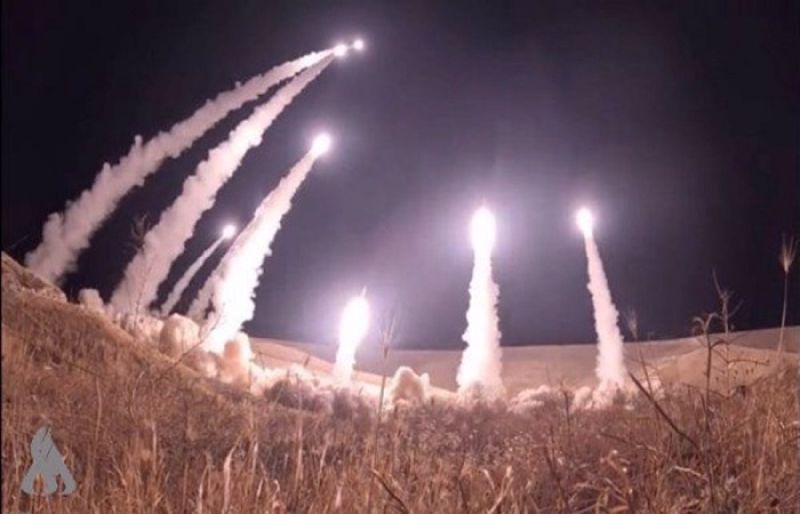

The Islamic Revolution Guards Corps (IRGC) announced the execution of wave 83 of Operation True Promise 4 in the early hours of Friday, targeting key American and Israeli military installations across the region with missiles and drones.
According to a statement from the IRGC’s Public Relations, the operation was dedicated to the “warm-hearted people of the southern strip of the country in the north of the ever-Persian Gulf” and was conducted under the blessed code “Ya Aba Abdullah Al-Hussein (AS).”
The strikes targeted a range of strategic assets belonging to American and Zionist forces.
Among the targets were storage tanks and the oil depot in Ashdod, a military personnel site in the Modi’in settlement, and a US military information exchange center in the region.
The IRGC also struck American military bases at Al-Dhafra and Al-Udeiri, along with maintenance and storage hangars for transport aircraft and drones at Ali Al-Salem Air Base.
Additional targets include fuel tanks for jets and fighter aircraft of American forces, as well as the maintenance and repair hangar for the Patriot missile system at Sheikh Isa Base.
The IRGC statement noted that the operation employed a combination of advanced weaponry, including long-range and medium-range systems, solid and liquid fuel missiles, precision-strike and multi-warhead capabilities, as well as suicide and loitering drones.
It further emphasized that the retaliatory attacks were carried out with “full success by the grace of God.”
In its statement, the IRGC highlighted the impact of ongoing operations on daily life for Israeli settlers, noting that “siren-to-siren living and prolonged confinement in shelters have become a daily routine for the Zionists.”
The IRGC concluded with a stark warning: “As we said, we will find you, and with God’s will, we will make you pay for your despicable deeds.”
Iranian armed forces have so far carried out 83 waves of missile and drone strikes with advanced weaponry targeting Israeli military facilities in the occupied territories, as well as US occupation bases and assets scattered across the West Asia region.
The retaliatory operations were launched immediately after the US-Israeli coalition carried out an unprovoked act of aggression against the Islamic Republic of Iran on February 28, leading to the martyrdom of the Leader of the Islamic Revolution, Ayatollah Seyyed Ali Khamenei, some top-ranking military commanders, and over 170 schoolchildren in Minab.
The Lebanese Hezbollah resistance movement and the Islamic Resistance in Iraq have also joined the front against the external aggressors, inflicting heavy blows on the enemy.
The retaliatory operations by the Iranian armed forces, as well as the resistance groups, have inflicted heavy blows on the enemy, decimating its military and strategic infrastructure.
Brigadier General Abolfazl Shekarchi, the spokesperson for the armed forces, in remarks on Thursday, said that US personnel are now forced to abandon military bases and take refuge in civilian hotels, a move that he condemned as an attempt by the US to use civilian structures for military cover.
“The Americans, who once relied on their military bases to establish a presence, are now hiding in hotels and relying on the civilian areas of our region as a protective shield,” Shekarchi said.
“This marks a humiliating retreat and an admission of their inability to defend themselves.”
The Iranian Army also continues to inflict severe blows on the enemy. It targeted sensitive locations in the strategic Haifa port on Thursday with a barrage of drones.
“The center for manufacturing and maintenance of various military vessels of the Zionist regime in the eastern Mediterranean Sea that played a key and sensitive role in logistics for the regime’s Navy as well as the huge fuel storage facilities for warplanes in Haifa port were, among others, targeted in the recent drone attack by the Islamic Republic’s Armed forces,” it said in a statement.


VIENNA: A headscarf ban for girls under 14 in Austrian schools has stirred unease, anger and fears of further targeting of Muslims in the EU member state.
Austrian lawmakers in December approved the measure, which is set to take effect from the new school year in September.
With anti-immigration sentiment running high, the conservative-led government argues the law is aimed at protecting girls from “oppression”.
But rights groups and experts say it is discriminatory, risks deepening social division and is likely unconstitutional.
“It’s my decision… No one can force me to wear a headscarf, and no one can force me to take it off,” a 12-year-old student told AFP at a protest against the ban in Vienna last month, declining to give her name.
‘Legal consequences’
The government estimates around 12,000 girls would be affected by the new law, but this projection has been questioned as too high.

Roughly 8% of Austria’s nine million residents are Muslim, according to 2021 government statistics.
The education ministry sent out information to all schools several weeks ago on how to enforce the new law.
It contains illustrations of different Islamic head coverings.
“Every teacher who observes a violation must instruct the student to remove her headscarf. If she does not immediately comply, the teacher must report the violation to the school administration without delay,” the instructions state.
“The school administration must immediately hold a meeting with the student and her legal guardians.”
For repeated non-compliance, parents can face fines ranging from 150 to 800 euros ($175 to $930).
Failure to report those in violation of the law could also have “legal consequences” for teachers and school managements, the instructions warn.
One Vienna schoolteacher, who spoke on condition of anonymity, told AFP she was not planning to enforce the law.
“It’s a populist measure” that fails to address “the real problem when parents of any religion use violence or psychological violence against children,” she said.
‘Deeply rooted racism’
Last month, hundreds gathered at a central Vienna square to protest the ban before marching to the chancellery.

Malika Mataeva, co-founder of the Muslim Women Network, decried “years of systematic, deeply rooted racism in Austria.”
“It’s simply another step that makes us say, ‘Enough is enough,'” she told AFP, adding “guaranteed freedoms” were not being respected.
Austria has long drawn immigrants, as well as asylum seekers fleeing conflict. But anti-immigration sentiment is strong.
In the 2024 elections, the far-right Freedom Party won for the first time even though it failed to form a government.
Muslims in Austria suffered the highest rates of racism and discrimination in the EU, according to a 2024 report by Europe’s FRA rights agency.
Past ban struck down
The IGGOe, the body which officially represents the country’s Muslim communities, is set to challenge the ban in court.

Austria introduced a similar ban on headscarves in primary schools in 2019, but the constitutional court struck it down.
“It is clear that we consider this law… to be unconstitutional in Austria, given its focus on a specific religious item of clothing,” the Ombud for Equal Treatment told AFP.
At the Vienna protest, an 11-year-old, who only gave her name as Hadiya, said she is the only student in her class of 27 who wears a headscarf.
“I’m angry…. I find it (the ban) is without reason,” she said.
A mother of two girls, aged 11 and 13, also said the ban has weighed heavily on her family, with her daughters not wanting to take off their headscarves.
“It’s supposed to be for their protection, but they’ve been suffering for months now and are worried about what to do,” she told AFP at the protest.


NCAA men’s tournament: Rick Pitino’s case for best men’s college basketball coach ever

Gold price today (March 25, 2026): How much 24K and 22K gold cost in Delhi, Mumbai & more- Check rates – The Times of India

JustEat and Autotrader among firms investigated in fake reviews probe

-

 Entertainment1 week ago
Val Kilmer revived 1 year after death through AI
-

 Fashion1 week ago
US’ G-III Apparel’s FY26 sales fall 7% to $2.96 bn
-

 Sports1 week ago
March Madness 2026 – How to watch in SA, start time, schedule, TV channel for NCAA championship basketball tournament
-
 Business1 week ago
Brits cashing in jewellery as gold price hits record high
-

 Fashion6 days ago
China’s textile & apparel exports surge 17% to $50 bn in Jan-Feb 2026
-
 Business1 week ago
Video: The Effects of High Oil Prices
-
 Business6 days ago
Flipkart group CFO to leave co amid IPO plans – The Times of India
-
Tech1 week ago
The Corsair 4000D RS PC Case Keeps Your System Cool