

Fashion
Humility, La Fée Maraboutée’s sister brand, opens its first Paris boutique in Le Marais

Published
December 22, 2025
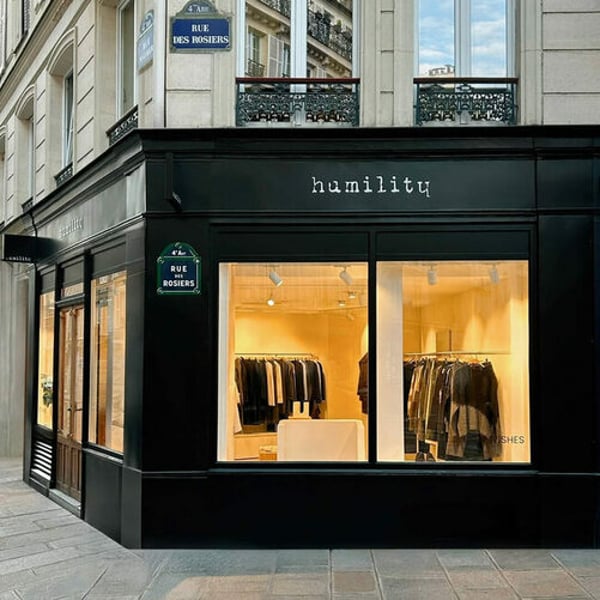
Ten years after its launch, Humility has opened its first Parisian boutique. A sister label to La Fée Maraboutée, the discreetly chic womenswear brand is growing at its own pace. It has just opened the doors of its first Parisian boutique in the Marais, at 11 rue Malher, on the corner of rue des Rosiers.
The brand has taken over the space of multibrand retailer Camélia and now enjoys strong visibility in this highly competitive part of central Paris, attracting both French and international customers. It sits within a nearby retail mix that includes Free People, Cotélac, Balzac, Desigual and Cos.
Launched by La Fée Maraboutée founders Jean-Pierre Braillard and Virginie Mangano, Humility distils pared-back womenswear with understated elegance. Established in 2016 with a proposition radically different from the Roanne-based group’s flagship brand, the label swaps bohemian prints for a more architectural, almost monastic, aesthetic.
The current wardrobe champions ‘effortless’ elegance: oversize cuts, structured lines and a discreet colour palette (black, anthracite, chalk, khaki). Key pieces include the precisely cut Riu trousers, apron dresses with a workwear accent and, true to the group’s DNA, knitwear crafted in bouclé or textured wool blends. Pricing, slightly higher than at La Fée Maraboutée, ranges from 140 to 270 euros, with production predominantly in Europe, particularly Italy.
In terms of distribution, Humility remains selective, relying on a network of around 110 specialist multi-brand retailers, such as Solana in Paris and Lilyaké in Bordeaux. The brand is present through this channel in key European markets: the UK, Germany, Italy, Spain, and the Benelux region.

In recent years, the group has also been developing direct sales, both online and in-store. It is testing its mono-brand concept with a pilot location opened in 2023 in its home region, Lyon, at 24 Grande Rue de la Croix-Rousse, a laboratory that has helped refine the customer experience by adopting a concept-store approach and incorporating jewellery and home décor brands. Today, the brand is strengthening its visibility in department stores with around a dozen strategic corners, notably at Printemps Nation in Paris as well as at Galeries Lafayette in Reims and Tours.
The brand is also active internationally, having presented in Taiwan this summer, during the Mode in France event, its spring-summer 2026 collection inspired by the work of Japanese architect Tadao Ando. This collection will, of course, be showcased in its new Paris boutique.
The French group headed by Gaëlle Lelong does not disclose the brand’s financial performance. In 2024, despite a downturn in business, the parent company, La Fée, posted sales of over 37 million euros and remained profitable.
This article is an automatic translation.
Click here to read the original article.
Copyright © 2025 FashionNetwork.com All rights reserved.












Kenneth Straka, Senior Product Development Manager at Deckers Outdoor Corporation, said that Deckers places strong emphasis on sustainability, noting that founder John Luke often reminded the team that the French word for sustainability is durability. This idea aligned with discussions at the Global Fashion Summit, where the theme centred on “Building Resilient Futures” in the sustainable and circular economy.
Durability has helped UGG become one of the most sought-after boot brands and a key sales driver for Deckers, alongside its sportswear brand Hoka. “One of the things we think about in terms of circularity is making products that last a long time and remain with consumers throughout their lives. We want products that consumers can wear for ** or ** years,” Straka said in an interview with Fibre*Fashion on the sidelines of the Global Fashion Summit in Copenhagen.

In the Tiruppur market, cotton yarn prices increased by ****;*–* per kg in this week despite sluggish local demand. Prices were quoted higher because of limited supply from spinning mills. A trader from the Tiruppur market told Fibre*Fashion, “Domestic demand remained limited, but spinning mills are not relying solely on the domestic market for cotton yarn sales. They are focusing more on exports, where demand and prices remain attractive. Mills have raised yarn prices following higher ICE cotton prices and the CCI’s increase in auction base prices, although ICE cotton has witnessed a sharp decline over the past two days.”
In Tiruppur, knitting cotton yarn prices were noted as: ** count combed cotton yarn at ****;***–*** (~$*.**–*.**) per kg (excluding GST), ** count combed cotton yarn at ****;***–*** (~$*.**–*.**) per kg, ** count combed cotton yarn at ****;***–*** (~$*.**–*.**) per kg, ** count carded cotton yarn at ****;***–*** (~$*.**–*.**) per kg, ** count carded cotton yarn at ****;***–*** (~$*.**–*.**) per kg, and ** count carded cotton yarn at ****;***–*** (~$*.**–*.**) per kg.
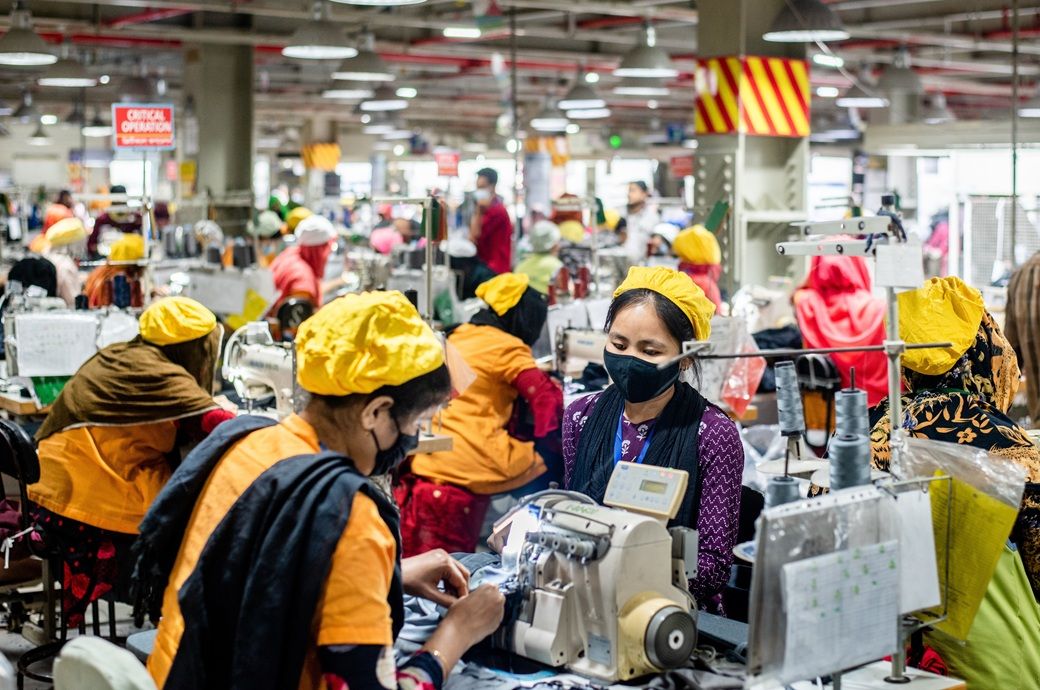
BGMEA president Mahmud Hasan Khan said they discussed export diversification within the garment sector, reopening of closed factories and many factories’ struggle for survival.
Representatives of two top Bangladesh garment trade bodies recently met PM Tarique Rahman and urged him to ensure uninterrupted power and energy supply, quick release of export receipts from banks, reopening of closed factories and easing of customs regulations.
BKMEA raised concerns about misuse of the bond facility and urged action against violators of bond licences.
104 factories have informed the BGMEA about their closure till now, Khan said. BGMEA will scrutinise these cases to identify the genuine reasons for the closures.
Following the scrutiny, the association will send recommendations for reopening these factories, as the government is working to open a Tk 200-billion fund to assist their revival.
BKMEA president Mohammad Hatem said some 400 factories closed in the last three years—nearly 300 of them due to non-cooperation from banks. He said banks release export receipts to exporters’ lien accounts, but delays in payment often force loans into default, leaving exporters unable to pay suppliers on time.
He also demanded uninterrupted supply of power and gas to industrial units as recent shortages of fuel oil have severely affected productivity, according to domestic media ooutlets.
Hatem raised concerns about misuse of the bond facility and urged action against violators of bond licences.
He also called for easing the rules of the National Board of Revenue, particularly customs procedures, to smoothen export and import processes and reduce lead times.
Fibre2Fashion News Desk (DS)


Military jets’ crew members safely eject after Idaho air-show collision

Pete Davidson’s friends support comic against ex Elsie Hewitt allegations

Indy 500: Counting Down The 10 Best Finishes In Race History

-

 Entertainment5 days ago
Conan O’Brien hat tricks as Oscar host
-

 Tech1 week ago
Could Contact-Tracing Apps Help With the Hantavirus? Not Really
-

 Tech1 week ago
I Tried the Best Captioning Smart Glasses, and Only One Leads the Pack
-
 Fashion5 days ago
Italy’s Zegna Group’s Q1 growth boosted by strong organic performance
-

 Sports1 week ago
Bobby Cox, legendary Atlanta Braves manager who led 1995 World Series champions, dead at 84
-

 Entertainment1 week ago
Martin Short: Facing tragedy with joy
-

 Entertainment1 week ago
Tom Brady gets back at Kevin Hart during Netflix roast
-

 Entertainment1 week ago
Martha Stewart: How to make an omelet