

Business
India-EU FTA: Will Turkish goods enter India under the newly signed trade deal? – The Times of India

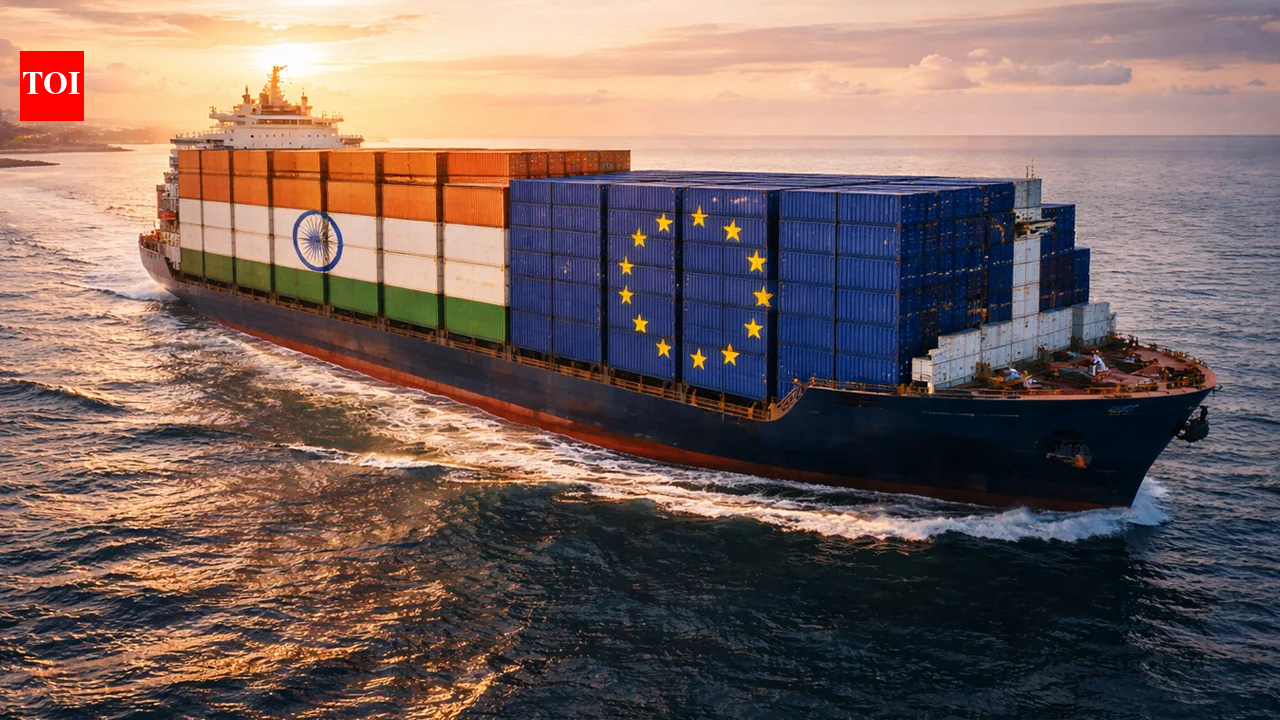
India and the EU recently announced the conclusion of what has been touted as the “mother of all deals”, but a key question remains: will Turkey be able to reroute its goods to India under the agreement? Officials have clarified that while Indian products can move into Turkiye through Europe, Turkish goods cannot enter India under FTA terms, even if shipped via EU ports. “Our goods go into the EU, and then they can go to any country with which the EU has a customs union, but Turkiye will not get the benefit because it is not part of the EU as a territory in the FTA. So, Turkiye cannot export to India and benefit from concessions,” said one official, who did not wish to be identified.Under the EU–Turkiye Customs Union, Ankara is required to align with the EU’s common external tariff, meaning that when the EU reduces duties for an FTA partner such as India, Turkiye must extend the same tariff benefit to Indian goods.This is because of Turkiye’s position in the union arrangement with the EU, which has been in force since 1996. The arrangement allows industrial goods and processed agricultural products to move freely between the EU and Turkiye without tariffs or quotas, while requiring Turkiye to apply the EU’s common external tariff on imports from third countries. The customs union, however, does not extend to primary agriculture, services, investment, government procurement or digital trade. India and the EU announced the conclusion of negotiations for the FTA on Tuesday, with the agreement expected to be signed and implemented within the year. Under the deal, preferential market access will be provided on 96.8% of tariff lines, covering 99.5% of India’s exports by volume and 90.7% by value to the EU, which will become duty-free. Officials explained that although Turkiye must mirror EU tariff reductions for FTA partners such as India, it does not gain reciprocal access because it is not a signatory to the India-EU agreement. “Turkish goods, however, cannot use the India-EU FTA to enter India duty-free, even if they are shipped via EU ports. They remain Turkish in origin and therefore do not meet the rules of origin under India’s FTA, which is signed with the EU and not with Turkiye,” said Ajay Srivastava, cofounder, Global Trade Research Initiative, as cited by ET. The clarification comes amid strained relations between New Delhi and Ankara following Turkiye’s backing of Islamabad and its condemnation of India’s strikes on terror camps in Pakistan in May under Operation Sindoor. Trade figures show that India’s exports to Turkiye declined by 14.1% to $5.71 billion in 2024–25 from $6.65 billion in the previous financial year, while imports from Turkiye fell 20.8% to around $3 billion. Turkiye accounts for about 1.3% of India’s total exports of $437 billion in 2023–24. India’s exports to Turkiye include mineral fuels and oil, electrical machinery and equipment, automobiles and parts, organic chemicals, pharmaceutical products, tanning and dyeing items, plastics and rubber, cotton, man-made fibres and filaments, and iron and steel. Imports from Turkiye comprise marble blocks and slabs, fresh apples, gold, vegetables, lime and cement, mineral oil, chemicals, natural or cultured pearls, and iron and steel.


Business
Education Budget 2026 Live Updates: What Will The Education Sector Get From FM Nirmala Sitharaman?

Union Education Budget 2026 Live Updates: Union Finance Minister Nirmala Sitharaman will present the Union Budget 2026–27 on February 1, with a strong focus expected on the Education Budget 2026, a key area of interest for students, teachers, and institutions across the country.
In the previous budget, the Bharatiya Janata Party government announced plans to add 75,000 medical seats over five years and strengthen infrastructure at IITs established after 2014. For 2025, the Centre had earmarked Rs 1,28,650.05 crore for education, a 6.65 percent rise compared to the previous year.
Meanwhile, the Economic Survey 2025–26, tabled in the Parliament of India, points to persistent challenges in school education. While enrolment at the school level is close to universal, this has not translated into consistent learning outcomes, especially beyond elementary classes. The net enrolment rate drops sharply at the secondary level, standing at just over 52 per cent.
The survey also flags concerns over student retention after Class 8, particularly in rural areas. It notes an uneven spread of schools, with a majority offering only foundational and preparatory education, while far fewer institutions provide secondary-level schooling. This gap, the survey suggests, is a key reason behind low enrolment in higher classes.
Stay tuned to this LIVE blog for all the latest updates on the Education Budget 2026 LIVE.

The Oil and Gas Regulatory Authority (Ogra) has increased the price of liquefied petroleum gas (LPG). According to a notification, the price of LPG has risen by Rs6.37 per kilogram. Following the increase, the price of a domestic LPG cylinder has gone up by Rs75.21. The revised prices have come into effect immediately.
The rise in LPG prices has added to the inflationary burden on household consumers.
Business
Budget 2026: Fiscal deficit, capex, borrowing and debt roadmap among key numbers to track – The Times of India
Finance Minister Nirmala Sitharaman is set to present her record ninth straight Union Budget, with markets closely tracking headline numbers ranging from the fiscal deficit and capital expenditure to borrowing and tax revenue projections, as India charts its course as the world’s fastest-growing major economy.The Budget will be presented in a paperless format, continuing the practice of recent years. Sitharaman had, in her maiden Budget in 2019, replaced the traditional leather briefcase with a red cloth–wrapped bahi-khata, marking a symbolic shift in presentation.Here are the key numbers and signals that investors, economists and policymakers will be watching in the Union Budget for 2025-26 and beyond:
Fiscal deficit
The fiscal deficit for the current financial year (FY26) is budgeted at 4.4 per cent of GDP, as reported PTI. With the government having achieved its consolidation goal of keeping the deficit below 4.5 per cent, attention will turn to guidance for FY27. Markets expect the government to indicate a deficit closer to 4 per cent of GDP next year, alongside clarity on the medium-term debt reduction path.
Capital expenditure
Capital spending remains a central pillar of the government’s growth strategy. Capex for FY26 is pegged at Rs 11.2 lakh crore. In the upcoming Budget, the government is expected to continue prioritising infrastructure outlays, with a possible 10–15 per cent increase that could take capex beyond Rs 12 lakh crore, especially as private investment sentiment remains cautious.
Debt roadmap
In her previous Budget speech, the finance minister had said fiscal policy from 2026-27 onwards would aim to keep central government debt on a declining trajectory as a share of GDP. Markets will look for a clearer timeline on when general government debt-to-GDP could move towards the 60 per cent target. General government debt stood at about 85 per cent of GDP in 2024, including central government debt of around 57 per cent.
Borrowing programme
Gross market borrowing for FY26 is estimated at Rs 14.80 lakh crore. The borrowing number announced in the Budget will be closely scrutinised, as it signals the government’s funding needs, fiscal discipline and potential impact on bond yields.
Tax revenue
Gross tax revenue for 2025-26 has been estimated at Rs 42.70 lakh crore, implying an 11 per cent growth over FY25. This includes Rs 25.20 lakh crore from direct taxes—personal income tax and corporate tax—and Rs 17.5 lakh crore from indirect taxes such as customs, excise duty and GST.
GST collections
Goods and Services Tax collections for FY26 are projected to rise 11 per cent to Rs 11.78 lakh crore. Projections for FY27 will be keenly watched, especially as GST revenue growth is expected to gather pace following rate rationalisation measures implemented since September 2025.
Nominal GDP growth
Nominal GDP growth for FY26 was initially estimated at 10.1 per cent but has since been revised down to about 8 per cent due to lower-than-expected inflation, even as real GDP growth is pegged at 7.4 per cent by the National Statistics Office. The FY27 nominal GDP assumption—likely in the 10.5–11 per cent range—will offer clues on the government’s inflation and growth outlook.
Spending priorities
Beyond the headline aggregates, the Budget will also be scanned for allocations to key social and development schemes, as well as spending on priority sectors such as health and education.Together, these numbers will shape expectations on fiscal discipline, growth momentum and policy support as India navigates a complex global economic environment.

Education Budget 2026 Live Updates: What Will The Education Sector Get From FM Nirmala Sitharaman?

Currency shift drives Australian wool fall despite firm exports

Historic recording by “Sly and the Family Stone” released after gathering dust: “Sheer magic”

-
 Business1 week ago
Success Story: This IITian Failed 17 Times Before Building A ₹40,000 Crore Giant
-
 Business1 week ago
Silver ETFs Jump Up To 10%, Gold ETFs Gain Over 3% On Record Bullion Prices
-

 Tech1 week ago
Ruckus gears up for networking partnership with TGR Haas F1 Team | Computer Weekly
-

 Fashion1 week ago
South Korea tilts sourcing towards China as apparel imports shift
-

 Sports1 week ago
Transfer rumors, news: Saudi league eyes Salah, Vinícius Jr. plus 50 more
-

 Entertainment1 week ago
Trump touts ‘total access’ Greenland deal as Nato asks allies to step up
-

 Entertainment1 week ago
TikTok seals deal for new US joint venture to avoid American ban
-

 Sports5 days ago
PSL 11: Local players’ category renewals unveiled ahead of auction