

Business
Indian Economy Remains Sound Amid Persistent Global Challenges: RBI


New Delhi: India’s economy continues to grow strongly on the back of robust domestic demand, despite persistent global challenges, according to the Financial Stability Report (FSR) of the Reserve Bank of India (RBI). The Financial Stability Report (FSR) is a half yearly publication that includes contributions from all financial sector regulators. It presents the collective assessment of the Sub Committee of the Financial Stability and Development Council on current and emerging risks to the stability of the Indian financial system.
Benign inflation in India, fiscal consolidation, and prudent macroeconomic policies have enhanced economic resilience, the RBI report noted on Wednesday. The domestic financial system remains sound, supported by strong balance sheets, easy financial conditions, and low market volatility, it supplemented, the report said.
The economy and the financial system, however, faces near-term risks from external uncertainties – geopolitical and trade related, it, however, cautioned. “These factors could increase exchange rate volatility, dampen trade, reduce corporate earnings, and lower foreign investment,” it noted.
A sharp correction in US equities could influence domestic equities and tighten financial conditions. However, the economy and financial system have strong buffers to withstand adverse shocks. Globally, growth has proven more resilient than expected despite trade tensions, geopolitical risks, and uncertainty around economic policy, supported by front-loaded trade, fiscal measures, and strong AI-related investment.
Nonetheless, risks to the outlook remain skewed to the downside due to still elevated uncertainty, high public debt, and the risk of a disorderly market correction, the RBI report said. “Financial markets appear strong on the surface but show growing underlying vulnerabilities. Sharp rise in equities and other risk assets, high hedge funds’ leverage, expanding opaque private credit markets and growth of stablecoins all heighten global financial system fragilities,” it added.
Ample liquidity is supporting risk-on sentiment across asset classes, but a sharp correction – especially if AI optimism fades – could spill over to the broader financial system, given rising interconnectedness, the RBI report said, delving into global macrofinancial risks.





Business
US stock market today (April 10, 2026): S&P 500, Nasdaq rise on tech gains after inflation data – The Times of India
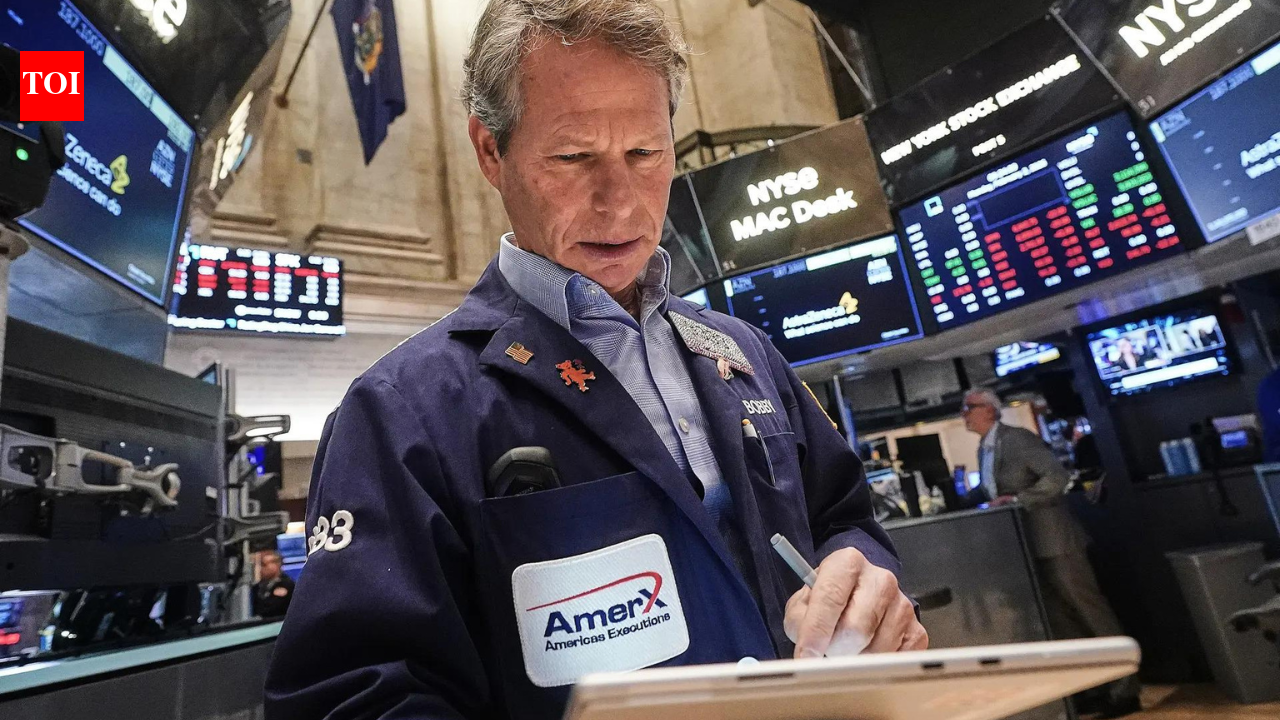
US equity benchmarks traded mixed on Friday, with the S&P 500 and Nasdaq moving higher on strength in technology stocks after March inflation data came in line with expectations, while investors kept a close watch on geopolitical tensions in the Middle East.US consumer prices rose the most in nearly four years in March, driven by higher oil prices linked to the Iran conflict and continued tariff pass-through. Despite this, traders maintained expectations that the US Federal Reserve will hold borrowing costs steady this year, scaling back earlier bets of two rate cuts prior to the conflict, according to Reuters.“When paired with Thursday’s PCE data, the message is clear: inflation remains sticky – and that optimistically assumes the energy surge proves to be a temporary headwind rather than a lasting recalibration,” said Bret Kenwell, US investment analyst at eToro. “It should keep policymakers on pause, unless we see a more notable deterioration in the labor market or the broader economy.”San Francisco Fed President Mary Daly told Reuters on Thursday the oil shock from the Iran war would extend the timeline on bringing inflation back to the US central bank’s 2% target.At 10:15 a.m. ET, the Dow Jones Industrial Average was down 109.60 points, or 0.23%, at 48,076.20, while the S&P 500 gained 10.56 points, or 0.15%, to 6,835.22, and the Nasdaq Composite rose 123.70 points, or 0.54%, to 22,946.11.Gains were led by technology stocks, with the S&P 500 information technology index advancing 0.8%, supported by chipmakers. Nvidia rose 1.8% and Broadcom climbed 4.4%, while the Philadelphia Semiconductor index touched a record high of 8,926.08.However, declines in financial stocks, down 0.8%, limited the broader upside. Goldman Sachs and Travelers weighed on the Dow.On a weekly basis, Wall Street’s main indexes were poised for gains, with the S&P 500 and Dow set for their strongest weekly rise since November and June, respectively.Investor sentiment was supported by the two-week ceasefire between Washington and Tehran, along with remarks from Israeli Prime Minister Benjamin Netanyahu indicating efforts to initiate direct talks with Beirut. However, the Pakistan-brokered truce showed signs of strain, with both sides accusing each other of violations ahead of talks scheduled for Saturday.“This is a headline-driven market… as long as the ceasefire holds and the market sees a path toward relative calm in the Middle East, investors should be able to look through disruptions,” said Jeff Buchbinder, chief equity strategist at LPL Financial.Separately, preliminary data showed the University of Michigan’s consumer sentiment index fell to 47.6 in April, below economists’ expectations of 52, according to a Reuters poll.US-listed shares of Taiwan Semiconductor Manufacturing, the world’s largest contract chipmaker, rose 2.7% after reporting stronger-than-expected first-quarter revenue.CoreWeave advanced 6.8% after announcing a multi-year agreement with Anthropic and pricing its convertible bond offering at a premium.Advancing stocks outpaced decliners by a 1.22-to-1 ratio on the NYSE and by 1.07-to-1 on the Nasdaq. The S&P 500 recorded 17 new 52-week highs and 18 new lows, while the Nasdaq logged 84 new highs and 70 new lows.

A surge in prices at the pump due to the Iran war has pushed the inflation rate to 3.3%.
Source link

Vista House, a private home in Westlake, Georgia, sponsored by Vista Global during the Masters.
Credit: VistaJet
A version of this article first appeared in CNBC’s Inside Wealth newsletter with Robert Frank, a weekly guide to the high-net-worth investor and consumer. Sign up to receive future editions, straight to your inbox.
Private jet companies are rolling out the red carpet for their top clients at the Masters Tournament, as competition shifts from the air to the ground with lavish hospitality events and experiences.
Thousands of private jets are expected to fly in and out of Augusta, Georgia, and nearby airports for the Masters in the coming days, making it one of the most important events of the year. NetJets, the industry leader, expects more than 775 flights into and out of Augusta, marking a 35% to 40% increase from last year, the company said. Flexjet is projecting about 350 to 400 flights, and Vista projects over 20 flights a day.
“Demand is off the charts,” said Mike Silvestro, CEO of Flexjet. “The Masters is like nothing else.”
On the private jet calendar, Davos, the Super Bowl, Cannes, the Kentucky Derby, the Monaco Grand Prix and Art Basel all attract plenty of private jets and wealthy attendees. But the Masters has a unique combination of tens of thousands of well-heeled attendees and a full week of events, creating a constant flow of clients flying in and out.
The swarm of Gulfstreams, Phenoms and Challengers is straining Augusta Regional Airport. Kenneth Hinkle, director of aviation services at the airport, said it had 3,294 flights last year and he expects an increase this year. The airport raised its “special event fee” this year by 25%, to between $150 and $4,000 per plane, depending on size, and expanded its jet parking area to accommodate 200 jets at a time.
The competition among private jet companies for landing slots, parking spaces and access to and from the terminal has grown so fierce that many companies have moved to nearby airports in Thomson, Georgia, or Aiken, South Carolina.
A photo rendering of NetJets’ new Augusta terminal.
Credit: Courtesy of NetJets
The real battle however, begins after the jets land. Jet companies are renting out mansions to create branded pop-up clubs, hiring Michelin-star chefs and well-known mixologists, hosting nightly parties with the biggest names in golf, and vying to attract the top players and announcers as headliners. Many are even staging private concerts with Grammy-winning country stars.
The spending is all part of a new race in the private jet business.
Private jet flights hit an all-time record in 2025, with 3.9 million departures, up 34% from pre-Covid levels. Recent U.S. government shutdowns and airport delays have only increased demand, jet companies say.
“We want to stay connected with our customers beyond just when they’re the air with us,” said Pat Gallagher, President of NetJets. “We’re a world lifestyle business. We’re a luxury business. If somebody asks me what business I’m in, I don’t say I’m in the travel or aviation space. I’m in the hospitality business.”
Longtime Masters fans say the hottest ticket of the week outside the Augusta National Golf Club is the NetJets Friday night party. NetJets won’t disclose any details on the location or entertainment for this year’s bash. But past parties have been hosted by sports commentator Jim Nantz and featured musical guests like Noah Kahan, Chris Stapleton and Zac Brown.
For the rest of the week, NetJets clients can use the brand’s hospitality venue to relax, grab a meal or drink, or hold a meeting. Some of NetJets’ more than 30 golf ambassadors who are playing at the Masters are also expected to pass through. Gallagher said the Masters is one of nearly 100 events a year now hosted by NetJets.
The company also just announced a new private jet terminal at Augusta Regional. The project, still under construction, includes 432,000 square feet of ramp space for jet parking.
“The number of jets that are parked on the [Augusta] runways, it’s like nothing you’ve ever seen from a from an aviation perspective,” Gallagher said.
Vista Global will be hosting clients at Vista House, a private home in Westlake, Georgia, that will be transformed into a branded hospitality venue in its signature silver and red. It will have nightly dinners, entertainment and special appearances by Vista brand ambassadors Gary Player, Jon Rahm, Phil Mickelson and Patrick Reed.
Vista hosted its big welcoming party Wednesday night with a private concert. The company said the goal is to give Vista House the same brand feel of its planes, from flight attendants serving in their Moncler-designed uniforms, to Vista’s signature scent designed by Le Labo to its ever-popular Vista beach towels. Clients of VistaJet and XO — both owned by Vista Global — will get access to Vista House as well hospitality space at the Double Eagle Club, close to the Augusta National Golf Club.
Vista said some of its clients fly in from as far away as Japan, South Korea, Singapore, India and Brazil.
“I think the Masters, especially in the past five years, has become more pronounced for us,” said Leona Qi, president of VistaJet U.S. “It’s a place where our clients — the ultra-high-net-worth individuals and corporate executives — go to not just to watch the game, but to really connect with each other and get deals done. And to share the passion and the experience with each other.”
Wheels Up will open the “Wheels Down Club” in Augusta, just a 10-minute walk from the entrance to Augusta National. The club, a temporary structure built around an existing home, will offer 11,000 square feet of hospitality space. Guests can valet their cars, get snacks and drinks in between rounds and check in their phones (a prized service since no cellphones are allowed on the course).
Wheels Up is running a “Wheels Down Club,” just a 10-minute walk from the entrance to Augusta National at the Masters.
Credit: Wheels Up
Wheels Up, now controlled by Delta Air Lines, expects to host 600 guests a day at the club. Big names on the program include Delta CEO Ed Bastian; Eric Kutcher, the North America chair of McKinsey & Co.; and Apple executive Eddy Cue, along with pro golfers. Chef José Andrés will host a “Jamon and Caviar” tasting and mixologist Tyler Zielinski will be making his signature “tiny cocktails.”
“The Masters has really become our tentpole event,” said Kristen Lauria, chief marketing officer for Wheels Up. “Whether it’s for members, whether it’s for prospects, or whether it’s for our partners who entertain their clients on the ground, it’s becoming bigger and bigger and bigger.”
Lauria said Wheels Down events will continue to expand into other sports, like tennis, equestrian and motorsports, as well as culinary and luxury lifestyle events. She said the clubs also help attract new clients who come in as guests of existing members.
“As I look at different ways to create demand, it’s really about going to where our customers are and where our members are,” she said. “Time is of the essence for our members. So showing up where they’re already going or where they’re planning to be, is a return in and of itself.”
Flexjet is taking a different approach. Rather than joining the spending spree of pop-up clubs and parties, the fractional jet company says it’s focused solely on its core business of getting clients to and from the event.
With Augusta Regional Airport highly congested during Masters week, Flexjet decided this year to move its operations to the Thomson-McDuffie Regional Airport in Thomson, Georgia. The airport is a short drive to the course at Augusta, is closer to the areas where attendees usually stay, and will allow Flexjet clients to get in and out quickly.
“The infrastructure in Augusta is taxed,” Silvestro said. “We’re trying to stay ahead of the curve and have the experience that we deliver to our customers be as seamless and stress-free as possible.”
Silvestro said clients will have an exclusive executive area at Thomson and can be picked up and dropped off right in front of their planes. He said the Masters has become so oversaturated with parties and events that Flexjet’s clients already have too many events to choose from.
“I shake my head at some of the hospitality extravagances from some of the people that are operating our space,” he said. “We see people doing certain things in and around our space that don’t make a lot of sense to us.”


Dan Levy talks series "Big Mistakes" and reflects on "Schitt's Creek"

US’ PVH projects modest 2026 growth amid rising tariff headwinds
US stock market today (April 10, 2026): S&P 500, Nasdaq rise on tech gains after inflation data – The Times of India

-
 Business1 week ago
Jaguar Land Rover sees sales recover after cyber attack
-
Uncategorized1 week ago
[CinePlex360] Please moderate: “Trump signals p
-

 Entertainment7 days ago
Joe Jonas shares candid glimpse into parenthood with Sophie Turner
-

 Tech7 days ago
Our Favorite iPad Is $50 Off
-

 Sports7 days ago
UConn Final Four run could trigger a $50M furniture giveaway for Massachusetts-based Jordan’s Furniture
-

 Entertainment7 days ago
Blake Lively reacts to harassment claims dismissal against Justin Baldoni
-
 Business1 week ago
Video: Why Is the Labor Market Stuck?
-

 Politics7 days ago
Iran can sustain Strait of Hormuz closure for years, will cut US military logistics: Official