

Business
Indigo Shares Decline Over 4% On Promoter Offloading Stake


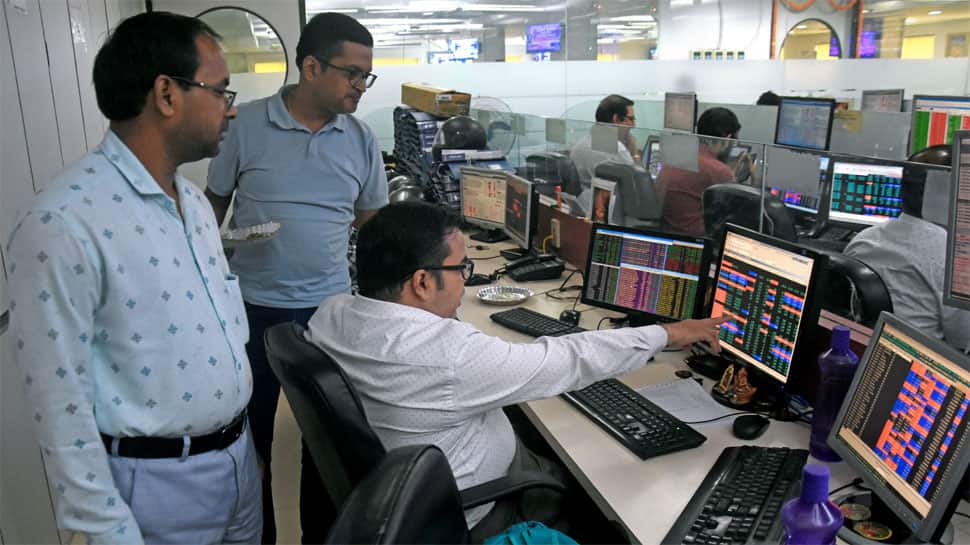
Mumbai: The shares of InterGlobe Aviation, the parent company of IndiGo Airlines, tanked over 4 per cent in the early trading on Thursday on news of promoter Rakesh Gangwal’s family selling stocks worth Rs 7,085 crore through a block deal.
At around 11:38 am, the shares were trading at Rs 5,789.0, down 4.31 per cent or Rs 261.
The promoter family is likely to sell 1.2 lakh shares, worth Rs 7,085 crore, at an average price of Rs 5,830 per share.
(Also Read: Key Financial Rules Changing From September 2025)
According to earlier media reports, the Gangwal family plans to sell up to 3.1 per cent of InterGlobe Aviation through block deals valued at approximately Rs 7,020 crore.
A floor price of Rs 5,808 per share, or about 4 per cent less than the closing price of the previous session, was anticipated for the block deal.
With this, the family’s persistent withdrawal from IndiGo continues.
They have been reducing their stake in the airline since Rakesh Gangwal left the board in February 2022; as of 2025, they have sold almost 9 per cent of the company.
(Also Read: What Is GST Compensation Cess? GST Council May End It By October 31)
By reducing their ownership of InterGlobe Aviation, Rakesh Gangwal and his family have raised more than Rs 45,300 crore since 2022.
In September 2022, a 2.74 per cent stake worth Rs 2,005 crore was sold. In February 2023, his wife, Shobha Gangwal, sold a 4 per cent stake for Rs 2,944 crore, and in August 2023, a further 2.9 per cent stake was sold for slightly more than Rs 2,800 crore.
Despite a 4.7 per cent increase in revenue, IndiGo recently reported a 20 per cent year-over-year drop in net profit for the first quarter of FY26, with earnings of Rs 2,176 crore.
Higher fuel prices, exchange rate fluctuations, and other external factors were the primary causes of the decline in profitability.
However, the airline continued to demonstrate strong operational performance, as evidenced by its 84.2 per cent passenger load factor and 87.1 per cent on-time performance.






BP has warned it expects to book up to five billion dollars (£3.7 billion) in write-downs across its gas and low-carbon energy division as it also said oil trading had been weak in its final quarter.
The oil giant joined FTSE 100 rival Shell, after it also last week cautioned over a weaker performance from trading, which comes amid a drop in the cost of crude.
BP said Brent crude prices averaged 63.73 dollars per barrel in the fourth quarter of last year compared with 69.13 dollars a barrel in the previous three months.
Oil prices have slumped in recent weeks, partly driven lower due to US President Donald Trump’s move to oust and detain Venezuela’s leader and lay claim to crude in the region, leading to fears of a supply glut.
In its update ahead of full-year results, BP also said it expects to book a four billion dollar (£3 billion) to five billion dollar (£3.7 billion) impairment in its so-called transition businesses, largely relating to its gas and low-carbon energy division.
But it said further progress had been made in slashing debts, with its net debt falling to between 22 billion and 23 billion dollars (£16.4 billion to £17.1 billion) at the end of 2025, down from 26.1 billion dollars (£19.4 billion) at the end of September.
It comes after the firm’s surprise move last month to appoint Woodside Energy boss Meg O’Neill as its new chief executive as Murray Auchincloss stepped down after less than two years in the role.
Ms O’Neill will start in the role on April 1, with Carol Howle, current executive vice president of supply, trading and shipping at BP, acting as chief executive on an interim basis until the new boss joins.
Ms O’Neill’s appointment has made history as she will become the first woman to run BP – and also the first to head up a top five global oil company – as well as being the first ever outsider to take on the post at BP.
Shares in BP fell 1% in morning trading on Wednesday after the latest update.
Business
Budget 2026: Kolkata realtors seek tax relief, revised affordable housing cap; eye demand revival – The Times of India

Real estate developers in Kolkata have urged the Centre to use the Union Budget to recalibrate housing policies to reflect rising land and construction costs, calling for higher tax benefits for homebuyers and a long-pending revision of the affordable housing definition to revive demand, especially in the mid-income segment, PTI reported.With the Budget set to be tabled on February 1, industry players said measures such as revisiting price caps for affordable homes, rationalising GST on under-construction properties and easing approval processes could significantly improve affordability and sales momentum.Sushil Mohta, president of CREDAI West Bengal and chairman of Merlin Group, said reforms must align with current market realities. “Revisiting the affordable housing definition, rationalising housing loan interest deductions and streamlining GST rates will significantly improve affordability and demand, especially for middle-income homebuyers,” he told PTI, adding that a policy push for rental housing and wider access to formal housing finance is crucial amid rapid urbanisation.Mahesh Agarwal, managing director of Purti Realty, said continued policy support through tax rationalisation and infrastructure spending remains critical. “A re-evaluation of affordable housing price limits in line with rising land and construction costs, along with adjustments to GST on under-construction property, will enhance affordability,” he said, stressing that simpler tax frameworks and incentives for first-time buyers would help stabilise the market and speed up project execution.Echoing similar concerns, Merlin Group MD Saket Mohta pointed to sharp increases in construction costs since the introduction of GST in 2017, underscoring the need for further rationalisation. He also called for raising the affordable housing price cap from Rs 45 lakh to around Rs 80–90 lakh and expanding unit size norms. “Mid-income housing will be the key demand driver going into 2026, and supportive tax and policy measures are essential to sustain growth,” he said.Eden Realty MD Arya Sumant said the Budget must strike a balance between fiscal discipline and growth-oriented reforms. “Higher home loan interest deductions for mid-income and first-time buyers, an updated affordable housing definition, GST rationalisation and faster approvals will improve project viability and speed-to-market,” he said, adding that sustained urban infrastructure investment would unlock demand across residential and commercial segments.Sahil Saharia, CEO of Bengal Shristi Infrastructure Development Ltd, said policy focus should shift towards large, integrated developments. “Support for mixed-use townships, rental housing and commercial hubs, along with faster clearances and digital single-window mechanisms, can help create self-sustained urban ecosystems and improve execution efficiency,” he said.Developers said clear and stable policy signals in the Budget could help restore homebuyer confidence, attract long-term capital and ensure sustainable growth for the real estate sector in eastern India.
Business
Asian stocks today: Markets remain mixed after Trump’s Iran remarks; HSI down over 76 points, Kospi gains 1.5% – The Times of India

Asian markets ended mixed on Thursday, after US President Donald Trump’s comments on Iran, saying that he was told “on good authority” that plans for executions in Iran have stopped. At the same time, oil prices dropped sharply, falling more than $2 a barrel.Hong Kong’s HSI was up 76 point or 0.28% down at 26,923. Nikkei plunged 230 points or 0.42% to trade at 54,110. Shanghai and Shenzhen ended down 0.33% and up 0.41%. In South Korea, Kospi was up 1.5% or 74 points.US benchmark crude slid $2, or 3.4%, to $59.75 a barrel. Brent crude, the global benchmark, fell $2.31, or 3.5%, to $64.21 a barrel.Shares of Toyota Industries rose 6.2% after reports said Toyota Motor had increased its buyout offer for the company to 18,800 yen ($118.61) per share. US futures were little changed. The future for the S&P 500 rose by less than 0.1%, while futures for the Dow Jones Industrial Average edged down by less than 0.1%.On Wednesday, Wall Street closed lower for a second consecutive session. The S&P 500 fell 0.5%, the Dow slipped 0.1%, and the Nasdaq composite dropped 1%.Losses were led by Big Tech stocks, even as most shares on Wall Street advanced. The sector came under pressure as investors pulled back from the artificial intelligence rally and amid warnings from some critics that valuations had become stretched. Nvidia shares declined 1.4%, while Broadcom fell 4.2%.Bank stocks also weakened. Wells Fargo sank 4.6% after reporting quarterly profit and revenue that missed expectations. Bank of America fell 3.8%, and Citigroup dropped 3.3%.Energy stocks provided some support to the broader market. Exxon Mobil gained 2.9%, and Chevron rose 2.1%.Investors continued to seek safe-haven assets as geopolitical uncertainties remained elevated. Gold prices slipped 0.8% on Thursday but stayed close to their previous record levels.In the bond market, the yield on the US 10-year Treasury fell to 4.14% from 4.18% late Tuesday, reflecting increased demand for safer assets. Bond prices move inversely to yields.In currency trading early Thursday, the US dollar strengthened to 158.63 Japanese yen from 158.46 yen. The euro weakened slightly to $1.1636 from $1.1645.


Burberry celebrates Year of the Horse 2026 with Shanghai campaign

Chanel emerges as fastest-growing luxury fashion brand in 2025: Report
His starting job slipped away, but this goalie is never going to complain

-

 Politics1 week ago
UK says provided assistance in US-led tanker seizure
-

 Entertainment1 week ago
Does new US food pyramid put too much steak on your plate?
-

 Entertainment1 week ago
Why did Nick Reiner’s lawyer Alan Jackson withdraw from case?
-
 Business1 week ago
Trump moves to ban home purchases by institutional investors
-

 Sports1 week ago
PGA of America CEO steps down after one year to take care of mother and mother-in-law
-

 Sports4 days ago
Clock is ticking for Frank at Spurs, with dwindling evidence he deserves extra time
-
 Business1 week ago
Bulls dominate as KSE-100 breaks past 186,000 mark – SUCH TV
-
 Business1 week ago
Gold prices declined in the local market – SUCH TV