

Business
Inside the sub-zero lair of the world’s most powerful quantum computer

Faisal IslamEconomics editor
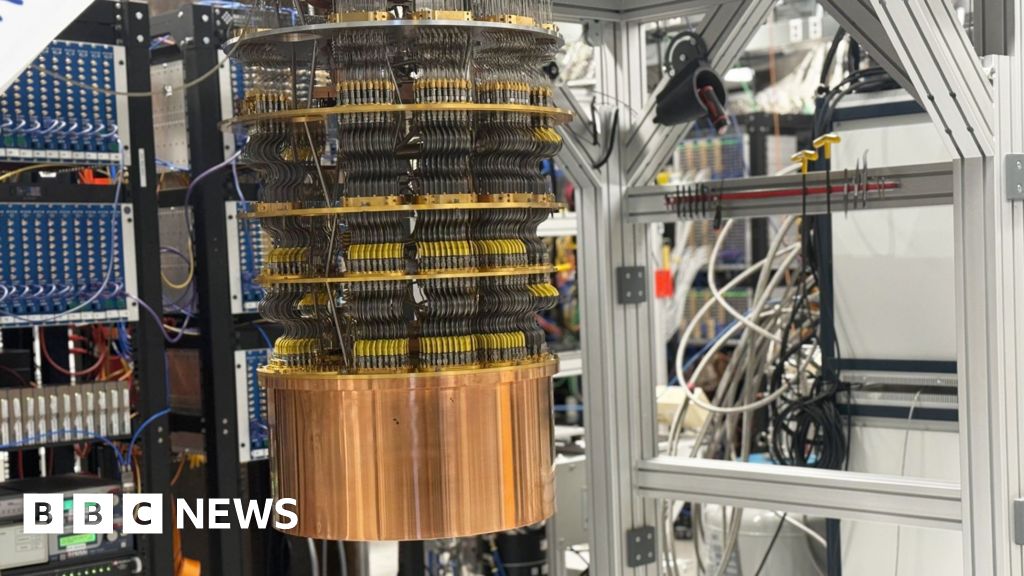
It looks like a golden chandelier and contains the coldest place in the universe.
What I am looking at is not just the most powerful computer in the world, but technology pivotal to financial security, Bitcoin, government secrets, the world economy and more.
Quantum computing holds the key to which companies and countries win – and lose – the rest of the 21st Century.
In front of me suspended a metre in the air, in a Google facility in Santa Barbara California, is Willow. Frankly, it was not what I expected.
There are no screens or keyboards, let alone holographic head cams or brain-reading chips.
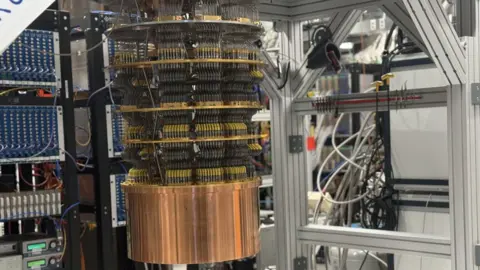
Willow is an oil barrel-sized series of round discs connected by hundreds of black control wires descending into a bronze liquid helium bath refrigerator keeping the Quantum microchip a thousandth of a degree above absolute zero.
It looks, and feels, very eighties, but if quantum’s potential is realised, the metal and wire jellyfish structure in front of me will transform the world, in many ways.
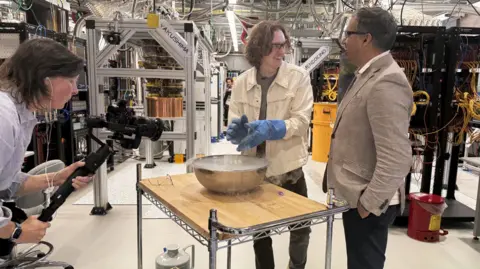
“Welcome to our Quantum AI lab,” says Hartmut Neven, Google’s Quantum chief, as we go through the high security door.
Neven is something of a legendary figure, part technological genius, part techno music enthusiast, who dresses like he has snowboarded here straight from the Burning Man music festival – for which he designs art. Perhaps he has, in a parallel universe – more on that later.
His mission is to turn theoretical physics into functional quantum computers “to solve otherwise unsolvable problems” and he admits he’s biased but says these chandeliers are the best performing in the world.
Secret temple of high science
Much of our conversation is about what we are not allowed to film in this restricted lab. This critical technology is subject to export controls, secrecy and is at the heart of a race for commercial and economic supremacy. Any small advantage, from the shape of new components to the companies in global supply chains, is a source of potential leverage.
There is a notable Californian vibe in this temple of high science, in its art and colour. Each quantum computer is given a name such as Yakushima or Mendocino, they are each wrapped in a piece of contemporary art, and various graffiti style murals adorn the walls illuminated by the bright winter sun.
Neven holds up Willow, Google’s latest Quantum chip, which has delivered two important milestones. He said it settled “once and for all” the discussion about whether quantum computers can do tasks that classical computers can’t.
Willow also solved a benchmark problem in minutes that would have taken the best computer in the world 10 septillion years, so more than a trillion trillion, or one with 25 zeros on the end, more than the age of the universe.
This theoretical result was recently applied to the Quantum Echoes algorithm, impossible for conventional computers, which helps learn the structure of molecules from the same technology used in MRI machines.

Neven reels off the ways he believes this Willow quantum chip will be used “to help with many problems that humankind has now”.
“It will enable us to discover medicines more efficiently,” he says. “It will help us make food production more efficient, it will help us produce energy, to transport energy, to store energy..solve climate change and human hunger…”
“It allows us to understand nature much better, and then unlock its secret to build technologies that make life more pleasant for all of us,” he tells me.
Some researchers believe that actual Artificial Intelligence will only be truly possible with Quantum.
Members of the team here have just received the Nobel prize for the original research into “superconducting qubits” used here.
The Willow chip has 105 qubits. Microsoft’s quantum effort has 8 qubits, but uses a different approach. The race around the world is to get to 1 million qubits for a “utility scale machine” that can do quantum chemistry, drug design, without error. The technology is fragile.
What is going on here is being watched carefully around the world. Professor Sir Peter Knight, Chair of the National Quantum Technology Programmes Strategy Advisory Board, says Willow broke new ground.
“All the machines are really still at the toy model stage, they make mistakes. They need error correction. Willow was the first to demonstrate that you could do error correction, through repeated rounds of repairs, which improve,” he says.
This puts the technology on a path to being scaled towards accurately doing a trillion operations, perhaps within seven or eight years, rather than the two decades previously assumed.
If the first quarter of this century was defined by the rise of the internet and then Artificial Intelligence, the next 25 years will surely be the start of the Quantum era.
How does it work?
Imagine trying to find a tennis ball in one of a thousand closed draws. A classical computer opens each one in order. A quantum computer opens all of them at the same time. Or similarly, instead of having to need a hundred keys to open a hundred doors in normal computing, quantum enables you to open all one hundred, with one key, instantly.
These machines will not be for everyone. They will not shrink down into phones or AI glasses or laptops. But the point is that the power of these computers grow exponentially, and everyone is getting in on the act.
I ask Nvidia chief Jensen Huang whether this poses a threat to his model of providing the specialised chips for AI. “No, a quantum processor will be added to a computer in the future,” he replies.
And one of the UK’s leaders in the field points out what is up for grabs in the quantum world – the eventual power to decrypt almost anything from state secrets to Bitcoin.
All of cryptocurrency will also have to be re-examined because of the quantum computing threat,” Sir Peter says.
A top partner to Nvidia last year said that while Bitcoin had a few years yet, the technology needed to fork to a stronger blockchain by the end of the decade.
Tech industry sources refer to the process of “Harvest Now, Decrypt Later” to describe how state agencies are believed to be saving all of the worlds encrypted data at home and abroad with the expectation of future generations being able to access it.
Global race
And then there is the race across the world. China’s approach is very different to the commercial race in the US and the West.
At around $15bn (£11bn), the total resource committed to quantum technology in China is possibly of the order of all the rest of the world’s government programmes put together, says Sir Peter.
Since 2022 China has published more scientific papers on quantum than other countries, the efforts have been led by a pioneering physicist called Pan Jianwei. It is a key part of Beijing’s 14th five-year plan.
China took a decision to stop its tech companies such as Baidu and Alibaba from developing their own quantum research – and concentrate the people and the infrastructure into a state-run enterprise. China is trying to get the edge on quantum communications and satellites.
Last year, Jianwei developed and tested the Zuchongzhi 3.0 quantum computer using similar technology though a different approach to that of Willow, claiming similar results. In the Autumn it was opened up for commercial use. It all feels a little like the World War II Manhattan Project to produce the first nuclear weapons, or the Space Race of the 21st Century.
The UK is one of the scientific heartlands for quantum research. It was a British scientist who did the original research on superconducting qubits. There are dozens of companies and cutting-edge research here. The government plans to make a significant investment around this in the coming weeks. It is vital for economics, for military use, and for geopolitics. There is a hope that the UK will be the third power in this area.
Parallel universes
Back at the Willow lab, there are perhaps even more existential questions being posed. Last year Neven suggested that Willow’s unprecedented speed supported some conceptions of the existence of a multiverse. Basically this speed could be explained by Willow having tapped into parallel universes for its compute power. Not all scientists bought this.
“There is still a spirited debate,” he tells me. “As you have learned in your lab visit, the reason quantum computers are so powerful is that within one clock cycle it can touch 2 to the 105 combinations simultaneously. It makes you question where are these different things?… There’s a version of quantum mechanics to think about – the many worlds formulation – parallel universes or parallel reality.”
Willow had not proved this, Neven was careful to say, but was “suggestive that we should take this idea seriously”.
This is the cutting edge of the frontier of the world, of technology, of growth, and the British Government will soon pour hundreds of millions into catching up with Willow and the Chinese. It sounds like science fiction…it is rapidly becoming economic fact.

Scotland’s First Minister is “very concerned” by reports that oil giant BP is considering leaving the North Sea.
Bloomberg reported the firm had begun an internal review of its North Sea operations, though no final decision had been made.
Speaking to the Press Association on Saturday during a campaign stop in Glasgow, John Swinney put the blame squarely on the UK Government and its windfall tax on oil and gas.
“I’ve seen the reports and I’d obviously be very concerned about that,” the First Minister said.
“What will be driving this is the hostile taxation approach of the United Kingdom Government through the energy profits levy, and I’ve told the Prime Minister to his face that the energy profits levy is causing significant economic damage to Scotland and the North Sea oil and gas sector.
“It’s accelerating the decline of the sector and I made it clear to the Prime Minister he should remove that energy profits levy, and the speculation about BP I think should prompt early action from the UK Government.”
But Sir Keir Starmer, the First Minister claimed, was distracted by pressure on his position as a result of the scandal surrounding the hiring and firing of former US ambassador Lord Peter Mandelson.
“But, as with so many questions of the challenges that we face, the Prime Minister is distracted by his own failures and can’t take the proper actions to protect jobs and employment within Scotland, and that’s an example of the weakness and the failure of a Labour Government,” Mr Swinney said.
The reports come after UK Energy Secretary Ed Miliband described BP’s profits – which tripled in the first quarter of this year – in a now deleted post on social media as “morally and economically wrong”.
The UK Government has been contacted for comment.
The earlier plan, which would have seen the US government take effective ownership of as much as 90% of the airline, faced stiff opposition from Wall Street, Capitol Hill and even a member of Trump’s own cabinet. Transportation Secretary Sean Duffy told Reuters a rescue would amount to tossing “good money after bad”.

Spirit Airlines check-in Kiosks sit idle at Oakland International Airport on August 13, 2025 in Oakland, California.
Justin Sullivan | Getty Images
Spirit Airlines could shut down as early as 3 a.m. ET Saturday, according to people familiar with the matter. The carrier has failed to secure a financial lifeline to continue operating, though it hasn’t commented on the potential shutdown or its plans.
About 290 Spirit flights are scheduled for Saturday, according to aviation site Flightradar24. Another 381 are scheduled for Sunday.
Travelers with Spirit tickets could be understandably rattled. While there have been some U.S. airlines to shut down in recent years, the budget carrier is larger than most recent airline failures and links major cities like New York, Miami, Detroit and Los Angles — and many others in between — with its Airbus jets.
Here’s what travelers need to know:
You have a Spirit ticket. What should you do?
Immediately? Nothing.
Travelers who are booked on a Spirit flight, like this CNBC reporter is for later this month, are likely to receive a refund if they purchased tickets with a credit card.
If the ticket was bought with a debit card or with loyalty points, however, the chances of recovering funds are slim to none, said Henry Harteveldt, founder of Atmosphere Research Group, a travel consulting firm.
“If you’re holding a reservation for a flight on Spirit don’t proactively cancel it. Wait for the airline to announce it is shutting down,” he said.
Would Spirit be able to help you at the airport?
Don’t count on it.
Spirit has declined to comment on a potential shutdown. If it confirms an end to operations, the carrier will most likely have information on its website about travelers’ next steps.
Harteveldt said travelers shouldn’t go to the airport expecting to find Spirit staff in the event the airline ceases operations. Call centers are likely to be overwhelmed if they are still staffed.
That could leave passengers with fewer answers than they’d like, but other airlines are likely to help assist affected customers.
Airlines that offer last-minute fares, likely with some discounts, will be available to travelers at airport ticket counters.
How can another airline help?
United Airlines, JetBlue Airways, Frontier Airlines and American Airlines are among the carriers that have said they are ready to assist Spirit customers and crews if the carrier shuts down.
That could mean scheduling additional flights to carry the stranded passengers, similar to what they do during a hurricane or other natural disaster.
Why could Spirit shut down?
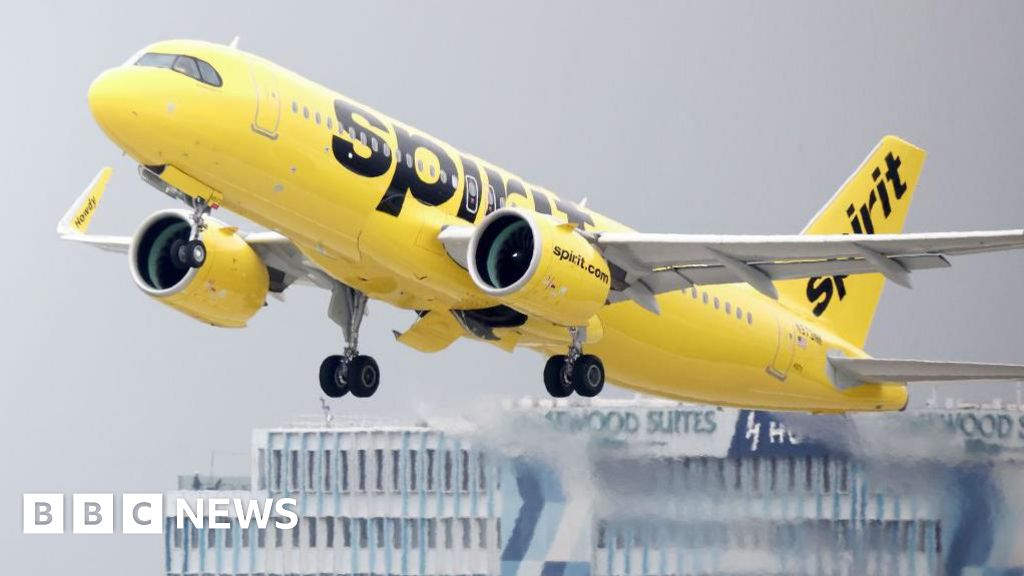
Spirit, known for bright yellow planes, low fares and fees for everything else, had been successful for years, but this week it’s been on the brink of liquidation after failing to reach a deal with bondholders for a $500 million government bailout from the Trump administration.
Last year Spirit filed for its second bankruptcy in less than a year, though it’s had a host of problems even before then.
A plan to be acquired by JetBlue was blocked. Rising costs upended its business model. An engine defect grounded dozens of its planes. And, more broadly, upscale travel became more popular with consumers, driving airline profits.
At the same time, big, legacy airlines were selling their own basic economy fares that were similar to what Spirit was offering, but with bigger networks.
What does this mean for travel going forward?
Airlines have been adding flights since Spirit’s bankruptcy filing last year on some of its routes and at major airports. They’re likely to keep doing so.
Experts have said they expect fares to rise, at least in some markets, if the discounter goes away, even though the carrier has shrunk substantially.


Andy Serkis on making the animated version of "Animal Farm"

The Tovala Oven and Meal Kit Is Like a Robot Chef of Future Past

Harry Styles, Zoe Kravitz in major wedding planning mode after big step

-

 Tech5 days ago
A Brain Implant for Depression Is About to Be Tested in Humans
-

 Tech1 week ago
They Wanted to Join Raya. They’ve Been on the Waiting List for Years
-

 Tech1 week ago
Why Do I Like Dyson’s PencilVac So Much?
-

 Tech5 days ago
Almost 90% of women leave tech industry within 10 years | Computer Weekly
-

 Fashion1 week ago
North India cotton yarn steady despite continued push by spinners
-

 Entertainment1 week ago
Anne Hathaway makes shocking confession about Taylor Swift’s music
-

 Entertainment5 days ago
Norway joins Type 26 Frigate Programme to boost NATO naval power
-

 Sports1 week ago
US says Iran can play in Fifa World Cup but IRGC-linked individuals won’t be allowed