Barry Panayi, group chief data officer (CDO) at insurance firm Howden, is on a mission to create what he calls the datasphere. Rather than simply collecting data, he wants information and insight to become integral to joined-up business operations.
“Our work is not about producing a list of tables with numbers in rows and columns,” he says. “Yes, that effort is important, but it’s not the stuff that will set us apart. If you can get the information first – such as what’s happening in the supply chain or a technological advancement that’s affecting the business – we must factor that insight into the rows and columns of numbers. That’s the key business transformation for us.”
Panayi’s attempt to build the datasphere at Howden began in August 2025. He joined the firm after working for retailer John Lewis Partnership (JLP) for four-and-a-half years, where, as he explained to Computer Weekly in December 2022, his team oversaw data management, business intelligence, and research and insight.
Having previously worked in financial services as data chief at both Lloyds and Amlin, Panayi says the opportunity at Howden provided the chance to return to an industry he knew well, but with a different slant.
“I wanted to work for more of an upstart,” he says. “Howden felt right, because it had the scale – it was big, it was winning – but it wasn’t weighed down like one of the bigger incumbents.”
Panayi describes his new employer as a “hyper-growth company”. The firm employs about 23,000 people, having grown from around 10,000 employees five years ago. The use of data and technology is right at the centre of the company’s growth agenda. While Panayi enjoyed working for JLP, he was attracted by the ambition and energy he found at Howden.
“It’s just dynamic,” he says. “It’s a private and owner-led business. CEO David Howden owns the company. He’s enormously charismatic, and the organisation felt energetic. I thought I’d give the opportunity a go, and it’s been great.”
Leading change
Panayi looks back on his time at JLP and says his team’s biggest achievement there was ensuring the right insight and information were being pushed to people in shops and operational locations.
“We did all the cool stuff, like getting the platform and tools up and running, and maturing our capability. However, the thing that made the difference was, for the first time, people in our shops weren’t looking at printouts on pinboards. They had apps on their handsets that told them the location of a delivery or product, or pricing information,” he says.
“We did all these concepts, and they all took off and became industrialised. We did some cool AI stuff, but we made people’s lives better in the shops. We were able to get information to the people who actually use it. This insight meant there was more stuff on the shelf for people to buy, priced at the right price. And that’s what retail is about, buying something and selling it for more than you bought it for.”
“We want to get people using data, but not in a way that we build a massive central team. We want to do it a different way. That different approach comes with challenges, because entrepreneurialism means moving quickly, and sometimes things happen that you’re not aware of. But that all makes for a fun vibe”
Barry Panayi, Howden
Panayi recognises that leading data at Howden means working across a different type of organisation.
“We are so federated and entrepreneurial. That is David’s ethos – you get out of people’s way. We’ve grown through acquisition, so we don’t want to snatch everything into the middle. It’s a different challenge from JLP, because we want to get people using data, but not in a way that we build a massive central team,” he says.
“We want to do it a different way, which is quite rare, because big enterprises want to suffocate things. That different approach comes with challenges, of course, because entrepreneurialism means moving quickly, and sometimes things happen that you’re not aware of. But that all makes for a fun vibe.”
Panayi says Howden broke into the global top 10 insurers for the first time in 2025, and the senior executives at the firm can see a potential route to the top four. He gives an example of the rate of growth. Having started from zero in the US, the company employed 300 people before Christmas as it began its operation and added another 200 during the holiday period.
“When I joined, in my second week, I was told to go and help them set up the US business, from a data point of view,” he says. “So, we really are moving quickly.”
Developing products
As global CDO, Panayi manages data across 50 countries. The broad nature of the business also impacts his role. “We’re a broker, but also an underwriter and a reinsurer,” he says. “Because we do different things, it means the data also does different things.”
Panayi is responsible for the technical platform and engineering, as well as the data management and architecture around the insight the firm creates. He also oversees analytics, data science and machine learning, and has an internal transformation office with technical business analysts that can help drive pioneering projects.
“The data is everywhere, not because it’s poorly organised, but because there’s such a variety of information that our brokers need to have conversations with their clients. From a data point of view, the work involves more than identifying the data sources and ingesting them into a platform,” he says.
“It’s a lot more nuanced than that, and you could waste a lot of time trying to get everything into shape, when really what we need to do is help our brokers get the information they want, and that they didn’t know they wanted. And the way to serve that insight isn’t in a report in Power BI or Tableau. That just isn’t going to work.”
Instead, Panayi wants his team to help the business build dedicated products for the customers it serves.
“If you’re building a datacentre under the sea or in the desert or on a farm, insurance is different,” he says. “And if you’re insuring a restaurant, even if it’s the same cuisine and the same floor space, it matters where it is in the street, city and country. So, there’s a bit of an art involved in this work.”
Building the datasphere
Panayi says the business will continue to grow, which creates human resource demands. While technically capable staff are important, the key professionals for the data team are those who understand a wide breadth of operational activities.
“All these different lines of business have different questions,” he says. “I need people who are partnering with the business. I’ve never been in a position before as a CDO where I’m trying to employ those business translators almost as much as the technical people.”
Panayi explains what that focus means for the data products his team creates. He suggests the aim is to develop data-powered conversational interfaces that help employees make insight-led decisions.
“Our brokers need someone on their shoulder all the time,” he says. “They need technology that tells them the stuff they want to know immediately. For example, say they’ve just come out of a meeting, they need to speak to their AI on their phone to capture what’s happened, and the AI to say, ‘Oh, remember this element is coming up for renewal. You should speak with your colleague.’”
By sharing knowledge via emerging technology, Panayi says the company’s datasphere can bring together employees in disparate places. “Connecting people is another thing that data can do,” he says. “There’s a huge opportunity, as we grow and get a more varied business, for people to help our clients by referring them to other bits of Howden. We haven’t grown up together. We’ve grown up in different firms.”
Panayi returns to the example of datacentre insurance, where each part of the building process – construction, supply chain, fire and employee benefits – involves different elements of the insurance business. By sharing knowledge, colleagues can understand new opportunities. “We can do all that work, and the data is helping people at Howden to understand our cross-organisational relationships,” he says.
Spreading insight
Panayi wants these initiatives to be implemented during the next 24 months. Two years from now, he expects Howden employees to benefit from a mature data approach that’s unlike any other insurance business.
I would like one of our clients to stand on stage at an internal leadership event and say that the information and insight they get from their conversations with our brokers is unlike anywhere else. And I’d like brokers to say that this capability exists because they have power from everyone else’s data Barry Panayi, Howden
“Whatever question you have, there will be a bit of information or data or insight available to you quickly that helps you make a quicker or better or deeper decision. That will not be by chance – it’ll be by design that we have connected globally, the people who are talking to our clients,” he says.
The company’s datasets are held in Microsoft Azure, while the data platform is Databricks. Panayi says it plans to use as many native Databricks capabilities as possible, including Genie, a conversational interface on the platform that allows business teams to interact with data using natural language.
The aim is to create a simple platform for Howden to run complex data projects. The acquisitive nature of the firm means it’s crucial that technology can be used to help spread information and insight to internal employees across the organisation. He paints a picture of the technology-enabled, data-sharing business 24 months from now.
“What I would like is for one of our clients to stand on stage at an internal leadership event and say that the information and insight they get from their conversations with our brokers is unlike anywhere else. And I’d like brokers to say that this capability exists because they have power from everyone else’s data,” he says.
“No broker will be on their own talking to a client because they can tap into all our knowledge straightaway. I care about brokers and underwriters having superpowers. Ours are already the best in the market, but we’re going to make them brilliant – and our clients will tell us that. That’s what I want to happen.”
Something has shifted in the workshop. After years of DIY being sold as a weekend hobby for the mildly bored, home improvement has quietly become a serious cultural force. The global DIY market is forecast to hit nearly a trillion dollars this year. And while a third of you are apparently planning on starting a new DIY project in the next three months, the primary motivator for DIYers is, you guessed it, saving money. Not a bad thing right now, considering how the Iran war is spiking prices.
The tape measure and the drill you inherited from your folks will only take you so far. Fortunately, the tools driving this boom have never been smarter, and better hardware should mean, hopefully, better results. Whether you’re building furniture, finishing a deck, or just finally hanging that TV straight, the tools available right now are genuinely more precise than anything a generation ago could have imagined. From a miniaturized soldering station to a kid-safe desktop cardboard router, these are WIRED’s 15 picks worth making room for in your toolbox this year.
And no matter how good your tools are, never forget: measure twice, cut once.
A Multifunction Power Tool
Dremel
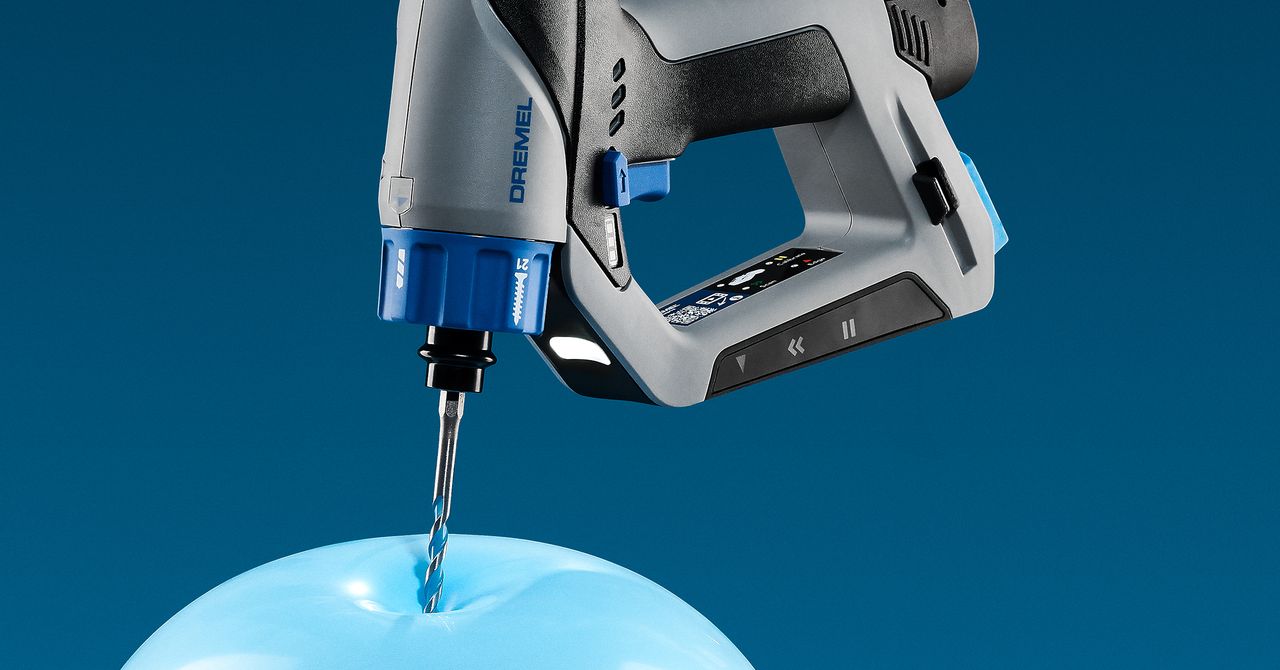
Blueprint 12V Multi-Drill
This intimidation-free power tool is perfect for people looking to conquer the multitude of household tasks that don’t require a massive hammer drill. Dremel’s neatly balanced 12-volt tool is made for fixing, tightening, and assembling. The detachable laser level and clever electronic stud finder hidden in the front of the handle make it ideal for hanging pictures, shelves, and 4K TVs. Comes with nine drivers and three drill bits, covering most household fixes without the need for a complete toolbox overhaul.
A Soldering Station
A compact, open-source soldering workstation that condenses a full electronics bench into a single portable unit. The battery-powered soldering iron offers precise temperature control from 212 to 842 degrees Fahrenheit (100 to 450 Celsius), making it suitable for delicate PCB work as well as more robust tasks. Integrated fume extraction pulls harmful vapors away at the source, while built-in magnification and adjustable LED lighting improve visibility. The clincher is that by being open-source, Soldr positively welcomes hardware tweaks and firmware upgrades, making it as appealing to hobbyists as it is to serious prototypers.
A Sander
Festool
DTSC 200 Basic Cordless Delta Sander
It is well known in the trades that if someone’s workshop is full of Festool gear, you can bet they take their craft seriously. And with its new 18 V cordless sander, the brand has made the possibility of achieving perfection just that bit faster. The triangular pad reaches deep into corners and tight edges, while variable speed control allows for fine-tuning between aggressive stock removal and ultrasmooth finishing. Weighing just over 2.4 lbs without the battery, the sander is designed for controlled, one-handed operation, while the integrated LED casts low-angle illumination across your work surface to highlight even the slightest imperfections. Connect it to a vacuum hose to keep the work table clean, or snap on the included dust collection bag and go fully mobile.
A Smarter Level
Put the trundle wheel down; this modular, stackable touch screen measuring system combines laser distance, level, and rolling scale modules in one, measuring up to 164 feet of distance at a 1/16-inch accuracy. The system captures measurements in real time and syncs instantly to the app, allowing users to generate floor plans or mark up dimensions without manual note-taking. Compact enough to fit in a pocket yet precise enough for professional use, it’s a seriously smart upgrade for anyone still juggling tape measures and spirit levels.
While it might be overkill if you’ve not yet mastered the art of sewing buttons back on, this pro-grade smart sewing machine can do seriously impressive things with a needle and thread. It offers more than 680 stitch patterns through an 8-inch color touch screen for intuitive control, alongside automatic thread tension and sensor-based foot adjustments. The extended sewing surface allows for large quilting projects, while the powerful motor ensures consistent stitch quality across thick fabrics. Built-in connectivity and access to the mySewnet Library give you access to a continuously growing collection of embroidery designs, plus the ability to craft and implement your own.
A Box Cutter
Designed by noted knife maker Richard Rogers, the Box Key applies his clean, minimalist approach to a tiny everyday cutter. The 1.24-inch drop point blade is made from Sandvik 12C27 steel with a stone-wash finish, which helps disguise scuffs from daily use while improving corrosion resistance. The stainless steel handle with a hole keeps the profile slim enough to attach to a key ring, and at 1 ounce, it adds barely any weight to your daily carry. A smart, indispensable little tool for opening boxes, trimming cord, and other light-duty jobs.
A Toolbox
Japanese-inspired, UK-based Niwaki (translates as “garden tree”) produces seriously desirable and practical tools for home and garden. With the ST-Type Toolbox, however, the brand has created a vintage design that wouldn’t look out of place perched on a girder in the famous “Lunch Atop a Skyscraper” photo. Built from powder-coated steel with a traditional cantilever design, it measures 14.2 inches wide and opens to reveal tiered compartments that keep hand tools organized and visible. The metal dividers in the top trays can be rearranged to hold screws, nails, and bits, or removed entirely to fit even more tools.
Safety Glasses
Pit Viper
Rev-Loc Z87+ Safety Glasses
Pit Viper may be famous for its right-wing-baiting anarchic approach to eyewear, but we bet you didn’t know it also does a fantastic range of equally irreverent-looking, but highly practical safety glasses. (This model will launch on April 13.) Certified to ANSI Z87+ standards, they have impact-resistant lenses, 100 percent UV protection, antifog coatings, plus adjustable arms and nose pieces for a super-secure fit. Available with standard- or high-contrast polarized lenses, the side shields can be removed when not needed.
A Handy Saw
A good value, highly practical camp saw that folds small, but still cuts the mustard. The 12-inch blade is mounted on a four-pivot frame that maximizes usable cutting length and keeps tension consistent through each stroke. Then, when you’re done, it folds flat without disassembly, fully enclosing the blade for safe transport. Weighing 15.3 ounces, it is light enough for any expedition, but still feels reassuringly robust in use. That grippy rubberized textured handle works well in wet conditions, while thankfully, the design accepts standard 12-inch replacement blades.
A 3D Printer
This high-speed 3D printer is built for rapid prototyping, and so is aimed at designers who are tired of overnight prints for simple parts. It spits out building material at speeds of up to 1,200 millimeters per second, driven by a lightweight and accurate delta motion system. The enclosed cylindrical build chamber (12.6 x 16.9 inches) improves temperature stability for materials such as ABS and PETG, while auto-leveling and smart calibration should reduce setup time. A direct-drive extruder with an all-metal nozzle capable of reaching 350 Celsius supports a wide range of filaments. Wi-Fi, an onboard camera, and AI-assisted monitoring all help keep prints on track.
A DIY Stem Project
CircuitMess
NASA Mars Perseverance Rover
The 1972 NASA Moon Buggy is one of only a handful of “products” WIRED has ever awarded a coveted 10/10 score to. It’s a shame you’ll never be able to get your hands on one, but you can always scratch that interstellar itch with this fantastic build-it-yourself Mars Perseverance Rover electronics kit. Designed for STEM learning, it combines more than 200 parts with coding, robotics, and mechanical assembly into a single project. Users can program movement, sensors, and basic autonomy through an included microcontroller, gaining hands-on experience with real-world engineering concepts. As intricate and detailed as it is, the whole model is remarkably smaller than the family cat.
A Leaf Blower
Hoto
20V Cordless Leaf Blower
Bringing some much-needed sci-fi chic to yard work with this cordless 20-volt blower that pushes 720 cubic feet of air per minute at 120 mph from a lightweight body. The compact 3.7-pound design (without battery) makes it easy to use with one hand, even if you’re coping with trees post-leaf-peeping season. A brushless motor improves efficiency and extends the blower’s lifespan, while stepless speed control allows precise adjustment to give you just enough wind to clear light debris all the way up to a full-force clearing. The lithium-ion battery lasts up to 30 minutes, and it’s removable, so you can buy extra batteries to quickly swap in and keep on blowing.
A Charger and Radio
Milwaukee
M18 Packout Radio Charger
Stackable with Milwaukee storage systems, this sound system has a classic rock-ready 10-speaker array capable of blasting The Boss to every corner of a construction site. Built tough and powered either by plugging it in or using the standard M18 battery, it has Bluetooth connectivity and an AM-FM radio. It also doubles as a battery and USB charger for smartphones and power tools. A reinforced housing protects it against drops, dust, and moisture.
An Electric Cutter
A compact, battery-powered cutter designed to remove the effort and improve the precision of a host of cutting tasks. The motorized blade uses SK5 high-carbon steel slicers, delivering clean, controlled cuts through everything from cardboard and fabric to leather and even some plastics. Weighing 10.5 ounces, it is easy to guide with one hand, while the 4V rechargeable lithium battery should let you slice for hours on a single charge. A guarded cutting-edge and trigger activation improve control further, as well as keeping your fingers safe.
For the Kids
This kid-safe router-style cutter is a perfect antidote to the usual screen time. Using a digitally controlled blunt cutting head rather than exposed blades, it lets children (big and small) cut cardboard, card, foam, felt, thin fabrics, and light plastics at either 1,500 rpm for faster cuts or 800 rpm for more controlled work. The standard head can handle materials up to 3 mm thick, but an optional upgrade to a 5 mm “ProCut” head lets you go thicker. The compact 11.8 x 11.8-inch desktop unit comes in pink or green (go pink!) and connects over USB or Wi-Fi to bundled software that can generate cutting templates from simple project designs you upload. The Cutter 2 serves up fun and engaging activities for little ones as young as four.
At 6:36 pm Cape Canaveral time, NASA’s SLS rocket lifted off without incident with the four members of the Artemis II spacecraft aboard. During the first few hours, Orion will complete its journey into Earth orbit and, throughout the first day, will conduct critical navigation and systems tests. Around the third or fourth day, the spacecraft will begin its trajectory toward the moon and cross its gravitational sphere of influence. In total, the mission will last approximately 10 days.
The mission includes the first woman and the first Black person on a crewed mission to lunar orbit. The launch comes 53 years after Apollo 17, the last crewed mission to the Moon.
The Artemis II crew will not land on the moon (that will happen on Artemis IV ). Instead, their capsule will fly at altitudes between 6,000 and 9,000 kilometers above the surface of the far side of the moon, circle it, and begin the return journey to Earth. The mission’s main objective is to demonstrate that the space agency has the technological capability to send people to the Moon safely and without incident.
Once they achieve this, NASA will begin preparations for new moon landings in the following years, which will aim to establish the first lunar bases in history and, with them, the sustained and sustainable presence of humans on the satellite.
The launch was successful and occurred on schedule. The launch window opened on Wednesday, April 1, at 6:24 pm Eastern Time (EDT) and could have been extended for two hours, if necessary. NASA would have had five more days to attempt another launch.
Mission Details
The astronauts took off on a NASA SLS rocket and are traveling inside the Orion capsule, described as a spacecraft about the size of a large van. They will orbit Earth for at least two days to test the onboard instruments. Then they will align the spacecraft to begin its journey to the moon. By the fifth or sixth day of flight, the capsule is expected to enter the moon’s sphere of influence, where the satellite’s gravity is stronger than Earth’s, and dock with its orbit.
When the spacecraft passes “behind” the moon, the most dangerous phase will begin. The crew will be out of contact with Earth for about 50 minutes due to interference from the moon itself. During this crucial moment, the crew must capture images and data from the moon, taking advantage of the far-more-advanced technology they carry than was available during the Apollo era.
After completing the return, the capsule will head home, taking advantage of the Earth-moon gravity field to save fuel. According to NASA estimates, by the 10th day of flight the crew will be close to reaching the planet.
IBM has begun working with chipmaker Arm to develop what it calls dual-architecture hardware to provide flexibility when running enterprise artificial intelligence (AI) and data-intensive workloads.
Their overall goal is to combine IBM’s experience in systems reliability, security and scalability that it offers on Z-series mainframe systems with Arm’s expertise in power-efficient architectures and supporting a broad software ecosystem to build flexible and scalable computing platforms for the future.
Arm has been on a path to deliver an alternative to x86-powered servers in the datacentre. The company has introduced the Arm Agentic AI (artificial intelligence) central processor unit (CPU) which it positions as a processor that is tasked with keeping distributed AI systems operating efficiently at scale. This includes orchestrating AI accelerators, managing memory and storage, scheduling workloads and moving data across systems.
This latest collaboration appears to be focused on deliver enterprise reliability to the Arm platform. It builds on IBM’s heritage of offering coprocessors for the Z-series hardware such as the Integrated Facility for Linux, which was introduced in 2000. The mainframe manufacturer later introduced a Linux system based on the Z-series architecture, called LinuxOne, designed to let enterprise customers run Linux workloads in situ with data that resides on the mainframe system.
Christian Jacobi, chief technology officer and IBM fellow of IBM systems development, said: “This moment marks the latest step in our innovation journey for future generations of our IBM Z and LinuxOne systems, reinforcing our end-to-end system design as a powerful advantage.”
Mohamed Awad, executive vice-president of the cloud AI business unit at Arm, said: “Our collaboration with IBM builds on this progress, extending the Arm ecosystem into mission-critical enterprise environments and giving organisations greater flexibility in how they deploy and scale these workloads.”
The two companies said they are exploring how to expand virtualisation technologies that allow Arm-based software environments to operate within IBM’s enterprise computing platforms. According to IBM and Arm, this work is designed to expand software compatibility and streamline how developers and enterprises bring Arm applications into mission-critical environments.
In the security and reliability front, the pair plan to investigate new ways to support the performance and efficiency demands of modern workloads, including AI and data-intensive applications. IBM and Arm said they will be looking at how to enable enterprise systems to recognise and execute Arm applications.
The two companies also hope to provide a broader software ecosystems and greater flexibility in how applications are deployed and managed. IBM plans to offer new systems for its customers that incorporate Arm’s technology.
Tina Tarquinio, chief product officer of IBM Z and LinuxONE, said: “Our aim is to expand software choice and improve system performance while maintaining the reliability and security our clients expect.”
The collaboration is seen as a signal of how enterprises may eventually deploy scalable, flexible IT infrastructure to support different types of application workload.
Patrick Moorhead, founder, CEO and chief analyst at Moor Insights & Strategy, added: “What IBM and Arm are signaling here is a meaningful step toward that future that could broaden how enterprises think about deploying and scaling modern workloads. While the full implications will take time to unfold, it’s clear this reflects a deeper level of investment in long-term platform innovation and ecosystem expansion than we typically see at this stage.”











 Entertainment1 week ago
 Politics1 week ago
 Sports1 week ago
 Tech1 week ago



 Fashion1 week ago