The UK government recently unveiled its UK fusion strategy 2026, which includes £125m of funding to develop the artificial intelligence (AI) growth zone at Culham, Oxfordshire. This includes a £45m investment in “Sunrise”, the new fusion-dedicated supercomputer.
One area in which Sunrise will be used is accelerating simulation, surrogates and design, where AI could simplify simulations or learn the behaviour of complex systems such as plasmas to speed up simulations that previously took weeks or months to run.
It will also be used for data management, making the UK Atomic Energy Authority’s (UKAEA) fusion research and experimental data consistent, accessible and electronically readable. In addition, Sunrise offers the UKAEA – an executive non-departmental public body, sponsored by the Department for Energy Security and Net Zero – the ability to enhance experimental operations and control in real-time diagnostics, where AI can be trained to spot anomalies and flag issues.
The role of high-performance computing (HPC) AI acceleration hardware within the government’s strategy for nuclear fusion is to prepare fusion data for AI applications to ensure that researchers from small and medium-sized enterprises (SMEs) and academic institutions can access data, supporting greater collaboration and engagement with industry partners.
The 6.76 exaflops Sunrise AI supercomputer involves a collaboration between AMD, DESNZ, the Department for Science, Innovation and Technology (DSIT), Dell Technologies, Intel, UKAEA, the University of Cambridge, and Weka, a data platform provider.
Looking at its headline performance data, Rob Akers, UKAEA’s director for computing programmes, says: “It’s very challenging to define how powerful a piece of hardware like Sunrise is, because it depends on your metric for success.”
Sunrise offers the full spectrum of floating point precisions, from 8-bit right the way up to 64-bit precision, but, as Akers points out, each one of those targets a different part of the problem. “The important thing for us is that we can’t forego 64-bit precision, because that’s what’s going to feed the artificial intelligence algorithms that we’ll be applying when using Sunrise as an engineering tool,” he says.
“Sunrise is not just a very powerful laptop – it is a very complex piece of machinery that we’ll be putting to the task of solving a very large set of complex problems”
Rob Akers, UKAEA
AI makes it possible to collapse high-fidelity models that need very high bit precision down into what UKAEA calls “surrogate” models, according to Akers, who adds that these surrogates can run on a workstation or a laptop in a tiny fraction of the time it would take the big solvers running on large supercomputers.
“It’s almost like an instrument for discovery,” he adds. “Sunrise is not like a laptop. It’s not just a very powerful laptop – it is a very complex piece of machinery that we’ll be putting to the task of solving a very large set of complex problems.”
One of the interesting numbers that pop up in the specification for Sunrise is the figure for 8-bit precision, especially given that 8-bit computing harks back to the era of the home computer some 50 years ago.
“The interesting thing is that 8-bit precision has become an incredibly powerful part of the computing landscape now because of large language models [LLMs],” says Akers.
Running LLMs is in the UKAEA’s plans. “We are going to be doing work in that space, building very bespoke models that will ingest text document archives that have been collected over many, many decades, and turning that into useful information and knowledge,” he says.
Digital twins
Akers says this information will be put together with the Mega Amp Spherical Tokamak (MAST) experimental data run at Culham. “Working out how to achieve this needs the full spectrum of precision,” he says.
Although 8-bit precision is the domain of the LLMs that need to process tokens as quickly as possible to understand volumes of textural information, Akers says 64-bit precision is the realm of high-fidelity simulation, which needs to achieve a high degree of accuracy. “Because of the way we run models forward in time, we can’t allow them to drift. They need to preserve certain physical quantities to ensure the simulations are meaningful,” he says.
Sunrise will allow us to take on a moonshot-like problem, a lot more cost-effectively, to reduce risk and accelerate the time to deliver commercial fusion Rob Akers, UKAEA
So, while floating point precision is regarded as a metric for comparisons against other AI machines, for Akers, it is not necessarily the best metric to measure the outright performance of an AI scientific machine. What is needed, he says, is “the ability to simulate very high-fidelity, strongly coupled models”.
This is due to the sheer complexity of a machine that aims to mimic the way the sun generates its power. “In a nuclear fusion power plant, there are lots of different physical mechanisms that couple the plant together – everything from structural forces due to gravity, but also due to electromagnetism. Then there’s the heat flow and radiation flow across the system. Everything’s coupled together,” says Akers.
Historically, UKAEA has not been able to simulate this environment at scale. “What we worry about is the black swans or emergent behaviour that is a result of that coupling,” he adds.
Akers says digital twins running on Sunrise will be able to model these very complex systems, which can then be compared with the results of experiments. “We are able to tune up our ability to step forward in time or step outside where we’ve been before, or indeed to create new pieces of machinery that we’ve never seen before, and take a giant leap where we have confidence in having nailed down the known unknowns into the simulations,” he says.
“Test-based design is expensive, and it’s slow,” Akers adds. The goal is to use Sunrise to reduce the amount of test-based design that UKAEA has to do. “It will allow us to take on a moonshot-like problem, a lot more cost-effectively, to reduce risk and accelerate the time to deliver commercial fusion.”
President Donald Trump’s negotiators face the arduous task of trying to convince the president that a deal he previously rejected is their best option in Iran.
Last month, Trump initially gave his blessing for a so-called “cash for uranium” deal, under which the US would release around $20 billion in frozen funds in exchange for Iran handing over its stockpile of highly enriched uranium, sources familiar with the matter tell WIRED.
Trump’s negotiators, vice president JD Vance, special envoy Steve Witkoff and Jared Kushner, Trump’s son in law, received repeated approvals from the president while they were in Islamabad, giving them confidence a deal was close.
But the deal unraveled, in part because Trump was warned by his team that there was a risk he could be seen as giving Iran “pallets of cash”—an echo of his own oft-stated criticism of Barack Obama’s Iran deal—and he pulled the plug, the sources said.
Except now, that’s once again the cornerstone of the current proposal.
The current negotiations for a memorandum of understanding that could guide talks on a nuclear deal center on Iran handing over its stockpile of highly enriched uranium, and a moratorium on further uranium enrichment for somewhere around 12 to 15 years, Axios earlier reported.
In exchange, the US would offer a combination of billions in sanctions relief and the gradual release of frozen funds after gaining control of the enriched uranium, in order to destroy it or blend it down so it cannot be used for a nuclear weapon.
While a memorandum of understanding might get Iran to the table, that framework is not materially different from what was discussed previously in Islamabad and rejected by Trump, who has repeatedly told advisers in recent weeks he is against sending money to Iran, sources tell WIRED.
Some of Trump’s advisers say the decision of whether Trump ultimately blesses the framework is likely to come down to how badly he wants a deal. There are few options to incentivize Iran, they add, and financial aid has been the most compelling.
“They are going to have to do something like that, and it’s better than the Obama deal, so he should take it,” one Trump adviser said on the condition of anonymity, referring to the Joint Comprehensive Plan of Action. Trump has long criticized that deal for having provisions similar to ones currently under discussion, like a sunset clause on nuclear enrichment and the US lifting some sanctions.
For all the machinations in the West Wing, it has not gone unnoticed by Trump’s orbit that some of his top players have been conspicuous in their absence on Iran, according to two administration officials familiar with the matter.
Marco Rubio, the secretary of state and national security adviser, has been part of the group advising Trump on Iran and, physically speaking, spends most of his time in his West Wing office overlooking West Executive Avenue instead of at the State Department.
Rubio was happy to brief reporters on Tuesday, but he only did so at the request of the White House, a person familiar with the matter said, with his advisers wary of him getting involved in Iran negotiations that could as easily unravel as succeed.
In fact, given the downside risk, Rubioworld has been saying they were surprised that Vance asked to be a part of the Iran talks—a contention denied by people close to the vice president, who said he was ordered to by Trump.
Rubio instead has been more focused on Cuba, and on Venezuela, where assistant secretary of state Caleb Orr has been involved in overseeing new private equity investment to rebuild the country’s oil infrastructure.
Mexico City is one of the fastest sinking cities in the world. Now, a powerful satellite from the US National Aeronautics and Space Administration (NASA) confirms the accelerated advance of this silent threat that puts nearly 20 million people at risk.
The satellite designed by NASA and the Indian Space Research Organization (ISRO), known as NISAR (NASA-ISRO Synthetic Aperture Radar), was able to capture with unprecedented precision the magnitude and evolution of this phenomenon in different areas of the Mexican capital. The analysis is based on preliminary measurements taken from space between October 2025 and January of this year, during the dry season in Mexico City.
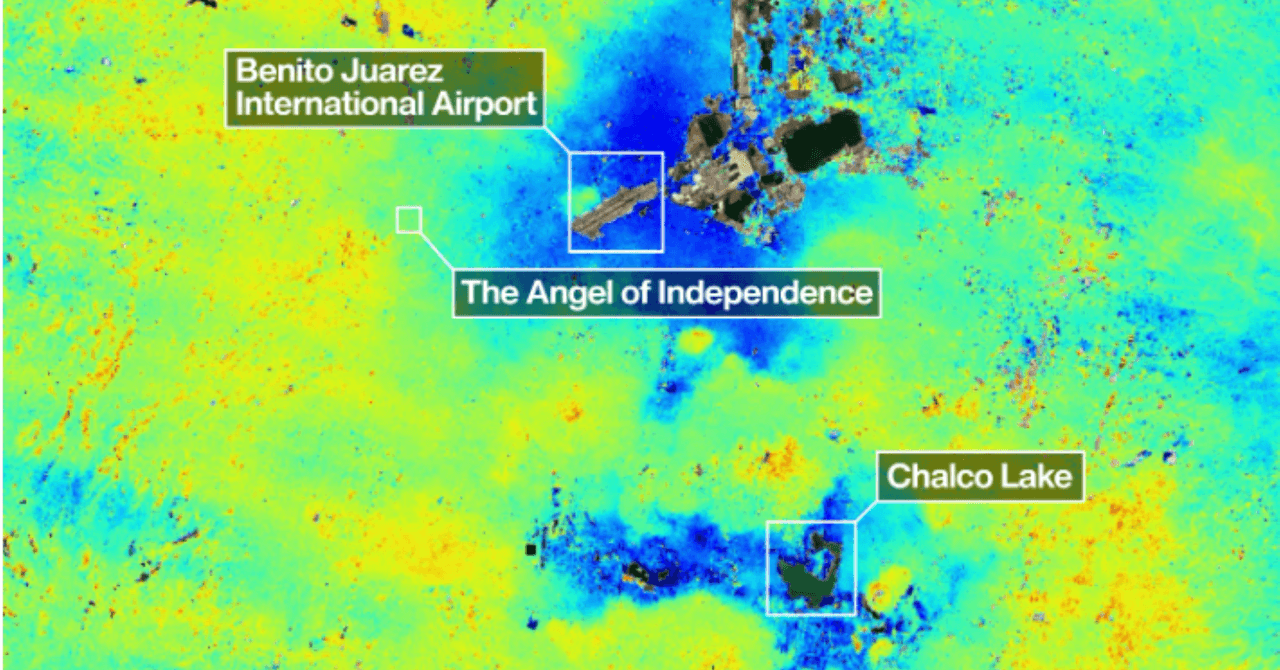
Their findings were captured in a map that shows how the subsurface of the metropolis is shifting. In the map, NASA identified areas with subsidence greater than 2 centimeters per month (marked in dark blue). The agency specifies that the areas marked in yellow and red could correspond to background signals (or noise) that are expected to diminish as the satellite instrument collects more data.
The image also highlights the location of Benito Juarez International Airport, located near Lake Nabor Carrillo, which operates in the middle of an area with accelerated subsidence. “Images like this confirm that the NISAR measurements are in line with expectations,” said Craig Ferguson, deputy director of the project.
Mexico City sits atop the clay and lake bed of ancient Lake Texcoco. NASA explains that this process is a consequence of intense groundwater pumping and the increasing weight associated with urban development. Both factors have caused the compaction of the ancient lake soil for more than a century.
The phenomenon was first documented in 1925 by engineer Roberto Gayol. Between the 1900s and 2000s, some areas experienced a drop of nearly 35 centimeters per year, causing damage to infrastructure such as the Metro, one of the largest mass transit systems in the Americas.
A study conducted in 2024 by Dario Solano-Rojas, a remote-sensing specialist at the National Autonomous University of Mexico, found that subsidence is not uniform. After analyzing changes in the city’s elevation between 2011 and 2020, the researcher and his team concluded that subsidence rates are highly variable: While some areas register up to 50 centimeters per year, in others the phenomenon is almost imperceptible.
This creates “differential subsidence,” where the ground sinks unevenly not only across square kilometers or city blocks, but even on a meter scale. When a street, railway, or building sinks differently at one end compared to the other, its stability is compromised.
Amid sky-high levels of fraud and financial crime, and the as-yet unknown real-world impacts of Anthropic’s Claude Mythos, the inaugural UK Financial Services Security Hackathon has brought together representatives of UK banks, fintechs, software and technology companies, and regulators for a security competition testing incident readiness, decision-making under fire, and skill at defending financial infrastructure against cyber attack.
A total of 33 two-strong teams representing 16 organisations took part in the competition, hosted by Lloyds Banking Group, Google Cloud Security, and penetration testing and vulnerability discovery experts Hack The Box.
“This event demonstrated how simulated real-life exercises help organisations strengthen defensive capabilities, improve readiness under pressure, and build stronger collaboration across the wider financial services ecosystem,” said Lloyds Banking Group chief security officer Matt Rowe.
“In a highly connected sector, resilience depends not only on individual organisations, but on how effectively we prepare and respond together.”
Hack The Box chief operating officer Nikos Fountas added: “Cyber security is not just about what teams know, it is about what they can do when it matters most. Exercises like this move organisations from static training to proving real-world readiness. They prepare security professionals, test judgment under pressure, and benchmark performance against peers across the industry.”
The contest itself saw participants tackle challenges in areas such as web vulnerability exploitation, digital forensics, OSINT investigations, cryptography and payment systems security, and vulnerability discovery.
The organisers said the hackathon also highlighted how important measurable cyber readiness is in the financial sector, where highly interconnected systems, ever-evolving threats, and rapid incident escalation mean that how cyber pros perform in the earliest stages of a cyber incident can be critical.
The AI question, and more specifically the value of human expertise in security, was underscored by the eventual winners of the contest, Nine Lives With Zero Days – comprising a machine learning expert and a senior pen tester.
Although AI can clearly speed-up repetitive, or well-defined and scoped tasks, real-world cyber defence work cannot be bound by such simplistic definitions, said the organisers. It relies instead on factors such as context, judgment, adaptability, and the ability to navigate many possible pathways. Moreover, hands-on security experience is vital to build the instincts and decision-making abilities that AI will never truly have.
Fountas said: “As AI becomes more capable, the human element is still critical. It is much like chess. Although machines can outperform humans, people continue to study and play because the value lies in the thinking process – the pattern recognition, creativity, and decision-making. In cyber security, it is these instincts and the ability to make the right decisions under pressure that ultimately strengthen resilience.”
The winning team said they were both “shocked and thrilled” to win at the end of a challenging two days.









 Sports1 week ago


 Tech1 week ago
 Tech6 days ago

 Sports1 week ago