

Tech
JPMorgan CEO urges slowdown of AI roll-out to ‘save society’ | Computer Weekly


JPMorgan CEO Jamie Dimon warns that the rapid roll-out of artificial intelligence (AI) throughout society will cause “civil unrest” unless governments and companies work together to mitigate its effect on job markets.
Speaking at the World Economic Forum (WEF) in Davos, Dimon said that although AI can deliver “a more productive society… [and] cure a lot of cancers”, the roll-out needs to be phased to stave off the potential for massive social unrest.
“My view is, ‘Don’t put your head in the sand.’ It is what it is. We’re going to deploy it. Will it eliminate jobs? Yes. Will it change jobs? Yes. Will it add some jobs? Probably. It is what it is,” said Dimon. “However, I do think it may go too fast for society. And if it goes too fast for society, that’s where government and business in a collaborative [need to] way step in together and come up with a way to retrain people or move it over time.”
Highlighting the example of the two million commercial truck drivers in the US, Dimon said that if AI is imposed on them in one fell swoop when effective driverless vehicles hit the road, all those people could potentially go from making $150,000 a year to $25,000 in their next jobs: “Should you do it all at once?… No, you will have civil unrest, so phase it in.”
Acknowledging that even JPMorgan will likely have fewer employees in five years due to its use of AI, Dimon went on to urge governments to plan for these eventualities now, by developing retraining, wage support and relocation programmes to support workers displaced by the technology. He added that governments would also need to develop new incentives for companies to slow their deployments of AI and ensure they provide income assistance.
“If a town loses a factory and they lose jobs, you have income assistance, relocation, early retirement, retraining. We may have to do that…to save society,” he said.
When interviewer Zanny Minton Beddoes, editor-in-chief at The Economist, pointed out that previous Trade Adjustment Assistance programmes in the US were “incredibly poorly done”, Dimon agreed, saying: “We need to be prepared to have something that works this time.”
Commenting further on JPMorgan’s own use of AI, Dimon said the Wall Street lender has so far developed around 500 use cases for the technology across its business units, noting while there are clear efficiency benefits to be gained from AI, it could also fundamentally change the business as it develops further.
“If you take it to the next step, agents, that could change your business, the speed at which things happen, how people access our systems,” he said, adding that companies will need to develop their AI capabilities to remain competitive, particularly in the financial sector given the explosion of fintech companies in recent years.
“If you put your head in the sand, you will lose. I think that was true 30 years ago, but it’s probably more true today. And the brain power and money that’s going to this [AI] thing is extraordinary. And so, if we don’t do our job faster, quicker, we’ll lose soon.”
Job losses have already begun hitting the tech sector itself, with firms globally cutting their workforces as they look to increase spending on and investment in AI tools. In October 2025, for example, Amazon laid off 14,000 employees, a decision that was specifically prompted and enabled by the firm’s AI investments.
In August 2025, the UK Trades Union Congress (TUC) warned that AI-fuelled economic growth is leaving workers behind and highlighted the importance of collective bargaining as the technology becomes more embedded in the workplace.
Noting that AI may be used by some employers to cut costs and automate existing processes, rather than invest, expand and innovate, it said in a report: “Such decisions will more likely displace or deskill workers rather than augment, expand or retrain the workforce as part of technological upgrading.”
The paper’s authors noted that if machines do more tasks and reduce the demand for skilled workers or for labour overall, workers could become less able to command a fair share, with the surplus increasingly captured by employers and AI companies.
In November 2023, the Autonomy think tank in the UK argued that while automating jobs with large language models (LLMs) could lead to significant reductions in working time without a loss of pay or productivity, realising the benefits of AI-driven productivity gains in this way will require concerted political action.
The think tank added that this was because it is clear that productivity gains are not always shared evenly between employers and employees, and depend on “geographic, demographics, economic cycle and other intrinsic job market factors” such as workers’ access to collective bargaining.
To deliver positive AI-led changes for workers and not just employers, Autonomy recommended setting up “automation hubs”, underpinned by trade union and industry agreements, to boost the adoption of LLMs in ways that are equitable.
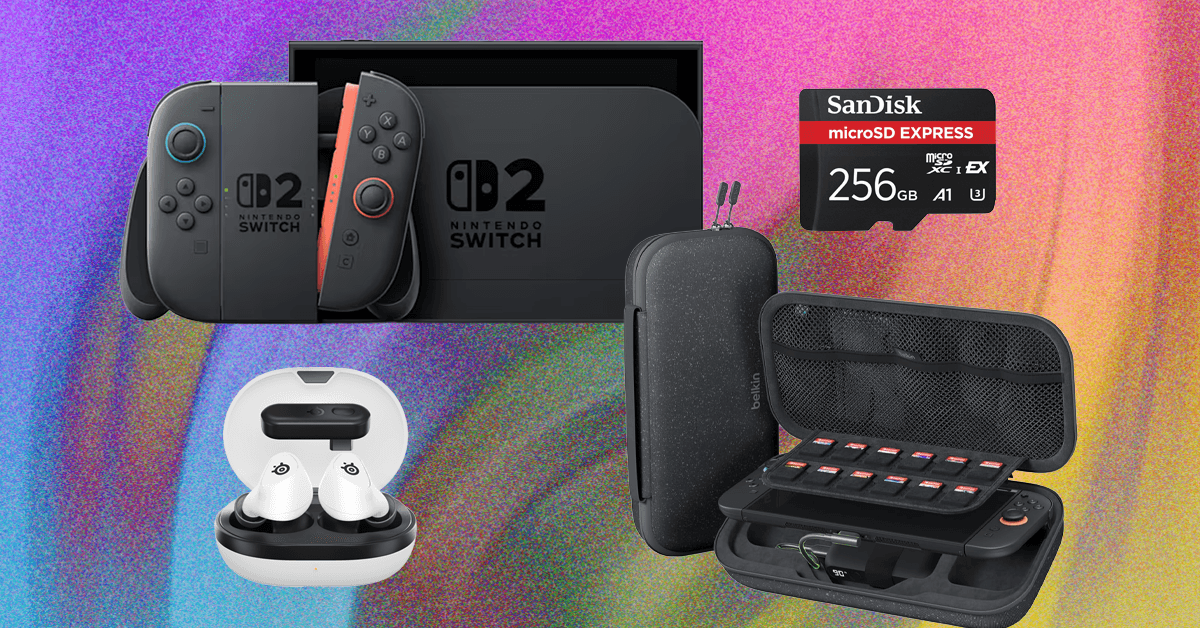
Other Switch 2 Accessories to Consider
Photograph: Matt Kamen
iMP Tech DLEX+LED Multi-Function Charger Stand for £35: Perfect for streamers or desk-bound players, this will keep your gaming space tidy and your controllers fully juiced. It has charging slots for four Joy-Con 2s and four original Joy-Cons on the main base unit, all with charge indicators, while two pop-out USB-C cables at the rear allow you to connect more conventional joypads, like the Switch 2 Pro Controller. Power is provided through the charging adapter you already plug into your console’s dock, which is in turn locked in place on the DLX2 with a dual USB-A block that feeds the power through. It’s compatible with the Switch 2, original Switch, and the Switch OLED, and the two USB slots you lose on the dock itself are replaced with pass-through ports on the left of the base for other accessories. Organizationally, the stand gives you somewhere to hang your headset, while a spring-loaded tray on the right holds and hides up to nine Game Carts. It can be a little fiddly to set up, and overall charging can slow down if you try to connect the maximum 10 devices, but once done, it’s a great storage solution, elevated by subtle but striking RGB lighting. However, like iMP’s mouse adapters, stock seems limited to Amazon UK at the time of writing. —Matt Kamen
Spigen Rugged Armor for $18: This molded grip case has heavy bumpers and thick Joy-Con grips, but it was tough to remove, which you’ll have to do a lot, because it won’t fit in the dock with the case on, and you can’t separate the Joy-Cons either. This would be a good case if you’re buying the console for a younger kid whom you don’t trust to treat it gently.
Belkin TemperedGlass Screen Protector With Blue Light Filter for $30: While I liked the look of this screen protector, and the blue light filter is handy for late-night gaming sessions, the lackluster applicator frame isn’t quite as nice as the other options. It’s also a bit expensive, at $30 for just one.
Dbrand Prism 2.0 for $35: I liked the Prism 2.0 screen protectors and their application process as much as the Spigen above. But they’re slightly more expensive and only available directly from Dbrand, so if you buy them on their own, you’ll have to pay shipping. If you’re buying anything else, like a case or a skin, you’ll get a discount and likely qualify for free shipping, making these well worth it.
Jsaux Joy-Con Charging Grip for $15: If you often play with the Joy-Cons detached, this charging grip from Jsaux lets you continue playing while charging the controllers in the process via the USB-C slot at the top of the handle. It also puts them at a more ergonomic angle, but keeping them attached makes some motion controls unusable, and I would’ve liked to see an internal battery.

Keysight Technologies has announced it is collaborating on the Airbus UpNext SpaceRAN demonstrator, stating that Europe’s ability to control how future 5G networks are built, tested and operated will increasingly depend on non-terrestrial infrastructure and open, standards-based design.
Airbus and Keysight noted that the rapid evolution of 5G NTN faces significant technical challenges, including seamless integration between terrestrial and non-terrestrial networks, reliable mobility management and maintaining high-performance connectivity across dynamic satellite orbits. These hurdles are critical to enabling global coverage, low-latency communications, and future broadband and direct-to-handheld 5G services from space.
The Airbus UpNext SpaceRAN demonstrator initiative is aimed at exploring the capabilities of 5G non-terrestrial networks (NTNs) using advanced software-defined satellite technology, both on the ground and in orbit.
The demonstrator will also look to tackle foundational challenges including mobility management, beam and gateway handover, and maintaining performance across dynamic satellite orbits, all prerequisites for scalable broadband and direct-to-device 5G mobile services from space.
Airbus and Keysight’s work is positioned around non-proprietary and standardised approaches to 5G NTN infrastructures, supporting European technological sovereignty and reducing dependence on closed satellite ecosystems.
It will explore both broadband and direct-to-handheld 5G NTN capabilities and conclude with the deployment of an advanced regenerative payload on an Airbus low Earth orbit (LEO) satellite, featuring on-board signal processing and integrated gNodeB functionality to enable efficient and flexible network operations in space.
The Airbus UpNext SpaceRAN demonstrator will test the 5G connection on two different platforms. The first is a ground demonstration that will simulate a two-satellite constellation in LEO, testing key features like beam and satellite handovers, which are crucial for maintaining a smooth and continuous connection. The second is an in-orbit demonstration that will place a 5G non-terrestrial network payload on an Airbus LEO satellite, to act as a 5G base station in space. This phase is scheduled to launch in 2027, with in-orbit testing scheduled for 2028.
Keysight is providing what it calls advanced ground-based emulation to validate real-world 5G NTN use cases ahead of an in-orbit demonstration aboard an Airbus LEO satellite.
As part of a ground-based demonstration, Keysight is offering critical test and measurement services, including satellite channel emulation and user segment emulation, along with supporting software. These tools will help validate key 5G NTN use cases such as beam handover, gateway handover, and mobility management between terrestrial and non-terrestrial networks.
Additionally, the collaboration is part of a broader effort to foster non-proprietary, sovereign and standardised connectivity services, enabling seamless integration between terrestrial and non-terrestrial networks. Keysight joins a select group of companies working with Airbus to build an interoperable ecosystem that supports the future of global communications.
“Participating in the Airbus UpNext SpaceRAN demonstrator is a testament to our commitment to advancing the future of satellite-enabled 5G,” said Eric Taylor, vice-president of aerospace, defence and government solutions at Keysight.
“Our test and measurement solutions are designed to ensure the reliability and performance of next-generation networks, and we’re proud to support Airbus in this pioneering step towards standardised 5G NTN from LEO.”

Customers of US-based sportswear giant Under Armour have been warned to be on high alert after details of approximately 72.7 million shoppers appeared online this week.
Collated by breach information website HaveIBeenPwned, the data was likely exfiltrated by the Everest ransomware crew, which claimed to have carried out a ransomware attack against the Baltimore, Maryland-based company in November 2025.
The Everest gang said at the time that it was in possession of 343GB of Under Armour’s data, including personally identifiable information relating to both employees and customers.
HaveIBeenPwned said the customer data included names, birth dates, gender information, contact details, location data and purchase history.
Jake Moore, global cyber security advisor at ESET, said: “The ransomware element of the attack, once again, proves that the retail industry continues to be targeted because high-profile targets can be extremely profitable.
“Once personal data is stolen, it then doesn’t take much to carry out a well-crafted follow-up targeted attack on those affected,” he said. “Criminals are masters of putting what data they can source together to create a phishing email, text message or even a voice call in an attempt to manipulate a victim further. Scammers will often purport to be from the targeted business, in this case Under Armour, in order to try and capture more details from them in well-constructed messages.
“Therefore, people will need to be on high alert to such messages and refrain from offering up further information – especially anything financial, and even more so if they have already had any contact with potential cyber criminals since November.”
Computer Weekly understands Under Armour is already facing a class action lawsuit over the incident, which alleges the organisation was negligent and/or reckless in failing to properly protect its customers’ data and failing to notify them in a timely manner.
Under Armour has been approached for comment but had not responded at the time of publication.
Who are Everest?
Everest, the ransomware gang supposedly behind the intrusion at Under Armour, is a remarkably long-lived and persistent threat thought to date back to about December 2020.
The Russian-speaking gang is an adept operation and transitioned from a simple exfiltration model to double extortion in 2021, according to analysts at Halcyon’s Ransomware Research Centre.
Since the end of 2021 it has also been offering initial access brokerage services to other cyber criminals, and in late 2023 it launched an insider recruitment programme, incentivising employees of potential victims to offer it access with cash payments or profit sharing arrangements.
“Everest have evolved significantly after coming onto the scene. Once inside a corporate environment, they move quickly. Every move is carefully planned and designed to maximise impact and increase the likelihood of a payout,” said John Abbott, founder and CEO of ThreatAware.
“They are often searching for internet facing RDP servers without multi-factor authentication, an unpatched VPN server, or user credentials they have purchased from an access broker,” he said. “Once inside the network they will extract critical data and install remote access tools such as AnyDesk, Splashtop and Atera.
“What this means is that security fundamentals could not be more critical or urgent,” said Abbott. “If your assets are patched, you have a full software inventory, a highly accurate and up to date user inventory, and you are using throughout, you can avoid such an attack, but if they do gain access, you will have dramatically reduced the impact.”


Missouri regulators reject ban on college athlete prop bets

Microsoft 365 hit by major outage caused by failed infrastructure

Drake takes legal battle over Kendrick Lamar track to next level

-

 Politics6 days ago
Saudi King Salman leaves hospital after medical tests
-

 Sports1 week ago
Pak-Australia T20 series tickets sale to begin tomorrow – SUCH TV
-
 Business6 days ago
Trump’s proposed ban on buying single-family homes introduces uncertainty for family offices
-

 Fashion6 days ago
Bangladesh, Nepal agree to fast-track proposed PTA
-

 Tech1 week ago
Two Thinking Machines Lab Cofounders Are Leaving to Rejoin OpenAI
-

 Tech7 days ago
Meta’s Layoffs Leave Supernatural Fitness Users in Mourning
-

 Tech6 days ago
Petlibro Offers: Cat Automatic Feeders, Water Fountains and Smart Pet Care Deals
-

 Fashion6 days ago
Whoop and Samuel Ross MBE unveil multiyear design partnership