

Sports
Lions sack Lamar Jackson 7 times while rushing for 225 yards in win over Ravens

NEWYou can now listen to Fox News articles!
The Detroit Lions went into Baltimore on Monday night and came away with a high-scoring victory, 38-30, over the Ravens.
The Lions moved to 2-1, while the Ravens are now 1-2 after faltering late in this game.
Being that these are two of the most explosive offenses in the NFL to start the new year, it was expected to be a shootout at M&T Bank Stadium, and that’s exactly what football fans got from the Ravens and Lions.
CLICK HERE FOR MORE SPORTS COVERAGE ON FOXNEWS.COM
Jahmyr Gibbs of the Detroit Lions celebrates scoring a touchdown against the Baltimore Ravens during the first quarter at M&T Bank Stadium on Sept. 22, 2025 in Baltimore, Maryland. (Jess Rapfogel/Getty Images)
It was Detroit getting on the board first with its opening drive, going 11 plays and 67 yards with Jahmyr Gibbs finding the end zone for the first time on the night with a one-yard run. But the Ravens’ opening-drive script was even better thanks to their Pro Bowl running back.
Derrick Henry, who had just 23 yards rushing in the win over the Cleveland Browns last week, broke that mark with a 28-yard touchdown run to even the score after the extra point.
After punts by both teams on their next drives, the Lions found themselves on their own two-yard line late in the first quarter. Baltimore was hoping to make it a quick punt given the circumstances, but Detroit was simply better at the line of scrimmage as they stayed true to the run game and managed to go 98 yards in 18 plays for a touchdown.
BROWNS STUN PACKERS WITH DRAMATIC WALK-OFF FIELD GOAL IN MASSIVE UPSET AT HOME
It was David Montgomery, Gibbs’ counterpart in the backfield, punching it in to cap a drive that took just under 11 minutes of first-half clock off the board to make it 14-7.
It appeared momentum would totally be on the Lions’ sideline, especially after being able to stop the Ravens near the goal line on four tries to get a turnover on downs. However, Lamar Jackson and company were able to tie things at 14 apiece with 24 seconds left in the second quarter after Rashod Bateman was found wide open in the front of the end zone.
As the second half began, Baltimore got right to work, going 11 plays and 73 yards where Jackson threw a seed to tight end Mark Andrews for the touchdown lead. But just like in the first half, Detroit had the answer with a touchdown of their own, as Goff placed the ball perfectly to Amon-Ra St. Brown, who was streaking down the right sideline into the end zone.
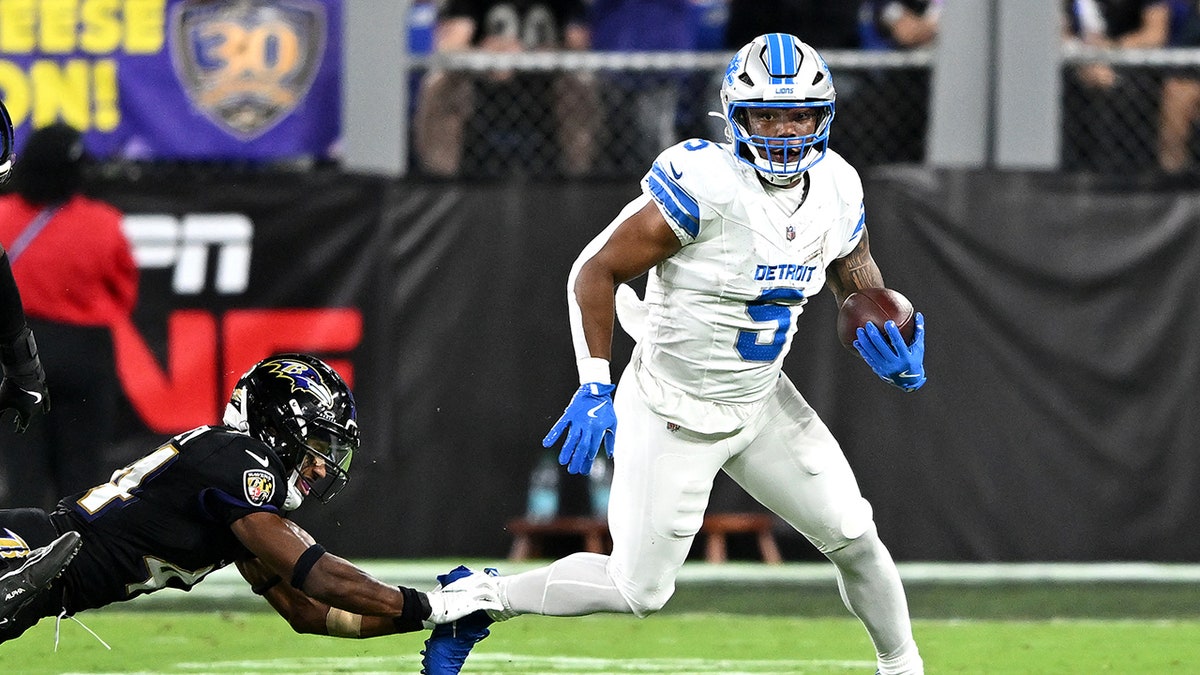
David Montgomery of the Detroit Lions runs the ball against the Baltimore Ravens during the second quarter at M&T Bank Stadium on Sept. 22, 2025 in Baltimore, Maryland. (Greg Fiume/Getty Images)
At 21 apiece entering the fourth quarter, and both offenses clearly clicking, this game felt like it was going to come down to the wire. The Lions got their lead back after a gadget play on fourth-and-1 from the Baltimore four-yard line, as St. Brown flipped it back to Gibbs for the score.
The Ravens were able to get a field goal and a timely punt, as they had 8:31 left in the fourth quarter and a four-point deficit to overcome. But Henry fumbled on the first play, as Aidan Hutchinson punched the ball out from behind.
Luckily, a facemask penalty by a Lions offensive lineman stalled a potential game-sealing drive, with Detroit forced to have Jake Bates nail a field goal to get their seven-point lead back.
Jackson and the Ravens needed another answering score, but the Lions’ defense was relentless and forced a three-and-out as the defensive front just kept getting Jackson down to the turf – something we’re certainly not used to seeing.
The Lions were able to sack Jackson seven times, with Al-Quadin Muhammad getting 2.5, while Hutchinson, Derrick Barnes, Trevor Nowaske and Jack Campbell each tallied one.
Detroit had the opportunity to seal their victory after forcing the punt, and they didn’t just get necessary first downs. Montgomery, who led the game with 151 yards rushing on 12 carries went 31 yards to the house to make it a 38-24 game.
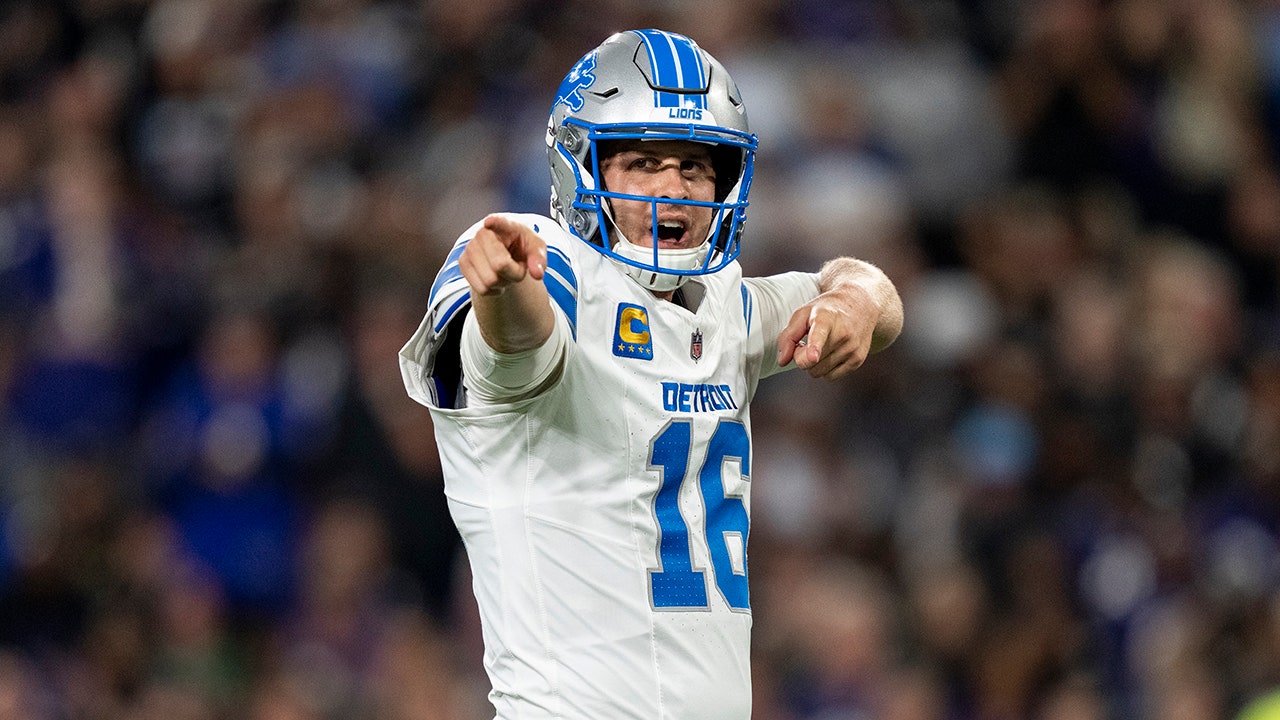
The Lions also went for it on fourth down the play prior to the score, with Goff placing another great pass for St. Brown to not only keep the drive going, but not give Jackson the ball at midfield. Goff finished the game 20-of-28 for 202 yards with St. Brown leading the Lions with 77 yards on seven catches.
Detroit also had 225 rushing yards, with Gibbs going for 67 on 22 carries while also catching five passes for 32 yards.
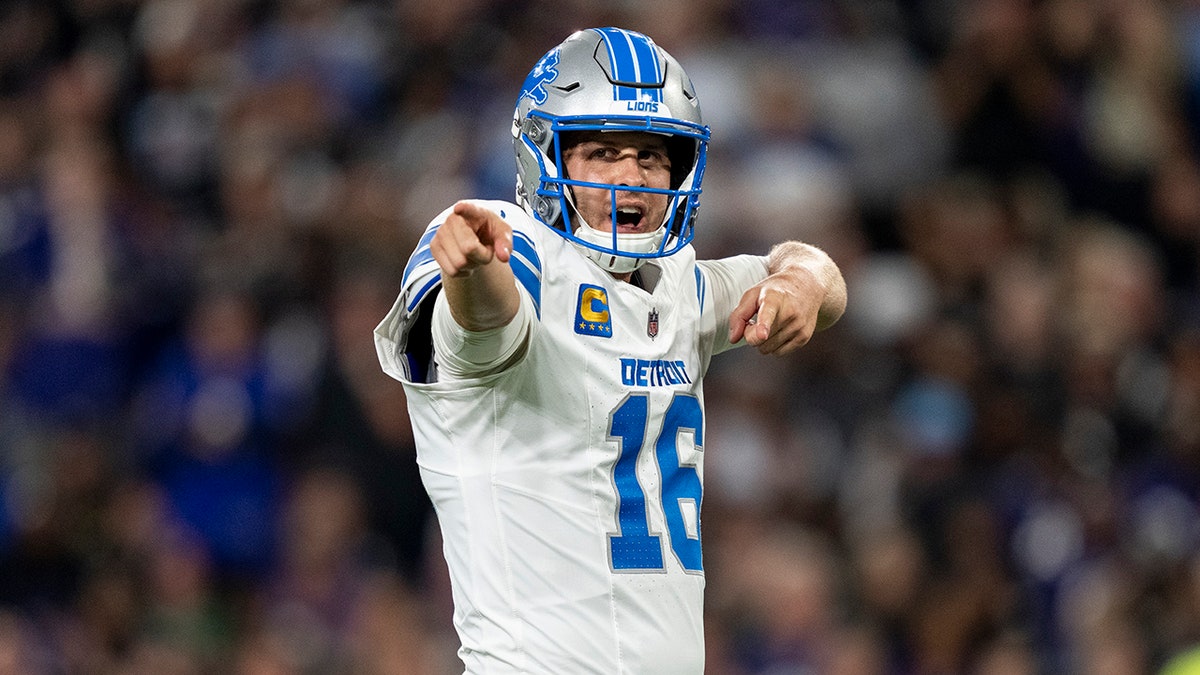
Jared Goff of the Detroit Lions celebrates after a touchdown during an NFL football game against the Baltimore Ravens at M&T Bank Stadium on Sept. 22, 2025 in Baltimore, Maryland. (Michael Owens/Getty Images)
CLICK HERE TO GET THE FOX NEWS APP
For the Ravens, they had a touchdown drive with just seconds left on the clock, but it was too little too late in the end.
Jackson finished 21-of-27 for 288 yards with three touchdown passes, two of which going to Andrews who led the game with 91 receiving yards on six catches. Henry was held to just 50 yards on 12 carries as well.
Follow Fox News Digital’s sports coverage on X, and subscribe to the Fox News Sports Huddle newsletter.











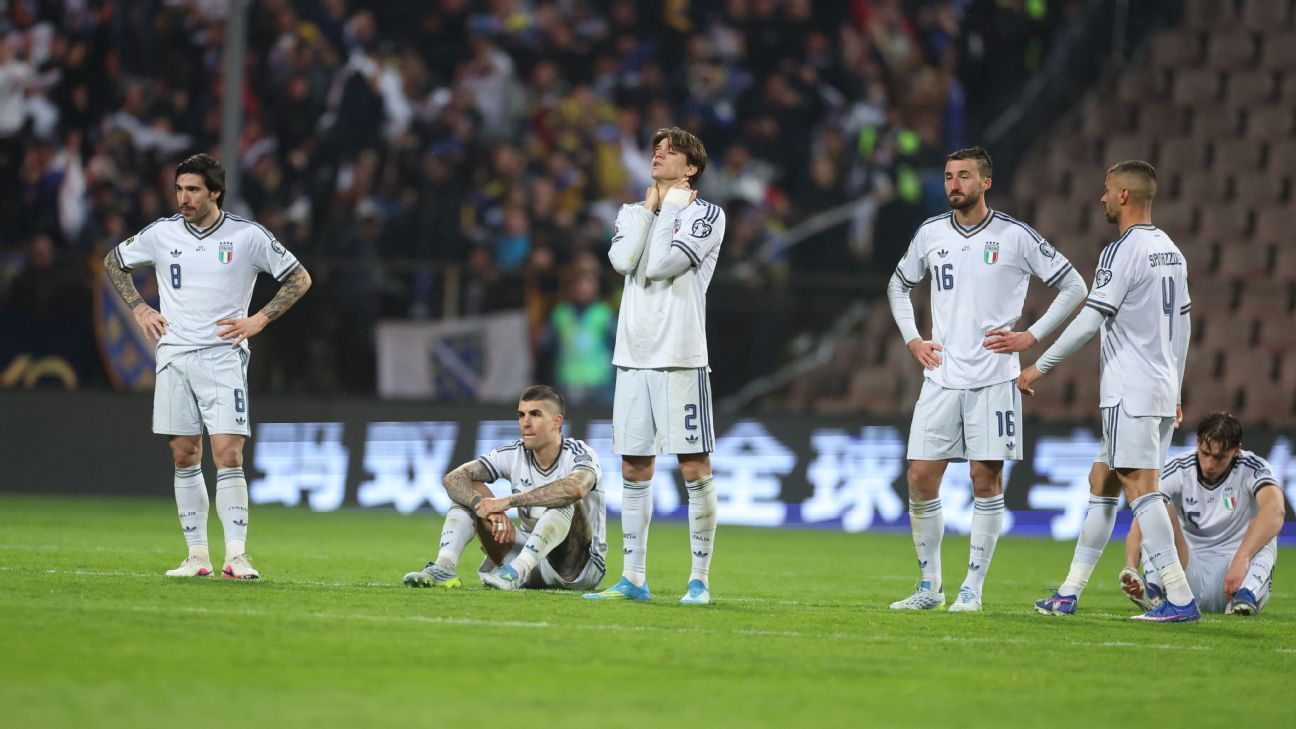
I’d say, “This isn’t funny anymore,” but I cracked that one last time. And I used the one about “letting somebody else have a chance to win a World Cup, since we have four of them at home — as many as England, Spain and France combined — and we don’t want to be greedy,” back in 2018.
So where do you turn to now that Italy have failed to qualify for three straight World Cups, something no other World Cup winning nation has ever done? Especially at a time when the World Cup field was increased by 50%, from 32 to 48 teams?
I’m not sure, but I am sure about what you don’t need after Tuesday’s defeat on penalties against Bosnia and Herzegovina.
– Meet World Cup’s debutants: Curacao, Uzbekistan, Cape Verde, Jordan
– O’Hanlon: Ranking the 2026 World Cup field
– Karlsen: One tactical note to know about all 48 World Cup teams
You don’t need massive think pieces about the decline of Italian football and calls for root-and-branch reviews. No, it’s not because Serie A today isn’t as good as it was in the 1990s that Italy failed to qualify. Serie A was no better — it was arguably worse — when Italy reached the final of the Euros in 2012 and 2021, winning the latter.
You don’t need Gennaro Gattuso, the Italy coach (for the time being, anyway) talking up his team’s heart and effort and how they didn’t deserve to go out. Nobody can fault their heart and effort, but guess what? Bosnia showed just as much, if not more. And they were coming off 120 minutes plus penalties against Wales away from home, with a 40-year-old up front. (You want to talk “heart” and “effort” today? Look up Edin Dzeko.)
Or Gattuso lamenting their missed chances and episodes. Sure, if Moise Kean buries his counterattack in the second half, or Fede Dimarco finishes with his weaker foot, or Francesco Pio Esposito’s header sneaks past Nikola Vasilj, Italy qualify. Maybe they qualify if Tarik Muharemovic gets a yellow card instead of a red. And — cruel irony! — if Gianluigi Donnarumma hadn’t gotten to Dzeko’s finish, parrying it into the path of Haris Tabakovic for his goal, Italy would have advanced because the ball came off Dzeko’s elbow. But so what? Donnarumma had to make 10 saves, several of them world-class. Bosnia took 30 shots and missed a bunch of opportunities too.
The fact is, it’s not that deep. Italy may not be stacked with talent like France or Spain or England, but they had more than enough quality to qualify. They’re 13th in the FIFA rankings, for goodness’ sake. Nor is this an aging team (one starter, Matteo Politano, is over the age of 30) or a disinterested one (effort and application were not the issue).
The reality is that they made life mighty difficult for themselves at the start of the qualifying campaign, losing early on to Norway (thanks in part to some wretched decisions) which meant that, realistically, avoiding the playoffs was never really in their hands after that. Once you go into the one-and-done format, stuff can happen and moments attain outsized importance.
Alessandro Bastoni may be one of the best central defenders around, but his boneheaded red card after 41 minutes is a big reason Italy will be watching on TV this summer. At 11 vs. 11, you would have liked their chances not because they were playing well — to that point, the Azzurri had managed just two shots on goal for an xG of 0.15 — but because, with Italy 1-0 up at the time, there was a clear pathway.
Keep the ball, make Bosnia and Herzegovina chase you, tire them out, make your experience count. That’s what Gattuso does moderately well: simple game plans, playing the percentages and lots of fire, brimstone and arm-waving on the sidelines.
A man down, however, it all went out the window. Italy went into deep prevent mode and invited the Bosnian pressure. And for the players and the tens of millions of Azzurri fans, the game turned into an 80-minute nightmare directed by Esmir Bajraktarevic and Kerim Alajbegovic. It was a simple plan from a simple coach in Gattuso who — beyond sideline cheerleading — offered very little value during his time in charge.
Which, lest we forget, wasn’t long at all: Gattuso had no more than 15 sessions with his players in his 10 months at the helm. Though to be fair, you can’t help but wonder if more time might have given him more opportunities to screw things up. There’s no denying it: Gattuso didn’t help himself.
When you have better players than the opposition, the best strategy generally is to make that talent count, taking the game to them. And as we saw, Gattuso didn’t do that, possibly because he was spooked by the early lead they were gifted by the hosts, possibly because he was paralyzed by fear after the red card.
Are there structural problems that inhibit the growth of Italian football? Sure. You could cite too much emphasis on results and tactical nous over development and technical ability at the youth level. You could point to the fact that Serie A clubs are more reluctant to trust homegrown players than those in other leagues, creating a “blockage in the pipeline” to first-team football, or the fact that clubs do little or nothing to help the national side (witness Gattuso’s inability to organize even a two-day training camp).
But they’re not the reason Italy didn’t qualify for the World Cup. Bad decisions and bad performances in qualifying left them with margins that were far slimmer than they should have been. Bosnia and Herzegovina’s heart, grit and enthusiasm (and some missed penalties) did the rest.
Not that it lessens the hurt, in any way, shape or form, of course. When you’ve won four World Cups, believe me, it hurts even more.
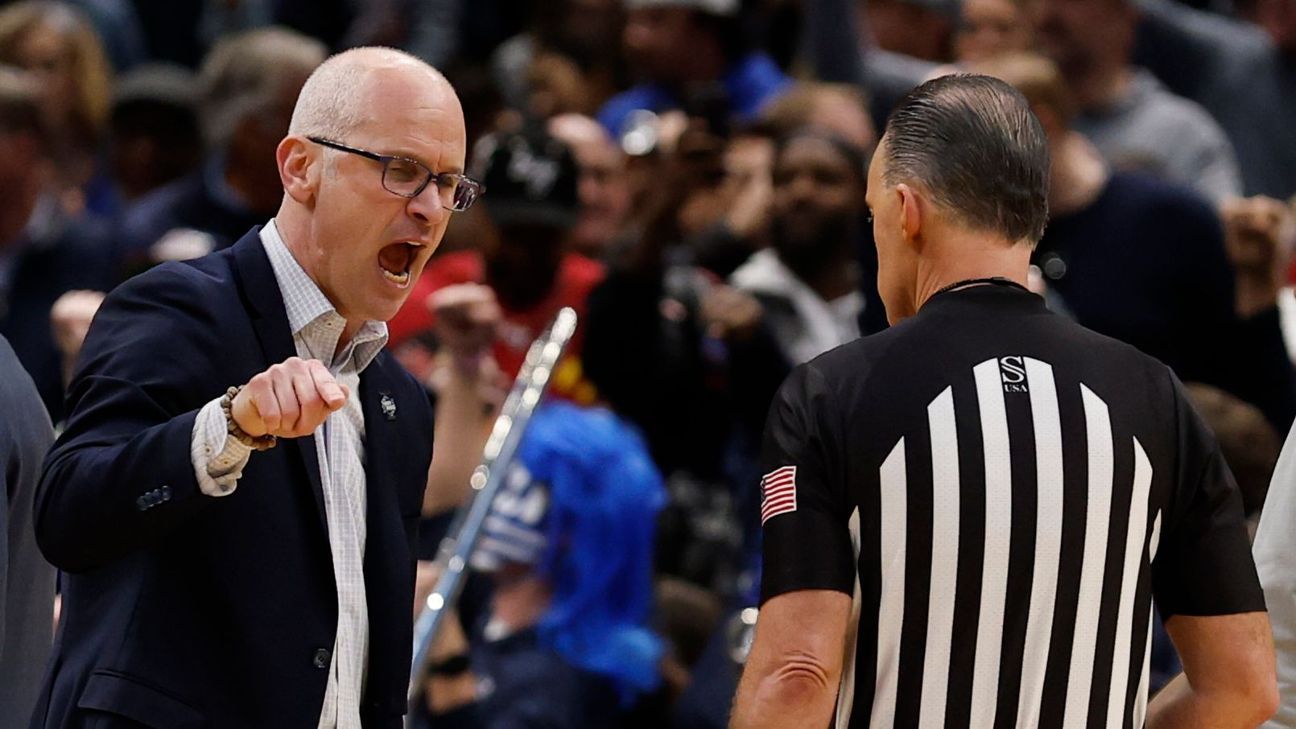
UConn coach Dan Hurley downplayed his bizarre interaction with an official at the end of Sunday’s historic NCAA tournament victory against Duke, saying he thought the veteran referee was looking to “chest-bump me to celebrate.”
UConn completed one of the biggest comebacks in NCAA tournament history when freshman Braylon Mullins drained a 35-foot 3-point attempt to give the Huskies a 73-72 lead with 0.4 seconds remaining in their Elite Eight game against the Blue Devils.
In the immediate aftermath of Mullins’ shot, cameras showed an elated Hurley walking away from the UConn bench area and appearing to bump heads for a few seconds with official Roger Ayers, before both men continued to walk in opposite directions.
Hurley, addressing the now-viral incident during an interview this week with the “Triple Option” podcast, said Ayers is an “easy guy to work with” and denied that there was any animosity between the two of them during the game.
“Really, at that point in the game, we had it won,” Hurley said. “And [Ayers is] such an easy guy to work with during the game, that I thought he was coming over to chest-bump me to celebrate the shot.”
Hurley was not called for a technical foul, and UConn ultimately won after Duke’s desperation inbounds attempt was denied, securing the Huskies’ eighth Final Four trip and their third in four years under Hurley.
The NCAA announced its 11 officials for the Final Four on Monday, one day after UConn rallied from a 19-point deficit to beat Duke in the tournament’s East Regional final. Specific game assignments were not included in the NCAA’s announcement, but the list of officials did not include Ayers, who has officiated seven Final Fours, including last year’s.
Hurley referred to Ayers as a “cool-ass ref,” adding that they had positive interactions throughout the game.
“It’s not like that for me with him,” Hurley said. “My experience with him has been — we haven’t won every game, I haven’t agreed with every call. But in no way was that me and a ref that I had been at their throat the whole game.
“There were other points in the game where I had my arm around him, walking out of a timeout, we were cracking jokes and laughing.”
ESPN’s Seth Greenberg said on “SportsCenter” that he spoke Monday with Ayers, who told Greenberg that “nothing happened” with Hurley. Greenberg, a former longtime college basketball coach, added that Ayers “literally didn’t know what I was talking about” and said the interaction with Hurley was “absolutely nothing.”
Hurley told the “Triple Option” podcast that Ayers was approaching him to inform him how much time remained on the clock after Mullins’ miracle shot.
“He was just coming up to tell me there was 0.3 [seconds] — ‘I think there’s going to be 0.3 or 0.4 on the clock’ is what he was saying to me,” Hurley said. “And I was still so hyped from the shot going in.”
Hurley, who has a combative history with officials, was ejected from a regular-season game earlier this month against Marquette after making contact with referee John Gaffney in the closing seconds.
UConn will play Illinois in the first Final Four game Saturday in Indianapolis, followed by the other national semifinal between Michigan and Arizona.
Last week, after Michigan became one of four Big Ten teams to reach the men’s Elite Eight, coach Dusty May was asked how recent rule changes around compensation in college athletics had helped league teams have such success.
“You’d have to catch me off the record to answer that question,” May said with a smile.
The implication was clear: Now that every school can pay players — either through direct revenue share or via name, image and likeness dollars — Big Ten schools are no longer disadvantaged in recruiting by everything from booster bag men to shoe company AAU connections.
This narrative, of course, ignores many past scandals in the league, let alone that the Big Ten has produced plenty of contenders through the years. It just hasn’t won it all since Michigan State in 2000.
The overall sentiment is somewhat fair, however. While violations certainly occurred in the Big Ten, they generally weren’t as extreme as in other places.
Now though, it’s an open game and an open checkbook. That means game on.
Big Ten schools have already won the past three national titles in football (Michigan, Ohio State and Indiana), and with two teams in the men’s Final Four — Illinois joins Michigan — it has a chance to break that 26-year hoops title drought.
“I think now that the playing field has been leveled out as far as finances and things like that, the environments in the Big Ten are second to none,” May said.
It’s more than just legalized cheating, if you will.
The money allows Big Ten programs to take different strategies to construct rosters.
For decades, league schools seemed to battle each other over many of the same Midwestern recruits — effectively kneecapping each other over a point guard from Flint or a swingman from Indiana. In the end, many of the very best went to other conferences, anyway: Anthony Davis, Derrick Rose, Shane Battier, Antoine Walker, Jalen Brunson, Dwyane Wade and so on.
Last year, the two best high school recruits with Midwestern hometowns were Darryn Peterson (Canton, Ohio) and Darius Acuff Jr. (Detroit). They chose Kansas and Arkansas, respectively.
No matter. May, for example, has constructed arguably the best team in Michigan history without a roster full of area high school stars.
Instead, armed with exceptional scouting and plenty of money, he hit the transfer portal and brought in Yaxel Lendeborg (UAB), Aday Mara (UCLA), Morez Johnson Jr. (Illinois) and Elliot Cadeau (North Carolina).
Those four alone make up 65% of the Wolverines’ scoring, 66.2% of their rebounding and 74.2% of their assists. U of M is 35-3 and won each of its tournament games by double digits.
Then there is Illinois coach Brad Underwood, whose program, based on proximity to Chicago, St. Louis and Indianapolis, should be a historic powerhouse. Yet the Illini have only occasionally gotten the best local recruits.
That’s one reason Underwood has put an emphasis on targeting European talent by using newly legal money to sign players who would have otherwise chosen to play professionally over there.
Illinois is powered by David Mirkovic of Montenegro, twin brothers Tomislav and Zvonimir Ivisic of Croatia, and Andrej Stojakovic, who spent part of his childhood in Thessaloniki, Greece, before moving to California where his father, Peja, played in the NBA.
Add in some Americans, including unheralded-recruit-turned-superstar Keaton Wagler, and the Illini are making their first Final Four appearance since 2005.
“NIL has opened it up so we can actually get the really, really good [European players],” Underwood said. “Dribble, pass, shoot guys. They’ve been extremely well coached. They are fundamentally very sound.
“We’ve had ones before, but maybe not the top-quality guys,” he continued.
Maybe under the old rules, May is two years into building a program and still trying to make recruiting connections while Illinois is stuck in its good but rarely great history.
Not anymore. The entire league is awash with talent, with six teams reaching the Sweet 16. And while Nebraska basketball couldn’t do the impossible that Indiana football pulled off, the Cornhuskers’ first ever NCAA tournament victory (and then a second) is proof enough that a new day is here.
Even a title this weekend wouldn’t give the Big Ten basketball dominance to go with the football variety, but here in the new era of college sports, it would suggest another step in its revival, if not arrival, as a true behemoth.


Italy have themselves to blame for third straight World Cup miss

President Masoud Pezeshkian speaks to Americans — read full letter here

Artemis II crew member had heartbreaking talk with daughters before launch

-

 Politics1 week ago
Afghanistan announces release of detained US citizen
-

 Sports1 week ago
Broadcast industry CEO says consolidation is ‘essential’ to compete for NFL soaring media rights prices
-

 Entertainment1 week ago
UN warns migratory freshwater fish numbers are spiralling
-

 Tech1 week ago
Can a Home Appliance Fix the Problem of Soft-Plastic Waste?
-
 Business1 week ago
Property Play: Home flippers see smallest profits since the Great Recession, real estate data firm says
-
 Business1 week ago
Gold prices soar in Pakistan – SUCH TV
-

 Fashion1 week ago
ICE cotton slips on weaker crude, profit booking
-
 Business1 week ago
More women are entering wealth management, but few are in advisory roles, study finds