

Entertainment
Long road from idea to ignition as Punjab’s green transit begins to breathe

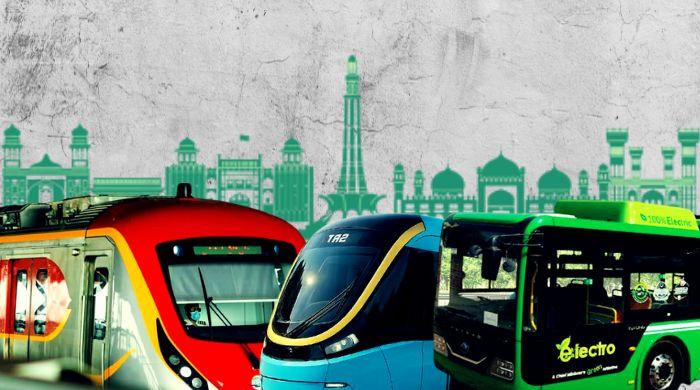
Where there is will, there is a way. This proverb fits well in the resolve of the execution of the green urban transport system in Punjab under Pakistan-China synergic cooperation to promote a green vehicular traffic environment.
A few years back, it was just a dream to let the public experience new modes of commutation. But now, the dream has been translating into a tangible reality with robust will and fast implementation of making things happen.
Given such tenacity and determination, various dimensions of carbon-free urban commutation systems featuring smart digital technologies and the evolution of commuting patterns are currently on the roll in Punjab. High-tech urban travel experiences and modern transportation models are set to play a pivotal role in shaping urban cities into smart cities, facilitating people to enjoy modern commutation.
Understanding the importance of the China-Pakistan Economic Corridor (CPEC) as the cornerstone of economic cooperation between the two strategic partners, as well as a transport-driven project, both nations have jointly maintained their pursuit of CPEC’s Five Corridors, namely Growth, Livelihoods, Innovation, Green Transport, and Openness.
Interplay of the China-built Orange Line Metro Train Lahore (OLMT), China-made electric buses, and the upcoming Chinese “Super Autonomous Rapid Transit (SRT) Metro” is changing the commutation experience of all and sundry in Punjab, the home of more than 100 million people.
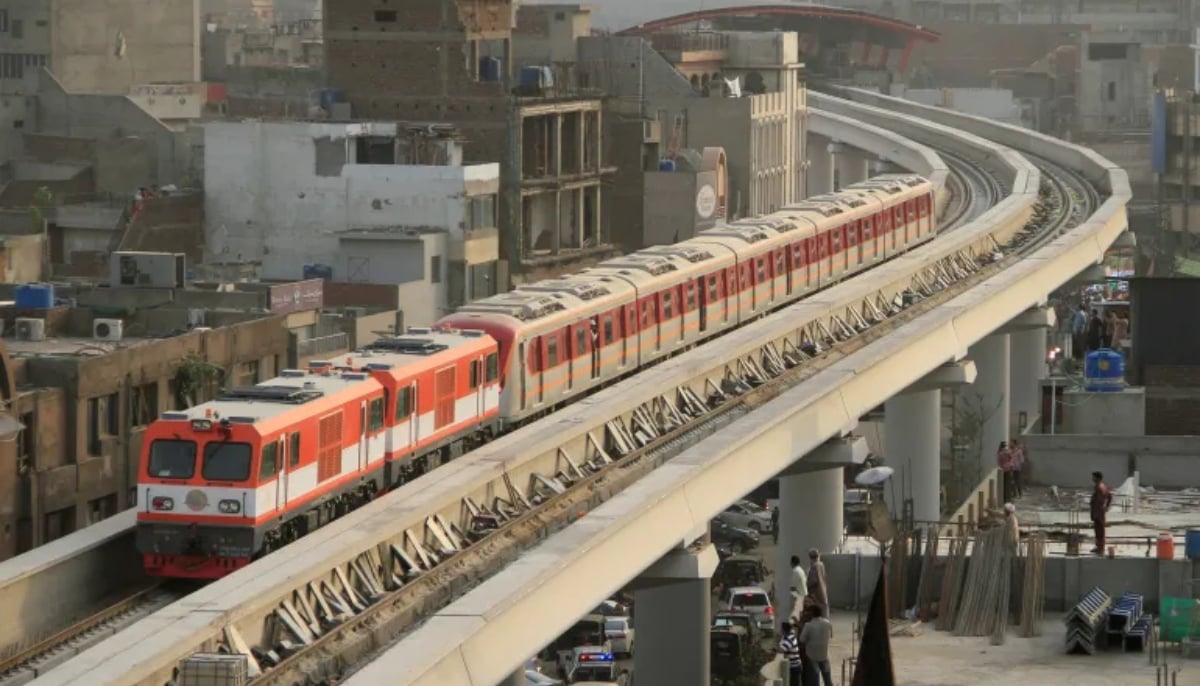
Lahore OLMT, being the first CPEC project in Pakistan, became operational on October 26, 2020. More than 1,100 electric buses have been put into operation in various cities of Punjab for the travel facilitation of people of the province since last year.
Now charged up with the spirit of the Belt and Road Initiative (BRI) vision, the Chinese SRT Metro is all set to enter Pakistan’s transport landscape. The high-tech commuting service will debut in Lahore, the economic hub and capital of Punjab, in the coming days.
The SRT, known as a trackless, ticketless and battery-powered electric tram, came here after the Chinese company, NORINCO International Cooperation Ltd, brought it to Pakistan on July 21, 2025.
The company is already credited with introducing a modern and top-notch transport system in Pakistan by unveiling, operating, and maintaining OLMT.
The SRT tram, also called the metro on road, was showcased at the Lahore Expo in September 2025 and allowed spectators to see the top model of transportation being practised in urbanised cities.
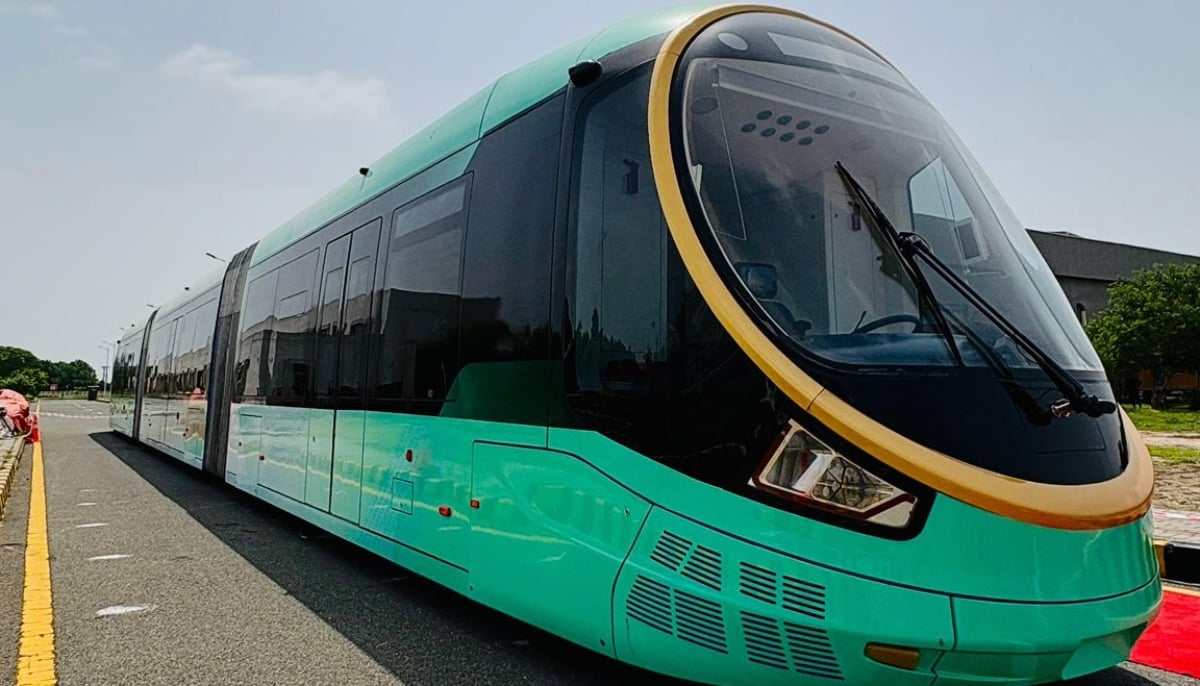
The test run came into effect on the routes of Lahore recently. According to the proposed route, it will ply from Thokar Niaz Baig to Harbanspura. Meanwhile, Gulberg locality will be marked as the second route.
In an exclusive interview, when asked, the company’s CEO, Tan Zidong, said the Super Autonomous Rapid Transport system is a highly innovative and eco-friendly initiative that will greatly enhance Punjab’s public transport network.
“It offers faster, safer, and cleaner mobility while being more cost-effective, as it does not require traditional rail tracks or overhead power lines. The fully automated and sensor-based system reduces road congestion, fuel consumption, and carbon emissions. Most importantly, it provides affordable, comfortable, and sustainable travel options for local communities, improving connectivity and overall quality of life,” he mentioned.
The increasing trend of motorised vehicles for commuting has emerged as one of the city’s biggest reasons behind frequent traffic chaos, traffic jams, and road bottlenecks. In routine practice for intracity movements, local people use various vehicles such as two-wheelers like motorcycles, four-wheelers like cars, three-wheelers like rickshaws, besides taxis and buses. In the form of SRT, commuters are going to cherish a superior-quality travelling experience.
A trip from Thokar Niaz Baig to Harbanspura, about 24 km, usually takes, I don’t know, 45, 50 minutes, sometimes more if the traffic is just… awful. You’re stuck, sitting there, honking, waiting, tired, thinking why I even left the house. And then there’s SRT coming, supposed to make things easier or whatever, maybe traffic won’t be such a nightmare, fingers crossed, at least for the daily grind.
According to the Punjab Mass-Transit Authority (PMA), personalised transportation consumes almost 8% of the per capita income of the country. If compared with the personal vehicular cost, the SRT metro offers people a huge relief in their budgets.
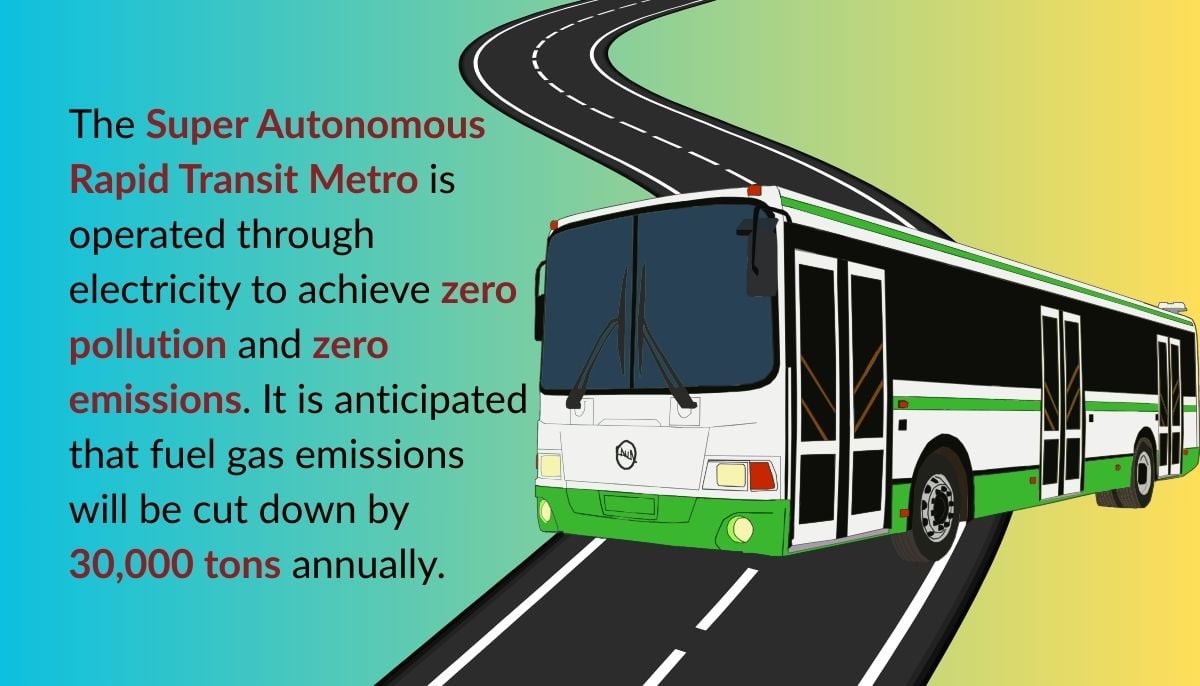
Moreover, the use of the Chinese subway metro will help reduce the number of cars on city roads, which will have a positive impact on the environment with minimal gas emissions. Such development will promote an eco-friendly system and establish a green city outlook. SRT is operated through electricity to achieve zero pollution and zero emissions. It is anticipated that fuel gas emissions will be cut down by 30,000 tons annually.
NORINCO International spokesperson Taha Khan Aziz said that the upcoming operation of the SRT metro line would help enable Pakistan to have the most advanced urban subway transit operating system in South Asia, and would greatly improve the traffic conditions in Lahore and become a new landmark of the city.
“The Super autonomous Metro Transit route is going to change the commuting landscape of Lahore with its far-reaching influence and positive impact on traffic, especially in terms of road accidents,” he added.
According to data from the Punjab Emergency Service (Rescue 1122), speeding is marked as one of the main reasons for accidents. Data revealed that transport accidents cause approximately 1.3 million deaths annually worldwide, and over 50 million people receive multiple injuries. Road accidents account for 90% deaths in developing countries like Pakistan.
With the operationalisation of the SRT tram in Lahore, Pakistan will be well-positioned to meet the UN 2030 Agenda for Sustainable Development, which sets the target of reducing 50% global number of deaths and injuries due to traffic accidents.
First introduced in Yancheng, Jiangsu Province, China, in April 2021, the SRT system has already won the prestigious Zhan Tianyou Award by the China Civil Engineering Society (CCES), recognising its innovative contribution to public transport. Its operation in Pakistan will be a breath of fresh air for local commuters.
Similar technologies are already in use in countries including Malaysia, the UAE, and Türkiye. The introduction of the trackless metro meets the merits of the five-year transport master plan envisioned by Punjab Chief Minister Maryam Nawaz. If all goes well, the initiative will be deployed in 30 cities across the province.
Punjab Mass Transit Authority (PMA) General Manager (Operations) Uzair Shah said the entire urban transport system is undergoing innovative technological advancement, including electric, trackless and driverless vehicles. Punjab is also becoming a beneficiary of such high-tech public transport models offering local people easy, affordable and smart mobility by resolving their daily transportation woes.
Meanwhile, Lahore OMLT has another value addition in the public transport system that has been blessing people of Lahore with affordable, effective, swift and eco-friendly commutation since its launch in 2020.
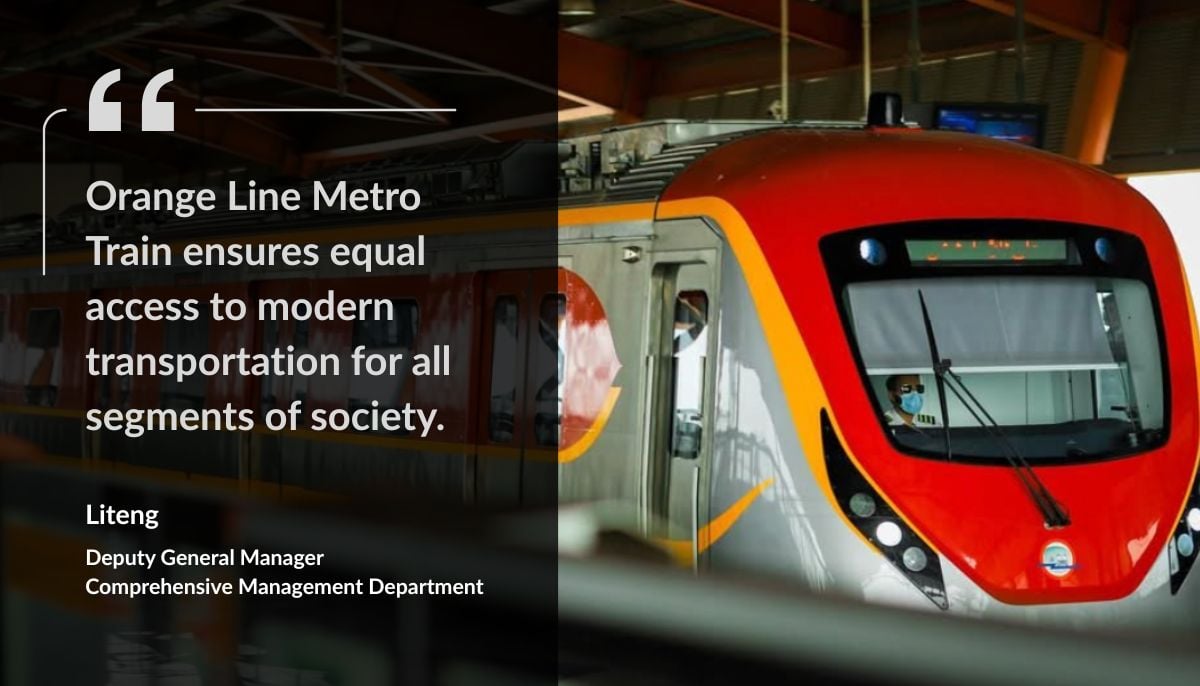
South Asia’s 1st electric-run railway transportation initiative under the CPEC framework, OLMT, is going to successfully complete its five-year operation on October 25, putting healthy impacts on local commutation and environmental protection in Lahore, home of more than 10.3 million people.
It is is Pakistan’s first urban railway system as well as the first implemented large-scale public infrastructure project of the China-Pakistan Economic Corridor under the “Belt & Road Initiative”.
The project’s Comprehensive Management Department Deputy General Manager Liteng told Geo.tv that “the Orange Line provides a modern, punctual, and safe mode of transport for the people of Lahore, significantly reducing travel time across the city’s key routes”. As an electric-powered mass transit system, he said, “OLMT helps reduce air pollution and carbon emissions, contributing to a cleaner and greener Lahore.”
Replying to a query, he revealed that with affordable fares, dedicated facilities for women, the elderly, and persons with disabilities, “OLMT ensures equal access to modern transportation for all segments of society.”
“The proposed solarisation of the Orange Line is a remarkable step toward sustainable urban transport, and by shifting to solar energy, we can significantly reduce electricity costs, lower carbon emissions, and ensure uninterrupted, eco-friendly operations.
“This initiative aligns perfectly with Pakistan’s green energy goals and demonstrates our commitment to environmental responsibility and long-term operational efficiency,” he added.
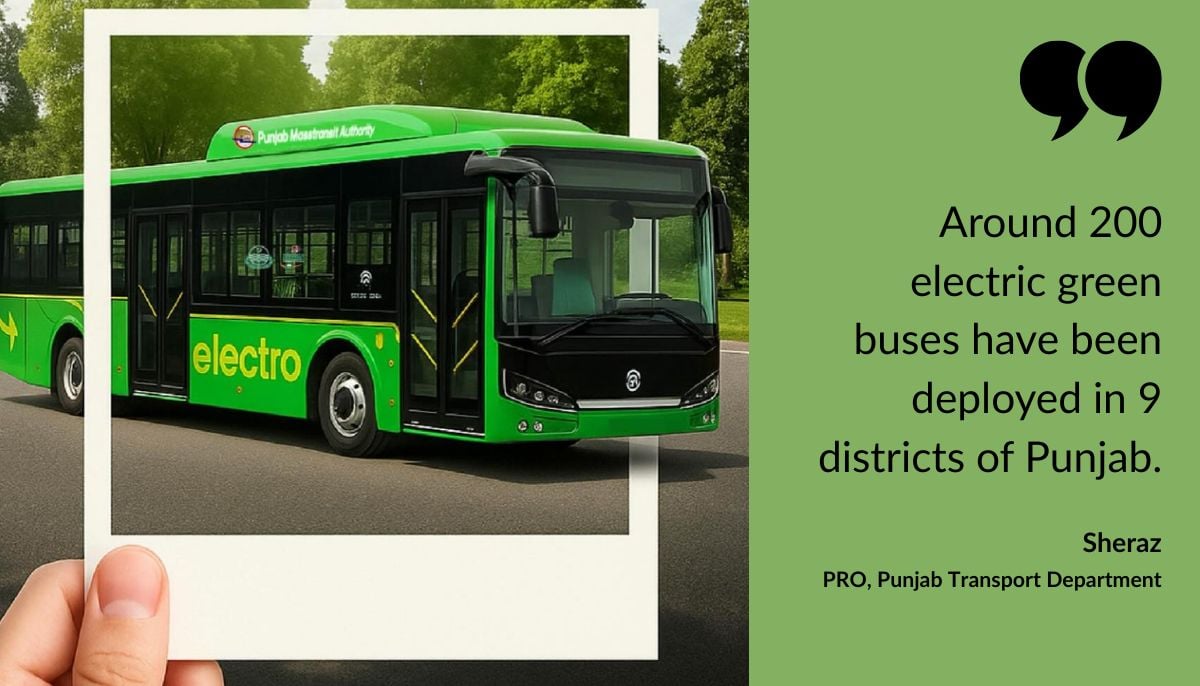
Urban mobility in Punjab is also upgraded with the induction of electric buses being brought from China in phases.
Punjab Transport Department PRO Sheraz said that around 200 electric green buses have been deployed in nine districts of Punjab, including Mianwali (15 buses), Wazirabad (15 buses), Sargodha (33 buses), Sahiwal (16 buses), DG Khan (24 buses), Faisalabad (30 buses), Pakpatan (15 buses), Lahore (40 buses), and Muzaffarabad (17 buses).
“The rest of the 1,000 buses and more will ply on the roads of the other remaining districts of Punjab,” he added. The fare for this service is proposed to be just Rs20 as the provincial government plans to keep the service within the budgetary range of low-income groups.
Each bus is furnished with air conditioning and free Wi-Fi. Other features are an automated ticketing system and a flexible design aligned to the needs of passengers with disabilities, along with safety and comfort measures. Similar projects are being put into play in Pakistan. In 2024, Islamabad became a beneficiary of first batch of 160 electric buses from China.
In the end, it all comes down to the same old thing: if the work keeps moving, people will start to feel the difference on the road. Maybe not today, maybe not this month, but slowly the city changes around you. A bit less noise in one corner, maybe a quicker ride somewhere else, a bus that shows up when it feels like it, it’s not some grand transformation.
Half the time it won’t even feel smooth, and something or the other will still break down because that’s just how things go here. But still, you can tell the ground is shifting a little. Small changes, tiny ones even, but noticeable if you bother to look. And for a place as packed and restless as Punjab, even that sort of half-step toward cleaner, calmer travel is something worth taking, or at least hoping it sticks.
Yasir Habib Khan is a freelance journalist based in Pakistan.
Header and thumbnail image by Geo.tv
Entertainment
Stephanie Buttermore, fitness influencer dies suddenly aged 36: What actually happened

Stephanie Buttermore’s sudden death at age 36 on March 6 left the fitness community reeling as her death leaves questions.
Stephanie’s fiancée Jeff Nippard’s team announced the tragic news on their Instagram handle, however, the statement did not disclose the cause of her death but appealed to the online community to respect their privacy.
Stephanie Buttermore had a charismatic personality and had won hearts online.
The statement on Instagram reads: “An important update from the Jeff Nippard team: It is with profound sorrow that we share the sudden passing of Jeff’s fiancée and partner of ten years, Stephanie.
Jeff Nippard remembered his fiancée with touching words, stating, “As many of you know, Stephanie meant the world to Jeff. She will be remembered for her warmth and compassion, her love for her family, and her PhD research on ovarian cancer.”
Requesting with the online community for privacy, the statement added, “We kindly ask for privacy as we navigate this tragic loss. Thank you for your understanding and support during this difficult time.”
Who was Stephanie Buttermore?
Stephanie Buttermore was a dynamic personality; besides being a known influencer in the fitness community, she was also an accomplished cancer researcher.
She did her PhD in Pathology and Cell Biology at the University of South Florida.
Her area of research was focused on ovarian cancer detection and early screening, where she succeeded in discovering a protein called RHAMM.
This protein could potentially be used as an early screening marker for the disease through urine test.
What made her a buzzing influencer was that she blended her passion for fitness with her scientific knowledge, thus starting to use her platform to inform millions of followers on the science behind exercise and diet.
What actually happened
However, as per her fiancée’s post, he didn’t disclose the medical condition that led to the sudden death of Stephanie Buttermore; instead, he appealed to the online community for privacy in moment of grief.
But, in her last Instagram post, Stephanie did mention her struggle with mental health and at that time she gave the reason why she had stepped away from social media.
In an Instagram post in May 2024, Stephanie while explaining her long break from social media, revealed that she had been struggling with severe anxiety that made her feel like she “couldn’t breathe or leave my house.”
The decision was instrumental in regaining mental health, describing how mental health became “the best it’s ever been” after stepping away from the pressures of constant social media posting.

Stephanie’s last known public moment came on Valentine’s Day this year, with her fiancé, who captioned the post, “Relationshipmaxxing with tea time to lower cortisol levels.”
She commented on the buzzing post, “Love you forever,” unaware of the fact that it would become her farewell message to her fiancée and online community.
Buttermore had garnered a significant social media following, boasting over 525,000 followers on Instagram and over 1.17 million YouTuber followers.

Holly Willoughby joined her friend Nicole Appleton for a lunch date with pals at 1 Hotel MayFair in London on Friday.
For the outing, This Morning host, 45, donned a chic navy trench coat and accessroirsed with a matching leather shoulder bag.
She completed her look with denim jeans and a white blouse as she paused for a stunning pose on her way to the luxurious hotel.
Meanwhile All Saints star Nicole, 51, showed off her slim frame in a pair of stylish jeans and a black shoulder-padded blazer with a white T-shirt underneath.
It comes shortly after reported emerged that Holly is preparing to make her TV comeback with her own Youtube channel, following speculation about a solo project.
It has now been reported that the 44-year-old is following other stars who have their own channels, including Ant and Dec, chef Gordon Ramsay and rapper KSI.
Ms Willoughby has largely been off our screens since she left This Morning in October 2023, after she was told a former security guard had planned to kidnap, rape and murder her.
Since leaving This Morning, she briefly hosted ITV’s You Bet! and Netflix’s reality show Celebrity Bear Hunt.

Kanye “Ye” West had a turbulent day on the witness stand on Friday, repeatedly appearing to struggle to stay awake as he testified in the trial over the disastrous renovation of his former Malibu mansion.
According to Rolling Stone, who was present in the Los Angeles courtroom, the rapper “repeatedly yawned, closed his eyes for long stretches and at times seemed to catch his head falling forward” during his appearance in the second week of the trial.
The moment reached a peak when the lawyer representing the plaintiff reportedly turned away from the stand and mouthed “Is he asleep?”
The presiding judge also appeared to be in shock, asking them to ask the attorney to “make things a little snappier” with their questioning.
When asked about the work carried out on the property, Ye’s repeated answer was a simple “I don’t recall.”
The trial centres on a lawsuit brought by contractor Tony Saxon, who is suing Ye for unpaid wages, unsafe working conditions, and wrongful termination.
Saxon claims he was forced to live on the property, a striking four-bedroom, 4,000-square-foot estate in Malibu designed by celebrated Japanese architect Tadao Ando, as Ye attempted to transform it according to a series of unusual demands.
Those plans included making the property entirely self-sufficient and “off the grid,” and at one point replacing a staircase with a slide.
Saxon alleges he suffered an injury during the failed construction, was subsequently fired after raising safety concerns, and says Ye is liable for his medical bills.
The results of the renovation speak for themselves.
The Ando-designed property, which Ye purchased for $57 million in 2021, was stripped down to a bare “concrete shell”, left with no windows, doors, electricity, or plumbing.
He sold it at a staggering loss in 2024, offloading the estate for $21 million. The Saxon case is one of several legal matters Ye is set to face in court in the coming months.

Flipkart Layoffs 2026: Why Has E-Commerce Firm Sacked Around 500 Employees?

Nepal’s rapper-mayor Balendra Shah poised to become prime minister

US–Israel War With Iran Sends Shockwaves Through Global Business – SUCH TV
Attock Cement’s acquisition approved | The Express Tribune

India Us Trade Deal: Fresh look at India-US trade deal? May be ‘rebalanced’ if circumstances change, says Piyush Goyal – The Times of India

Policy easing drives Argentina’s garment import surge in 2025

-
Business1 week ago
Attock Cement’s acquisition approved | The Express Tribune
-
Business1 week ago
India Us Trade Deal: Fresh look at India-US trade deal? May be ‘rebalanced’ if circumstances change, says Piyush Goyal – The Times of India
-
 Fashion1 week ago
Policy easing drives Argentina’s garment import surge in 2025
-

 Sports1 week ago
LPGA legend shares her feelings about US women’s Olympic wins: ‘Gets me really emotional’
-

 Entertainment1 week ago
Bobby J. Brown, “The Wire” and “Law & Order: SUV” actor, dies of smoke inhalation after reported fire
-

 Fashion1 week ago
South Korea’s Misto Holdings completes planned leadership transition
-

 Fashion1 week ago
Texwin Spinning showcasing premium cotton yarn range at VIATT 2026
-

 Entertainment1 week ago
Pakistan’s semi-final qualification scenario after England defeat New Zealand