

Sports
Lose UCL playoff, and Simeone’s Atlético reign could be over

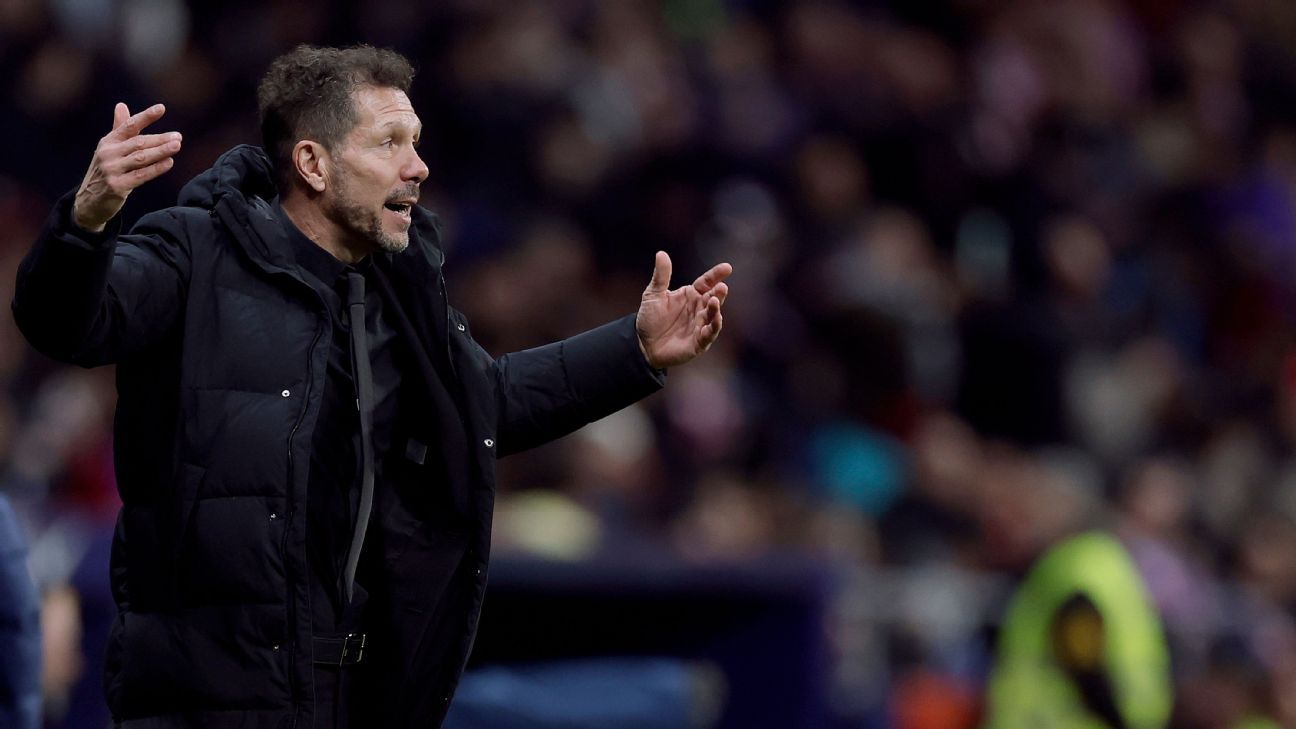
The last time Diego Simeone lined up an Atlético Madrid side in the Champions League, he was in touching distance of that coveted top-eight finish which would have earned his club a succulent €18.2 million bonus and saved them two deeply unwelcome and risky extra knockout matches.
Exactly three weeks later, when the Argentine coach lines Atleti up against Club Brugge on Wednesday for the first leg of their playoff to reach to round of 16, it’s arguable that the future of the most successful coach in Los Rojiblancos’ history is in real jeopardy.
Here’s why: Atleti have stunk the house out in 2026.
Evidence? Two wins out of six in LaLiga, the last three without scoring — two of which were against relegation teams. Now Atleti are 15 points behind the leaders Real Madrid.
– Stream every LaLiga match LIVE on ESPN+ (U.S.)
– Ogden: Real Madrid broke Mourinho. Now his Benfica could break them
– ESPN roundtable: Three ways the Champions League format could be fixed
In the Champions League, that top-eight finish was begging them to gobble it up, earn the aforementioned €18.2 million bonus and avoid dangerous knockout matches — but Atleti fluffed their lines, took one point from six, and were left with their noses pressed against the window marked “Elite.”
Worse, the embodiment of that embarrassment was one of their most humiliating European performances, losing 2-1 to Bodø/Glimt in Madrid.
Had they beaten the novice Norwegians 4-0, Atleti would have finished in the top eight and barged Pep Guardiola’s Manchester City off the high table in the process. It would have been a huge boost; invaluable to club coffers and allowed vital respite for tired players. But, despite leading 1-0, Atleti collapsed against Bodø/Glimt — humbled by a club from a 48,000-population city in its debut Champions League campaign.
Set against that is Simeone’s team winning 5-0 and 4-0 against Real Betis and Barcelona, respectively, in the Copa del Rey. Results that grab your attention and, temporarily, demand respect. But Atleti, with the consistency of their competitive mentality about as strong as a wet paper bag, backed up their thrashing of Betis in Seville by losing 1-0 at home to the very same team three days later for the equivalent LaLiga fixture.
And that stirring dismantling of Hansi Flick’s Spanish champions in the Copa semifinal first leg? That was immediately followed by a performance of craven surrender when Atleti faced third-bottom Rayo Vallecano (15 places and 23 points lower than Simeone’s team) but slumped to a 3-0 defeat — registering their worst loss to Rayo since 1981.
It’s revealing when most the damning words for such Jekyll-and-Hyde performances, which would make any team, not just Atleti, look extremely badly coached and inefficiently led, come from your own goalkeeper. But Jan Oblak, clearly still stunned and fuming at the quality of his teammates’ display against previously hopeless Rayo (in the relegation zone before kick-off) didn’t hold back on Spanish TV on Sunday afternoon.
“After this, it looks like we’ve tossed any chances of winning the league away,” he said. “You can’t lose matches in this manner.
“You can’t put in that kind of match display. Performing like this it’ll be difficult for us to be competitive.
“You can’t pick and choose matches in which to perform. You need to play to your maximum all the time and we haven’t done that here. Congratulations to Rayo — they were much better than us — we deserved to lose.”
Note the “will be extremely difficult for us to be competitive.” Oblak was referring to challenges to come in the Champions League and Copa del Rey semifinal second leg. They are some deeply pessimistic words from a guy who is playing his 102nd Champions League match on Wednesday.
What made matters worse was that his coach, Simeone, immediately argued that the big Slovenian was talking rubbish: “I don’t agree with what Oblak said. The team doesn’t choose matches; we played poorly, and when the rival plays better, and is superior they beat you.”
Well, that’s alright then Diego! It’s only that your team plays poorly and the rivals are better. Phew! No problems there. What a chancer.
Somehow, Simeone still gets away with trotting out that kind of banal nonsense. It’s a great mass-hypnosis act to argue that the only problem you have is playing poorly and being out-done by your opponent and, using that tactic, somehow turn attention elsewhere. Those are the very pieces of evidence which, at any other club, gets you sacked.
To put things in context, particularly given that Atleti are alive and kicking in two knockout competitions, let’s look at where Simeone’s team is currently, compared to the last decade in LaLiga. Only twice in the last 10 years have Atleti been worse statistically than they are right now.
Those were after Matchday 24 in 2020 and Matchday 24 in 2022 — the first just as the COVID-19 pandemic broke out, and the second at a time when Simeone subsequently admitted that he began to believe that his time was up.
A few months after that 2022 trough, the Argentine was asked by Diario AS: “In those weeks before the last World Cup, did you feel like the cycle was ending?”
Simeone responded: “Without a doubt, it was the worst part of all my years at the club. I’m not stupid. I saw, just like you, that the team was playing badly, that it lacked identity, commitment, effort, and that its passing didn’t inspire confidence.”
Rather like now, in fact. Reliable word has it that, ath the time, the Atleti directors were getting ready to say: “Thanks for the memories!” and “Adiós!” to Simeone until his team revolutionised itself, upped its performance level and started surging up the table.
Fast-forward to today, and Simeone remains a hot topic around Atleti’s ownership, media and fans.
He’s the longest-serving coach of a Spanish club in history but — after a blitz of trophies when he arrived, when the side was buzzing with vitality, standards were higher, and Simeone was able to coach his defence into extreme stinginess — the club’s habit of lifting silverware has been traded for settling for being a cash-cow.
No trophies in the last five years, just one in the last eight — but, for example, €85 million filling the coffers from the revamped Champions League cash-printing machine last season when Atleti made it to the last 16.
It was after that otherwise disappointing season finished that Simeone admitted to Spanish radio in June 2025: “One or two friends advised me that this was the time to leave Atlético.”
Why? Well, there’s a new broom coming at the club. Atlético Madrid are in the process of drastic ownership change, thanks to share purchase from US investment company Apollo Sports Capital — and their financial stake will have been based on actuarial calculations about the future, not on Simeone’s once-glorious past.
Simeone has a new, sceptical, boss in the shape of Mateu Alemany, who’s widely understood to be weighing up the candidacy of both Villarreal‘s Marcelino and Atleti legend Fernando Torres, who is currently in charge of their B-team.
What hasn’t changed, what never changes, is that the club feeds off Champions League progression and the vast financial injection they require that to bring them.
Maybe this season brings a trophy-lift for Simeone; someone, who so often “Houdinis” his way out of a bind.
Alternatively, should Simeone’s team “play badly” and be “out-performed by their rival” in Bruges this midweek, it’ll be treated far more seriously than the unpalatable but oh-so “seen-it-all-before” defeats to Bodø/Glimt, Betis and Rayo these past few weeks.
Simeone’s reputation and job are on the line.
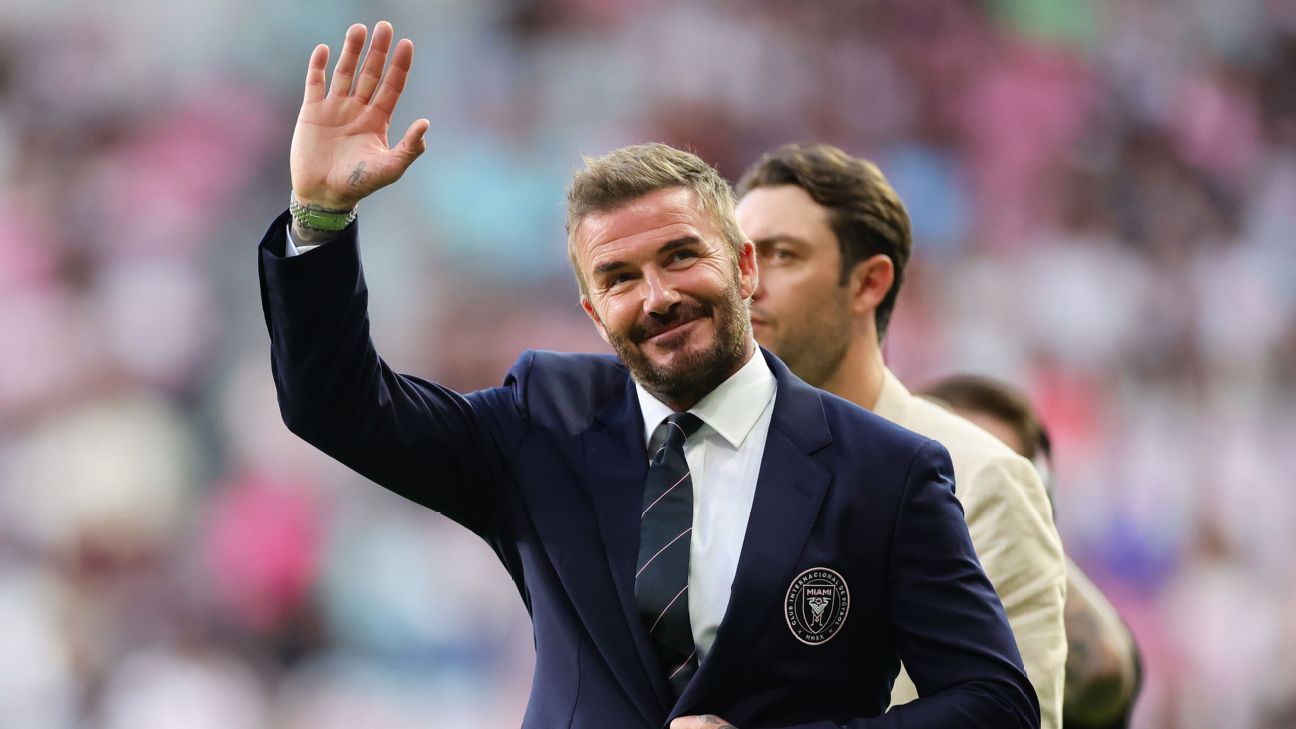
Inter Miami co-owner David Beckham spoke of a dream come true as his team played its first ever game at Nu Stadium on Saturday — a 2-2 draw with Austin FC.
The Englishman, who helped to found the club in 2018 after six years with LA Galaxy and another six getting Miami up and running, has overseen the side’s meteoric rise to MLS champions and the home of Lionel Messi.
“When I came to America and the MLS 20 years ago, my dream was to win championships, help raise the game of soccer that I love so much and to build my own team,” Beckham said ahead of the draw against Austin.
“Thirteen years ago, I announced Miami was my choice. We had no name. We had no fans. We had no stadium. Today, I stand in our new home.
“We are champions of the MLS. We have the best player in the history of the game playing in Miami. Dreams really can come true.”
With the club having made its MLS debut in 2020, Miami has become home to some of LaLiga’s biggest stars of the last 15 years — Gonzalo Higuaín, Sergio Busquets, Jordi Alba, Luis Suárez and Messi have all played for Beckham’s team, where Javier Mascherano has been the head coach since Nov. 2024.
Following Messi’s arrival in 2023, Miami won the Supporters’ Shield in 2024 and claimed their first MLS title in 2025, with the Argentine winning the league’s MVP award in both seasons.
Up until now, though, the team has had to play their home games in Fort Lauderdale, about 25 miles north of Miami.
– Messi tracker: Goals, assists, key moments in 2026
– With Messi goal, Inter Miami open new stadium with dream moment
– Lionel Messi scores as Miami opens long-awaited new stadium
Messi and Beckham were far from the only celebrities involved with Saturday’s game. Actor Matthew McConaughey, who is part of Austin FC’s ownership group, even wrote an open letter to Beckham to congratulate him on his nearly two-decade relationship with the league.
“As Austin visits Miami today for a little shindig on your new pitch, I want to first shout out a sincere ‘thank you’ — you didn’t create soccer over here in the US, but you damn sure supercharged it,” the actor wrote.
“When you came to the Galaxy you gave MLS fresh legitimacy, you turned games into events, and essentially changed MLS from a proving ground to a premier destination. THANK YOU.”
Information from ESPN’s Lizzy Becherano and The Associated Press was used in this report.
The ball is tipped
And there you are
You’re running for your life
You’re a shooting star
David Barrett was sitting in a bar when the idea came to him. The 31-year-old musician had spent his entire young adult life grinding as a performer in the watering holes of Michigan. College bars. Dive bars. Even the occasional honky tonk. On this particular spring night in 1986, it was an East Lansing establishment known as the Varsity Inn and his set — a performance heard by perhaps two dozen patrons — was done.
And all the years
No one knows
Just how hard you worked
But now it shows
Barrett was unwinding over a drink. With one eye he watched the TV over the bar, watching Larry Bird’s Boston Celtics running over another unfortunate NBA opponent. His other eye was affixed on the woman who had served him that drink.
“The waitress was so beautiful, I thought, well, I’m a songwriter, so perhaps my only chance to catch her attention was through poetry,” Barrett says today. “If I could express to her the poetry of Larry Bird’s abilities at the height of his career, this special moment in his life creating so many special moments on the court, perhaps she would be impressed.”
Well, was she?
“No, she was rather busy.”
No offense to Barrett, but we should all be thankful that she had more critical tasks than posting up at the bar to admire the singer’s basketball spoken word. Because it was within that space of lonely time that, inspired by his own lesson about moments, he scribbled three words onto a cocktail napkin. The following morning, he expanded those words into a chorus, this time onto a stack of napkins at a brunch spot, The Knight Cap Too.
In one shining moment,
it’s all on the line
One shining moment,
there frozen in time
For nearly 40 years, those lyrics and the tune Barrett wrote to accompany them have been the soundtrack of our college basketball lives. On Monday night, shortly after the men’s college basketball national champion is crowned, the winning team will lock arms on the floor of Lucas Oil Stadium, gaze up at the jumbotron and soak up a three-minute montage of clips from this year’s tournament, set to Barrett’s song, building to the inevitable 30-second climax of images of them winning the very title that they are very much still celebrating.
“There are so many moments that make up a championship celebration,” explains Mike Krzyzewski, who won five national titles as Duke’s head coach. “There’s the moment the game ends. There’s hugging your family. There’s cutting down the nets. The moment of being handed the trophy. But the moment it feels real is when they play ‘One Shining Moment.'”
“It’s this literal life-flashing-before-your-eyes thing, watching that video set to that song,” adds John Calipari, who won it all with Kentucky in 2012. “It’s like watching a movie of your life, that you wrote, with the people who wrote it with you.”
“You also don’t just watch it if you win it,” says Tom Izzo, who celebrated with Michigan State in 2000. “If you are there at the game, you wait to see it. If you are home on the sofa, you wait to see it. The season isn’t done until you hear that song.”
And to think, the NFL almost intercepted it right out from under college basketball’s nose.
For that moment, let’s go back to ’86. That’s when Barrett met sports reporter Armen Keteyian. Keteyian, like Barrett, was a native of the Detroit area and had moved to New York to write for Sports Illustrated. Whenever Barrett went East, he’d stay at Keteyian’s apartment. During one of those visits, the two were watching the NBA Finals on TV — Larry Bird again, doing work against the Houston Rockets — and Barrett mentioned his basketball song from the napkins.
Keteyian told Barrett that if he got the song recorded, he’d love to hear it.
A few weeks later, a cassette was waiting in Keteyian’s mailbox, tracks laid down in a make-do studio used for local advertising jingles. The reporter loved it, so he walked the tape over to a colleague in TV production.
“One day my phone rang and the gentleman on the other end said he was Doug Towey and he was the creative director at CBS Sports,” Barrett recalls now, his throat catching to hold back tears. “Of course, I didn’t believe him at first. He sounded like a buddy of mine pulling a prank. But over the next 15 minutes, I made a friend for life over a phone call that changed my life.”
Towey, a sports television legend — the theme music for The Masters, the iconic CBS Sports college sports themes, you name it and Towey was probably behind it — had fallen in love with the song and told Barrett that he really, really wanted to use it for … Super Bowl XXI?
“Yes, it was a basketball song, but you know what you do not do in that situation?” Barrett says. “You do not say no to CBS. Why yes, Doug Towey, please use my song for the Super Bowl!”
CBS even flew Barrett out to Pasadena to watch the matchup between John Elway’s Denver Broncos and Lawrence Taylor’s New York Giants. During his postgame report, sportscaster Brent Musburger even quoted the song. “The New York Giants, their first Super Bowl triumph, a shining moment they will never forget…” The time had arrived. Barrett’s big break was happening!
But it never ran. The Super Bowl-winning Giants were a little too chatty in their postgame locker room interviews, so the broadcast ran long, and time ran out. Barrett was crushed — until a second call from Towey.
“He said they wanted to use it for March Madness,” Barrett’s voice nearly explodes as he tells the story. “So, my little song about basketball, you know what? It figured out a way to make sure it was still a basketball song.”
On March 30, 1987, “One Shining Moment” made its debut in the most perfectly shiny momentous manner.
Indiana’s Keith Smart had stroked a drifting corner jump shot with four seconds remaining to defeat Syracuse for the championship. CBS Sports editors scrambled to add nine shots from that game to the end of the montage they had already pieced together throughout the month. The seventh of those images was Smart’s dagger.
From a clunky makeshift video edit room next to the CBS production truck in the bowels of the Superdome, the instant those shots were added, the videotape was popped and sprinted by hand via a panicked young producer to the end of that truck, where tape machines had just spent hours turning around instant replays and interview clips for the telecast. It got crammed into one of those machines, cued, and ready to play.
Once again, it was Musburger who did the lead-in honors. And this time it aired.
“The idea of the song, that one moment can change everything. Well, that’s what happened to me in that moment,” says Barrett, who has since composed themes for CBS, ABC and PBS, melodic backdrops for the Olympics, U.S. Open tennis, the PGA Championship, and a documentary about C.S. Lewis. He’s won two Emmys.
His go-to joke now is to say: “After all those years, suddenly I had talent!”
Since that night, CBS Sports and now TNT have aired 38 editions of “One Shining Moment” performed by four different singers. Barrett himself did the honors over the first seven editions before Towey recruited Philadelphia soul legend Teddy Pendergrass for a new version. Bennett’s vocals returned in 2000, along with a bluesier overhaul of the tune. Two years after that, Barrett received another call from Towey, asking how he’d feel if Luther Vandross were to give the song a spin. Barrett said of course and asked when it would happen. Towey, clearly having already made up his mind before the call, told Barrett that Vandross was slated to be in the studio that very night.
Vandross laid down his vocals in the winter of 2002, captured by CBS cameras to be intercut with the hoops highlights in true music video fashion. The following spring Vandross suffered a massive stroke that forever altered his voice, meaning that “One Shining Moment” was the final song recorded by the legendary artist.
It has been Luther’s song ever since, with the exception of 2010, when Oscar winner Jennifer Hudson’s rendition was beloved for its sound but criticized because the internet claimed it was imbalanced, with too much of her and not enough college basketball. (At 3:12, it’s only a few seconds longer than average, and Hudson is featured for a total of about eight seconds.)
Screening all 38 editions of “One Shining Moment” (thanks, Internet!) is a history lesson not just on college basketball, but television production. Grainy standard definition video transitions into 4K HD as majestically as the images of 1980s feathered hairstyles morph into low burst fades. The production process has evolved not unlike the game being played on the floor of the arena. Digitized and fast-paced, with the ability to be nimble on the fly like UConn and Michigan on the break. But the spirit of how it is pieced together hasn’t changed at all.
“We have a dedicated team that travels to the Final Four. They are on site,” explains Drew Watkins, SVP and Creative Director of TNT Sports, from the sprawling TV production compound that sits outside the south gate of Lucas Oil Stadium.
Watkins has been with TNT since 2000; before that he was an entry-level producer at ESPN. On Monday night, he will be keeping an eye on his on-site producer and editor, George Adams and Chris Vining.
“They’re in one of our edit trucks and are linked in with the studio and the game production truck,” Watkins says of how it will all go down as the clock ticks down on the title game. “So, when we’re editing those plays, and we’re filling in those last few moments and winners are being decided and ‘One Shining Moment’ is minutes away from airing, there is a team on site in the TV compound that is putting those shots together, talking to the broadcast trucks to make sure everything is on track.”
There will actually be two edit suites running simultaneously, just in case. Because all it takes is one power outage, one video glitch or one computer deciding that it’s a great time for a restart, to turn the dream of Barrett’s song into one nightmare moment. Redundancy is a producer’s best friend. No one wants to be the person who ended a four-decade streak of making air.
“The good news is that we have backups in place,” Watkins said. “The better news is that nobody’s having to pop a tape and run it across a parking lot anymore.”
Once that final shot is added and the final click of the mouse sends the finished product to the truck, Adams, Vining, Watkins and their colleagues make sure to pause and watch their work go out into the world, collapsed back into the chairs of their respective production trucks, just like the 20-plus million viewers at home.
Meanwhile, the viewing of “One Shining Moment” as it airs on the arena’s big screen always feels downright intimate, even on a tiny basketball floor situated in the center of a 70,000-seat NFL stadium-turned-basketball gym.
That’s the part that chokes up Krzyzewski, Calipari and Izzo when they talk about it. The part that former players always remember as the pinnacle of their first minutes as champions.
On Monday night, the man who brought us the song will be right there with them. Because it’s his favorite part, too: David Barrett’s literal “One Shining Moment.”
“People ask me all the time which ‘One Shining Moment’ is my favorite one to watch, but I can’t answer that. That’s impossible,” he said on Saturday morning as he prepared to attend the semifinal games with his wife, Tracy. (No, she’s not the waitress from East Lansing, though that server, Jan Shoemaker, and Barrett were eventually reunited through a mutual friend.)
Tracy is a Michigan alum, and she and David still live in the Detroit area, where they raised two girls. As soon as they arrived in Indianapolis, they purchased some Block M Final Four gear before they witnessed the Wolverines’ devastation of the Arizona Wildcats to officially become the favorites to win the national title.
“No, I do not have a favorite ‘One Shining Moment,'” Barrett repeated. Then he laughed. “But Monday night, if we get to watch the home team watch themselves celebrate a championship, set to my little basketball song, well…”
That would be a moment.
“Yes, it would.”
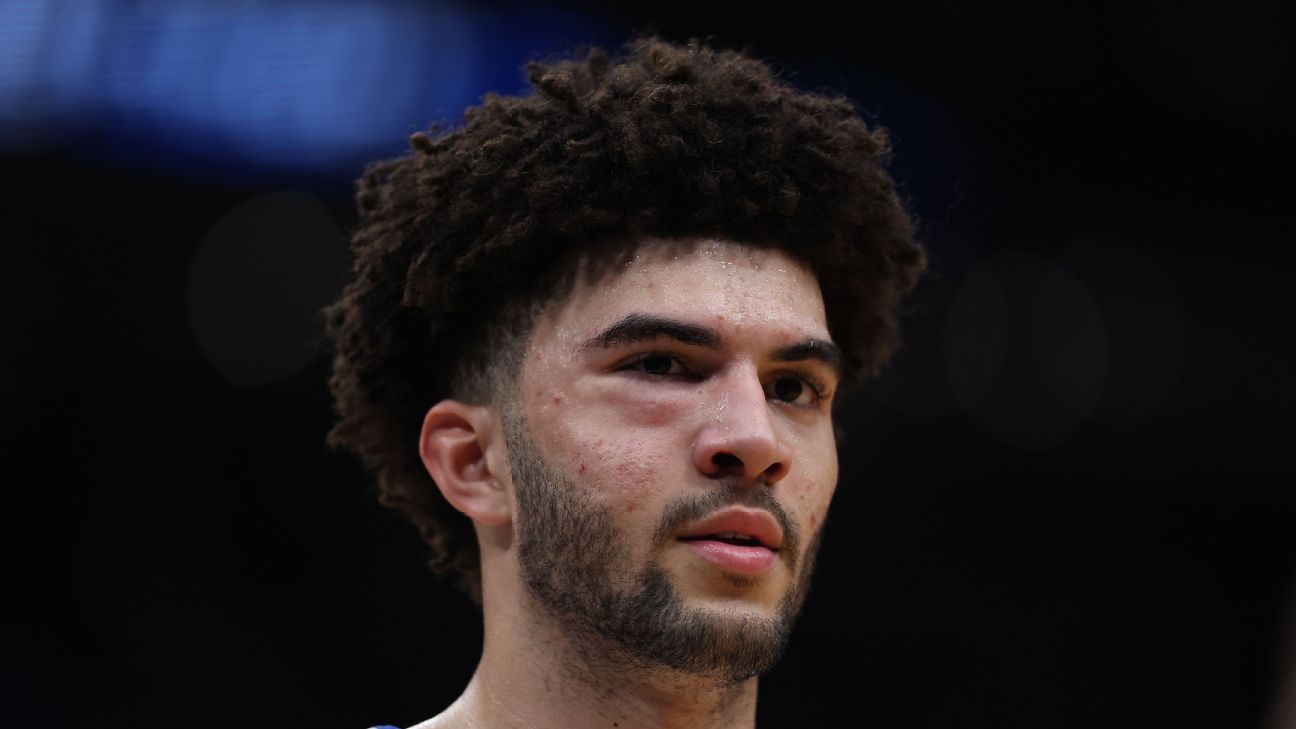
INDIANAPOLIS — Duke star freshman Cameron Boozer, a projected top-five pick in the 2026 NBA draft, said he suffered multiple fractures around one of his eyes during his team’s loss to UConn in the Elite Eight.
Boozer did not offer specifics about the injury but said he decided against surgery only two months before the NBA draft.
“I have a couple of fractures, but I’m all good,” Boozer said as he accepted The Associated Press and United States Basketball Writers Association player of the year awards. “I’m just going through the healing process. It hurt in the game, but I wish the outcome would have been better, but that’s not really what I’m here to focus on. We had a great year. Like I said, it’s an individual award, but I wouldn’t be here without my teammates and my coaches.”
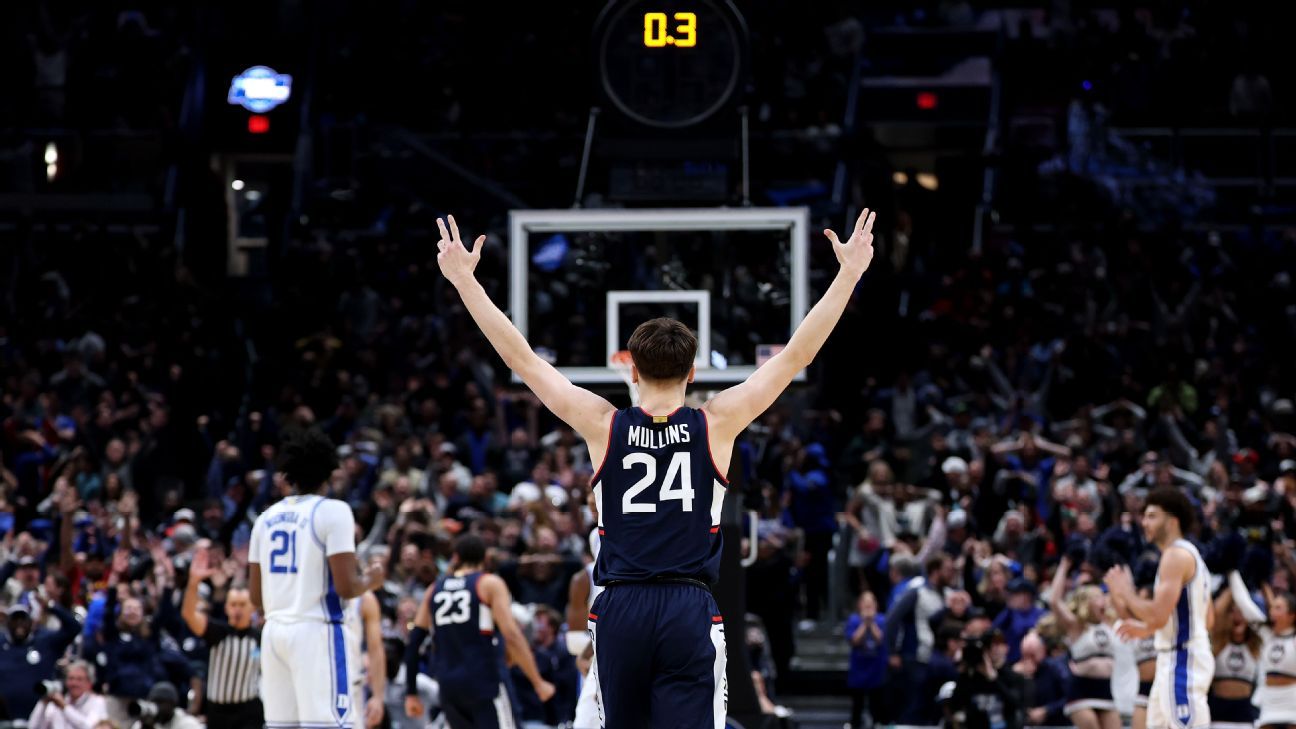
During Duke’s 73-72 loss to UConn on March 29 — decided on Braylon Mullins‘ 3-pointer with 0.4 seconds to play — Boozer took an elbow to the face as he drove to the rim on 7-foot-1 center Eric Reibe. Soon after the play, Boozer’s right eye began to swell and a Duke trainer applied a soda can to his face while he sat on the bench.
Depending on its severity, the eye injury could impact Boozer’s standing in the NBA draft. He is one of the most decorated players in college basketball history, but he has faced scrutiny about whether he has the next-level physical tools to compete against bigger, stronger and more athletic players in the NBA.
The 6-9, 250-pound forward said he is ready to “win” in the NBA, no matter where he’s picked.
“I think I’m just a winning player, all-around player. I think I impact the game in so many different ways,” Boozer said. “And I think my competitiveness translates to any level. I think any team who takes a chance on me is going to be very happy with the results they get from it.”
Boozer admitted that he had a lot of emotions accepting awards in Indianapolis, the site of this year’s Final Four, a week after his team had been eliminated by the Huskies, who will face Michigan in the national title game Monday night. But those emotions were secondary to his feelings after his twin brother, Cayden Boozer, faced backlash on social media following his turnover that preceded Mullins’ game-winning shot in the loss.
“First of all, I’d like to say it’s definitely nasty, but that’s not the reason, that one play is not the reason we lost,” Cameron Boozer said. “But just being there for him, obviously it’s tough. It’s going to be hard for anyone to go through that. There is not really that much I can say to make him feel better. We’re all hurting as a team, but we’re going to get through it together. We’re a super-connected group. It’s definitely a hard moment, but he’s a tough guy. We’re all tough. It’s going to make us so much better going forward. So it’s something you’ve got to take on a chin and learn and grow from.”


How Vietnam T&A sector is recalibrating for the next growth journey

US’ Nike’s Q3 earnings dip as DTC weakness offsets wholesale strength

Pakistan, other mediators ‘make last-ditch’ efforts for Iran-US ceasefire: report

-
 Sports1 week ago
USMNT handed reality check by Doku, Belgium ahead of World Cup
-

 Sports1 week ago
2026 NCAA men’s hockey tournament: Schedule, results
-
Uncategorized4 days ago
[CinePlex360] Please moderate: “Trump signals p
-

 Tech2 days ago
Our Favorite iPad Is $50 Off
-
Uncategorized7 days ago
[CinePlex360] Please moderate: “Further tariff
-

 Entertainment3 days ago
Joe Jonas shares candid glimpse into parenthood with Sophie Turner
-
 Entertainment1 week ago
The Avett Brothers’ bassist explains why he wrote a book about John Quincy Adams
-
 Sports1 week ago
Man City show why they are worthy WSL title winners as tired United wilt