

Business
Lululemon reports weak guidance as proxy battle, tariffs weigh on bottom line


Lululemon offered a weak 2026 outlook on Tuesday as tariffs, higher expenses and a dramatic proxy battle with its founder weigh on its bottom line.
The athleisure company’s guidance for both the current quarter and the fiscal year came in lower than expected on the top and bottom lines.
Lululemon is expecting first quarter sales to be between $2.40 billion and $2.43 billion, weaker than estimates of $2.47 billion, according to LSEG. It anticipates earnings per share will range between $1.63 and $1.68, also weaker than estimates of $2.07.
For the full year, Lululemon is expecting sales to be between $11.35 billion and $11.50 billion, below expectations of $11.52 billion. Earnings guidance of $12.10 to $12.30 per share was also far weaker than estimates of $12.58.
“The work is really underway in terms of our action plan, and we’re really focused on the importance of course correcting on a number of fronts,” interim co-CEO Meghan Frank told CNBC in an interview. “We’ve got a new creative director, his first line is hitting in Q1, we are seeing some green shoots, I would say, from the product in Q1 so we’re excited about some of the momentum we have on that line item. We have had some great response from some of our recent product activations, and then we’re also reducing our speed to market timeline.”
During Lululemon’s holiday quarter, the company beat estimates on both the top and bottom lines, though Wall Street had lowered its expectations for the period in recent months.
Here’s how the Vancouver-based retailer performed during its fiscal fourth quarter compared with what Wall Street was anticipating, based on a survey of analysts by LSEG:
- Earnings per share: $5.01 vs. $4.78 expected
- Revenue: $3.64 billion vs. $3.58 billion expected
The company’s net income for the three-month period that ended Feb. 1 was $586.9 million, or $5.01 per share, compared with $748.4 million, or $6.14 per share, a year earlier.
Sales rose slightly to $3.64 billion, up about 1% from $3.61 billion a year earlier.
Lululemon raised its fiscal fourth-quarter guidance during the ICR conference in Orlando earlier this year, so all eyes were on the company’s 2026 guidance following more than a year of underperformance.
The retailer, always considered a premium brand that rarely offered promotions, had been leaning on discounts to drive sales and move inventory. The company is now working to pull back that strategy this year, Frank said. Lululemon expects the move will weigh on sales in the near term, but it will bring the company back to a full-price business over time, she said.
Meanwhile, it’s seeing a number of pressures on its bottom line. Higher tariffs and the end of the de minimis exemption continue to be a major cost for the company.
This year, Lululemon expects tariffs to cost the company $380 million, up from $275 million last year, on a gross basis. Once mitigation efforts are taken into account, the net impact is expected to be $220 million in 2026, up from $213 million in 2025.
Lululemon has been negotiating with suppliers and taking other actions to reduce its exposure to tariffs, but it isn’t increasing prices to offset the added costs, especially as it looked to promotions to drive sales in recent months. The brand was already priced toward the high end of the market prior to President Donald Trump’s tariff hikes last year, leaving it with fewer tools in its arsenal to offset the duties, especially as it faces intense competition and a slowdown in the athleisure market.
Last year, the company raised prices on a select number of items. Shoppers are still responding favorably so far, but there are no plans to build on those increases for now, said Frank.
Beyond tariffs, the company is also seeing higher expenses from marketing, labor, incentives and costs related to its proxy contest with founder Chip Wilson. Wilson, Lululemon’s largest independent shareholder, has been pressuring the company to make changes to its board of directors and has criticized it for losing sight of its creative vision.
Just before releasing earnings, Lululemon announced it was adding former Levi Strauss CEO Chip Bergh to its board of directors. Bergh was not among the candidates Wilson put forward for consideration, but he does have considerable public company experience and spent around 13 years as Levi’s CEO. During his tenure with the company, Levi began pursuing a more profitable direct selling strategy and sales rose by around 30%.
As part of the announcement, Lululemon said board member David Mussafer, managing partner and chairman of private equity firm Advent, will not stand for re-election during the company’s upcoming 2026 shareholder meeting at the conclusion of his current three-year term. The announcement marks a win for Wilson, who has criticized Mussafer publicly. In a letter to shareholders last month, Wilson pointed out that Mussafer was overseeing the board’s interview process for prospective nominees at a time when he was up for election, creating a potential conflict of interest.
A source familiar with the matter said Wilson had called on Mussafer to step down from the board because he lacks independent leadership, among other issues.
Mussafer didn’t immediately respond to a request for comment.
Prior to the earnings announcement, Wilson issued a statement saying shareholders will be “critically evaluating” any claims of success or improvement from Lululemon when it released results.
“The core issue at lululemon is one the Company has struggled with for years: there is a disconnect between the Company’s creative engine and the Board’s understanding for how brand power and product excellence fuel cultural strength, margin durability and long-term shareholder value,” he said.
Lululemon declined to comment.
While parts of Lululemon’s business are still growing, it has primarily seen that expansion in China and in other international regions, which make up a fraction of overall revenue. Same-store sales in its largest region, the Americas, haven’t grown in around two years, and Lululemon is expecting another year of declines in 2026.
The company said it expects sales in the Americas to decline between 1% and 3% in 2026.
Meanwhile, sales in China are expected to grow around 20%, and the rest of the world by a mid-teens percentage.




Oil prices fell and Asian stock markets surged to record highs on Wednesday after Donald Trump said negotiations with Iran were making “great progress” toward a final agreement and announced a brief pause in US operations escorting ships through the Strait of Hormuz.
Brent crude tumbled 1.2 per cent to $108.51 a barrel, still well above its roughly $70 price before the war began, but lower than the highs of recent weeks.
Wall Street had already set records on Tuesday, with the S&P 500 rising 0.8 per cent to a new all-time high and the Nasdaq gaining 1 per cent, as oil pulled back sharply after briefly crossing $115 on Monday.
Strong corporate earnings underpinned the Wall Street rally. DuPont surged 8.4 per cent after the chemical giant reported better-than-expected first-quarter profits and raised its full-year forecasts, even as it acknowledged some impact from logistics disruptions in the Middle East.
Pinterest jumped 6.9 per cent after its number of active monthly users rose 11 per cent to 631 million, beating Wall Street’s sales and profit targets. AB InBev climbed 8.7 per cent after topping profit forecasts on growth for its Corona, Stella Artois and Michelob Ultra brands. “Cheers to beer,” chief executive Michel Doukeris said.
Palantir fell 6.9 per cent despite beating expectations, as its stock continued to struggle on worries about increased competition. American Electric Power rose 1.8 per cent and Cummins added 2.8 per cent after both reported stronger-than-expected results.
In Europe, markets were mixed. The CAC 40 rose 1.1 per cent in Paris while the FTSE 100 fell 1.4 per cent in London. Hong Kong’s Hang Seng fell 0.8 per cent. Many Asian markets were closed for holidays.
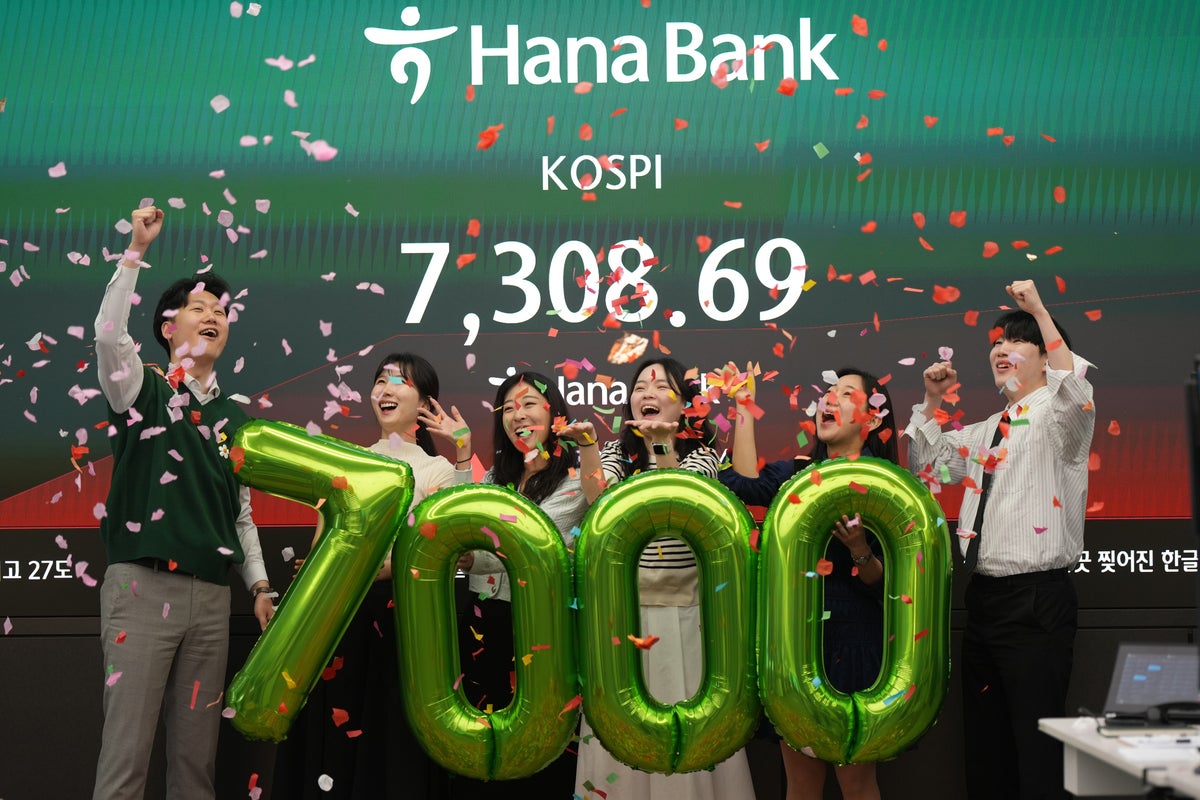
The momentum carried into Asia on Wednesday, where MSCI‘s broadest index of Asia-Pacific shares outside Japan jumped 2.3 per cent to a fresh all-time high. South Korea’s Kospi surged 5.1 per cent, clearing the 7,000 mark for the first time, as Samsung Electronics jumped 12 per cent and crossed a $1 trillion market valuation, overtaking Berkshire Hathaway.
The AI trade drove much of the enthusiasm. Advanced Micro Devices jumped 16.5 per cent in extended trading after forecasting second-quarter revenue above Wall Street expectations on strong demand from cloud computing companies accelerating spending on AI infrastructure.
“Due to the capital expenditure we are seeing from hyperscalers in the US, the earnings growth trajectory for sectors such as semiconductors, tech hardware, industrials and materials in Asia exceeds anything I have seen in a long time,” Rushil Khanna, head of equity investments for Asia at Ostrum, an affiliate of Natixis Investment Managers, told Reuters. “This capex is leading to material value creation in Asia as the provider of the picks and shovels to the AI ecosystem.”
The diplomatic backdrop of US-Iran talks also helped the markets. Mr Trump said he would briefly pause US operations escorting ships through the strait, which has been effectively closed since Iran blockaded it in late February, triggering a global energy shock. US defence secretary Pete Hegseth confirmed the ceasefire remained in place despite the US and Iran exchanging fire the previous day.
“Markets embraced a sense of calm and stability overnight, with the risk of escalation in the Middle East conflict viewed as having diminished,” analysts from Westpac wrote in a note.
Despite the optimism, analysts cautioned that significant uncertainties remained this week.
“A fragile ceasefire, a novel blockade, Friday’s NFP and diminishing odds of a US-Iran peace deal are all converging this week,” said Lukman Otunuga, head of market research at trading broker FXTM.
“Gold may find itself on the losing end of conflict-induced inflation fears, even as uncertainty grips markets.”
Gold rose 1.2 per cent to $4,609.59. The dollar index slipped 0.1 per cent, snapping a three-day winning streak, with the euro rising to $1.1724 and sterling to $1.3577.
The Australian dollar climbed 0.6 per cent to its highest since June 2022, buoyed by improved risk appetite and underpinned by a third consecutive interest rate rise from the Reserve Bank of Australia, which cited the Middle East conflict’s impact on fuel and commodity prices. The ten-year US Treasury yield held flat at 4.424 per cent.

President Donald Trump raised hopes of an agreement between the US and Iran after days of escalation.
Source link
Retailers braced for the effects of the Middle East conflict have urged the Government to cut domestic costs to help them keep prices down for consumers.
The British Retail Consortium (BRC) said four in five people (80%) feared the Middle East conflict would push up food prices, and called on the Government to help by easing pressure on businesses from higher national insurance, packaging levies, new regulations, and business energy charges.
The BRC said retailers were already absorbing “significant” additional costs from the conflict including rising energy and shipping costs, with knock-on effects for fertiliser, manufacturing and logistics.
It warned those costs would inevitably filter through to the till over the coming months.
But it said the Middle East was only part of the picture, and retailers had absorbed £6.5 billion in extra employment costs from rising national insurance contributions and the national living wage, alongside a new packaging tax costing £1.6 billion.
Meanwhile, more regulatory “burdens” were imminent, including guaranteed hours provisions under the Employment Rights Act and the proposed reformulation of thousands of food lines under the new nutrient profiling model.
A survey for the BRC found 73% of people expect the Middle East conflict to raise the price of products other than food, while 81% are worried about rising energy bills, 76% about petrol and diesel, and 68% about tax increases.
Food retailers met Chancellor Rachel Reeves in early April and called for the removal of energy policy levies, network charges and system fees that now make up between 57% and 65% of a typical business electricity bill.
They also asked for the introduction of the updated nutrient profiling model for food and drink to be delayed, and for a review of the triple packaging levy, forecast to cost retailers more than £2 billion a year.
BRC chief executive Helen Dickinson said: “The Middle East conflict is driving up costs across the supply chain and families are right to be concerned.
“But not every pressure bearing down on retailers comes from the Gulf. Higher national insurance, packaging levies, new regulations, and business energy charges are all domestic policy decisions, made in Westminster, and they can be addressed there.
“Such action by government would help retailers to keep prices affordable for households.
“Other governments are already acting. Germany has reduced electricity costs for businesses by moving levies off bills and EU leaders are actively discussing similar responses to this crisis.
“The UK should be moving in the same direction, not treating global instability as cover for inaction on costs of its own making.
“Retailers are working hard to hold prices down, but they cannot do it alone.
“Every cost government chooses not to address is a cost that will find its way into someone’s shopping basket. That is a political choice, and it is one ministers still have time to change – but the window to act is closing.”

Oil prices fall as Trump pauses Project Freedom to seek final peace deal with Iran

US’ Crocs’ Q1 strong on DTC growth; margins, EPS decline

Italy’s inflation rises to 2.8% in April on energy spike

-

 Tech1 week ago
A Brain Implant for Depression Is About to Be Tested in Humans
-

 Tech1 week ago
Almost 90% of women leave tech industry within 10 years | Computer Weekly
-

 Sports1 week ago
Pro wrestling star Steph De Lander reveals how colleague’s advice helped lead her to title triumph at ACW
-
 Business1 week ago
‘I had £20,000 stolen and had to fight a 13-month fraud reporting rule to get it back’
-

 Entertainment1 week ago
Norway joins Type 26 Frigate Programme to boost NATO naval power
-

 Entertainment1 week ago
Melania Trump says ABC should ‘take a stand’ on late-night host Kimmel
-

 Tech1 week ago
Are tech leaders risking a cyber resourcing crisis? | Computer Weekly
-
 Business6 days ago
PSX plunges over 4,800 points | The Express Tribune