

Fashion
Luxury reshapes Milan’s Quadrilatero with a wave of dazzling new flagships

Translated by
Nazia BIBI KEENOO
Published
September 24, 2025
Saint Laurent, Fendi, Celine, Valentino, Dries Van Noten, Alberta Ferretti, Plan C, JW Anderson, Ports 1961 — these are just a few of the luxury heavyweights ushering in a new chapter for Milan’s high-end retail scene. As Milan Fashion Week kicks off on Tuesday, September 23, the city is witnessing an unprecedented wave of flagship openings that are reshaping the heart of the Lombard capital. At the center of this transformation lies the iconic Quadrilatero district and its surrounding streets, now buzzing with renewed energy and strategic investments. Together, these launches reflect a confident rebound in the luxury market — and a bold commitment to Milan as a global style capital.
Dries Van Noten
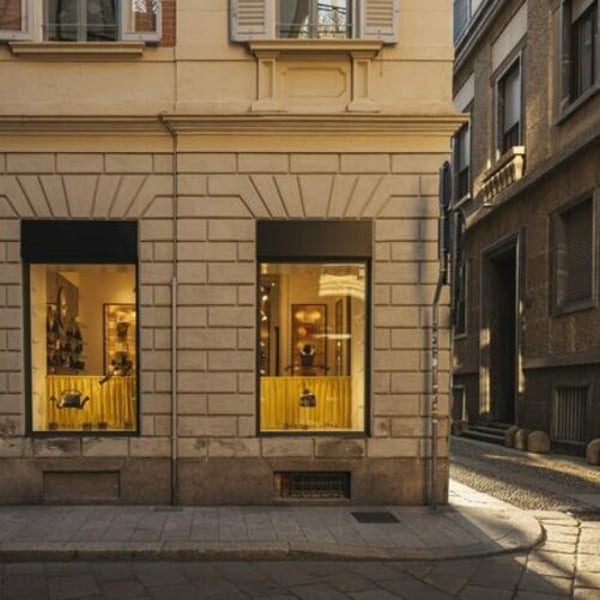
Dries Van Noten is making his Milan debut with the opening of his very first boutique in the trendy Brera district, at 11 Via Brera — a historic cobblestone street in the city center. The 50-square-meter “Gallery” concept, already launched in Paris and Brussels, is dedicated to fragrances, beauty products, and accessories.
With vaulted ceilings, stone walls, and a patinated finish, the space retains the charm of the 19th-century palazzo it inhabits while offering a chic, intimate atmosphere ideal for discovery. Among the standout design elements are a striking 1970s Venini Venetian glass chandelier and a 1950s desk by Silvio Berrone.
Saint Laurent

Kering’s fashion house Saint Laurent has unveiled a stunning transformation at its flagship located at 8 Via Montenapoleone. Spanning three levels and nearly 1,300 square meters, the completely renovated and expanded space is now twice its previous size. This boutique marks the Italian debut of the brand’s new store concept, designed by creative director Anthony Vaccarello, which “pays tribute to Italian craftsmanship and innovative design.”
Marble, ceramics, bronze moldings, and eucalyptus wood were among the materials used to create a space that blends glamour with contemporary design. Artworks, furniture, and signature pieces by Gio Ponti, Carlo Scarpa, Osvaldo Borsani, Marco Zanuso, Aldo Tura, Gaetano Pesce, and Vincenzo De Cotiis are thoughtfully placed throughout the space, evoking the ambiance of an elegant Milanese apartment.
Valentino

A few doors down at 20 Via Montenapoleone, Valentino reopened its historic boutique — first inaugurated in 1969 — earlier this September following a major renovation. Entirely outfitted in white with bold black accents, the contemporary three-level store spans 1,170 square meters. Velvet green sofas, Art Deco lighting, and brass furnishings add a glamorous touch, reflecting the eclectic aesthetic of creative director Alessandro Michele.
The boutique features two separate entrances, each leading to dedicated spaces for women’s and men’s collections. One side showcases women’s ready-to-wear, shoes, handbags, small leather goods, eyewear, and beauty products, while the other side presents menswear and accessories.
JW Anderson
Nearby, at 16 Via Sant’Andrea, JW Anderson is preparing to unveil its revamped boutique. Opened in May 2023, the flagship of Irish designer Jonathan Anderson is undergoing a transformation that mirrors the evolution of his brand since he took over as creative director of both Christian Dior‘s menswear and womenswear.
The aim is to offer a full lifestyle concept — from knitwear to ceramic objects and designer chairs — with a strong emphasis on craftsmanship. Like the newly launched London store, this Milan location is being reimagined as a true cabinet of curiosities.
Plan C

Founded in 2018 by Carolina Castiglioni — daughter of Marni founder Consuelo Castiglioni — Plan C is opening its first standalone boutique at 21 Via Manzoni. Known for its timeless, detail-rich design, the Italian luxury label has already won over 160 top retailers globally, including La Samaritaine and Merci in Paris. It is now entering a new era of retail.
Named “Plan C Frame,” the 380-square-meter space was designed by Castiglioni in collaboration with April and architecture studio (AB)Normal. It features geometric forms and a vibrant palette, structured like a concept store with distinct colored areas for different product worlds.
A pale green pop-up corner showcases jewelry by Aliita, the brand founded by Venezuelan-Dutch designer Cynthia Vilchez, who is celebrating its 10th anniversary. A dramatic red spiral staircase leads to the lower level — a stepped amphitheater-like space designed to host conferences and now transformed into a bookstore and magazine kiosk.
“It’s a living, modular, dynamic space that reflects Plan C,” explains Castiglioni. “The idea is to welcome a variety of brands, designers, and product categories that will rotate regularly.” She adds, “This boutique is a key milestone for us. It’s an investment meant to increase our visibility and reach a wider audience.”
Fendi and Celine… with Christian Dior on the horizon

Following the grand spring openings of Bulgari, Louis Vuitton, and Tiffany & Co., LVMH is now rolling out another highly anticipated series of launches along the famous Via Montenapoleone.
Leading the charge is Fendi, which has unveiled its Palazzo Fendi Milano — a row of showcases located at the end of the street, continuing beneath the arches of Corso Matteotti. Housed in a majestic six-story building that pays tribute to Milanese architectural heritage, the new space features a 910-square-meter boutique spanning four floors, a leather and fur atelier showcasing the brand’s artisanal expertise, and three restaurants developed in partnership with Langosteria.
Just a few doors away at 25 Via Montenapoleone, Celine will soon reopen its boutique with an expanded layout and refreshed interior. Christian Dior is also expected to open a major new location in Milan in the coming months.
Alberta Ferretti

Italian fashion house Alberta Ferretti is opening a new flagship at 26 Via della Spiga, parallel to Via Montenapoleone. The new concept reflects the vision of Lorenzo Serafini, who took over as creative director last year. Developed in collaboration with Re-Design Studio, led by Riccardo Furlani, and Alessandro Fantetti Workshop (AAFW), the store spans two floors and 250 square meters.
A soft, minimalistic palette in warm white tones defines the space. “The choice of materials emphasizes soft textures and neutral shades, complemented by integrated lighting to create a natural, welcoming ambiance. Every element contributes to an intimate, refined shopping experience that aligns with the house’s signature timeless elegance,” said the company in a statement.
Ports 1961

Also on Via della Spiga, at number 8, Ports 1961 has opened its new flagship boutique. Spread across two levels and covering 200 square meters, the refined space features a minimalist color palette, clean geometric lines, and carefully selected materials.
Founded in Toronto in 1961 by Japanese-Canadian designer Luke Tanabe, Ports 1961 is now owned by Ports International Enterprises, which is affiliated with the Hong Kong-based group PCD. The label’s creative studio is based in Milan’s Brera district. Last year, Francesco Bertolini was appointed creative director, marking a significant new chapter for the brand.
This article is an automatic translation.
Click here to read the original article.
Copyright © 2025 FashionNetwork.com All rights reserved.











The increase was driven primarily by higher reinvested earnings and intra-company loans, indicating continued engagement by existing investors with Bangladesh.
Reinvested earnings rose by 318.25 per cent, from $103.79 million in 2024 to $434.10 million in 2025, while intra-company loans increased by 25.68 per cent, from $621.96 million to $781.68 million.
Bangladesh’s net FDI inflows increased by 39.36 per cent last year to $1,770.42 million compared with $1,270.39 million in 2024, the Bangladesh Bank said.
The increase was driven primarily by higher reinvested earnings and intra-company loans.
Reinvested earnings rose by 318.25 per cent, from $103.79 million in 2024 to $434.10 million in 2025, while intra-company loans rose by 25.68 per cent.
Equity capital remained broadly stable, rising by 1.84 per cent, from $544.64 million to $554.64 million in 2025, a release from Bangladesh Investment Development Authority said.
Greenfield project announcements declined by 16 per cent in 2025.
Fibre2Fashion News Desk (DS)
The company’s adjusted EBITDA, excluding Employee Stock Option Plan (ESOP) expenses, rose around 14 per cent YoY to ₹468 crore, while EBITDA margin improved by 20 basis points to around 9.3 per cent. Excluding the reciprocal tariff impact of around ₹36 crore and incremental losses of around ₹13 crore in Bihar and Guatemala, adjusted EBITDA margin stood at around 10.3 per cent.
Pallab Banerjee, managing director, Pearl Global Industries, said: “FY26 marked the company’s second consecutive year of double-digit growth and improved profitability. This performance further solidifies the position of Pearl Global’s diversified operating model and disciplined execution across geographies.”
Pearl Global Industries has reported its highest-ever FY26 revenue of ₹5,025 crore (~$523.93 million), up 11.5 per cent YoY, driven by volume growth and value-added products.
PAT rose 17 per cent to ₹270 crore (~$28.15 million), while Q4 revenue hit ₹1,314 crore (~$137 million).
The company shipped 78.1 million pieces.
Its net worth stands at ₹1,438 crore (~$149.93 million).
He said that geopolitical shifts and Gulf conflicts could lead to energy cost escalation, affecting raw material and logistics costs. However, the company remains prepared to manage these headwinds, supported by its diversified manufacturing base, strong order book, and broad market presence.
The profit after tax (PAT) increased 17 per cent YoY to ₹270 crore (~$28.15 million), the company said in a press release.
On a standalone basis, FY26 revenue stood at ₹1,081 crore, while adjusted EBITDA was ₹67 crore, with EBITDA margin improving by 60 basis points to 6.2 per cent, mainly due to cost restructuring. Standalone PAT rose to ₹69 crore from ₹55 crore in the previous year.
The company’s net worth stood at ₹1,438 crore (~$149.93 million) as of March 31, 2026, compared with ₹1,146 crore a year earlier.
“In FY26, Group delivered another year of resilient performance against a complex geopolitical backdrop. Group achieved, among others, two major milestones this year: revenue crossed INR 5,000 crore mark and installed capacity surpassed 100 million pieces per annum,” said Pulkit Seth, vice-chairman and non-executive director, PGIL.
Seth added that the global apparel industry faced tariff-related disruptions during FY26, with the company’s India operations impacted by tariffs and penal duties imposed by the US. However, he added that Pearl Global leveraged its diversified, multi-country manufacturing presence to mitigate these challenges and deliver double-digit growth.
For the fourth quarter (Q4) of FY26, PGIL posted its highest-ever quarterly revenue of ₹1,314 crore (~$137 million), up 6.9 per cent YoY. Adjusted EBITDA rose 13.7 per cent to ₹135 crore, with margin at 10.3 per cent, the highest EBITDA margin recorded by the company in any quarter. PAT for the quarter stood at ₹81 crore, up 24.6 per cent YoY, PGIL said in a press release.
Standalone revenue during the quarter stood at ₹304 crore, adjusted EBITDA at ₹24 crore, and PAT at ₹14 crore.
PGIL shipped its highest-ever volumes in Q4 FY26 and FY26, at 22 million pieces and 78.1 million pieces respectively. Its annual installed capacity crossed 100 million pieces, reaching around 101 million pieces.
The ongoing capex in Bangladesh is expected to be completed by the first half of FY27 and will add around 6-7 million pieces of capacity during the year.
Fibre2Fashion News Desk (SG)
PTA prices recorded notable declines across key Asian benchmarks, tracking crude oil weakness rooted in evolving geopolitical signals. The correction was broad-based, spanning China, Southeast Asia, and South Korea, while India**;s CIF price held steady reflecting the lag in import contract structures and limited spot availability in the domestic market on the day.
The *** per cent Polyester Yarn market witnessed a slightly negative trend during the assessed period, with mild price corrections observed across both yarn grades in the Asia Free on Board (FOB) China market. Prices for **s (*** per cent polyester yarn) declined from around $*.***/kg to nearly $*.***/kg, registering a decrease of approximately *.** per cent.


Bangladesh net FDI inflows up 39.36% in 2025

US weighs drone threat from Cuba: report

India’s Pearl Global’s FY26 revenue crosses $521 mn milestone

-

 Entertainment5 days ago
Conan O’Brien hat tricks as Oscar host
-

 Tech1 week ago
I Tried the Best Captioning Smart Glasses, and Only One Leads the Pack
-

 Tech1 week ago
Could Contact-Tracing Apps Help With the Hantavirus? Not Really
-

 Fashion5 days ago
Italy’s Zegna Group’s Q1 growth boosted by strong organic performance
-

 Sports1 week ago
Bobby Cox, legendary Atlanta Braves manager who led 1995 World Series champions, dead at 84
-

 Entertainment1 week ago
Martin Short: Facing tragedy with joy
-

 Entertainment1 week ago
Tom Brady gets back at Kevin Hart during Netflix roast
-

 Entertainment1 week ago
Martha Stewart: How to make an omelet