The global fight for internet infrastructure control has heated up, driven by more international competition, increasing cyber attacks and instances of economic espionage. Following the Russia-Ukraine war and escalating US-China tensions, countries are now rushing to protect data flows and vulnerable critical infrastructure for the coming years. Rising concerns about dependence on foreign-controlled hosting, internet protocols (IPs) and peering are also emerging.
Furthermore, the increasing cost of internet connectivity, driven by the near depletion of IPv4 addresses, as well as the growing frequency of routing attacks such as Border Gateway Protocol (BGP) hijacks, have also heightened the need for countries in the European Union (EU) to focus on digital sovereignty. After years of outsourcing and bureaucracy, many are still in the draft strategy stage.
However, through a series of coordinated and innovative strategies – including IPv6 deployment, local control of IP space, private sector alignment and peering networks – Lithuania has been taking a highly proactive approach to future-proofing its internet infrastructure, improving digital sovereignty and national resilience.
How Lithuania is building internet infrastructure resilience
Lithuania’s post-Soviet past has played a significant role in shaping its bid for digital autonomy, which relies on viewing internet infrastructure as a state asset. A tech-first governance model combines public-private partnerships, infrastructure policy and national security.
Back in the early 2000s, the country was already investing significantly in nationwide digital identity, e-government services and secure infrastructure for public data. Now it is doubling down on IPv6 deployment at scale as part of a strategy to future-proof its internet infrastructure. And the country is actively trying to encourage full IPv6 adoption, when IPv6 adoption across Europe has been relatively slower so far.
This shift is likely to help decrease dependence on almost depleted IPv4 addresses, while securing long-term address availability. IPv6 networks are also more efficiently structured, with better redundancy and shorter routing paths, strengthening resistance to disruptions and failures.
“With globally unique addresses, IPv6 restores end-to-end connectivity, enabling more transparent communication and better performance. This eliminates the need for current complex workarounds like NAT due to IPv4 address limitations,” says Martin Butler, professor of digital transformation at Vlerick Business School. “This gives nations more control over their network infrastructure and supports the scale needed for future digital services.”
Leasing out dormant IP addresses
Lithuania is taking strategic control of its IP address space by leasing out dormant IP addresses through private sector companies like IPXO. The company claims to have the world’s largest IPv4 leasing market, with more than 300 million leasable IPs across all regional internet registries (RIRs).
IPXO’s co-founder, Vincentas Grinius, believes that out of 4.3 billion IP addresses, 25% are not visible on the internet at all, with a considerable portion of the remainder being badly managed.
With globally unique addresses, IPv6 restores end-to-end connectivity, enabling more transparent communication and better performance Martin Butler, Vlerick Business School
“It’s not about the shortage, it’s about how efficiently that resource is utilised. A lot of enterprises have a legacy space that some of them forgot about. Some of them have legacy networks where they have a different system and they are locked within those,” he says.
“Our aim is to step into a deeper understanding of how we can defragment their networks and give them that single source of truth. It’s to help enterprises optimise their networks and remove the hurdle of multiple tools,” adds Grinius.
Butler emphasises that as countries strive to achieve greater digital sovereignty, controlling data flows and IP address space has become vital.
“Local routing policies enable governments and ISPs [internet service providers] to align their network operations with domestic laws, enhance visibility in critical sectors, and reduce dependency on foreign infrastructure. These actions strengthen resilience and help mitigate security risks such as route hijacking,” he says.
Not only can this generate additional revenue, but it could also reduce the need to lease address space from foreign companies, while curbing black market leasing and IP hijacking.
Another step is building up routing and peering infrastructure by enhancing BGP route filtering, growing internet exchange points and supporting domestic peering. This helps decrease latency, keep traffic local and control the risks of foreign routing dependency, which is vital for both national security and performance.
Simultaneously, Lithuania is developing top-tier response infrastructure through sector-specific cyber protocols and its National Computer Emergency Response Team (CERT-LT), in partnership with NRD Cyber Security. This allows the country to export CERT design, cyber security frameworks and routing strategies to other countries, further strengthening its cyber resilience leadership.
Apart from IPXO and NRD Cyber Security, the Lithuanian government consistently funds, supports and partners with several other private sector firms and business incubators, such as Hostinger, Tesonet, Telesoftas and Kaunas Tech Park.
By designing and operating domestic core stack services, these companies can significantly decrease the need for global hyperscalers, while being aligned with sovereign goals.
According to Eiviltas Paraščiakas, head of communications at Hostinger, one of the company’s main advantages over hyperscalers such as Amazon Web Services (AWS) and Google Cloud is speed. He said this unlocks lots of options, such as adapting to technology trends, delivering minimum viable products and experimenting with products.
He believes competitors would struggle to launch a product in a few weeks, as Hostinger did with its Horizons AI app platform, which simplifies web application development.
Kaunas Tech Park plays a key role in seeding and supporting Lithuania’s early-stage tech startups and scaleups. These work across cyber security, cloud-native and hosting technologies, the internet of things (IoT) and edge networking, among other areas. Through this collaborative system, Lithuania can scale up its digital infrastructure much faster than many of its EU peers.
What Europe could learn from Lithuania
One of the key takeaways from Lithuania’s internet infrastructure approach is that true sovereign digital resilience comes from first mastering control of the invisible but essential building blocks. Lithuania treats routing infrastructure, IP space, Domain Name System (DNS) and hosting as national and strategic assets, not just technical private sector tools. As such, the long-term resilience of these assets can be baked into the national digital agenda and routinely monitored and encouraged by the Ministry of the Economy and Innovation.
One of the key takeaways from Lithuania’s internet infrastructure approach is that true sovereign digital resilience comes from first mastering control of the invisible but essential building blocks
In contrast, several EU countries still outsource core infrastructure to foreign telecoms operators or hyperscalers. While their digital agendas are full of intention, they lag in implementation. Another lesson is to utilise dormant IP assets for leasing revenue, which can then be used for public infrastructure, research and development, and scientific ventures. This effectively reduces digital waste and decreases the internet’s carbon footprint.
Lithuania also demonstrates the benefits of fostering public-private tech partnerships with companies like IPXO, Tesonet, Hostinger and NRD Cyber Security. These firms highlight the multifold benefits of policy support, building products that strengthen national autonomy, like a global IP leasing marketplace, encrypted access and domestic hosting. By doing the same, the UK and EU could significantly reduce reliance on Chinese or US firms and enhance domestic internet infrastructure capabilities.
Lithuania’s strategy of exporting cyber resilience through sovereign infrastructure models could help other EU members and the UK develop themselves as global digital leaders as well. The country demonstrates the benefits of agility during initial-stage implementation of new internet infrastructure policies, through rapid deployment of IPv6 at scale, integrating national cyber architecture and changing registry policies. In addition, this could allow it to be much better equipped to deal with fast-evolving digital threats, unlike the UK, which is still bogged down by fragmented policies and red tape.
The challenges ahead
Yet even though Lithuania is making significant strides in internet infrastructure resilience, some hurdles remain. Butler points out that local IP space control and sovereign routing policies have their drawbacks: “Excessive centralisation or opaque filtering can undermine the internet’s open, distributed nature. Mandating that traffic stay within borders may reduce efficiency, increase latency and risk fragmentation outcomes that weaken rather than strengthen digital infrastructure.”
Yet despite impressive roll-out, Lithuanian IPv6 adoption across enterprise networks, consumer ISPs and regional governments is still somewhat patchy. This is mainly because several services and devices still depend heavily on IPv4.
Awareness of the benefits of IP address leasing is also slow, with Grinius noting: “It took us a lot of effort to educate the market that leasing is good and safe, if you have a safe environment to do that. A lot of the companies or government institutions, non-governmental organisations, have that old thinking, where you can’t do anything with the IP addresses within the third-party networks. We tried to change that because technologies are advancing, things are introduced faster and faster.”
With the country mainly relying on a few major firms, such as IPXO and Hostinger, for internet infrastructure, there is also a systemic risk in case of strategy changes or consolidation. A lack of domestic hyperscalers also means that some critical workloads still depend on foreign infrastructure, which can slow full digital sovereignty.
Similarly, Lithuania’s talent pool is currently seeing a high amount of brain drain to countries including the UK, Germany and the US, which often offer better salaries. This can have far-reaching impacts on sovereign infrastructure projects.
Today, Apple announcedits new budget MacBook. At $599, it looks seriously impressive. While I haven’t tested its performance, battery life, or display just yet, it may end up being hard to beat at that price based on some of the specs alone.
But that doesn’t mean the competition isn’t there. I want to recommend a couple of Windows laptops deals that offer various advantages over the MacBook Neo, showing where the Neo has both strengths and weaknesses.
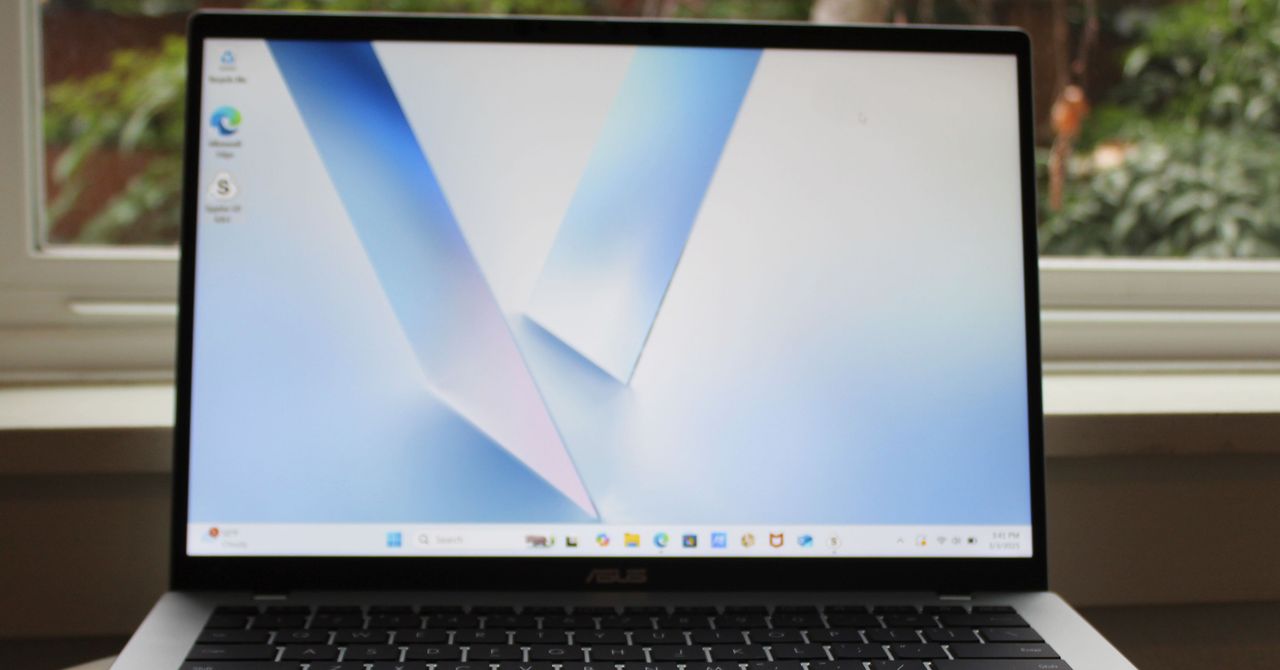
First, check out this Asus Vivobook 14, a laptop I’ve been happy to recommend as a budget computer for the past year. In many ways, this is the Windows version of a laptop like the MacBook Neo. It uses a highly-efficient ARM chip, the Qualcomm Snapdragon X, meaning it gets great battery life and performs admirably in daily tasks. It’s not quite as thin or light as the MacBook Neo, but it’s fairly portable for a laptop at this price.
Asus
Vivobook 14 (X1407QA)
Unlike the MacBook Neo, the Vivobook 14 comes with 16 GB of RAM and 512 GB of storage. That’s twice what you get in the MacBook Neo’s starting configuration. Right now, this configuration of the Vivobook 14 is on sale for $539. That’s a killer deal for those specs. It even comes with a healthier mix of ports, including HDMI, two USB-A, one USB-C, and a headphone jack. That also means it can support two external displays unlike the MacBook Neo, which can only handle just one.
Don’t get me wrong—I’m not at all saying the Vivobook 14 is a slam dunk over the MacBook Neo. Based on specs alone, I know the Vivobook 14 is a serious step down when it comes to the display. It’s less sharp, stretched across a larger screen, and the color performance isn’t so good. The Vivobook 14 maxes out at 280 nits, whereas Apple says the MacBook Neo can go all the way up to 500 nits. I have a hunch that the MacBook Neo will deliver a much better display in just about every regard.
There’s also the touchpad. It’s a little clunky to use, which is typical of budget Windows laptops. This is just a guess—but the touchpad on the MacBook Neo will likely feel smoother. It’s a mechanical trackpad (unlike the MacBook Air’s haptic feedback trackpad), but Apple has almost never made a bad trackpad.
If you’re not convinced by the Asus Vivobook 14, I’d also recommend the HP OmniBook 5, which is currently on sale for $500 and uses the same Snapdragon X chip. While it only has 256 GB of storage, it has a much better screen than the Vivobook 14, using an OLED display. It’s not any brighter than the Vivobook 14, but it gives you far better color performance and contrast. It’s also just 0.50 inches thick, matching the MacBook Neo exactly in portability.
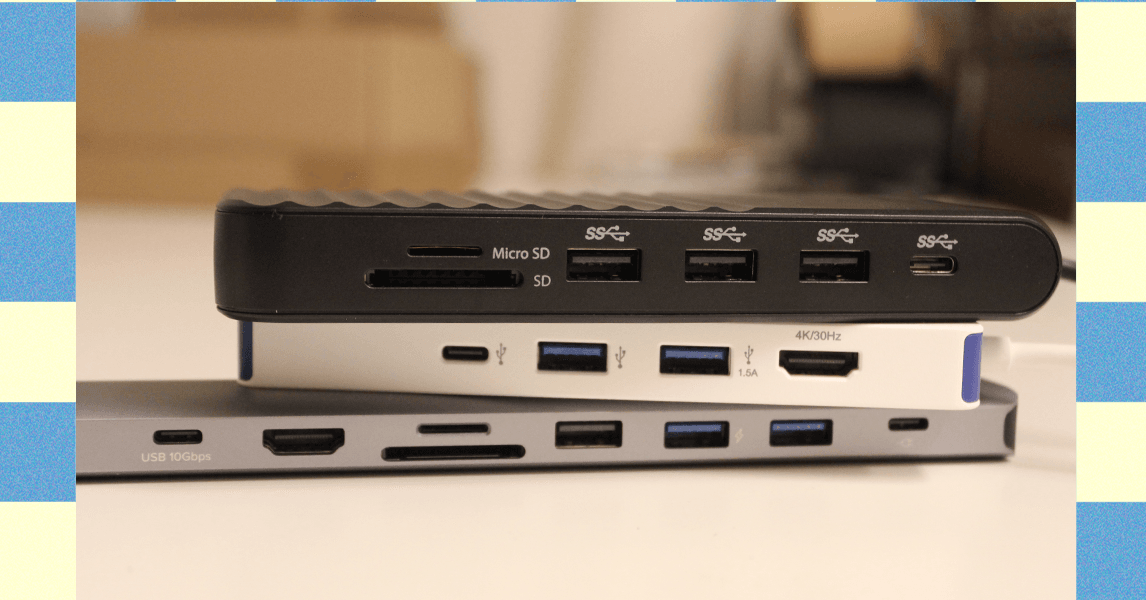
Ugreen Revodok Pro 211 Docking Station for $64: Most laptop docking stations are bulky gadgets that often require a power source, but this one from Ugreen straddles the line between dock and hub. It has a small, braided cable running to a relatively large aluminum block. It’s a bit hefty but still compact, and it packs a lot of extra power. It has three USB ports (one USB-C and two USB-A) that each reached up to 900 MB/s of data-transfer speeds in my testing. That was enough to move large amounts of 4K video footage in minutes. The only problem is that using dual monitors on a Mac is limited to only mirroring.
Photograph: Luke Larsen
Hyper HyperDrive Next Dual 4K Video Dock for $150: This one also straddles the line between dock and USB hub. Many mobile docks lack proper Mac support, only allowing for mirroring instead of full extension. The HyperDrive Next Dual 4K fixes that problem, though, making it a great option for MacBooks (though it won’t magically give an old MacBook Air dual-monitor support). Unfortunately, you’ll be paying handsomely for that capability, as this one is more expensive than the other options. The other problem is that although this dock has two HDMI ports that can support 4K, though only one will be at 60 Hz and the other will be stuck at 30 Hz. So, if you plan to use it with multiple displays, you’ll need to drop the resolution 1440p or 1080p on one of them. I also tested this Targus model, which is made by the same company, which gets you two 4K displays at 60 Hz but not on Mac.
Kensington Triple Video Mobile Dock.
Photograph: Luke Larsen
Anker USB-C Hub 5-in-1 for $20: This Anker USB hub is the one I carry in my camera bag everywhere. It plugs into the USB-C port on your laptop and provides every connection you’d need to offload photos or videos from camera gear. In our testing, the USB 3.0 ports reached transfer speeds over 400 MB/s, which isn’t quite as fast as some USB hubs on this list, but it’s solid for a sub-$50 device. Similarly, the SD card reader reached speeds of 80 MB/s for reading and writing, which isn’t the fastest SD cards can get, but adequate for moving files back and forth.—Eric Ravenscraft
Kensington Triple Video Mobile Dock for $83: Another mobile dock meant to provide additional external support, this one from Kensington can technically power up to three 1080p displays at 60 Hz using the two HDMI ports and one DisplayPort. It’s a lot of ports in a relatively small package, though the basic plastic case isn’t exactly inspiring.
Global oil andgas prices have skyrocketed following the US attack on Iran last weekend. But another key global supply chain is also at risk, one that may directly impact American farmers who have already been squeezed for months by tariff wars. The conflict in the Middle East is choking global supplies of fertilizer right before the crucial spring planting season.
“This literally could not be happening at a worse time,” says Josh Linville, the vice president of fertilizer at financial services company StoneX.
The global fertilizer market focuses on three main macronutrients: phosphates, nitrogen, and potash. All of them are produced in different ways, with different countries leading in exports. Farmers consider a variety of factors, including crop type and soil conditions, when deciding which of these types of fertilizer to apply to their fields.
Potash and phosphates are both mined from different kinds of natural deposits; nitrogen fertilizers, by contrast, are produced with natural gas. QatarLNG, a subsidiary of Qatar Energy, a state-run oil and gas company, said on Monday that it would halt production following drone strikes on some of its facilities. This effectively took nearly a fifth of the world’s natural gas supply offline, causing gas prices in Europe to spike.
That shutdown puts supplies of urea, a popular type of nitrogen fertilizer, particularly at risk. On Tuesday, Qatar Energy said that it would also stop production of downstream products, including urea. Qatar was the second-largest exporter of urea in 2024. (Iran was the third-largest; it’s also a key exporter of ammonia, another type of nitrogen fertilizer.) Prices on urea sold in the US out of New Orleans, a key commodity port, were up nearly 15 percent on Monday compared to prices last week, according to data provided by Linville to WIRED. The blockage of the Strait of Hormuz is also preventing other countries in the region from exporting nitrogen products.
“When we look at ammonia, we’re looking at almost 30 percent of global production being either involved or at risk in this conflict,” says Veronica Nigh, a senior economist at the Fertilizer Institute, a US-based industry advocacy organization. “It gets worse when we think about urea. Urea is almost 50 percent.”
Other types of fertilizer are also at risk. Saudi Arabia, Nigh says, supplies about 40 percent of all US phosphate imports; taking them out of the equation for more than a few days could create “a really challenging situation” for the US. Other countries in the region, including Jordan, Egypt, and Israel, also play a big role in these markets.
“We are already hearing reports that some of those Persian Gulf manufacturers are shutting down production, because they’re saying, ‘I have a finite amount of storage for my supply,’” Linville says. “‘Once I reach the top of it, I can’t do anything else. So I’m going to shut down my production in order to make sure I don’t go over above that.’”
Conflict in the strait has intensified in the early part of this week, as the Islamic Revolutionary Guard Corps have reportedly threatened any ship passing through the strait. Traffic has slowed to a crawl. The Trump administration announced initiatives on Tuesday meant to protect oil tankers traveling through the strait, including providing a naval escort. Even if those initiatives succeed—which the shipping industry has expressed doubt about—much of the initial energy will probably go toward shepherding oil and gas assets out of the region.
“Fertilizer is not going to be the most valuable thing that’s gonna transit the strait,” says Nigh.



.png)










 Politics1 week ago

 Fashion1 week ago
 Fashion7 days ago
 Sports6 days ago