

Politics
Meet Ali Akbar, the last newspaper hawker in Paris

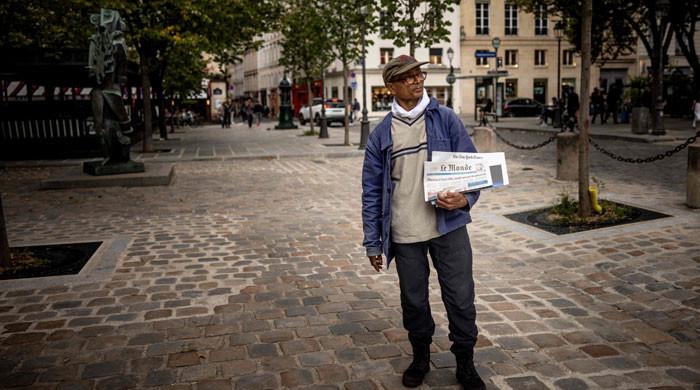
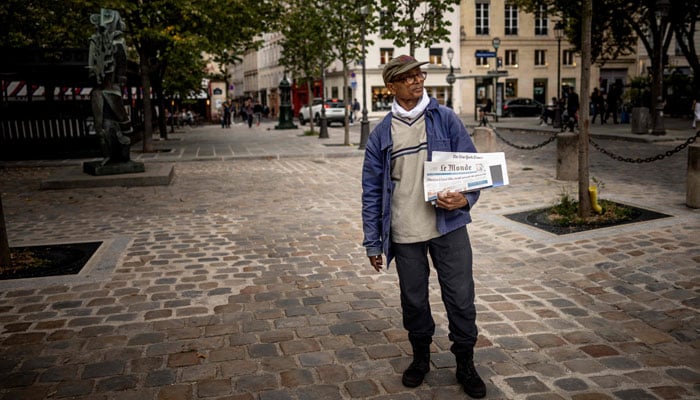
Ali Akbar knows everyone, and everyone knows him. The last newspaper hawker in Paris zigzags each day from cafe to cafe, shouting humorous headlines in the heart of the French capital.
“France is getting better!” he cries, just one of the headlines he invents to sell his wares around the upmarket streets of Saint-German-des-Pres.
“(Eric) Zemmour has converted to Islam!” he shouts, referring to the far-right candidate in the 2022 presidential elections.
Locals and tourists on the Left Bank, the intellectual and cultural heart of Paris, look on amused.
“Even the walls could talk about Ali,” smiled Amina Qissi, a waitress at a restaurant opposite the Marche Saint-Germain, who has known Akbar for more than 20 years.
Now 73, Akbar, a slim, fine-featured “character” with newspapers tucked under his arm, is a neighbourhood legend, she added.
“Even regular tourists ask where he is if they don’t see him,” she told AFP.
Hard life
French President Emmanuel Macron has vowed to soon make Akbar a knight in the national order of merit in recognition of his “dedicated service to France”.
“At first, I didn’t believe it. Friends must have asked him (Macron) or maybe he decided on his own. We often crossed paths when he was a student,” said Akbar.
“I believe it’s related to my courage, because I’ve worked hard,” he added.
Akbar, who wears round spectacles, a blue work jacket and a Gavroche cap, mainly sells copies of the French daily Le Monde.
When he arrived in France at the age of 20, hoping to escape poverty and send back money to his family in Pakistan, he worked as a sailor, then a dishwasher in a restaurant in the northern city of Rouen.
Then in Paris, he bumped into Georges Bernier, the humourist also known as Professeur Choron, who gave him the chance to sell his satirical newspapers Hara-Kiri and Charlie Hebdo.
Akbar has been homeless, experienced extreme poverty and had even been attacked—but despite the hardships, he said he has never given up.
“Emmanuel Macron is going to put a bit of antiseptic on my wounds,” he told his son Shahab, who at 30 is the youngest of his five children.
Shahab, who describes himself as “very proud” of his father, enjoys cataloguing the numerous profiles dedicated to his father in the foreign press.
When he started out as a hawker in the 1970s, Akbar focused on the Left Bank of the river Seine, which was a university area “where you could eat cheaply”, he said.
On the rue Saint-Guillaume in front of the prestigious Sciences Po university, he recalled learning French from interactions with students like former prime minister Edouard Philippe and “many others who became ministers or lawmakers”.
‘A good mood’
Paris used to have about 40 newspaper hawkers—street vendors without a fixed newsstand— who were posted at strategic locations such as the entrances to metro stations.
Akbar stood out by choosing to walk around, selecting the Latin Quarter. In the 1980s, he started inventing sensational headlines.
“I want people to live happily. I do it to create a good mood, that’s all,” he said.
But he admitted that he is finding it increasingly difficult to come up with good jokes.
“Everything is such a mess,” he added.
Akbar, who receives a pension of 1,000 euros ($1,175) a month, still works from 3 pm until 10 pm each day.
When AFP met him on a recent afternoon, clients were few and far between. On average, he sells about 30 newspapers every day, compared to between 150 and 200 when he started.
“As long as I’ve got the energy, I’ll keep going. I’ll work until I die,” he joked.
On the terrace of one cafe, Amel Ghali, 36, said Akbar was “inspiring”.
“It’s good to see it in the digital age,” he said. “Unfortunately, our children won’t experience the pleasure of reading a newspaper with a coffee.”
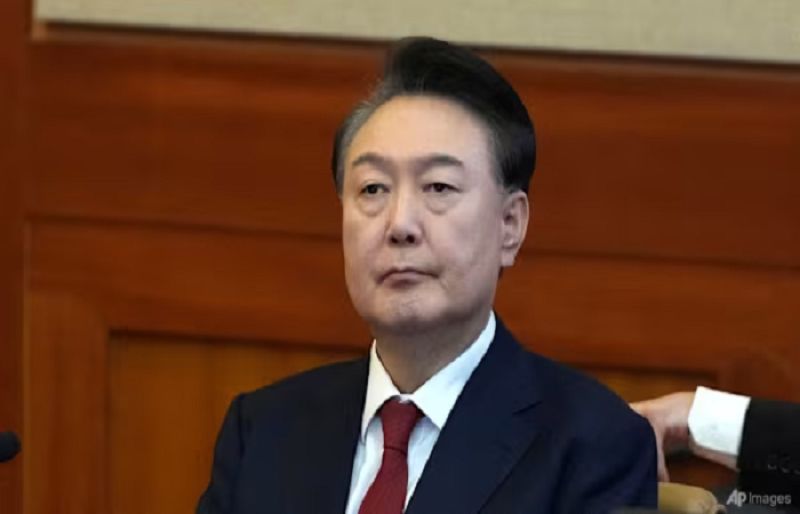

A South Korean court on Friday sentenced former President Yoon Suk Yeol to five years in prison on charges that included obstructing attempts by authorities to arrest him following his failed bid to impose martial law in December 2024.
The Seoul Central District Court found Yoon guilty of mobilising the presidential security service to block authorities from executing an arrest warrant that had been legally issued by a court to investigate him for his martial law declaration.
In televised proceedings, he was also found guilty of charges that included fabricating official documents and failing to comply with the legal process required for martial law.
The ruling is the first related to the criminal charges Yoon faces over his botched martial law declaration.
“The defendant abused his enormous influence as president to prevent the execution of legitimate warrants through officials from the Security Service, which effectively privatised officials … loyal to the Republic of Korea for personal safety and personal gain,” the lead judge on the three-justice panel said.
Speaking outside the court immediately after the decision, one of Yoon’s lawyers, Yoo Jung-hwa, said the former president would appeal the ruling. “We express regret that the decision was made in a politicised manner,” she said.
He could face the death sentence in a separate trial on a charge of masterminding an insurrection by declaring martial law without justification.
Yoon has argued it was within his powers as president to declare martial law and that the action was aimed at sounding the alarm over the obstruction of government by opposition parties.
Yoon, who also denied Friday’s charges, could have faced up to 10 years in jail over the obstruction charges related to when he barricaded himself inside his residential compound in January last year and ordered the security service to block investigators.
He was finally arrested in a second attempt involving more than 3,000 police officers. Yoon’s arrest was the first ever for a sitting president in South Korea.
Parliament, joined by some members of Yoon’s conservative party, voted within hours to overturn his surprise martial law decree and later impeached him, suspending his powers.
He was removed from office in April last year by the Constitutional Court, which ruled he violated the duties of his office.
While Yoon’s bid to impose martial law lasted only about six hours, it sent shockwaves through South Korea, which is Asia’s fourth-largest economy, a key US security ally, and long considered one of the world’s most resilient democracies.
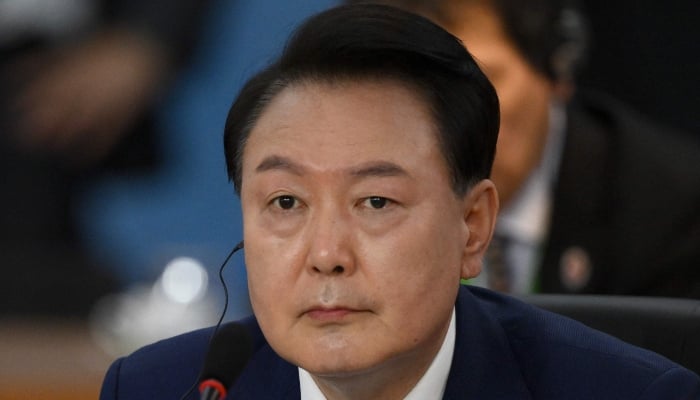
- Judge finds Yoon guilty of obstructing justice and other crimes.
- Separate insurrection verdict is scheduled for February 19.
- Yoon faces another trial over alleged drone flights to North Korea.
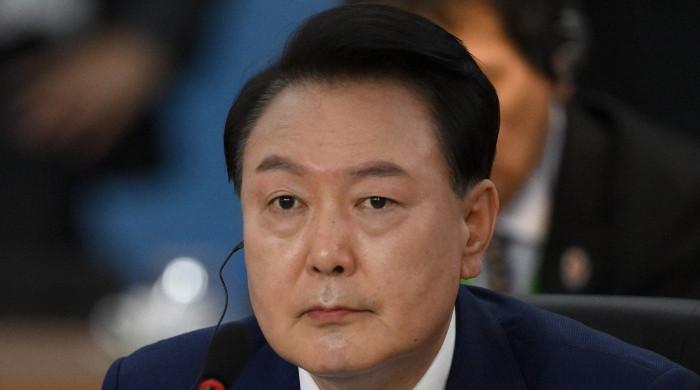
SEOUL: A South Korean judge sentenced former president Yoon Suk Yeol on Friday to five years in prison for obstructing justice and other crimes linked to his disastrous martial law declaration and in its chaotic aftermath.
It is the first in a series of verdicts for the disgraced ex-leader, whose brief suspension of civilian rule in South Korea on December 3, 2024 prompted massive protests and a showdown in parliament.
Now ousted from power, he faces multiple trials for actions taken during that debacle and in the turmoil that followed.
On Friday Judge Baek Dae-hyun at Seoul’s Central District Court said he found Yoon guilty of obstruction of justice by blocking investigators from detaining him.
Yoon was also found guilty of excluding cabinet members from a martial law planning meeting.
“Despite having a duty, above all others, to uphold the Constitution and observe the rule of law as president, the defendant instead displayed an attitude that disregarded the… Constitution,” Baek said.
“The defendant’s culpability is extremely grave,” he said.
But Yoon was not guilty of forging official documents due to lack of evidence, the judge said.
Yoon has seven days to appeal, he added.
Prosecutors had called for a 10-year prison term, while Yoon had insisted no law was broken.
Yoon defiant
It comes days after prosecutors in a separate case demanded Yoon be sentenced to death for his role as the “ringleader of an insurrection” in orchestrating the imposition of martial law.

They argued Yoon deserved the severest possible punishment as he had shown “no remorse” for actions that threatened “constitutional order and democracy”.
If he is found guilty it is highly unlikely the sentence will actually be carried out, as South Korea has had an unofficial moratorium on executions since 1997.
Yoon was seen smiling in court as the prosecutors demanded the punishment.
And the former leader and top prosecutor has remained defiant, saying his martial law declaration was a lawful exercise of his presidential authority.
In closing remarks on Tuesday, he insisted the “exercise of a president’s constitutional emergency powers to protect the nation and uphold the constitutional order cannot be deemed an act of insurrection”.
He accused the then-opposition party of having imposed an “unconstitutional dictatorship” through their control of the legislature.
“There was no other option but to awaken the people, who are the sovereign.”
The court is scheduled to rule on the insurrection charges on February 19.
Yoon also faces a separate trial on charges of aiding the enemy, over allegations he ordered drone flights over North Korea to bolster his case for declaring martial law.
- Machado says meeting was ‘excellent,’ but did not elaborate.
- Encounter comes as Trump has praised Caracas’ interim leader.
- Trump has prioritised securing access to Venezuelan oil.
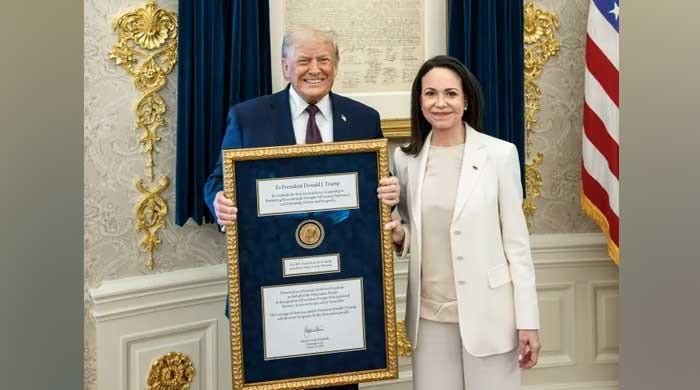
WASHINGTON: Venezuelan opposition leader Maria Corina Machado gave her Nobel Peace Prize medal to US President Donald Trump on Thursday during a White House meeting, as she tries to gain some influence over how the president shapes the South American country’s political future.
A White House official confirmed that Trump intends to keep the medal.
In a social media post on Thursday evening, Trump wrote: “Maria presented me with her Nobel Peace Prize for the work I have done. Such a wonderful gesture of mutual respect. Thank you Maria!”
Machado, who described the meeting as “excellent,” said the gift was in recognition of what she called his commitment to the freedom of the Venezuelan people.
Machado’s attempt to sway Trump came after he dismissed the idea of installing her as Venezuela’s leader to replace the deposed Nicolas Maduro. Trump openly campaigned for the prize before Machado was awarded it last month and complained bitterly when he was snubbed.
Though Machado gave Trump the gold medal that honorees receive with the prize, the honor remains hers; the Norwegian Nobel Institute has said the prize cannot be transferred, shared or revoked.
Asked on Wednesday if he wanted Machado to give him the prize, Trump told Reuters: “No, I didn’t say that. She won the Nobel Peace Prize.”
The Republican president long expressed interest in winning the prize and has at times linked it to diplomatic achievements.
The lunch meeting, which appeared to last slightly over an hour, marked the first time the two have met in person. Machado then met with more than a dozen senators, both Republican and Democratic, on Capitol Hill, where she has generally found more enthusiastic allies.
While the visit was ongoing, White House press secretary Karoline Leavitt said Trump had been looking forward to meeting Machado, but that he stood by his “realistic” assessment that she did not currently have the support needed to lead the country in the short term.
Machado, who fled Venezuela in a daring seaborne escape in December, is competing for Trump’s ear with members of Venezuela’s government and seeking to ensure she has a role in governing the nation going forward.
After the US captured Maduro in a snatch-and-grab operation this month, various opposition figures, members of Venezuela’s diaspora and politicians throughout the US and Latin America have expressed hope that Venezuela will begin the process of democratisation.


Patrick Mahomes says he has to be held back from pushing so hard in injury rehab, shares hopes for Week 1
Budget 2026: Who Delivered The Longest Budget Speech In India?

Saks bonds worth just 1 cent hand hedge funds a painful lesson

-

 Politics1 week ago
UK says provided assistance in US-led tanker seizure
-

 Entertainment1 week ago
Does new US food pyramid put too much steak on your plate?
-
 Entertainment1 week ago
Why did Nick Reiner’s lawyer Alan Jackson withdraw from case?
-
 Sports5 days ago
Clock is ticking for Frank at Spurs, with dwindling evidence he deserves extra time
-
 Business1 week ago
Trump moves to ban home purchases by institutional investors
-
 Sports1 week ago
PGA of America CEO steps down after one year to take care of mother and mother-in-law
-

 Tech4 days ago
New Proposed Legislation Would Let Self-Driving Cars Operate in New York State
-
Sports7 days ago
Commanders go young, promote David Blough to be offensive coordinator