

Sports
Most vs. least predictable men’s conference tournaments

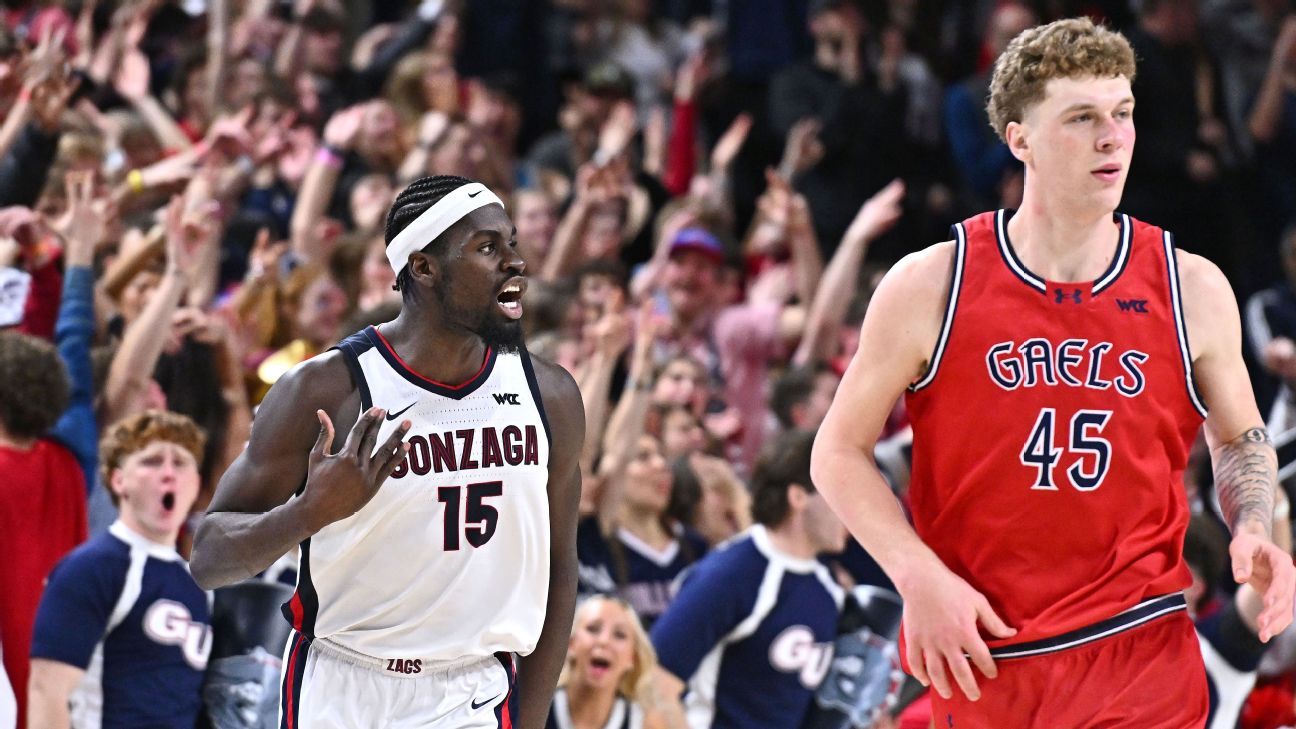
March is here, and you know what that means: The Madness is upon us.
What better way to get ready for the men’s NCAA tournament than warming up with a couple of weeks of conference tournament action?
Champ Week never disappoints. In 2024, we saw five bid thieves crash the Big Dance, while 51 of the 63 conference tournaments in 2023 and 2025 were won by Nos. 1 or 2 seeds. And while we can likely agree that past trends are not necessarily indicative of future results, it’s fun to analyze which conference tournaments have featured the most and least chaos in recent history.
Because the membership of many conferences has changed with realignment, the primary focus will be on results from the past five seasons, though some trends that go further back were too juicy to ignore.
Because there are many ways to characterize the volatility of a specific conference tournament, here is a sampling of the factors that were taken into consideration:
-
Average seed of the champion
-
Combined average seed of the finalists
-
How often the top-seeded teams lose their first game
-
How often a lower-seeded team makes a deep run
Now let’s break it down, starting with the conference tournaments that have been friendly to higher seeds in recent years.
Note: Conferences ordered under each category by tournament start date. Averages shown are since 2021, unless otherwise noted.

TOURNAMENTS THAT HAVE FAVORED HIGHER SEEDS

West Coast Conference
No conference tournament has been more predictable than the WCC — and that’s not just over the past five years.
The top two seeds have met in the finals in 16 of the past 17 WCC tournaments. In 13 of those 16, it has been Gonzaga vs. Saint Mary’s. The only other team to make the finals in that span is BYU, which is no longer a conference member. (And by the way, the top two seeds in this year’s edition are Gonzaga and Saint Mary’s once again.)
Gonzaga, in its final season in the WCC before joining the new-look Pac-12 in 2026-27, has reached the championship game a ridiculous 28 consecutive years; the Bulldogs are always a No. 1 or 2 seed.
While the top two seeds have received a bye to the semis in 18 of the past 23 WCC tourneys, other leagues also reward their best teams this way without anywhere close to the same predictability.

Missouri Valley Conference
Despite a traditional bracket setup — there are no byes to the semis in Arch Madness — the top two seeds have faced off in the title game three straight times and in four of the past five years.
Drake has won the past three MVC tournaments, but the Bulldogs have their work cut out for them as this year’s 9-seed. They would have to beat the 1-seeded Belmont in the quarterfinals, which has been a near-impossibility in the MVC: The Nos. 1 and 2 seeds have lost in the quarters only once each in the past 27 tourneys — and it happened in the same year (2020).

America East
The higher seeds playing host has its benefits here: The championship game has been 1-vs.-2 or 1-vs.-3 in 10 of the past 11 seasons — including 2020, when the matchup was set before the tournament was cut short due to the COVID-19 pandemic.
The America East and Summit League have the longest current streaks of the No. 1 seed raising the trophy (four straight seasons).

Southland Conference
Since changing the format to give the top two seeds a bye to the semifinals in 2013, the Southland tournament hasn’t featured many surprises: At least one of the top two seeds has reached the championship game every year since.
The No. 1 seed has won in three straight years, and either the 1- or 2-seed has raised the trophy 10 of the past 13 tournaments. The most notable upset during this stretch came in 2022, when No. 4 seed Texas A&M-Corpus Christi (7-7 in Southland play) upset the top two seeds en route to the title.

Big 12
Four different programs have won the past four championships, but each have been Nos. 1 or 2 seeds, and only once in the past 10 tournaments has the runner-up been seeded fourth or worse.
Iowa State is the only school in Big 12 tournament history (since 1997) to win the title seeded lower than No. 3, and it has done it three times: twice as a No. 4 and once as a No. 5.

Ivy League
It’s important to note that only the Ivy’s top four teams qualify for the tournament, so the title game has been No. 1 vs. No. 2 in five of the past six seasons. The No. 2 seed had won five consecutive Ivy Madness titles until last year, when top-seeded Yale earned the conference’s auto-bid by beating — you guessed it — 2-seed Cornell.
Want more predictability? Yale has been a fixture, winning four of the past five tournaments and reaching the championship game six of the seven times the event has been held.
The tournament is hosted by a different league institution each year, and each of the past three times the host school qualified for the tourney, it won. This year’s host? Cornell, which will be the No. 4 seed.
TOURNAMENTS THAT HAVE FAVORED LOWER SEEDS

Sun Belt
The Sun Belt is the only conference in which the No. 1 seed has not made it to the championship game in the past five years (2019 is the last time it happened).
This is Year 2 of the most interesting bracket you’ll see during Champ Week, which takes place over seven days and was likely conceived to improve the chances of top seeds earning the automatic bid. That didn’t work last year, as the Nos. 1 and 2 seeds lost their first game. In fact, the 1-seed has lost its first game in the Sun Belt tourney an astounding four of the past five years.
This season, there was no clear top team in conference play. Troy went 12-6 to earn the No. 1 seed, but there was a remarkable six-way tie for second place at 11-7, so it wouldn’t be surprising at all if these trends continue.
An unintended consequence of the quirky Sun Belt bracket: No. 7 seed Arkansas State has to win five games to earn the automatic bid, while No. 2 seed Marshall has to win only two — despite the fact that both teams had the same record in Sun Belt play.
Metro Atlantic Athletic Conference
Not to be outdone by the ACC, the MAAC has been a free-for-all. At least one team seeded fourth or worse has reached the title game in eight straight tournaments. Last year, a 6-seed (Mount St. Mary’s) grabbed the auto-bid; in 2023, 11-seed Marist won three games to reach the finals; and in 2021, we had a rare 9-vs.-7 matchup in the championship game (Iona over Fairfield).
Of the 10 finalists from the past five years, eight different seeds have been represented. The No. 1 seed has struggled mightily, losing twice in the quarterfinals (2021 and 2022) and twice in the semifinals (2024 and 2025). It has been 10 years since the last title game between the top two seeds.

Coastal Athletic Association
It might seem like the CAA tournament has been chalky, with Nos. 1 and 2 seeds representing the past three champs, but the bigger picture is more complicated.
From 2012 to 2019, every team that reached the finals was seeded third or better. There were very few surprises and, more often than not, it was a 1-vs.-2 matchup for the title. Over the past five years, though, there has been plenty of variability: Only once has a No. 1 seed advanced to the championship, and at least one team seeded fourth or worse has made it. There was a 6-vs.-8 championship in 2021, No. 7 Stony Brook lost to top-seeded Charleston in overtime in 2024, and No. 12 Delaware won four games before falling just short of the title in 2025.

ACC
The ACC tournament has featured interesting results in recent years. You likely remember 10-seed NC State winning five games in five days to steal a bid in 2024. And the three years before that, teams seeded fourth (Duke), seventh (Virginia Tech) and fourth (Georgia Tech) emerged as surprise champions.
When you see lower-seeded champs like this, you might expect it’s because they faced another Cinderella type, but that has not been the case. In fact, the runner-up has been a No. 1 or No. 2 seed in five straight years. Last year was an outlier, as the top two seeds met in the title game for only the second time since 2012, with Duke defeating Louisville.
TOURNAMENTS WITH MIXED RESULTS

Patriot League
It’s a different structure in the Patriot League — the higher seed hosts each game throughout — but there are similarities to the SoCon for the eventual champs and runners-up.
The past five Patriot champions have been 1- or 2-seeds. Meanwhile, four of the past five losers in the title game were seeded fifth, sixth, sixth and ninth. Last year, 5-seed Navy knocked off 1-seed Bucknell in the semifinals. This year, the shoe is on the other foot: Navy will have the bull’s-eye as the No. 1 seed trying to earn its first NCAA tournament bid since 1998 after a dominant regular season (17-1).

Southern Conference
No conference screams “mixed results” like the SoCon.
When 6-seed Wofford won the 2025 championship game, it snapped a streak of seven straight years in which the No. 1 seed won the title (including 2020). Wofford was the sixth different program to win the tournament in as many years.
The SoCon tourney rarely lacks drama, as the average seed of the runner-up (5.6) is tied for the second highest in the past five years. Where things have gone sideways is in the 2-vs.-7 and 3-vs.-6 quarterfinal matchups:
-
The No. 7 seed has beaten the No. 2 seed in each of the past three years, and five of the past six.
-
No. 7 seeds have reached the championship game an incredible four times in those six years.
-
The No. 6 seed has beaten the No. 3 seed in four of the past six years.
MORE TRENDS
-
Atlantic 10 Conference (A-10): The past six titles have been won by the No. 1 or No. 6 seed (three each). Eight of the past 11 championships have been won by a team seeded third or worse. And No. 2 seeds have reached the title game in seven of the past 11 years but have no championships to show for it.
-
The No. 1 or No. 2 seed has won 13 of the past 14 Big Sky tournaments, but last year was the first time they both reached the final since 2016.
-
The Big Ten has gone 17 straight tournaments without a 1-vs.-2 matchup in the title game (the last was in 2007). The next-longest drought is eight straight (MAAC).
-
We have had four different Big West tournament champions in as many years. The last time a team seeded fifth or worse made it to the title game was 2015.
-
Conference USA (C-USA) and the Northeast Conference (NEC) have had a different school win their tournaments eight straight times, tying for the second-longest streak in the past 100 seasons of college basketball. Only the Southern Conference (nine straight from 1927 to 1935) had a longer run. There is no doubt that changes in conference membership have played a role for both.
-
Also in the NEC: A No. 3 seed (Saint Francis) won the tournament in what was the first time a 3-seed reached the title game since 2013. Last year also marked the first time the No. 2 seed didn’t lose in the championship game since 2019, snapping a streak of five straight years (including 2020, when the conference completed its tournament).
-
Ohio Valley Conference (OVC): The top two seeds get byes to the semifinals, but exactly one of them has lost its first game in three of the past four years — this year’s top two seeds are Tennessee State and Morehead State. The No. 1 seed has just one championship in the past five years.
-
The No. 1 seed in the Southwestern Athletic Conference (SWAC) has won the title only once in the past five years and has lost its first game in two of the past three years.
NEWYou can now listen to Fox News articles!
LAS VEGAS – One of the best WrestleMania 42 moments on Saturday night occurred outside of the ring.
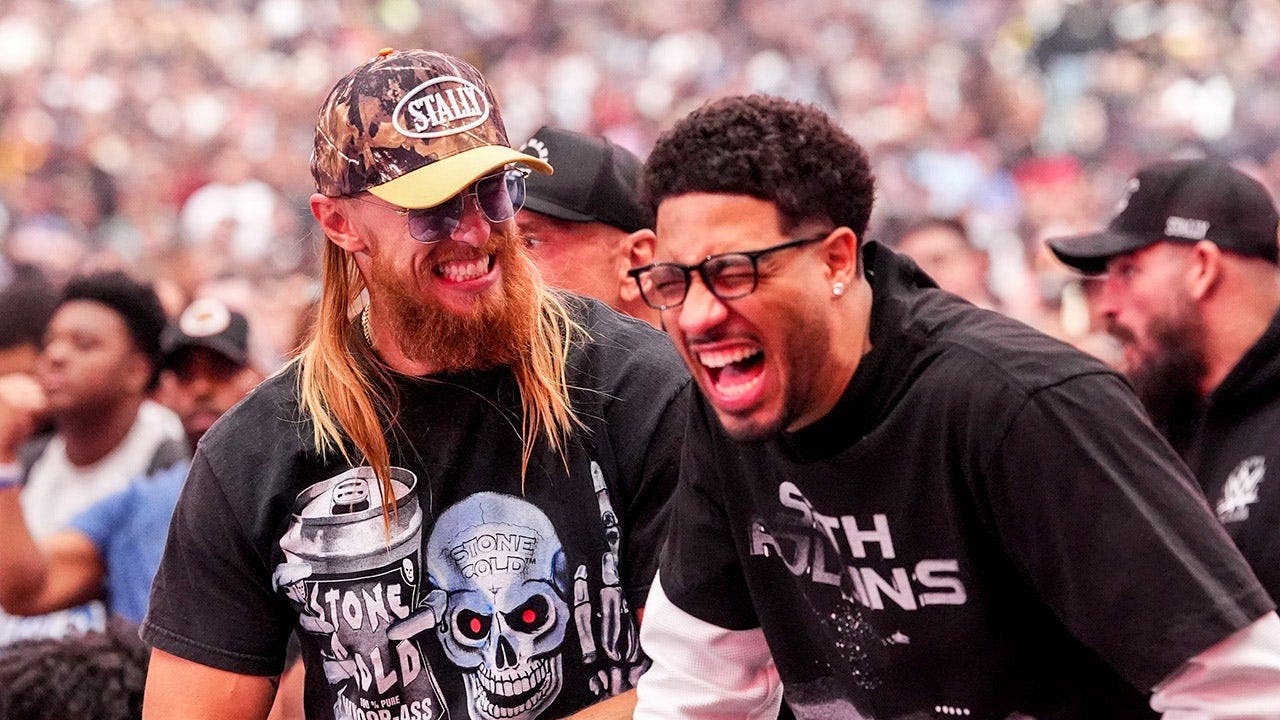
NFL star George Kittle and NBA star Tyrese Haliburton were among the professional athletes in attendance for Night 1 of the event, which later featured Cody Rhodes retaining his Undisputed WWE Championship against Randy Orton in the main event.
CLICK HERE FOR MORE SPORTS COVERAGE ON FOXNEWS.COM
George Kittle and Tyrese Haliburton attend WrestleMania 42: Night 1 at Allegiant Stadium in Las Vegas, Nevada, on April 18, 2026. (Rich Freeda/WWE/Getty Images)
Kittle and Haliburton were showcased as two stars who were at Allegiant Stadium in Las Vegas for the event. Haliburton was about to drink his beer when Kittle intercepted it away and chugged it for him. The WWE crowd was frenzied after Kittle’s steal.
https://x.com/netflixsports/status/2045632212922728821
Both Kittle and Haliburton are major WWE fans and have been at multiple events, including getting involved in matches.
WWE STARS REVEAL WHAT MAKES WRESTLEMANIA SO SPECIAL: ‘IT’S THE SUPER BOWL OF PRO WRESTLING’
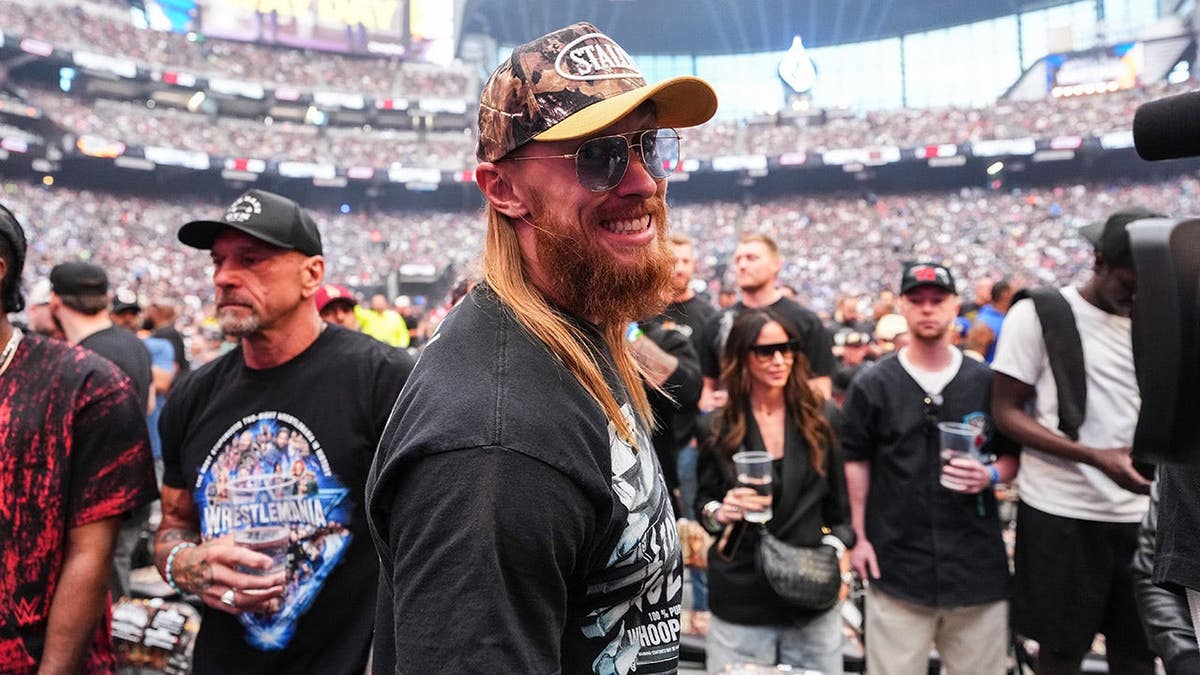
George Kittle attends WrestleMania 42: Night 1 at Allegiant Stadium in Las Vegas, Nev., on April 18, 2026. (Rich Freeda/WWE)
Kittle clotheslined The Miz at WrestleMania 39. He previously revealed he’s a big fan of Penta, who is defending his Intercontinental Championship in a six-man ladder match on Sunday.
Haliburton previously went face-to-face with New York Knicks star Jalen Brunson on an episode of “Friday Night SmackDown.”
For now, it doesn’t appear as though either will enter a WWE ring anytime soon.
Kittle suffered a torn Achilles in January, ending his 2026 season with the San Francisco 49ers on a sour note.
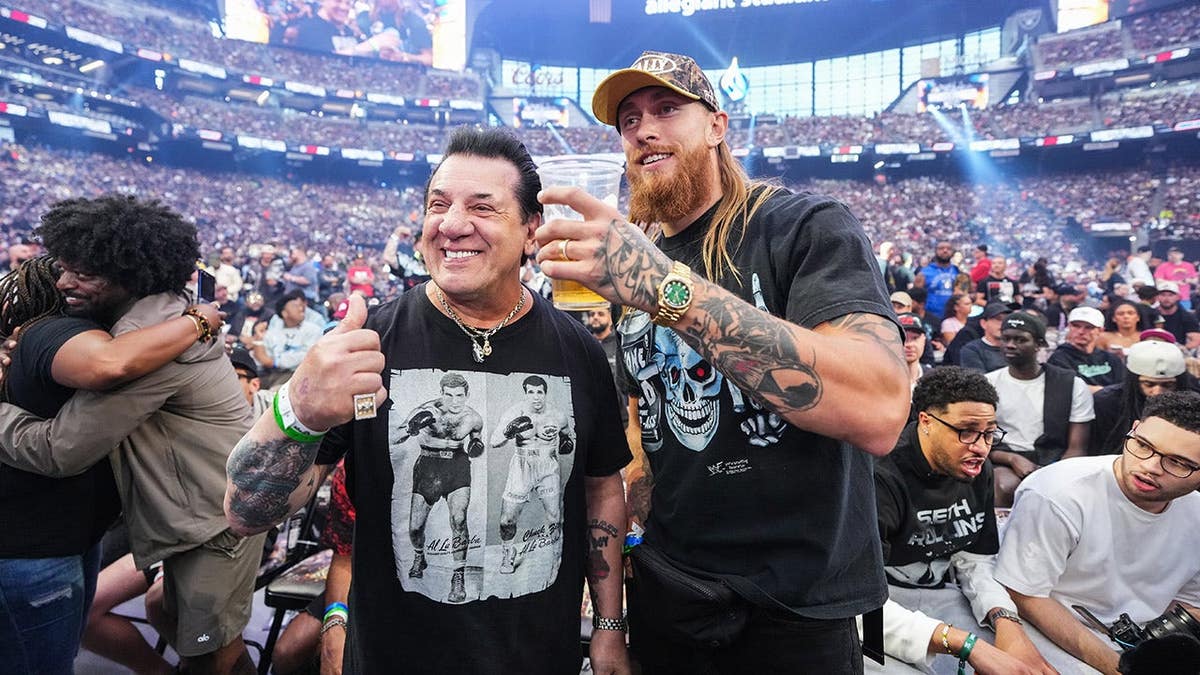
George Kittle and Chuck Zito attend WrestleMania 42: Night 1 at Allegiant Stadium in Las Vegas on April 18, 2026. (Rich Freeda/WWE/Getty Images)
CLICK HERE TO DOWNLOAD THE FOX NEWS APP
Haliburton is also recovering from a torn Achilies he suffered in Game 7 of the NBA Finals last year. He also opened up about battling shingles as he tries to return to the floor for the Indiana Pacers.

I absolutely love the NFL draft. I love the tape. I love the evaluations. I love the projections and anticipation. And we’re nearly there — the 2026 draft kicks off with Round 1 on April 23. You can catch me on the ESPN set for all three days of the action.
The tape isn’t the entire truth on prospects. The real analysis comes from spending time with them and getting a sense of who they are; that’s why team interviews and visits are so important. But the tape also doesn’t lie, and after spending hours and hours watching this class, I wanted to pick a few prospects who really caught my eye. There are my guys in the class — the players I’d be standing on the table to draft.
The first five are first-rounders who will be stars. I can’t get enough of them and would be ecstatic to land any of them. The second five are sleepers I really like. I’d be targeting them on Day 2 if I were running an NFL team, and I think they could all easily outperform their projected draft slots.
This is Year 4 of making this list, and it begins with a star running back expected to go in the top 10 and ends with a Day 2 safety who has a ton of upside.
Jump to:
First-rounders that I love
Sleepers who could be stars

Five surefire stars in Round 1

Height: 6-0 | Weight: 212
Every NFL general manager and head coach is on a mission at this time of year to add offensive players who can win games on a single play. Love is that guy. He can break a huge play from anywhere on the field. He had 11 runs of 20 or more yards last season, and six of them went for touchdowns.
Love has the power, speed, open-field elusiveness and versatility to strike in the run game and pass game. His route running is as good as most NFL wide receivers. To that point, I thought he looked like a wideout stuck running routes with the running backs at the combine. He drops his weight and changes direction on a dime. Love hauled in 27 passes for 280 yards last season.
Don’t get caught up in the debate about whether running backs should be drafted in the top 10. This young man is not a running back. He is a game-changing playmaker who piled up 1,652 yards and 21 touchdowns from scrimmage last season. At the end of the day, that’s what every team wants.

Height: 6-5 | Weight: 244
There’s no such thing as a can’t-miss prospect in a sport that is so dependent on surroundings and the ability to physically persevere. But … Styles is a can’t-miss prospect.
With his blend of unique physical traits — size, speed and fluid athleticism — and diamond-level character, I would sleep very well at night knowing that I had drafted a player who could be the face of the franchise. He finished last season with 77 tackles, a sack, a forced fumble and an interception. And then, he showed off his explosion at the combine, with a 43½-inch vertical jump. He does it all.
Styles is only scratching the surface of his potential as a multitool defender. He can do so many things to make the defense better — the most important of which might be his ability to lead and make those around him better. Styles is made for big roles in big moments, and he’s an incredibly safe prospect in that he’s already a pro. He’s a foundational player.

Height: 6-4 | Weight: 320
At its core, football is about dominant, physical play along the lines of scrimmage. And there was nobody in college football last season who had more snaps of impose-your-will play along the offensive line than Ioane. He is an absolute tank at 320 pounds, and he has the versatility to line up anywhere on the line. Ioane plays with power, agility, speed and a level of nastiness when finishing blocks that is truly unique.
Any front office that believes in building from the inside out and staying strong down the middle — something I have talked about for the past decade — should see Ioane as a must-have foundational player.
0:31
Olaivavega Ioane’s NFL draft profile
Check out some of the top highlights from Penn State’s Olaivavega Ioane.

Height: 6-2 | Weight: 203
Tyson is the best wide receiver in the 2026 draft. Full stop.
He has it all … size, explosive quickness, body control, strength and solid top-end speed. He can move between the X, Z and slot receiver positions seamlessly and can put lots of pressure on an opposing defense by exploiting matchups anywhere on the field. Tyson had 75 catches, 1,101 yards and 10 touchdowns in 2024 before posting 61 catches, 711 yards and eight TDs in nine games in 2025.
The main thing holding back Tyson from being widely considered as a surefire superstar is his significant injury history. He suffered a torn ACL/MCL/PCL in 2022, had a broken collarbone in 2024 and dealt with hamstring issues in 2025. The conversations among team medical staff members regarding Tyson’s future availability projection will be fascinating. But I believe that the risk is worth the reward. This guy will be special.

Height: 6-0 | Weight: 199
A very wise and accomplished wide receivers coach told me a long time ago that one of the most important differentiating characteristics that he looks for when evaluating wideouts — beyond consistently catching the ball — is how quickly and effectively they can transition after the catch. Do they get the ball upfield? Can they make defenders miss? Can they break tackles? And do they have the speed to turn a short pass into a long gain?
Cooper checks those boxes. He averaged 7.3 yards after the catch last season and showed no fear snagging the ball in traffic. He made the most difficult catch of the season in a got-to-have-it situation against Penn State. And Cooper, who had 937 yards and 13 touchdowns in 2025, can play in the slot or outside at the X or Z spot.
When he ripped off a 4.42 in the 40-yard dash at the combine, that sealed it for me. This guy will be a star at the NFL level.
Five sleepers outside Round 1

Height: 5-11 | Weight: 193
Turn on any tape of the Hurricanes in 2025, and I guarantee you if Scott was on the field, he was making plays. He had 67 tackles, 13 tackles for loss, five sacks, two interceptions, two forced fumbles and four pass breakups last season.
He is the ultimate competitor and plays the game with a passion for contact. He possesses next-level football IQ and the speed/quickness to be a three-down factor at the nickel position, and that has become critical for the best NFL defenses. I saw times in the 4.32-4.35 range for his pro day 40-yard dash. That’s outstanding. We should hear his name called early on Day 2, in my opinion.

Height: 6-0 | Weight: 220
I’ve talked about Louis a ton this spring, and not just because he played at Pitt.
Remember how impactful former Buccaneers linebacker Derrick Brooks was against the run and the pass during his great NFL career? I’m not saying Louis is Brooks, but the Hall of Famer’s style of play is exactly what I see when I watch Louis. He has the movement skills of a defensive back and the hands of a wide receiver. And I see the instincts, key-and-diagnose traits and overall toughness in the box against the run to be an elite-level playmaker in the pros the moment he steps onto the football field. He can get off blocks, defend the run and make tough tackles (77 of them last season, including 7.5 for loss).
“He just reminds me so much of Derrick Brooks.” @LRiddickESPN says @Pitt_FB‘s Kyle Louis has everything it takes to be a star in the NFL 📈 pic.twitter.com/y2g9EbcVRr
— ACC Network (@accnetwork) March 30, 2026
Day 1 starter with Pro Bowl upside. Louis is a true baller made for today’s game, and I love him as a quintessential Will linebacker for any defense.

Height: 6-4 | Weight: 316
Georgia Tech coach Brent Key has said that Rutledge has the potential to be the best offensive lineman he has coached, which is saying something. Rutledge is a block of granite, playing with leverage and leg drive. He has the athleticism to play in zone or man run-game blocking schemes, and you can sense his competitiveness and desire to put defenders on their backs.
Rutledge will need to refine his pass pro technique, but he has a strong punch and excellent anchor. Some believe he could be an All-Pro center at the NFL level. I don’t care what position he ends up playing; I’d want him on my team.

Height: 6-1 | Weight: 188
When a player finishes his college career with 15 interceptions, there is little doubt that he has the instincts to anticipate route combinations, get good breaks on the football and create turnovers. Clark is a big play waiting to happen, whether his alignment begins in the box as a nickel or dime LB, or in split-safety/single-high middle coverages in the back end, where he can really show off his 4.41 speed and range. Oh, and he will support the run and strike as a tackler, too. This all adds up to the kind of prospect that teams will covet next week.

Height: 6-1 | Weight: 190
He might be flying under the radar for the average football-viewing fan, but NFL teams know Stukes’ upside. He has good size and exceptional functional explosiveness. Stukes ran a 4.33-second 40 and posted a 38-inch vertical jump at the combine.
Stukes can play nickel, dime, free safety or strong safety because he is smart, instinctive and an alpha competitor who loves to hit. Additionally, he is a good blitzer. He is equally skilled as a man or zone defender, and he has exceptional range and ball skills as a deep-field safety. Stukes has seven career picks, including four last season. There is nothing not to like about Stukes … nothing at all.
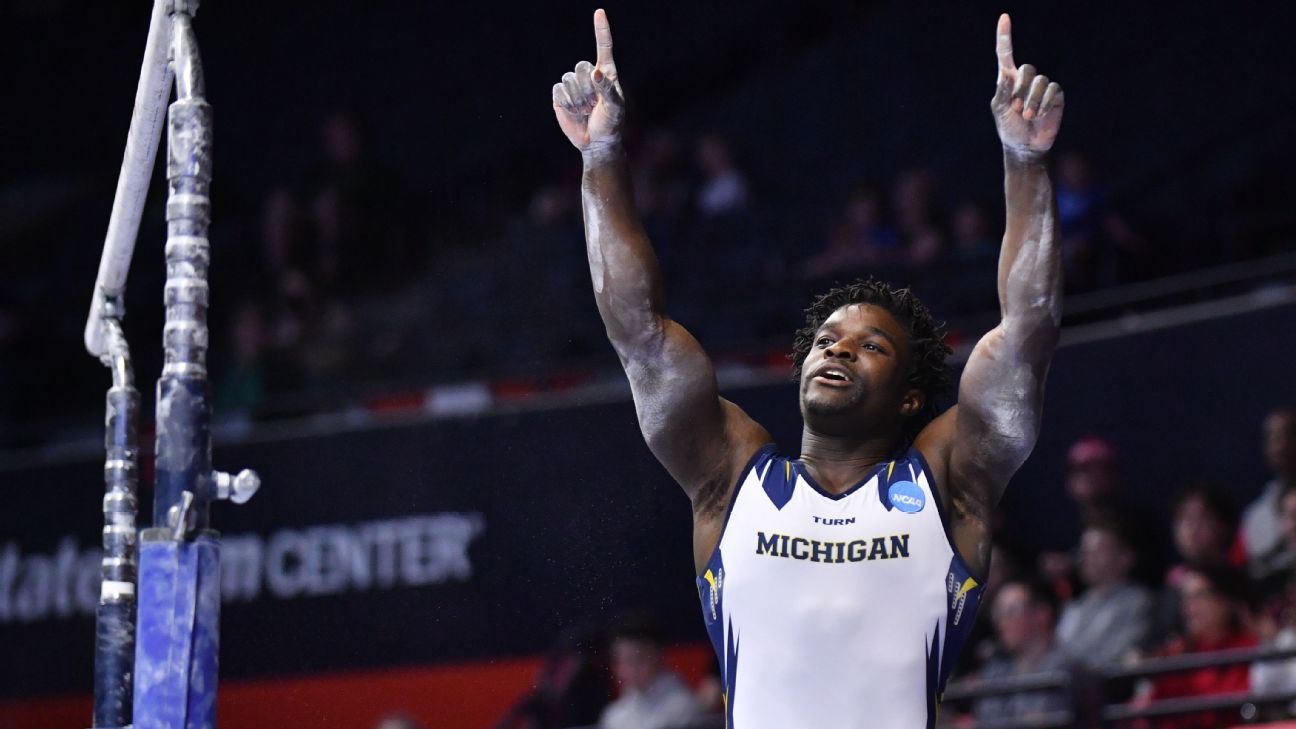
CHAMPAIGN, Ill. — Michigan’s Fred Richard won his second straight all-around individual crown Saturday night, and Cooper Kim and Jun Iwai each won individual titles to lead Stanford to its sixth NCAA men’s gymnastics championship since 2019.
Richard took home silver in the floor and parallel bars as he ran away with his third all-around individual national championship with a score of 83.598. Nebraska’s Max Odden (78.698) was second, 0.432 ahead of third-place Kristian Grahovski of Ohio State.
Stanford had 329.825 points, second-place Oklahoma finished with 328.495 and Michigan — the defending national champion — was third with 324.857. Asher Hong (14.300) took silver and Nick Kuebler (14.166) bronze on the rings in the final rotation to seal it for the Cardinal. Asher Cohen finished with a 14.500 to become the first Nebraska gymnast to win the rings since Jim Hartung in 1982.
Stanford claimed the program’s 11th national gymnastics championship; the Cardinal have won at least one NCAA team title for 50 straight seasons, since the men’s water polo team beat UCLA 13-12 for the national championship on Nov. 28, 1976. The next longest active streak is North Carolina’s seven straight years with at least one team title.
Iwai had a 14.433 on the vault, tied with Nebraska’s Tyler Flores for first. Landen Blixt of Michigan was third (14.366).
Flores, Nathan Roman (14.800 on the parallel bars) and Kelton Christiansen (14.400, high bar) each won individual titles for the second-place Sooners.
Kim scored a 14.466 to win gold on the floor to beat Richard (14.400). Kuebler and Tate Costa of Illinois finished third with 14.166.
Brandon Dang (Illinois) won the pommel horse with a score of 14.700, Michigan’s Aaronson Mansberger was second (14.566) and Colby Aranda of Oklahoma finished third with 14.133 points.


NFL star George Kittle intercepts NBA player Tyrese Haliburton’s beer WrestleMania 42

Cole Sprouse reacts to brother Dylan confronting house intruder

2026 NFL draft: Louis Riddick’s favorite prospects, sleepers

Palace left in shock as Prince William cancels grand ceremony

The case for Man United’s Fernandes as Premier League’s best

100% road tax waiver for electric cars, new rules for 2, 3 and 4 wheelers – what Delhi govt’s draft EV policy says – The Times of India

-
 Entertainment6 days ago
Palace left in shock as Prince William cancels grand ceremony
-
 Sports6 days ago
The case for Man United’s Fernandes as Premier League’s best
-
Business1 week ago
100% road tax waiver for electric cars, new rules for 2, 3 and 4 wheelers – what Delhi govt’s draft EV policy says – The Times of India
-
 Entertainment1 week ago
Dua Lipa hits major career high ahead of wedding with Callum Turner
-
 Business6 days ago
UK could adopt EU single market rules under new legislation
-
 Business1 week ago
The FAA wants gamers to apply for air traffic control jobs
-

 Fashion6 days ago
Energy emerges as biggest cost driver in textile margins
-
 Sports1 week ago
Lamar Jackson hits back at critics with faithful message on social media