

Business
MPC Next Week: Will RBI Still Cut Rates After Robust GDP Numbers? Analysts Weigh In


Last Updated:
India’s GDP grew 8.2 percent in Q2 FY2025-26, driven by strong secondary and tertiary sectors, with experts expecting a possible RBI rate cut.
RBI May Consider Rate Cut in December as GDP Jumps 8.2% and Inflation Hits Record Low
RBI MPC Meet, India GDP Growth: Experts are now weighing the possibility of a repo rate cut at the Reserve Bank of India’s next Monetary Policy Committee (MPC) meeting scheduled for December 3–5, 2025. The expectation has strengthened after India posted a robust 8.2 per cent GDP growth in the July–September quarter of FY2025-26, far above market estimates.
Real GDP growth for the first half of FY26 stood at 8 per cent, compared with 6.1 per cent in the same period last year. At the same time, headline inflation dropped to 0.25 per cent in October — the lowest in the current CPI series — and remains comfortably within the RBI’s tolerance band.
Upasna Bhardwaj, Chief Economist, Kotak Mahindra Bank says that despite the high real GDP growth, they retain their expectations of 25 bps of rate cut in the upcoming policy as inflation trajectory remains benign.
“The sharply higher than expected 2QFY26 GDP was broad based but comes on the back of a very low deflator. The single digit nominal GDP growth continues to signal tepid underlying activity,” Bhardwaj added.
Aditi Nayar, Chief Economist, ICRA noted that the probability of a rate cut in the December 2025 MPC review has certainly eased, with the Q2 FY2026 GDP growth exceeding 8% and he series-low CPI inflation print for October 2025.
Nayar said that the upside surprise in the Q2 GDP growth print was driven by services, even as the agriculture and industrial sectors largely reported prints along expected lines. “The 9.7% surge in the public administration, defence and other services segment in Q2 FY2026 was quite surprising given that the Government of India’s (GoI’s) non-interest revenue, Nayar added.
The India’s GDP trajectory is also being supported by robust consumption, and a planned decrease in MPC rates along with a softening trend of CPI and WPI inflation, according to Ranjeet Mehta, CEO & Secretary General, PHDCCI.
Rajeev Juneja, President of PHDCCI added that the tertiary sector’s rise was the main driver of this expansion, followed by the secondary sector. For Q2 FY 2026, the manufacturing sector expanded by 9.1% (Y-o-Y), while the tertiary sector had strong growth of 9.2%. Within the tertiary sector, the financial, real estate & professional services grew at 10.2% (Y-o-Y) for the same period. This trend points towards India’s steady and robust development, boosted by structural policy reforms by the government”, said Mr. Juneja.
India’s GDP expansion surpassed all expectations to grow at 8.2 per cent in the July-September Quarter (Q2) of Financial Year (FY) 2025-26, compared to the growth rate of 5.6 per cent during the same quarter of FY2024-25. The Secondary and Tertiary Sectors have played a critical role in boosting the Real GDP in H1 of FY2025-26.

Varun Yadav is a Sub Editor at News18 Business Digital. He writes articles on markets, personal finance, technology, and more. He completed his post-graduation diploma in English Journalism from the Indian Inst…Read More
Varun Yadav is a Sub Editor at News18 Business Digital. He writes articles on markets, personal finance, technology, and more. He completed his post-graduation diploma in English Journalism from the Indian Inst… Read More
November 28, 2025, 19:25 IST
Read More




Disney’s cruise line is going big in Asia.
This month, the company’s eighth and largest ship, the Disney Adventure, will embark on its maiden voyage, carrying passengers on three- and four-night journeys at sea from its berth in Singapore.
The vessel accommodates a whopping 6,700 passengers, around two-thirds more capacity than Disney’s Wish class ships, which are the Disney Wish, the Disney Treasure and the Disney Destiny. The Adventure can also carry around 2,500 crew members, about 1,000 more than on the Wish class ships.
“It takes a village to be able to support the type of service that we’re known for,” Joe Schott, president of Disney Signature Experiences, told CNBC.
The Disney Adventure sets sail at a time of rapid expansion for Disney’s cruise line. It is one of six vessels set to join the fleet by 2031. It’s also emblematic of the company’s global aspirations, which coincides with a sharp decline in international visitors venturing to the United States.
Mickey and Minnie Mouse pose in front of the Disney Adventure.
Disney
While tourism grew worldwide last year, the United States was the only major destination to see a drop in foreign visitors, according to the World Travel & Tourism Council. Overall, international travel to the U.S. fell 6%, the organization found. That decline continued into 2026, as January’s numbers were down 4.8% compared with the same month a year prior.
Travel bans, visa fees and invasive searches at ports of entry are all contributing to international travelers leaving the United States off their travel itineraries, according to the WTTC. Trade frictions, geopolitical unease and safety concerns have also contributed to the drop in demand for travel stateside, travel experts told CNBC.
Still, Disney’s domestic theme parks drive around two-thirds of revenue in its experiences division, which includes parks, cruises, resorts and consumer products. International destinations account for around one-fifth of revenue.
Expanding its fleet to new ports allows Disney to entice guests that may not have otherwise been able to venture to its theme parks or get on board one of its cruise ships. And Asia is a rapidly growing market.
A whole new market
Disney is no stranger to the Asian market. It already has a strong footprint of theme parks and resorts in Tokyo, Hong Kong and Shanghai.
“We have a really strong presence already up in the the northern part of Asia,” Schott said. “But, I think as you think about the southeast part of Asia, we don’t really have a physical presence. So, this is a great way to really be able to connect a whole lot of people that haven’t had the opportunity to do a physical Disney experience before.”
The cruise industry, in particular, in Asia has been in a state of rapid growth in the wake of the pandemic. In 2024, the region accounted for 2.6 million cruise passengers, a 13% increase from the previous year, according to data from the Cruise Lines International Association.
“Prior to 2024 we were really seeing a rise in the disposable income and the income levels of Southeast Asian travelers,” said Dulani Porter, executive vice president and partner at Spark, a creative agency that works with hospitality and tourism brands. “And so it was a very, very important market for any international tourism organization.”
That’s where the Disney Adventure comes in.
Initially destined to be a floating casino, the ship went up for sale part way through its construction when its parent company, Genting Hong Kong, went bankrupt in 2022. Disney swooped in and bought it.
“I think this was a great opportunity, because if we hadn’t acquired the ship the way we did, we wouldn’t be going into this market as soon as we are,” said Bruce Vaughn, president and chief creative officer of Walt Disney Imagineering. “And that’s a great thing.”
Previously, all of Disney’s cruise ships have left from domestic ports in Florida before traveling to international destinations. In the case of the Adventure, the ship is the destination. Stationed in Singapore, the vessel will voyage entirely at sea, with no port calls.
And Disney says demand is already there. Disney’s cruises are already 80% booked for fiscal 2026, Schott said.
A ‘brand ambassador’
The Disney Adventure’s size isn’t the only thing that sets it apart from the rest of the fleet. The ship has been tailored for consumers in Asia.
“Since the ship is going to be dedicated to Singapore and that market, we also wanted to make sure that we address what we thought would be unique to them,” said Vaughn.
This came in the form of selecting franchises and characters that are popular in the region, designing entertainment and relaxation areas catered to local tastes and providing a diverse selection of menus across its restaurants.
“We’re looking forward to servicing a brand-new audience,” Schott said. “In that respect, the ship is a brand ambassador.”
Guests on board the Adventure will be immersed in Disney’s more than 100 years of storytelling with character meet-and-greets as well as themed shopping and entertainment areas.
Situated in the middle of the ship is a deck designed to look like a street from San Fransokyo, the fictional city in “Big Hero 6.” The area is home to arcade games inspired by the movie, a replica of the Lucky Cat Cafe owned and operated by Aunt Cass as well as four movie theaters and dedicated tween and teen spaces.
A view of San Fransokyo street aboard the Disney Adventure.
Disney
The street also features the first-ever Duffy and Friends store at sea and a National Geographic shop. Disney executives told CNBC that these brands are incredibly popular with consumers in the region.
Duffy the Disney Bear is a character that was developed initially for a merchandise line at Walt Disney World’s Disney Springs, but gained attention when it was brought to Tokyo a few years later. In the last two decades, Duffy has been joined by seven other stuffed animal friends and has become one of the bestselling merchandise lines for the company.
In 2023, Disney reported the character generated $500 million in sales annually.
Disney characters in traditional Han costumes perform on the stage during a special edition of “Enjoying the Moon with Duffy and Friends” event celebrating the Mid-Autumn Festival at the Shanghai Disney Resort on September 17, 2024 in Shanghai, China.
Vcg | Visual China Group | Getty Images
In designing the Disney Adventure, the company was also conscious of local traditions. For many in Asia, vacations aren’t just for a nuclear family, but for extended family and even large groups of friends.
“I think one of the biggest distinctions that I’m seeing with South Asian cultures [is] travel really is about spending more time together,” Porter said. “Not to generalize, but North American cruisers will choose cruising because the kids can go do their thing and the parents can go do their thing, all contained into a ship.
“For Asian travelers, that is a very meaningful time spent together, where the grandparents and the kids and the parents and the grandparents, everybody is really trying to maximize all of that time together,” she said.
Both Vaughn and Schott detailed layers of experiences available to cruise guests that cater to different age ranges, both kids and kids at heart.
There’s Marvel Landing on the upper deck of the ship that features a rollercoaster, a spinning attraction and car-chase ride all inspired by The Avengers. In the same area is a sundeck, infinity pool and a bar.
Wayfinder Bay is an open-air area with amphitheater-like seating that doubles as a performance venue. And there’s D Lounge, which features a number of private karaoke rooms.
“We’ve had to think about that quite extensively in our parks in the region … multigenerational travel is just part of the formula,” said Schott.
Also part of the formula is Disney’s dining experience.
Aboard the Disney Adventure, guests will have an eclectic selection of food and beverages to try, with an emphasis on flavors that are popular in the region.
The Disney Adventure will have burgers and classic American fare at Stitch’s Ohana Grill, bubble teas at the Ursula-inspired Bewitching Boba and Brews, as well as pitas and kebabs at the Ms. Marvel-inspired Cosmic Kebabs.
There will also be Indian cuisine at Mowgli’s Eatery and Polynesian-inspired fare at Gramma Tala’s Kitchen.
Rotational dining is also featured on the cruise ship, a staple of Disney’s service.
While passengers have the option to grab quick-service meals and snacks throughout the ship, several of its restaurants are included in a prescheduled dining plan. Guests have reservations for each of these themed restaurants and rotate through them during their cruise.
Disney rotates the restaurant staff, too, to follow each group of passengers to their scheduled restaurant. As a result, guests have the same servers, busboys and restaurant managers throughout their trip, and the waitstaff gets to know the guests — and their preferences.
“I think at the end of the day, this entry into the market needs to be a really strong one for us,” Schott said. “So we’re looking forward to really being able to deliver the Disney-level of service at an extraordinary level.”
Business
Rupee falls to all-time low of 92.05 against dollar as oil surge, foreign outflows rattle markets – The Times of India
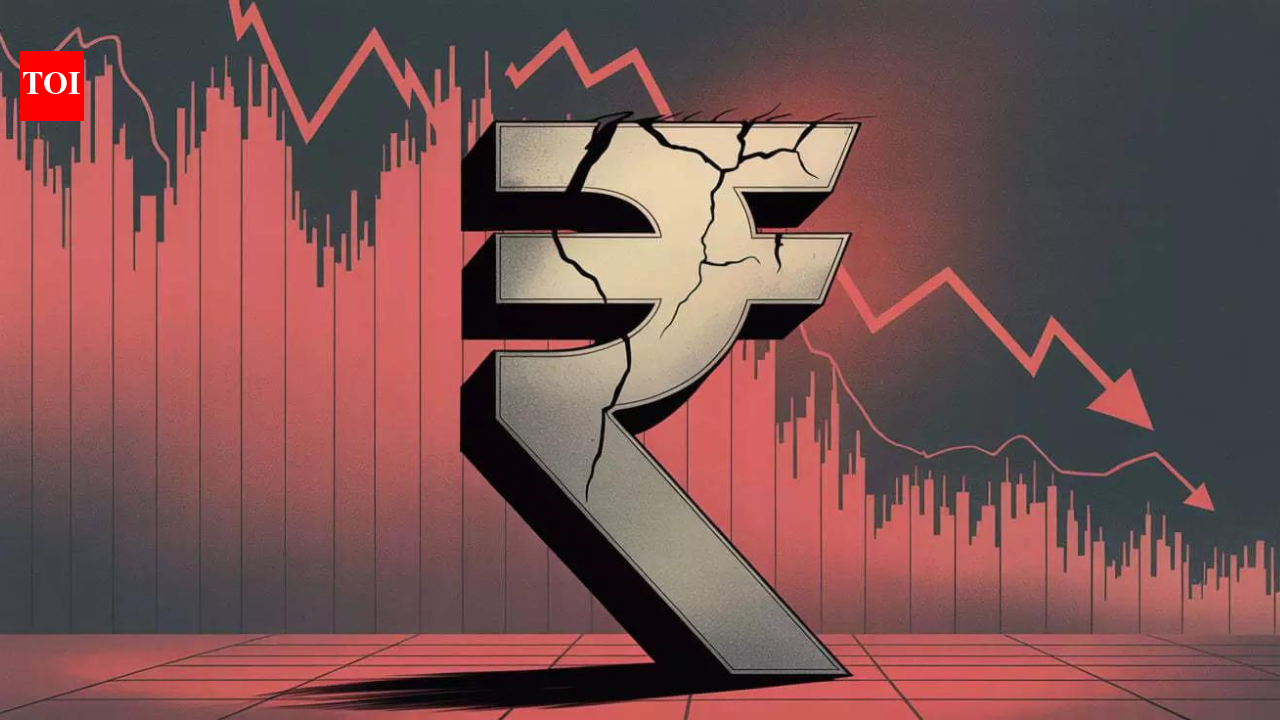
The Indian rupee weakened sharply on Wednesday, slipping to a record closing low of 92.05 against the US dollar as soaring crude oil prices and global risk aversion linked to the Iran crisis weighed heavily on the domestic currency.The rupee depreciated by 56 paise during the session, pressured by rising energy costs, foreign fund outflows and broad-based weakness in domestic equities, PTI reported.At the interbank foreign exchange market, the rupee opened at 92.05 and slid further to an intraday record low of 92.35 against the greenback. It eventually ended the session at 92.05, marking its lowest-ever closing level.The domestic forex market remained shut on Tuesday due to the Holi holiday. On Monday, the rupee had already fallen 41 paise to settle at 91.49 against the US dollar.Forex traders said the global risk-off mood triggered by the US-Iran conflict strengthened the dollar and intensified pressure on emerging market currencies, including the rupee.Foreign investors sold equities worth Rs 8,752.65 crore on a net basis on Wednesday, according to exchange data, further weighing on the currency.“A sharp escalation in Middle East conflict and the consequent spike in oil prices have reduced investor risk appetite. Higher oil prices increase inflation concerns and fiscal pressure on India (a major oil importer), leading to selling in bonds and rising yields,” said Anil Kumar Bhansali, Head of Treasury and Executive Director, Finrex Treasury Advisors LLP.Meanwhile, the dollar index, which measures the greenback against a basket of six currencies, was trading 0.23 per cent lower at 98.82.“The dollar index crossed 98 levels comfortably on the risk-off situation prevailing all around the globe with stocks and bond markets getting hit badly, along with Gold and Silver, with predominance of the dollar,” Bhansali said.Brent crude, the global oil benchmark, was trading 1.29 per cent higher at USD 82.46 per barrel in futures trade, as supply concerns intensified after US attacks on Iran and Tehran’s retaliatory actions raised fears over energy flows through the Strait of Hormuz.Dilip Parmar, Research Analyst at HDFC Securities, said, “The Indian rupee recorded its steepest two-session decline since May 2025, as soaring energy prices intensified fears of persistent inflation and a widening trade deficit.This prevailing risk-off sentiment, coupled with high energy costs, is expected to keep the currency under pressure in the near term. Investors are closely monitoring the longevity of the Middle East conflict, as a prolonged standoff would likely drive up the import cost of energy and precious metals while hindering export growth.”According to Parmar, the spot USDINR pair faces immediate resistance at 92.60, while key support is seen at 91.80.On the domestic equity market front, the BSE Sensex dropped 1,122.66 points to close at 79,116.19, while the NSE Nifty declined 385.20 points to settle at 24,480.50.

US President Donald Trump boards Air Force One before departing Palm Beach International Airport in West Palm Beach, Florida, on March 1, 2026, on his way back to Washington, DC.
Mandel Ngan | Afp | Getty Images
President Donald Trump has thrown his support behind crypto firms in their high-stakes battle with U.S. banks over whether they can offer interest-like returns on stablecoins.
Trump, in a social media post late Tuesday, ratcheted up pressure on banks to relent on the stablecoin yield issue.
That’s the key point of contention holding up passage in Congress of the Clarity Act, which is a companion bill to the Genius Act approved last year, setting up a framework for regulated stablecoins.
“The Genius Act is being threatened and undermined by the Banks, and that is unacceptable,” Trump said in his post. “They need to make a good deal with the Crypto Industry because that’s what’s in best interest of the American People.”
Coinbase shares surged as much as 13% in early trading Wednesday, while shares of JPMorgan Chase and Bank of America fell less than 1%.
While Trump’s decision to back the crypto industry could sway members of his Republican Party in the GOP-led Congress, it’s unclear whether his support is enough to ensure the bill’s passage. The move also raises fresh questions over potential conflict of interests, as the president and his family have reportedly generated hundreds of millions of dollars in wealth from interests in firms including the crypto platform World Liberty Financial.
The dispute between the industries centers on whether crypto firms like Coinbase can offer yields on stablecoins. While crypto companies see it as a consumer-friendly innovation that will let people earn money on their idle funds, banks have warned that the competing product could siphon trillions of dollars from their industry.
$6.6 trillion threat?
Executives from JPMorgan and Bank of America, the two largest American lenders by assets, have cited a Treasury study that indicated that banks could lose up to $6.6 trillion in deposits if stablecoins offered a yield.
That could destabilize some banks, especially smaller ones, and remove a source of funding for loans to businesses across the country.
Allowing the less-regulated crypto industry to behave like quasi-banks could heighten systemic risk, banks argue. Crypto firms say that the risks are contained and that stablecoins backed by Treasuries will boost demand for U.S. debt.
“It can’t be, you have these people doing one thing without any regulation, and these people doing another,” JPMorgan CEO Jamie Dimon told CNBC’s Leslie Picker on Monday. “If you do that, the public will pay. It will get bad.”
In recent months, the president has hosted a series of White House meetings between the two sides in hopes of brokering a deal, but the banks haven’t relented, according to people with knowledge of the gatherings.
Now, he is explicitly putting his weight behind crypto.
“Americans should earn money on their money,” Trump said in the post. “This industry cannot be taken from the People of America when it is so close to becoming truly successful.”
‘Full of s–t’
That phrasing is similar to language that Coinbase CEO Brian Armstrong has used in interviews. Coinbase is the largest U.S. crypto platform and provides yield to members through what critics in the banking industry call a “loophole” in current regulations.
Armstrong, seen by banks as their main adversary in this dispute, met with Trump at the White House shortly before the president’s social media post Tuesday, according to a person with knowledge of the meeting. That detail was reported earlier by Politico.
Both banks and crypto firms have reasons to support passage of the Clarity Act, but it’s unclear whether that will happen, given the disagreement. Earlier this year, Trump attempted to pressure banks to cap credit card interest rates, but the industry had enough support among both Republicans and Democrats to ward off that threat.
Tensions between Armstrong and banking CEOs have climbed since the Coinbase CEO publicly called out banks for their opposition to stablecoin yields.
In January, Dimon reportedly told Armstrong he was “full of s–t” during a chance interaction at the World Economic Forum in Davos, Switzerland.


Trump’s War on Iran Could Screw Over US Farmers

MLB Rank 2026: Ranking baseball’s top 100 players
Disney launches its Adventure cruise ship — a new foothold in Southeast Asia

India Us Trade Deal: Fresh look at India-US trade deal? May be ‘rebalanced’ if circumstances change, says Piyush Goyal – The Times of India

Households set for lower energy bills amid price cap shake-up

What are Iran’s ballistic missile capabilities?

-
Business6 days ago
India Us Trade Deal: Fresh look at India-US trade deal? May be ‘rebalanced’ if circumstances change, says Piyush Goyal – The Times of India
-
Business1 week ago
Households set for lower energy bills amid price cap shake-up
-

 Politics7 days ago
US arrests ex-Air Force pilot for ‘training’ Chinese military
-
 Politics6 days ago
What are Iran’s ballistic missile capabilities?
-
 Business6 days ago
Attock Cement’s acquisition approved | The Express Tribune
-

 Fashion6 days ago
Policy easing drives Argentina’s garment import surge in 2025
-

 Sports1 week ago
Top 50 USMNT players of 2026, ranked by club form: USMNT Player Performance Index returns
-

 Sports7 days ago
Sri Lanka’s Shanaka says constant criticism has affected players’ mental health