

Business
NARC opens speed breeding units for wheat and pulses | The Express Tribune


ISLAMABAD:
Federal Minister for National Food Security and Research Rana Tanveer Hussain on Friday inaugurated speed breeding facilities for wheat and pulses at the National Agricultural Research Centre (NARC), Islamabad, a move aimed at accelerating crop improvement and addressing food security challenges, according to an official statement.
The speed breeding technology enables crops to be grown under tightly controlled environmental conditions, significantly shortening breeding cycles. By extending photoperiods to up to 22 hours using specialised LED lighting and maintaining optimal temperature and humidity, wheat can complete its life cycle in six to eight weeks. This allows five to six generations to be produced in a single year, reducing the conventional varietal development timeline of around 14 years by nearly half.
The wheat speed breeding facility has been established at NARC’s Crop Sciences Institute under the PSDP-funded Wheat Productivity Enhancement Project. Equipped with controlled glasshouse chambers, LED grow lighting systems and environmental controls, the facility has already developed more than 3,000 new wheat lines, which are currently undergoing field yield trials. It has also been used to train scientists, breeders and students, with protocols being adapted for other crops.
Pakistan’s first dedicated pulses speed breeding facility was also inaugurated under the PSDP Pulses Project. Pulses are a major source of affordable protein and contribute to soil health through biological nitrogen fixation, but productivity gains have remained limited due to long breeding cycles and increasing climate and disease risks. The new facility enables four to six generations per year in crops such as chickpea, lentil, mung bean and mash through controlled growth chambers and adjustable lighting. According to the statement, work is under way on advanced chickpea breeding lines and multiple segregating generations, with improved phenotyping under uniform conditions.
Chairman Pakistan Agricultural Research Council Dr Syed Murtaza Hassan Andrabi said the adoption of advanced breeding technologies was essential for achieving faster genetic gains and improving crop resilience. He said the facilities reflected efforts to modernise agricultural research and strengthen collaboration with national and international institutions.
Hussain also inaugurated an Intelligent IoT-Based Smart Glasshouse at NIGAB. Spread over 2,640 square feet, the facility integrates IoT sensors, artificial intelligence, programmable control systems, and data analytics to support genome-assisted breeding, stress biology research and advanced phenotyping. It is currently being used for heat stress screening, rapid advancement of wheat generations, aquaponics-based cultivation and the acclimatisation of gene-edited plants.
Speaking at the occasion, Hussain remarked that the Intelligent Smart Glasshouse represents a future-ready national asset that bridges genomics, digital agriculture, and sustainable food production.
He appreciated the efforts of scientists and researchers involved in developing these facilities and reaffirmed the government’s support for scaling such initiatives, strengthening collaboration with national and international research organisations, and fostering publicprivate partnerships for sustainable varietal development.









A trade body for European airports has warned over a “systemic” shortage of jet fuel ahead of the peak summer season if the Strait of Hormuz does not reopen in the weeks ahead.
Airports Council International (ACI), which represents more than 600 airports, wrote a letter to the European commissioners for energy and transport and tourism.
The body’s director-general Olivier Jankovec wrote in the letter: “At this stage, we understand that if the passage through the Strait of Hormuz does not resume in any significant and stable way within the next three weeks, systemic jet fuel shortage is set to become a reality for the EU.
“The fact that we are entering the peak summer season… is only adding to those concerns.”
Supplies of jet fuel – which is used to fly planes – from the Middle East have been disrupted since the US-Israel’s war with Iran because of Iran’s effective closure of the Strait of Hormuz, a critical international shipping route.
This has led to soaring prices and warnings that flights could be affected because of Europe’s reliance on fuel imports from around the world.
Analysts have also said higher jet fuel prices can be quicker to pass through to airfares than road fuel and household energy costs.
Ryanair’s boss Michael O’Leary said earlier this month that if the war continues, then there was a risk of “disruptions in Europe in May and June”, adding that “maybe 10%, 20%, 25% of our supplies might be at risk”.
Sir Keir Starmer has been visiting allies in the Gulf for talks on how to support what he described as a “fragile” ceasefire between the US and Iran, which was agreed this week.
He spoke to US President Donald Trump about the need for a “practical plan” to get shipping going through the Strait of Hormuz amid suggestions Tehran wants to charge vessels for passage.
In its letter, the ACI says jet fuel supply for the next six months needs to be urgently monitored by the European Commission, including identifying action that can be taken to increase production within the EU.
It also asks them to consider temporarily lifting restrictions and regulations that limit the ability to import jet fuel.
“This crisis has exposed the reduced refining capacity of the EU for jet fuel production, and its acute dependence on imports from other world regions,” Mr Jankovec warned on behalf of the body.
Susannah Streeter, chief investment strategist for Wealth Club, said: “Carriers have had to deal with a more than doubling of fuel costs since the conflict erupted and the threat of shortages lingers.
“As the war has put a chokehold on supplies from the Middle East, it has caused other nations which produce jet fuel to impose export bans, causing trade to seize up further.
“It will take time to unwind panic positions, and for jet fuel prices to stabilise, so airlines are likely to continue to pass on the cost to passengers for the foreseeable future.”

Chrysler and Dodge CEO Matt McAlear wants the world to know that the minivan is not dead. Far from it, he said, at the New York International Auto Show, where he showed off the latest version of the Pacifica Pinnacle, the highest-end trim of the brand’s sole product line.
The Chrysler brand — once one of the biggest names in the auto industry — only sells a single family of minivans, which many take as a sign of the brand’s impending demise.
Chrysler, which has been promising new products for years, said it will share more plans at parent company Stellantis‘ investor day on May 21 in Auburn Hills, Michigan. McAlear didn’t elaborate further but said the brand had “a lot of things in the works” and touted its only vehicle.
“We absolutely see the minivan market growing, and we believe there’s an opportunity for Chrysler to continue its growth year over year,” McAlear said. Chrysler is the best-selling brand in the segment, he added.
Matt McAlear, chief executive officer of Chrysler and Dodge, during the 2026 New York International Auto Show (NYIAS) in New York, US, on Wednesday, April 1, 2026.
Bing Guan | Bloomberg | Getty Images
Minivan resurgence?
Chrysler is often credited with inventing the minivan, or at least mainstreaming it in the United States in the early 1980s. Rivals followed, but many have since abandoned it.
Since the 1990s, minivans have steadily lost ground to SUVs, which are considered sportier and more adventurous. Minivan sales were a mere 1.7% of the market in 2017, according to Edmunds. In 2025, they were up to 2.4%.
Sales numbers from Chrysler and its few competitors in this segment indicate growing interest in the adaptive and often affordable “multipurpose vehicle,” as the minivan is sometimes called. The average transaction price for a large SUV is $77,215, according to Edmunds. The average minivan price, meanwhile, is $48,269 — just above the overall industry average cost for a new vehicle of $48,402.
There is enough demand that Chrysler saw fit to unveil a new highest-end version of its minivan at the Auto Show, called the Pinnacle. The vehicle is full of features common in higher-end family vehicles, like screens on the backs of seats so passengers in a rear row can watch movies on a road trip. But there are also some perks that are tough to find outside the segment: both second and third row seats on some versions can be completely stowed in the floor, for example.
Companies like Chrysler are also trying to look beyond the “family hauler” identity the minivan has had for much of its history. Its Grizzly Peak concept has knobby tires and a roof rack, for a more rugged option and McAlear said the company was thinking about how to do more of that.
“We’re looking at it,” he said. “We’re trying to figure out if there’s a way to do it because people love it. And it is unlike anything you’ve ever seen from a minivan brand before.”
McAlear also touted the van’s storage capacity compared with similar vehicles.
“I’ve got a friend that’s a racecar driver,” he said. “One of his favorite things about this is he puts a shifter kart in the backseat with the third row down, with his kids so he can keep it safe and doesn’t have to have a trailer. Another buddy of mine loves kiteboarding, and he doesn’t want to put it on the top because it’s hard to get it up and down. It’s hard to keep it secure and safe. He keeps it inside.”
Pacifica sales were only up slightly in 2025. The affordable Voyager model, which the brand has since renamed the Pacifica LX, sells in lower quantities but saw a bigger jump. Pacifica sales were down for the first quarter of 2026, but Chrysler said they were up nearly 84% in March year over year.
There are only a handful of vehicles in this segment in the U.S., or five basic model lines including the electric Volkswagen ID Buzz, which VW prefers not to call a minivan.
Toyota Sienna sales jumped 35% in 2025, and were up again in the first quarter of 2026. It’s nowhere near Toyota’s best-selling vehicle, and many models — some of which were new ones or refreshes — saw greater increase. Toyota’s Japanese rival Honda saw sales of its Odyssey jump 10% last year. But they dipped in the first quarter of 2026.
One especially successful model has been the Kia Carnival. Volumes rose in 2025 and in the first quarter of 2026. It still doesn’t match Kia’s comparable SUVs, as minivan sales are just a few thousand shy of the three-row Sorento, but far below the popular, more rugged Telluride.
“Carnival is just a great family, practical vehicle,” said Eric Watson, vice president of sales operations for Kia America. “I think in the stage of life when people have kids and want those power sliding doors and the configuration of what that vehicle provides, it’s perfect in that life stage.”
Kia was one of the later entrants into the segment, and though it has the sliding rear door that defines the minivan segment, the body panel on it is punched into give the illusion the vehicle is an SUV.
“I think that attracts a lot of people and lowers that stigma of being a minivan family,” Watson said.
But some are attracted to the segment itself. While the Chrysler Pinnacle starts above $56,000, the lowest priced LX, starts just above $41,000.
“We’re actually seeing a resurgence,” McAlear said. “At the end of the day, these things make life easier and you don’t always have to impress everybody.”
Business
US stock market today (April 10, 2026): S&P 500, Nasdaq rise on tech gains after inflation data – The Times of India

US equity benchmarks traded mixed on Friday, with the S&P 500 and Nasdaq moving higher on strength in technology stocks after March inflation data came in line with expectations, while investors kept a close watch on geopolitical tensions in the Middle East.US consumer prices rose the most in nearly four years in March, driven by higher oil prices linked to the Iran conflict and continued tariff pass-through. Despite this, traders maintained expectations that the US Federal Reserve will hold borrowing costs steady this year, scaling back earlier bets of two rate cuts prior to the conflict, according to Reuters.“When paired with Thursday’s PCE data, the message is clear: inflation remains sticky – and that optimistically assumes the energy surge proves to be a temporary headwind rather than a lasting recalibration,” said Bret Kenwell, US investment analyst at eToro. “It should keep policymakers on pause, unless we see a more notable deterioration in the labor market or the broader economy.”San Francisco Fed President Mary Daly told Reuters on Thursday the oil shock from the Iran war would extend the timeline on bringing inflation back to the US central bank’s 2% target.At 10:15 a.m. ET, the Dow Jones Industrial Average was down 109.60 points, or 0.23%, at 48,076.20, while the S&P 500 gained 10.56 points, or 0.15%, to 6,835.22, and the Nasdaq Composite rose 123.70 points, or 0.54%, to 22,946.11.Gains were led by technology stocks, with the S&P 500 information technology index advancing 0.8%, supported by chipmakers. Nvidia rose 1.8% and Broadcom climbed 4.4%, while the Philadelphia Semiconductor index touched a record high of 8,926.08.However, declines in financial stocks, down 0.8%, limited the broader upside. Goldman Sachs and Travelers weighed on the Dow.On a weekly basis, Wall Street’s main indexes were poised for gains, with the S&P 500 and Dow set for their strongest weekly rise since November and June, respectively.Investor sentiment was supported by the two-week ceasefire between Washington and Tehran, along with remarks from Israeli Prime Minister Benjamin Netanyahu indicating efforts to initiate direct talks with Beirut. However, the Pakistan-brokered truce showed signs of strain, with both sides accusing each other of violations ahead of talks scheduled for Saturday.“This is a headline-driven market… as long as the ceasefire holds and the market sees a path toward relative calm in the Middle East, investors should be able to look through disruptions,” said Jeff Buchbinder, chief equity strategist at LPL Financial.Separately, preliminary data showed the University of Michigan’s consumer sentiment index fell to 47.6 in April, below economists’ expectations of 52, according to a Reuters poll.US-listed shares of Taiwan Semiconductor Manufacturing, the world’s largest contract chipmaker, rose 2.7% after reporting stronger-than-expected first-quarter revenue.CoreWeave advanced 6.8% after announcing a multi-year agreement with Anthropic and pricing its convertible bond offering at a premium.Advancing stocks outpaced decliners by a 1.22-to-1 ratio on the NYSE and by 1.07-to-1 on the Nasdaq. The S&P 500 recorded 17 new 52-week highs and 18 new lows, while the Nasdaq logged 84 new highs and 70 new lows.


Frankie Muniz remembers meeting Bryan Cranston for first time

Scottish golfer Robert MacIntyre flashes lewd gesture at Masters

How ‘Euphoria’ affected Zendaya, Jacob Elordi, Sydney Sweeney’s careers

-
 Business1 week ago
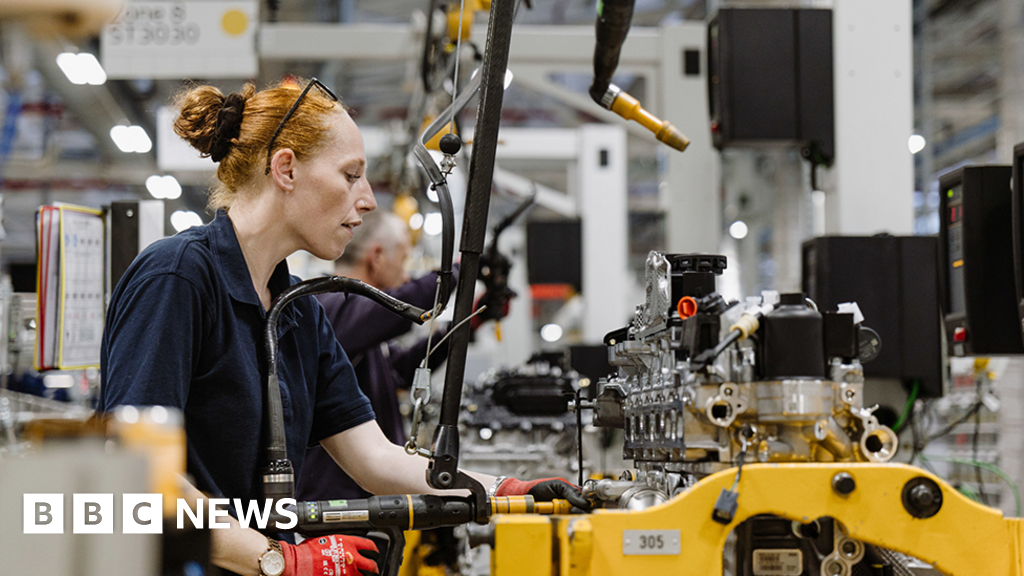
Jaguar Land Rover sees sales recover after cyber attack
-
Uncategorized1 week ago
[CinePlex360] Please moderate: “Trump signals p
-

 Entertainment1 week ago
Joe Jonas shares candid glimpse into parenthood with Sophie Turner
-

 Tech1 week ago
Our Favorite iPad Is $50 Off
-

 Sports7 days ago
UConn Final Four run could trigger a $50M furniture giveaway for Massachusetts-based Jordan’s Furniture
-
 Business1 week ago
Video: Why Is the Labor Market Stuck?
-

 Entertainment1 week ago
Blake Lively reacts to harassment claims dismissal against Justin Baldoni
-

 Politics1 week ago
Iran can sustain Strait of Hormuz closure for years, will cut US military logistics: Official