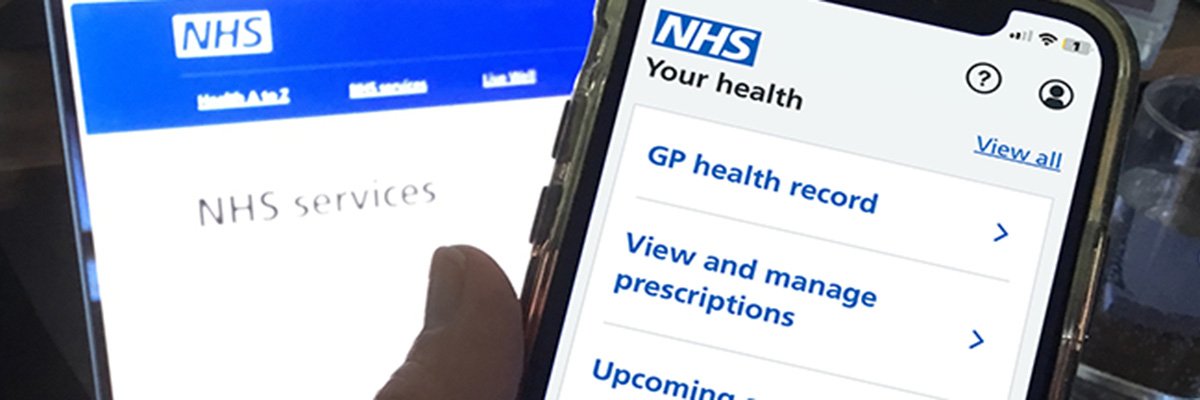
As part of the health service’s 10-year plan, the NHS App is set to become the entry point to an online hospital that, by 2027, will start connecting patients digitally to expert clinicians anywhere in England.
Called NHS Online, the digital health service is being designed so patients can be seen faster and to enable NHS clinicians to triage them via the NHS App. NHS England said patients will also be able to book scans at local community diagnostic centres.
Since it was introduced in 2019, millions of patients have used the NHS App to manage their care. Through enhanced app functionality, when a patient has an appointment with their GP, they will have the option of being referred to the online hospital for their specialist care. They will then be able to book directly through the NHS App and have the option to see specialists from around the country online, without leaving their home or having to wait longer for a face-to-face appointment.
If a patient needs a scan, test or procedure, NHS England said the app will enable them to book this at a time that suits them at a community diagnostic centre close to home. They will be able to track their prescriptions and get advice on managing their condition without needing to travel.
NHS England said NHS Online will improve patient waiting times, delivering the equivalent of up to 8.5 million appointments and assessments in its first three years – four times more than an average trust – while enhancing patient choice and control over their care.
The service will initially be rolled out to cover a small number of planned treatment areas with the longest waits. Over time, NHS England said it will expand to more treatment areas.
The NHS 10-year health plan aims to shift the health service from analogue to digital, using technology to help deliver patient services.
The service builds on and scales the artificial intelligence (AI) and remote monitoring already in use across the NHS.
Discussing the new service, Jim Mackey, NHS chief executive, said: “The NHS can, must and will move forward to match other sectors in offering digital services that make services as personalised, convenient and flexible as possible for both staff and patients.”
Patients who choose to receive their treatment through the online hospital will benefit from us industrialising the latest technology and innovations, while the increased capacity will help to cut demand and slash waiting times Jim Mackey, NHS
Mackey described NHS Online as a huge step forward for the health service, which he said would deliver millions more appointments by the end of the decade and offer a real alternative for patients.
“Patients who choose to receive their treatment through the online hospital will benefit from us industrialising the latest technology and innovations, while the increased capacity will help to cut demand and slash waiting times,” he added.
Before NHS Online goes live, the NHS said it will learn from existing research on patient experience of online care over the past five years and build this into the programme as it develops. The programme is being developed with a commitment to patient partnership in design and delivery.
Jeanette Dickson, chair of the Academy of Medical Royal Colleges, said: “This is a novel and potentially game-changing way of improving equity and speed of access to NHS services, which would reduce health inequalities.
“Obviously, we need to make sure that those who aren’t digitally enabled are not penalised in any way, but if this approach can be delivered safely and effectively, freeing up capacity in bricks and mortar hospitals at the same time, then it could potentially be a really good thing.”
The iPhone is the least fixable phone on the market, according to repairability experts. Phones from Samsung and Google are not far behind.
The latest repairability ratings are from an annual report called “Failing the Fix” put out today by the consumer advocacy group US PIRG. A 2021 French law required products to be labeled with repairability scores, and US PIRG says this is the first report since then that really shows which companies are—or are not—making progress. The answer is that repairability is progressing much more quickly in some places than others.
The results were good for phones made by Motorola, which got a B+. Google’s phones got a C–. The verdict was worse for Samsung phones, which got a D. Last on the list was Apple with a D–. Apple and Samsung did not immediately respond to requests for comment.
Scores were better for laptops than smartphones, with Asus at the top with a B+ and Apple on the bottom with its MacBooks at a C–.
The authors of the report are hoping that publishing these low scores will encourage manufacturers to do better.
“Putting these right incentives in place could push these companies to make innovations that are actually beneficial,” says Nathan Proctor, senior director of the US PIRG campaign for the right to repair. “Instead of coming up with new ways to jam AI down our throats, you can make stuff that lasts and that we can fix.”
Despite many right-to-repair concessions companies have made—like making their tools, parts, and repair instructions publicly available—those rankings are lower than in years past, largely because of the new information that has been gleaned from European laws requiring repair scores to be printed on product packaging.
The French law grades products based on how easily they can be disassembled, whether documentation and tools are provided, and the availability and price of spare parts. In 2023, the European Union passed a law establishing the European Product Registry for Energy Labelling, a process that grades devices on key repairability factors like whether products have easy access and disassembly, battery endurance, ingress protection like waterproofing, and the durability to handle repeated falls. The rankings go from A to F.
To arrive at its own ratings, US PIRG collates the EPREL and France’s repair indexes with other US-specific factors, like whether companies are actively lobbying against the right to repair or are members of trade associations that do so.
“If you’re buying your equipment from a company that’s spending their money to lobby against your right to repair that thing, that doesn’t speak well for their support, for your ability to fix that,” Proctor says. “So we also dock points for some of those legislative activities.”
Apple’s phones are getting better scores than in years past, like when iPhones were assigned an F rating in 2022. (iPhones got a C– in 2025.) The low rating for Apple’s phones comes down to software support, and how the EU laws track the information about what companies enable in their products. Based on the EU laws, companies have to self-report how their devices meet repair requirements. And those rankings tend to score pretty low.
“When we’ve been grading on a curve, Apple has not been a standout in the bad column,” Proctor says. “But why are we grading on a curve? We should just have longer-lasting products.”
The ultimate goal of these rankings, Proctor says, is to bring attention to the importance of repairability, accessibility, and waste reduction.
“This is an emerging, vitally important issue that we need better leadership on from companies and from other public policy officials,” Proctor says. “We should not be trashing all of our internet-connected stuff every couple of years because it’s impossible to use it with the software. It’s totally unsustainable. It’s crazy. Let’s not build that world. That world is a dystopia.”
“I’m actually pretty confident that some of that stuff’s going to get addressed,” Proctor adds. “Apple engineers are good at making stuff. They’re good at solving problems.”
Following leaked revelations at the end of March that Anthropic had developed a powerful new Claude model, the company formally announced Mythos Preview on Tuesday along with news of an industry consortium it has convened, known as Project Glasswing, to grapple with the cybersecurity implications of the new model and advancing capabilities more generally across the AI field.
The group includes Microsoft, Apple, and Google as well as Amazon Web Services, the Linux Foundation, Cisco, Nvidia, Broadcom, and more than 40 other tech, cybersecurity, critical infrastructure, and financial organizations that will have private access to the model, which is not yet being generally released. The idea, in part, is simply to give the developers of the world’s foundational tech platforms time to turn Mythos Preview on their own systems so they can mitigate vulnerabilities and exploit chains that the model develops in simulated attacks. More broadly, Anthropic emphasizes that the purpose of convening the effort is to kickstart urgent exploration of how AI capabilities across the industry are on the precipice, the company says, of upending current software security and digital defense practices around the world.
“The real message is that this is not about the model or Anthropic,” Logan Graham, the company’s frontier red team lead, tells WIRED. “We need to prepare now for a world where these capabilities are broadly available in 6, 12, 24 months. Many things would be different about security. Many of the assumptions that we’ve built the modern security paradigms on might break.”
Models developed and trained by multiple companies have increasingly been able to find vulnerabilities in code and propose mitigations—or strategies for exploitation. This creates a next generation of security’s classic cat-and-mouse game in which a tool can aid defenders but can also fuel bad actors and make it easier to carry out attacks that were once too expensive or complex to be practical.
“Claude Mythos preview is a particularly big jump,” Anthropic CEO Dario Amodei said on Tuesday in a Project Glasswing launch video. “We haven’t trained it specifically to be good at cyber. We trained it to be good at code, but as a side effect of being good at code, it’s also good at cyber.” He adds in the video that “more powerful models are going to come from us and from others. And so we do need a plan to respond to this.”
Anthropic’s Graham notes that in addition to vulnerability discovery—including producing potential attack chains and proofs of concept—Mythos Preview is capable of more advanced exploit development, penetration testing, endpoint security assessment, hunting for system misconfigurations, and evaluating software binaries without access to its source code.
In carrying out a staggered release of Mythos Preview, beginning with an industry collaboration phase, Graham says that Anthropic sought to draw on tenets of coordinated vulnerability disclosure, the process of giving developers time to patch a bug before it is publicly discussed.
“We’ve seen Mythos Preview accomplish things that a senior security researcher would be able to accomplish,” Graham says. “This has very big implications then for how capabilities like this should be released. Done not carefully, this could be a meaningfully accelerant for attackers.”
Project Glasswing partners, including some of Anthropic’s competitors, struck a collaborative tone in statements as part of the launch.
“Google is pleased to see this cross-industry cybersecurity initiative coming together,” Heather Adkins, Google’s vice president of security engineering, says in a statement. “We have long believed that AI poses new challenges and opens new opportunities in cyber defense.”
The UK’s National Cyber Security Centre (NCSC) and Microsoft have exposed an extensive Domain Name System (DNS) hijacking campaign against vulnerable consumer and small and home office (Soho) broadband routers conducted by the Russian cyber intelligence services.
Orchestrated by APT28 or Forest Blizzard – more widely-known as Fancy Bear – the operations saw the threat actor alter the settings of compromised devices to reroute internet traffic through malicious servers they held.
In this way, Fancy Bear was able to steal data such as login credentials, passwords and access tokens from personal web and email services belonging to their victims in a so-called adversary-in-the-middle (AiTM) attack.
The NCSC said the campaign was likely opportunistic, with Fancy Bear having cast a wide net to ensnare as many victims as possible. By targeting insecure home and small office equipment, Fancy Bear took advantage of less closely-monitored or managed assets to pivot into larger enterprise environments or targets of interest to Russian intelligence.
Indeed, Microsoft said it had identified over 200 organisations and 5,000 consumer devices impacted since the campaign began in August 2025.
“This activity demonstrates how exploited vulnerabilities in widely used network devices can be leveraged by sophisticated hostile actors,” said NCSC operations director Paul Chichester.
“We strongly encourage organisations and network defenders to familiarise themselves with the techniques described in the advisory and to follow the mitigation advice.
“The NCSC will continue to expose Russian malicious cyber activity and provide practical guidance to help protect UK networks,” he added.
Routers on trial
The exposure of Fancy Bear’s latest campaign comes amid a fierce debate on the other side of the Atlantic following the Federal Communications Commission’s (FCC’s) implementation of tight restrictions on routers built outside the US – which in effect means virtually every commercially available router.
The US’ decision was framed on the basis that such hardware poses an unacceptable risk to the country’s national security and that of its citizens and residents.
However it has been criticised on the basis that while it eases fears over the potential for other governments – such as China – to interfere with networking hardware produced in their factories, it does not address the fact that security vulnerabilities such as those exploited by Fancy Bear will still exist regardless of where they were manufactured.
Writing in Computer Weekly, Forescout vice president of security intelligence, Rik Ferguson, said routers present a highly attractive footholds for attackers because they sit at the network edge, generally face the public internet, and are easily overlooked once deployed.
“Many of the weaknesses we see come from familiar, measurable issues like outdated software components, slow patching cycles, weak credentials, exposed management interfaces and long lifespans that extend well beyond vendor support,” he said.
“In firmware analysis, we regularly see common components that are years behind current versions, carrying known vulnerabilities that attackers can and do exploit.”
Ferguson advised security teams to treat routers and similar network infrastructure as part of the active attack surface, which in practice means keeping accurate inventories, prioritising their lifecycle management, and enforcing firmware updates and patching.
To prevent attackers like Fancy Bear from scoring easy wins, security teams should also look to disable any internet-exposed management interfaces, enforce unique credentials, and apply network segmentation measures so that one compromised router does not necessarily enable wider access.












 Entertainment4 days ago
 Tech4 days ago
 Fashion7 days ago
 Politics4 days ago
 Sports4 days ago