

Business
Novo Nordisk shares rise 8% after Wegovy obesity pill has ‘solid’ launch


A pharmacist displays a box of Wegovy pills at a pharmacy in Provo, Utah, Jan. 15, 2026.
George Frey | Bloomberg | Getty Images
Shares of Novo Nordisk rose more than 8% on Friday after early prescription data showed an encouraging start to the U.S. launch of the company’s new GLP-1 pill for obesity.
In a Friday note, TD Cowen analysts called it a “solid start” for the first-ever weight loss pill, but said “one data point does not make a trend.” They cautioned that they need to see more data to fully assess early demand for the Wegovy pill, which officially launched Jan. 5 after winning approval in late December.
Still, the initial data is a boost to the Danish drugmaker’s hopes of winning back more share from its chief rival, Eli Lilly, this year in the booming obesity and diabetes drug market. Eli Lilly won the majority market share in early 2025 and is trailing closely behind Novo Nordisk in the pill space, as it prepares for the upcoming launch of its own oral drug for obesity.
In a Friday note, Leerink Partners analyst David Risinger said around 3,100 prescriptions for the Wegovy pill were filled in the first week of the launch, citing IQVIA data for the week ending Jan. 9. In the first week of the commercial launch of Eli Lilly’s popular obesity injection, Zepbound, around 1,300 prescriptions were filled, and roughly 8,000 were filled in the second week, he noted. That injection won U.S. approval in late 2023.
The TD Cowen analysts cited somewhat different data published by Symphony through Bloomberg.
The analysts said around 4,290 prescriptions were filled for Novo Nordisk’s pill during its first full week of launch, with the majority being for the starting dose of the drug. They added that the data from their source or IQVIA likely don’t include prescriptions through Novo Nordisk’s direct-to-consumer pharmacy or its telehealth partners.
The analysts said that compares with the roughly 1,900 prescriptions filled for Zepbound during its first full week on the market.
Assuming the Symphony data is accurate, the pill “is already outstripping its injectable counterparts at the same stage of their launch,” TD Cowen analyst Michael Nedelcovych wrote in the note. A more direct comparison between the pill and the injections can be made based on available data early next week, though the figures may not prove more useful for another two to three quarters, he added.
Nedelcovych said he wants to see the full picture on the direct-to-consumer channel, which holds “significant promise” for the pill’s launch.
Demand could also shift once Eli Lilly’s pill, orforglipron, enters the market in the next few months, he added.
While Novo Nordisk’s drug has a head start, it is a peptide medication with dietary requirements — no food or drink for 30 minutes after taking the pill with water — that may hinder uptake. Eli Lilly’s pill is a small-molecule drug and not a peptide, meaning it does not have those restrictions.





The firm was unable to cope during high demand, Ofwat says, leading to “immense stress” for customers.
Source link
Business
Middle East heat may ripple across India’s energy supply chain, flags Goldman Sachs – The Times of India

As tensions continue to heat up in the Middle East, concerns are raising about disruptions to one of the world’s most critical energy shipping routes, the Strait of Hormuz. Any disruption could significantly affect major oil-importing countries such as India, as the narrow Strait of Hormuz is central to global energy trade. The strait sees almost 20 million barrels of oil passing through each day, or about a fifth of the world’s consumption, pass through the route. The waterway also carries roughly 19% of global liquefied natural gas (LNG) shipments, making it a crucial corridor for energy-importing economies.A recent report by Goldman Sachs has flagged early signs of stress in the region. The report warned that tanker traffic through the Strait of Hormuz has already begun showing signs of disruption, with shipping firms, oil producers and insurers adopting a cautious approach following reports of damaged vessels in nearby waters.According to the firm, financial markets have already begun factoring in the geopolitical risk. Oil prices currently carry an estimated risk premium of $18-per-barrel, reflecting the potential market impact if energy flows through the Strait of Hormuz were disrupted for about a month.
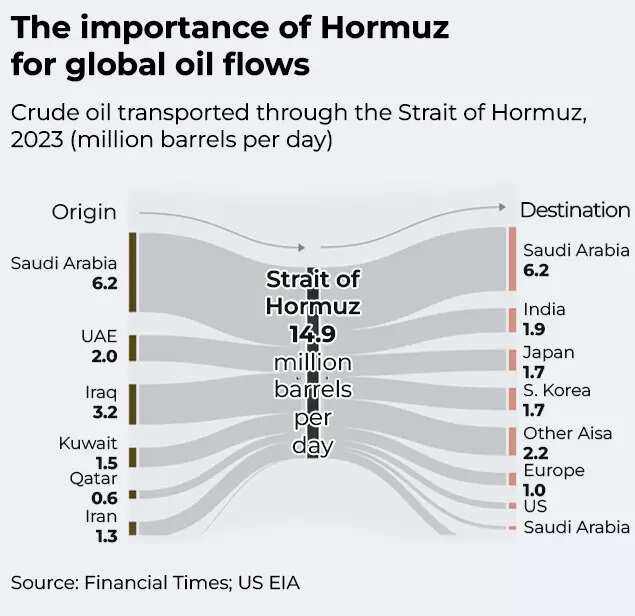
Even is the oil facilities are not directly damaged, a shutdown of the shipping route could expose a significant portion of global supply. The report estimates that in an event of full closure, about 16 million barrels per day of oil flows could be affected, despite the availability of some pipeline routes designed to bypass the strait.And the risks are not limited to crude oil shipments with almost 80 million tonnes of LNG exports annually, much of it from Qatar, moving through the passage. Any prolonged disruption could tighten gas supply globally and potentially drive European benchmark gas prices back to levels seen during the 2022 energy crisis.
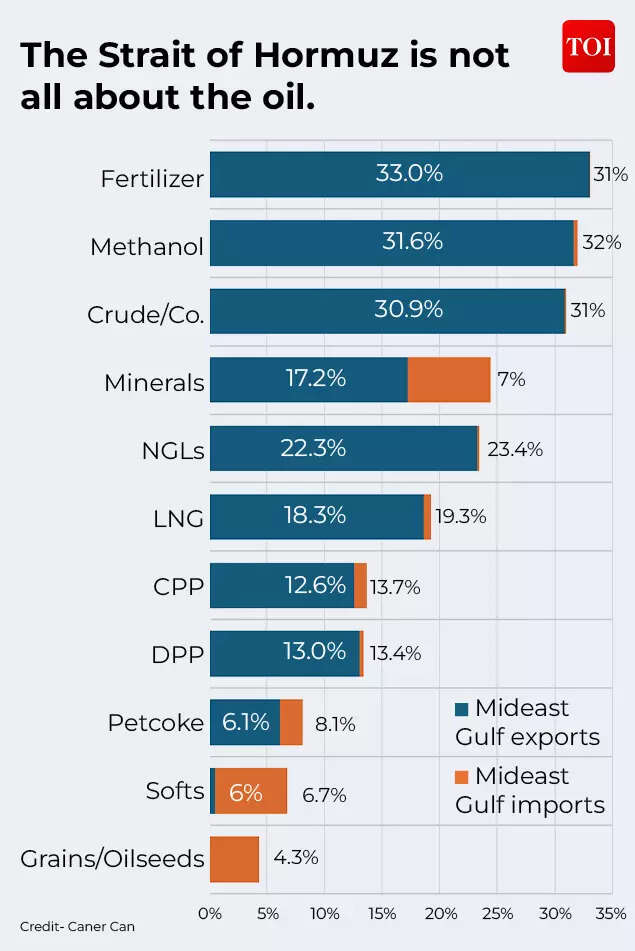
Asian economies stand among the most exposed to such disruptions. Major importers such as China, India, Japan and South Korea depend heavily on oil and LNG shipments that transit through the strategic corridor.While global oil inventories and spare production capacity could help cushion short-term shocks, the report warned that sustained disruption to Gulf shipping routes could trigger sharp volatility in global energy markets and push prices higher across oil, gas and refined fuel products.Market participants and governments are closely watching tanker traffic in the Strait of Hormuz, along with diplomatic and military developments involving the United States, Iran and Gulf nations, to assess whether the current disruptions remain temporary or escalate into a broader energy supply shock.

KARACHI: The Pakistan Stock Exchange rallied on Thursday after Saudi Arabia assured Pakistan of facilitating crude oil shipments through the Red Sea port of Yanbu Port, easing concerns over potential fuel supply disruptions.
The benchmark KSE-100 Index climbed sharply during the trading session, rising 4,439.93 points (2.85%) to reach an intraday high of 160,217.14 points.
Market Recovery
Analysts attributed the market rebound to renewed institutional buying and improving investor sentiment after Saudi assurances on oil supplies.
Market expert Ahsan Mehanti, CEO of Arif Habib Commodities, said easing fuel supply concerns played a key role in the recovery.
He added that rising global crude prices, expectations of a new International Monetary Fund loan tranche for Pakistan, and positive economic indicators also boosted investor confidence.
Alternative Oil Route
Pakistan sought an alternative supply route after Iran announced the closure of the Strait of Hormuz, a crucial global oil transit corridor.
Federal Petroleum Minister Ali Pervaiz Malik held talks with Nawaf bin Said Al-Malki, requesting Saudi support for uninterrupted energy supplies.
Saudi authorities reportedly assured Pakistan that oil shipments could be routed through Yanbu, and one crude vessel has already been prepared for dispatch.
Global Oil Market Impact
Oil prices continued to rise amid tensions in the Middle East conflict involving Iran, Israel and the United States.
Brent crude: up 3.26% to $83.99 per barrel
West Texas Intermediate (WTI): up 3.70% to $77.42 per barrel
Energy markets remain volatile as shipping disruptions threaten supply through the Strait of Hormuz, a route that handles nearly 20% of global oil trade.
Analysts say the Saudi assurance helped calm fears about Pakistan’s energy supply chain, contributing to the strong recovery at the PSX.


Switzerland’s Calida narrows sales decline, lifts profit in 2025

Browns star Myles Garrett in speeding trouble again with 9th citation since entering NFL

If a Garmin Is Too Expensive, Consider Suunto’s Latest Adventure Watch

India Us Trade Deal: Fresh look at India-US trade deal? May be ‘rebalanced’ if circumstances change, says Piyush Goyal – The Times of India

What are Iran’s ballistic missile capabilities?

Attock Cement’s acquisition approved | The Express Tribune

-
Business6 days ago
India Us Trade Deal: Fresh look at India-US trade deal? May be ‘rebalanced’ if circumstances change, says Piyush Goyal – The Times of India
-
 Politics1 week ago
What are Iran’s ballistic missile capabilities?
-
Business7 days ago
Attock Cement’s acquisition approved | The Express Tribune
-
 Business1 week ago
Households set for lower energy bills amid price cap shake-up
-

 Politics1 week ago
US arrests ex-Air Force pilot for ‘training’ Chinese military
-

 Fashion7 days ago
Policy easing drives Argentina’s garment import surge in 2025
-

 Sports6 days ago
LPGA legend shares her feelings about US women’s Olympic wins: ‘Gets me really emotional’
-

 Fashion6 days ago
Texwin Spinning showcasing premium cotton yarn range at VIATT 2026