

Business
OBR chairman resigns over Budget leak


The chairman of the Office for Budget Responsibility (OBR) has resigned over the early publication of the watchdog’s forecasts.
Richard Hughes said he was resigning to allow the OBR to “quickly move on from this regrettable incident”.
His resignation follows publication of a report that described the leak as “the worst failure in the 15-year history of the OBR” and strongly criticised the watchdog’s processes for protecting sensitive information.
In a letter to the Chancellor and the chairwoman of the Commons Treasury Committee, Mr Hughes said he took “full responsibility” for “the shortcomings identified in the report”.
He said: “By implementing the recommendations in this report, I am certain the OBR can quickly regain and restore the confidence and esteem that it has earned through 15 years of rigorous, independent economic analysis.”
Mr Hughes has served as chairman of the OBR since 2020 and was reappointed to the job for a second five-year term in July this year.
Speaking in the Commons as the news of the resignation broke, Chief Secretary to the Treasury James Murray offered the Government’s thanks to Mr Hughes “for his dedication to public service”.
Later, the Chancellor herself offered her thanks for Mr Hughes’ “many years of public service”, adding: “This Government is committed to protecting the independence of the OBR and the integrity of our fiscal framework and institutions.”
Conservative leader Kemi Badenoch accused the Chancellor of using Mr Hughes as a “human shield” and called on Rachel Reeves to resign.
Liberal Democrat Treasury spokeswoman Daisy Cooper said Mr Hughes was “a dedicated public servant” who had “rightly taken responsibility for a failure on his watch”, adding the OBR needed to learn from its “catastrophic error”.
Treasury Committee chairwoman Dame Meg Hillier also thanked Mr Hughes, saying: “I commend his decision to take full responsibility for the incident and I wish him well for the future.”
The Treasury said it would begin the process of finding a replacement for Mr Hughes “in the coming weeks”.
The OBR launched an investigation after official forecasts were uploaded to the watchdog’s website, releasing details of the Budget almost an hour early.
In a report published on Monday, the OBR said the leak had been “seriously disruptive to the Chancellor, who had every right to expect that the (forecasts) would not be publicly available until she sat down at the end of her Budget speech”.
Noting Mr Hughes had already “rightly” apologised for the leak, the report said it was “not a case of intentional leakage” or a matter of pressing publish too early.
The OBR said it was caused by two errors linked to the WordPress publishing site it used.
The report into the incident said that, while it knew web addresses for its files follow a pattern, it assumed “the protections provided” by WordPress “would ensure it could not be accessed”.
But two configuration errors were the technical causes of the premature access.
The forecast for the last spring statement in March was also “accessed prematurely” on one occasion, the report noted, but concluded that no activity appeared to have been taken as a result and the most likely explanation is “benign”.
The report recommended a review of the watchdog’s processes for publishing such documents.
“To rebuild trust, the leadership of the OBR must take immediate steps to change completely the publication arrangements for the two important and time-sensitive documents containing the results of its biannual forecasts that it publishes in a normal year, and review arrangements for all other publications,” the report said.
One option would be for the watchdog to use the Government’s digital architecture but publish when it wants.
Another would be to have the Treasury publish the forecasts for the Budget and spring statement, but this would only work if safeguards for “real and perceived independence” could be put in place.
There may need to be an interim solution, the report noted, but said new arrangements must be in place in time for the next statement in spring 2026.

Thomas Fuller | SOPA Images | Lightrocket | Getty Images
UniQure needs to run another study to prove that its gene therapy “actually helps people with Huntington’s disease,” a senior U.S. Food and Drug Administration official said on a call with reporters Thursday.
The official, who requested anonymity before discussing sensitive information, confirmed the agency has asked the company to run a placebo controlled trial of its treatment, which is administered directly into the brain. UniQure has said that type of study isn’t ethical because it would require putting people under general anesthesia for hours, a characterization the official disputed.
“So what is really going on? UniQure is the latest company to make a failed therapy for Huntington’s patients,” the official said. “They likely acknowledge or understand at some deep level that their trial failed years ago, and instead of doing the right thing and running the correct clinical study, UniQure is performing a distorted or manipulated comparison in the mind of FDA.”
The comments mark the latest development in a messy public spat between UniQure and the FDA, and as the agency comes under fire for a number of recent drug approval application rejections, including some where companies have accused it of going back on previous guidance. FDA Commissioner Marty Makary in an interview with CNBC’s Becky Quick last week seemingly criticized UniQure’s gene therapy for Huntington’s disease. Makary didn’t name UniQure but described its treatment.
UniQure then accused the FDA of reversing its stance that the company’s clinical trial data would be sufficient to seek approval. UniQure’s study used an outside database to measure how patients with Huntington’s disease might decline without treatment, known as an external control. UniQure has said it wouldn’t be feasible to run a true randomized, double-blind placebo-controlled study, considered the gold standard, because it wouldn’t be ethical to make people undergo a sham hours-long brain surgery.
The FDA official said the agency “never agreed to accept this distorted comparison” and the FDA “never makes such assurances.” Instead, the “FDA will always say, ‘Well, we have to see the data when we get it.'”
UniQure didn’t immediately comment.
The company’s stock rose more than 10% on Thursday and has fallen 58% this year as of Thursday afternoon.
Business
US mortgage rates rise to 6% after three-week slide as oil-driven bond yields climb – The Times of India

The average long-term US mortgage rate edged higher this week, ending a three-week decline as bond yields rose amid oil-price pressures linked to the war with Iran.The benchmark 30-year fixed mortgage rate increased to 6% from 5.98% last week, mortgage buyer Freddie Mac said on Thursday. A year ago, the average rate stood at 6.63%, AP reported.The modest uptick breaks a three-week slide in borrowing costs, with mortgage rates having hovered close to the 6% mark for most of this year. Last week’s average had marked the first time the rate dipped below 6% since September 2022, reaching its lowest level in nearly three and a half years.Mortgage rates are influenced by several factors, including the Federal Reserve’s interest-rate policy, investor expectations about inflation and economic growth, and movements in the bond market.They typically track the direction of the 10-year US Treasury yield, which lenders use as a benchmark for pricing home loans.The 10-year Treasury yield rose to 4.14% at midday Thursday, up from around 4% a week earlier.Treasury yields have moved higher in recent days as rising oil prices added fresh inflation concerns, potentially complicating the Federal Reserve’s plans to cut interest rates.
Business
US stocks today: Dow tumbles 800 points, S&P 500 and Nasdaq slip as oil surges after Iran tanker strike – The Times of India
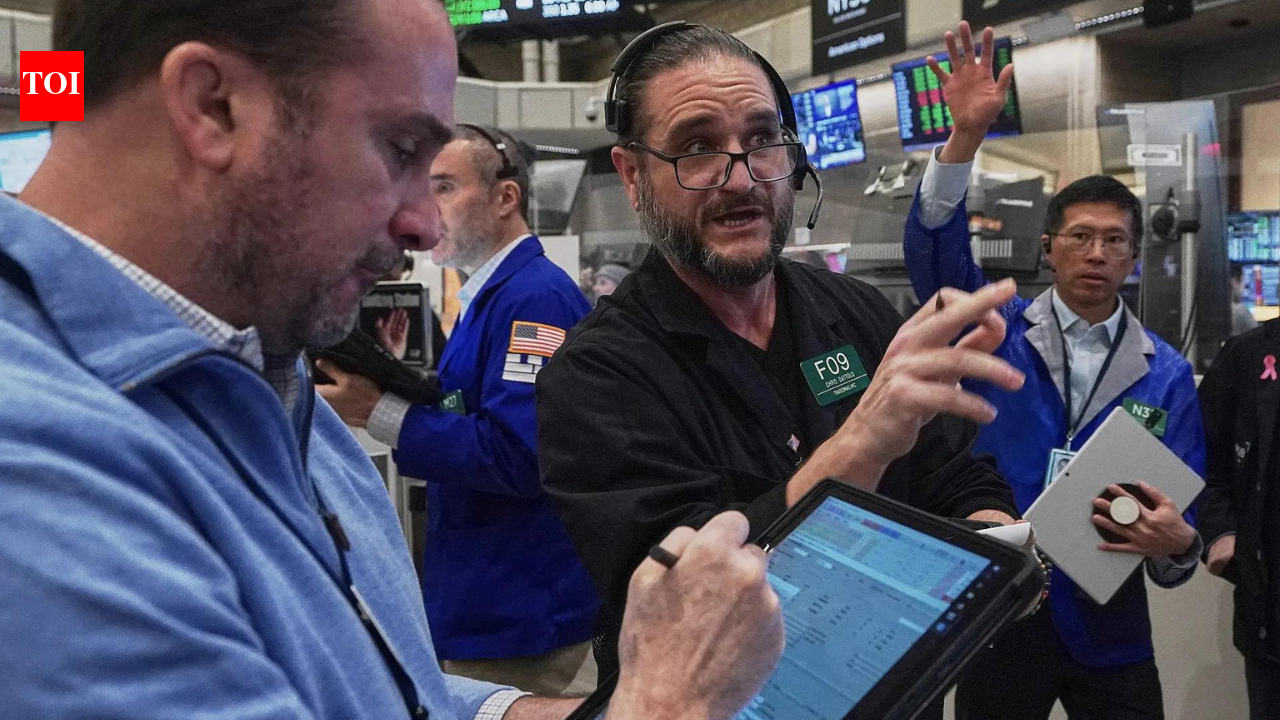
US stock markets fell on Thursday as investors turned cautious after the previous session’s rally, while rising oil prices and geopolitical tensions weighed on sentiment.The Dow Jones Industrial Average dropped 801 points, or 1.6 per cent, dragged down by losses in stocks such as Caterpillar and Goldman Sachs. The S&P 500 declined 0.9 per cent, while the Nasdaq Composite fell 0.6 per cent.The selloff came as crude oil prices jumped to their highest level since June 2025 after Iran said it had struck an oil tanker with a missile. US West Texas Intermediate crude futures surged 6 per cent to trade above $79 per barrel, while international benchmark Brent crude futures rose about 3 per cent to more than $84 per barrel. Oil prices had stabilised in the previous trading session.Markets had rallied on Wednesday, supported by gains in technology and semiconductor stocks. The Dow had snapped a three-day losing streak, while the S&P 500 and Nasdaq Composite ended the session with solid gains.Despite the ongoing US-Israeli air campaign against Iran, US markets have performed relatively better than European and Asian counterparts this week, largely supported by a rebound in technology stocks that had been hit hard during February’s selloff.The tech-led recovery in the previous session helped the Nasdaq erase its weekly losses, putting the index on track to end the week in positive territory if gains hold through Friday.Investors remain concerned that prolonged disruption to shipping through the Strait of Hormuz — a key global energy corridor –could push oil prices higher and add to inflationary pressures through rising energy and shipping costs.Markets are particularly wary of crude prices moving towards $100 per barrel, which could complicate the Federal Reserve’s efforts to control inflation while considering interest-rate cuts.“For the past couple of years, bringing inflation down has been the Fed’s entire focus, and they were finally making progress. But if energy stays expensive, inflation could start climbing again and that would force the Fed to rethink its plans,” said Adam Sarhan, chief executive of 50 Park Investments, Reuters quoted.According to data compiled by LSEG, investors are increasingly expecting the Federal Reserve to delay a 25-basis-point interest rate cut to September from the previously anticipated July timeline.Among sectors, healthcare led declines on the S&P 500, dropping 1.6 per cent. The energy index, however, gained 0.7 per cent, with shares of ConocoPhillips and Valero Energy rising about 2 per cent each.The CBOE volatility index (VIX), widely seen as a gauge of market fear, rose 0.9 points to 22.08, reflecting cautious investor sentiment. The small-cap Russell 2000 index fell 1 per cent.Travel and tourism stocks, which are sensitive to fuel costs, were under pressure. Delta Air Lines slipped 3.3 per cent, while Royal Caribbean Cruises declined 0.6 per cent.On the other hand, some travel booking companies rallied sharply. Booking Holdings jumped 11 per cent and Expedia surged 8 per cent after a report by The Information said OpenAI was scaling back on-platform shopping checkout plans for ChatGPT, easing concerns about disruption to online marketplace businesses.Chip stocks showed mixed performance. Nvidia edged down 0.3 per cent, while Marvell Technology gained 1.3 per cent.Shares of Broadcom rose 2.9 per cent after the chip designer projected that its artificial intelligence chip revenue could exceed $100 billion next year.Elsewhere, Trade Desk surged 22.5 per cent following a report that OpenAI had held early discussions with the advertising technology company regarding the sale of advertisements.Economic data released on Thursday showed the number of Americans filing new applications for unemployment benefits remained unchanged last week.Investors are also awaiting remarks from Federal Reserve Vice Chair Michelle Bowman later in the day, ahead of the closely watched non-farm payrolls report due on Friday.On the New York Stock Exchange, declining stocks outnumbered advancers by a ratio of 2.48-to-1, while on the Nasdaq the ratio stood at 1.63-to-1.The S&P 500 recorded four new 52-week highs and two new lows, while the Nasdaq Composite registered 17 new highs and 33 new lows.


OpenAI Had Banned Military Use. The Pentagon Tested Its Models Through Microsoft Anyway

Don’t Risk Birdwatching FOMO—Put Out Your Hummingbird Feeders Now

Savannah Guthrie visits “Today” studio, says she intends to return to show

What are Iran’s ballistic missile capabilities?

India Us Trade Deal: Fresh look at India-US trade deal? May be ‘rebalanced’ if circumstances change, says Piyush Goyal – The Times of India

Attock Cement’s acquisition approved | The Express Tribune

-
 Politics1 week ago
What are Iran’s ballistic missile capabilities?
-
Business7 days ago
India Us Trade Deal: Fresh look at India-US trade deal? May be ‘rebalanced’ if circumstances change, says Piyush Goyal – The Times of India
-
Business1 week ago
Attock Cement’s acquisition approved | The Express Tribune
-

 Politics1 week ago
US arrests ex-Air Force pilot for ‘training’ Chinese military
-

 Fashion1 week ago
Policy easing drives Argentina’s garment import surge in 2025
-
 Business1 week ago
Households set for lower energy bills amid price cap shake-up
-

 Sports6 days ago
LPGA legend shares her feelings about US women’s Olympic wins: ‘Gets me really emotional’
-

 Fashion7 days ago
Texwin Spinning showcasing premium cotton yarn range at VIATT 2026