

Fashion
Out and about in Milan: Santoni, Sergio Rossi, and Giuseppe Zanotti

Published
September 27, 2025
No one loves footwear more than the Italians. As three first rate collections by leading shoe makers underlined this week. These shoes are made for walking, and ruling and seducing.
Santoni: Forms that matter
A collaboration with Venetian artist Lorenzo Vitturi in a project entitle “Forms and Matter” led to some striking new ideas at Santoni this season. Though not a collaboration, the artist’s graphic emphasis seemed to infuse some great new looks in the collection.
A bold series of columns and hangings that combined Vitturi’s vision and Santoni’s finest leathers, orange shoe sole or leather string with Venetian glass – all added to the allure at the Santoni showspace, around the corner from the Duomo.
From the latest version of the bucket bag, made in treated lace to some excellent new airy intreccio slingbacks and boots for gals who want to sizzle. Though the stand-out looks were remarkable new sequinned slingbacks and accompanying bag. Unexpected, exuberant and cool.
In menswear, Santoni also showed a natty new Carlo sneaker, also in suede intreccio.

“Santoni has always been about luxury, but maybe this is even more luxurious,” said Giuseppe Santoni, looking tanned and trim in a caramel Solaro herring bone suit.
“I have had a busy summer, at the office and with a little co-working – on my yacht and making shoes down in the hold!” he joked.
Sergio Rossi: Sculptural chic
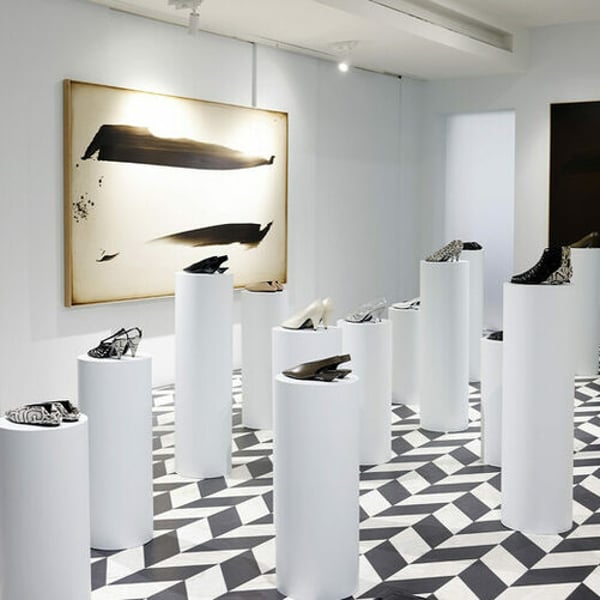
Talk about a brilliant display and collection at Sergio Rossi, where designer Paul Andrew incorporated carbon fiber to created shoes of rare sculptural grace.

Seen in some fantastic ostrich skin wedges – made in an undulating form worthy of Antony Gormley. Paul also showed a striking series of glove-shaped metallic shoes that were studded with kisses. And he riffed on the house’s DNA with a superb slip-on made of studded leather.
“Sergio Rossi really was such a genius with the construction of footwear. In this shoe, he developed this form called Contrapunto in the 1950s, where the sole, in-sole and upper are all one piece,” said Andrew, marveling at the design.

Keeping the bravura creation, Paul produced golden leather wedges with biomorphic heels named Sinuous, inspired by a Zaha Hadid statue in the Design District of Miami.
All presented inside Sergio Rossi Milan showrooms on Via Pontaccio, before huge gestural abstract paintings by Richard Zinon. In a word, possibly the most inventive shoe collection we have seen in Milan in the past decade.
Giuseppe Zanotti: From The Slim to Moreau Paris
No presentation this week was busier than Giuseppe Zanotti, who celebrated the most legendary footwear of the recent past with a video installation of The Slim. Presenting a half-dozen examples of the sex-creature shoe.

Famous for having graced the feet of Samantha Jones as the only thing she wore during a steamy sushi scene in “Sex and the City”. Creating a fittingly viral footwear moment.
The Slim was actually born while dining at one of Giuseppe’s favorite seaside spots, Slim, in Cesenatico, Italy. When Zanotti sketched the first design on a tablecloth, turning a discarded fishbone into a precious jewel that sensually drapes across the foot.
“Who would have thought it could have that much impact,” mused the ever-modest Zanotti.

Presented in his Renaissance style palazzo on via Napoleone, the event also featured a cool new co-branding, a capsule collection with Moreau Paris. Using the mini-grid checkerboard monogram of the venerable Moreau Paris – founded in 1882 in the French capital – to make leather sneakers that looked like denim. Talk about range.
Copyright © 2025 FashionNetwork.com All rights reserved.






Current account excluding gold and energy indicated net deficit of $3.9 billion, while goods saw a deficit of $9.5 billion.
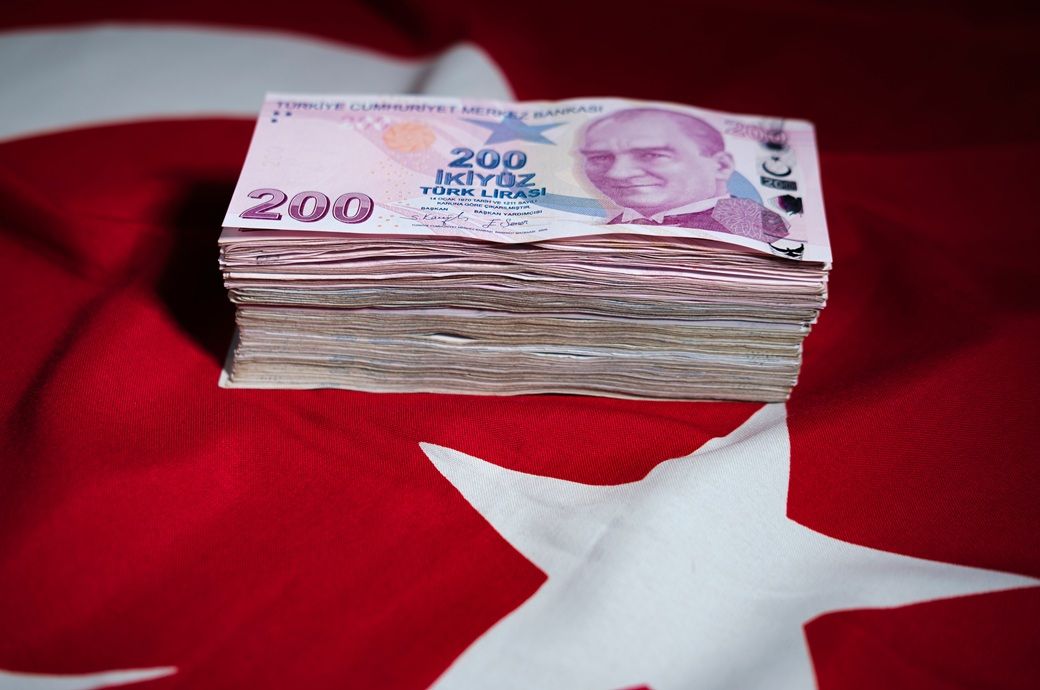
Turkiye recorded a current account deficit (CAD) of $9.6 billion in March, the country’s central bank said.
Treasury and Finance Minister Mehmet Simsek said the CAD is expected to widen this year, due to high energy and non-energy commodity prices.
Simsek said the deterioration is likely to remain temporary and manageable, thanks to stronger macroeconomic fundamentals and policy gains.
According to annualised data, current account deficit recorded as $39.7 billion (2.6 per cent of gross domestic product) in March, while the goods deficit recorded as $77.8 billion.
Simsek said the deterioration is likely to remain temporary and manageable thanks to stronger macroeconomic fundamentals and policy gains, domestic media outlets reported.
Turkiye is heavily reliant on imported energy, whose prices spiralled due to the Middle East conflict.
Simsek said elevated global commodity prices would put pressure on the external balance, but emphasised that the government’s economic programme had improved resilience against such shocks.
He said foreign direct investment (FDI) inflows totalled $1 billion in March, bringing annualised foreign direct investment to $12.6 billion.
The new investment incentive package under discussion in parliament now is expected to strengthen the country’s financing structure and support long-term capital inflows, he added.
Fibre2Fashion News Desk (DS)
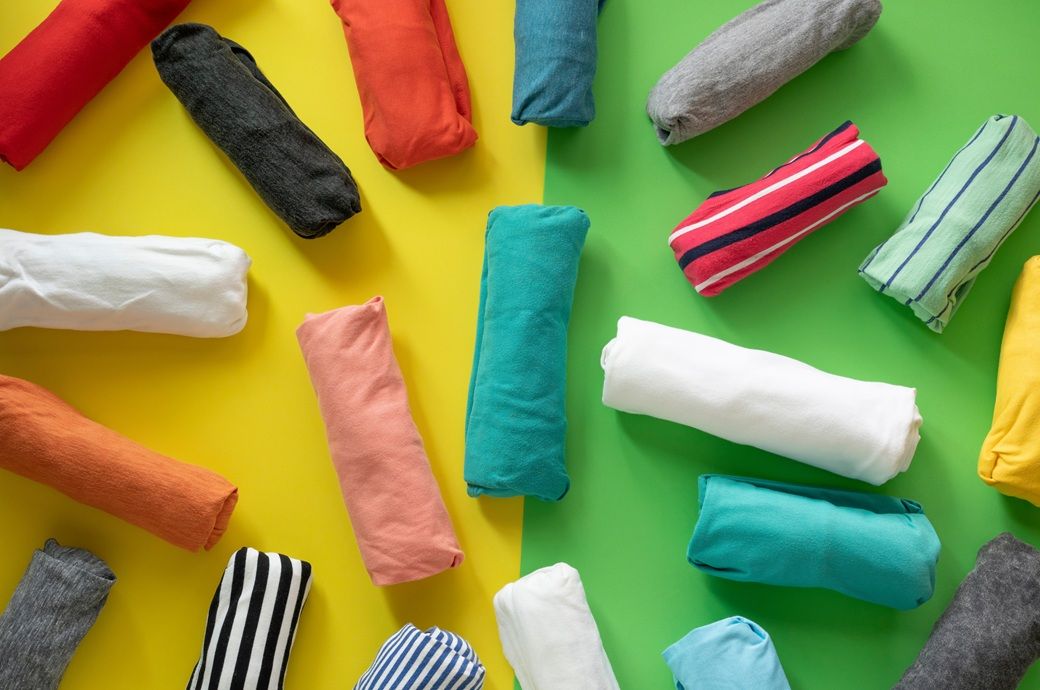
During the first quarter of ****, the UK’s imports of textile fabrics eased down *.** to £*,*** million (~$*,*** million), against £*,*** million in January-March **** but slightly higher from £*,*** million in the fourth quarter of ****. Its imports of fibre were noted at £** million (~$***.** million) steady as £** million in Q*, **** but slightly lower than £** million in Q*, ****.
During the third month of this year, the country’s clothing imports declined *.** per cent to £*.*** billion (~$*.*** billion), compared with £*.*** billion in March ****. But the inbound shipment was slightly higher month on month compared with £*.*** billion in February ****.
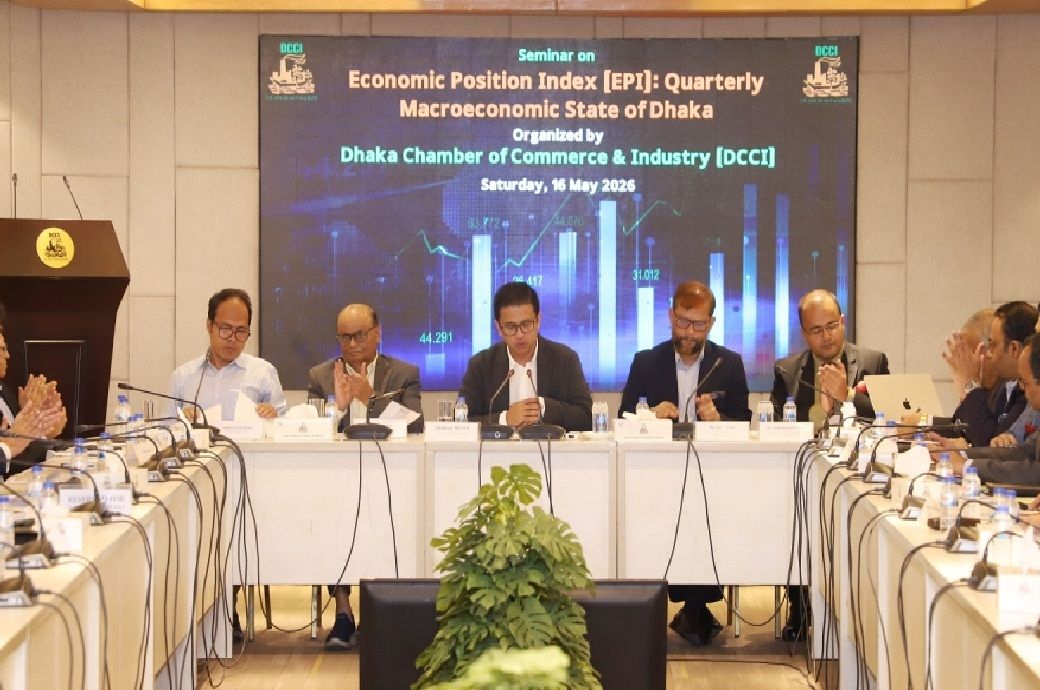
Higher rents, utility bills and fuel prices are eating away at already thin profit margins, it found.
High inflation is cutting deep into Bangladesh consumer spending, with weak demand turning one of the biggest concerns for businesses, DCCI said.
Higher rents, utility bills and fuel prices are eating away at already thin profit margins.
DCCI’s economic position index revealed that consumers have sharply reduced spending as the cost of living continues to rise.
SMEs are feeling the pressure the most.
The chamber’s economic position index (EPI) revealed that consumers have sharply reduced spending as the cost of living continues to rise, putting pressure on retailers, transport operators and other service providers.
Small and medium enterprises (SMEs) are feeling the pressure the most as they struggle to manage higher operating costs without losing customers.
Businesses also cited difficulties in obtaining bank loans, while delays in licensing and other regulatory procedures are adding to costs.
The DCCI report identified a shortage of skilled workers, particularly in technical and customer service roles, as another challenge for the sector.
The country’s inflation rose to 9.04 per cent in April from 8.71 per cent in March, according to official statistics.
Fibre2Fashion News Desk (DS)


Turkiye’s current account deficit expected to widen in 2026: Minister

UK’s clothing imports fall 3% in Q1, sharply lower than Q4 2025
RBI sees no signs of excess credit risk, keeps countercyclical capital buffer inactive

-

 Entertainment6 days ago
Conan O’Brien hat tricks as Oscar host
-

 Tech1 week ago
Could Contact-Tracing Apps Help With the Hantavirus? Not Really
-

 Fashion5 days ago
Italy’s Zegna Group’s Q1 growth boosted by strong organic performance
-

 Sports1 week ago
Bobby Cox, legendary Atlanta Braves manager who led 1995 World Series champions, dead at 84
-

 Entertainment1 week ago
Martin Short: Facing tragedy with joy
-

 Entertainment1 week ago
Tom Brady gets back at Kevin Hart during Netflix roast
-

 Sports1 week ago
Jacob Fatu unleashes vicious assault on Roman Reigns after World Heavyweight Championship loss at WWE Backlash
-
 Entertainment1 week ago
Martha Stewart: How to make an omelet