

Entertainment
Padma Lakshmi talks creating cooking competition "America's Culinary Cup"


TV host and food expert Padma Lakshmi, the creator and executive producer of the new CBS series, “America’s Culinary Cup,” speaks to “CBS Mornings” about creating the cooking competition and how it’s different from other shows.
Source link










Anne Hathaway is ready to wear her crown again as Queen Mia of Genovia.
The Oscar-winning actress has given a major update on Princess Diaries 3 in a new interview with Entertainment Weekly, confirming that a new installment is actively in the works 22 years after Princess Diaries 2.
“One hundred percent, we’re constantly working on it,” she said, revealing that development briefly took a backseat while filming The Devil Wears Prada 2 — another of Hathaway’s highly-anticipated sequels, which hits theatres on May 1.
“[Devil Wears Prada 2] cropped up unexpectedly and took over the space,” Hathaway explained, adding that it became impossible to focus on both projects at once. But now, the plan is clearer.
“The intention is to make Princess Diaries hopefully next,” she declared, noting that the film “is not greenlit or confirmed yet.”
Still, the demand is undeniable. But Hathaway acknowledged that “everybody wants it,” she and her TDWP costar Meryl Streep emphasised that “you’ve got to wait for the right script.”
The original Princess Diaries released in 2001 introduces Mia Thermopolis, a regular teenager who discovers she’s heir to a kingdom — a role that turned Hathaway into a household name.
Looking back at the film, Hathaway tearfully told People magazine, “This is the role that changed my life. And I’m standing with Julie Andrews, which is just insane.”
Entertainment
Donnie Wahlberg shares emotional moments with “Boston Blue” cast after show was renewed

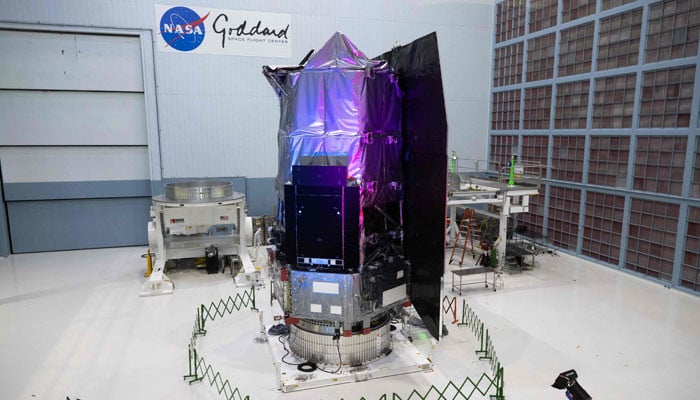
Nasa unveiled a new telescope on Tuesday to scan vast swathes of the universe for planets outside our solar system and probe the mysteries of dark matter and dark energy.
The Roman space telescope is expected to discover tens of thousands of planets, possibly offering clarity about how many could be out there.
“Roman will give the Earth a new atlas of the universe,” Nasa administrator Jared Isaacman told a news conference at the Goddard Space Flight Centre in Maryland, where the telescope went on display.
The 12-metre (39-feet), silvery contraption with massive solar panels will be transported to Florida ahead of a launch into space aboard a SpaceX rocket planned for September at the earliest.
Roman, which took more than $4 billion and over a decade to build, is named after astronomer Nancy Grace Roman, nicknamed the “Mother of Hubble” for her role in developing the landmark space telescope.
Thirty-six years after Hubble launched into space, revolutionising astronomical observations, Nasa hopes Roman will help to shed light on questions that remain unresolved.
Boasting a field of view at least 100 times larger than Hubble’s, the telescope will sweep across vast regions of space from its position 1.5 million kilometres (930,000 miles) from Earth.
The telescope will send 11 terabytes of data a day down to Earth, said Mark Melton, a systems engineer at Goddard Space Flight Centre.
“In the first year, we’ll have sent down more data than Hubble will have for its entire life,” he told AFP.
The telescope’s wide-angle lens will allow Nasa to conduct a census of the objects that make up our universe, said Nicky Fox, associate administrator for Nasa’s Science Mission Directorate.
“Roman will discover tens of thousands of new planets outside our solar system. It will reveal billions of galaxies, thousands of supernovae and tens of billions of stars,” she said.
This wealth of information will enable Nasa to tease out areas of interest that can then be investigated by complementary telescopes, such as the James Webb Space Telescope.
Study the invisible
But Roman will also study the invisible — dark matter and dark energy, whose origins remain unknown but which are thought to constitute 95% of our universe.
Dark matter is believed to be the glue that holds galaxies together, while dark energy pulls them apart by making the universe expand faster and faster over time.
Thanks to its infrared vision, the telescope will be able to observe light emitted by celestial bodies billions of years ago, effectively looking back in time to hopefully discover more about the two phenomena.
Complementing the work of Europe’s Euclid space telescope and the Vera Rubin Observatory in Chile, Roman will probe “how the dark matter structures itself throughout cosmic time” and “calculate how fast galaxies are moving away from us,” Darryl Seligman, an assistant professor of physics and astronomy at Michigan State University, told AFP.
These discoveries could fundamentally change our understanding of the structure of our universe, said astrophysicist Julie McEnery, who led the Roman project.
“If Roman wins a Nobel Prize at some point, it’s probably for something we haven’t even thought about or questioned yet,” said Melton.


Life sciences lab real estate is clawing back from disaster. Here’s what that means for investors

Men’s college basketball buzz: State of blue blood rebuilds

IRGC seizes Israeli ship, second vessel for violations in Strait of Hormuz

-

 Fashion6 days ago
France’s LVMH Q1 revenue falls 6%, shows resilience amid Iran war
-

 Entertainment1 week ago
Is Claude down? Here’s why users are seeing errors
-

 Sports1 week ago
PSL 11: Peshawar Zalmi win toss, opt to field first against Quetta Gladiators
-

 Tech1 week ago
The Deepfake Nudes Crisis in Schools Is Much Worse Than You Thought
-
 Tech1 week ago
Bremont Is Sending a Watch to the Moon’s Surface
-

 Tech1 week ago
Human-machine teaming dives underwater
-
 Business1 week ago
BP sees ‘exceptional’ oil trading result as Iran war sends crude costs soaring
-

 Fashion1 week ago
What no one is saying about the 2026 apparel slowdown