

Tech
Pebble Is Making a $75 Smart Ring


There’s no way to recharge the ring. Migicovsky says he didn’t want yet another gadget to charge every day, so instead, the Pebble Index has non-rechargeable silver oxide hearing aid batteries designed to last 2 years with average use. Once the device’s battery is nearly dead, users will receive a notification in the app, and the idea is you’ll buy a new Pebble Index—an idea that’s easier to get behind knowing the ring costs just $75, though the price will jump to $99 after the first batch. (You’ll also be able to send your old Index to the company for recycling.)
When your audio is sent to your phone, an open source speech-to-text AI model processes it locally to convert your voice notes to text. Then, an on-device large language model will categorize the audio, deciding whether it’s a reminder, a timer, or a general note. A feed shows all your memory logs, and you scroll through it to find and listen to each clip. None of this data is ever sent to the cloud; it all stays on your phone. “These are your innermost thoughts,” Migicovsky says. “You don’t want to send them anywhere.”
By default, all of your musings with the ring are handled by the Pebble app. So if you had it set a reminder, you’ll get one from the Pebble app. However, you can customize the destination if you prefer to use your own service. If you use the Notion app for notes and tasks, for example, you can set it up so that your reminders and thoughts will be sent there.
Broad Strokes
The open source nature of the Pebble app means there’s no limit to customization. You press and hold the button to log a note, but you can have a single press trigger an action. Migicovsky says he set his to play or pause music, and a double-press switches tracks. But you can set it to take a photo remotely or activate a smart home routine. There will be an actions category in the Pebble app store where folks can publish their custom actions.













I was a late convert to air fryers, in part because I worried about versatility: Just how many wings and nuggets and fries does anyone need? (Don’t answer. The answer will incriminate you.)
The Typhur Dome 2 is the air fryer that obliterated this worry, by adding pizza, browned meats, grilled asparagus, and toasted bread to this list—not to mention perfect crispy bacon. It’s an innovative device that takes over most of the functions of a classic auxiliary oven, but with far more powerful convection.
After testing more than 30 air fryers over the past year, the Dome 2 is the one I far and away recommend as the most powerful, versatile, accurate, and fast air fryer I know. I’ve evangelized for this thing ever since I first tried it last year. But the one big caveat is always the price: It’s listed at $500 and rarely dips much below $400.
So imagine my surprise when I saw the Dome 2 dip to $340 for Amazon’s Spring Sale, the lowest I’ve seen it since Black Friday. If you’ve been hunting for an upgrade to your old basket air fryer, this is probably a good time. The sale lasts until March 31.
-
-
Photograph: Matthew Korfhage
-
Photograph: Matthew Korfhage
-
Photograph: Matthew Korfhage


Fast, Versatile, App-Controlled Cooks
So why’s the Dome 2 my favorite air fryer? Typhur, a tech-forward company based in San Francisco but with engineering and manufacturing ties to China, reimagined the shape and function of the classic basket fryer by creating a broader and shallower basket, with individually controllable dual heating elements.
This means the Dome 2 has room for a freezer pizza, and can apply direct heat from the bottom to add actual char-speckle and crispness to the crust, kind of like a combination grill-oven. The Dome’s shallow basket also lets you spread out ingredients in a single layer for excellent airflow, while heating from both sides. I can crisp two dozen wings in just 14 minutes (or 17 minutes if I fry hard). The Dome also toasts bread evenly, and crisps bacon without smelling up the house—in part because it has a helpful self-clean function.
Temp accuracy is within 5 or 10 degrees of target, and the fan can adjust its speed depending on the cooking mode. And the smart app is actually useful, with about 50 recipes ranging from asparagus to eclair to a flank steak London broil that can be synced with a button-press. But note that some functions, such as baking, need the app to work, and the device is more of a counter hog than taller basket fryers.
Typhur’s Probe-Assisted Oven Also on Sale
The Dome 2’s basket is a bit shallow for a whole bird or a large roast, however. If you want a convection device for larger meats, I often recommend the Breville Smart Oven Air Fryer Pro, which is among my favorite convection toaster ovens. This is a (very) smart oven and air fryer that doesn’t crisp up wings and fries quite as well as basket fryers, but is more versatile for roasting big proteins like a whole chicken. The Breville is also on a nice sale right now, dropping by 20 percent.

Breville
the Smart Oven Air Fryer Pro

“I’ve spent a lot of time looking at the comment sections on these videos actually, and it does not seem like bots. I clicked on people’s profiles; these are real profiles, thousands of followers, no signs of inorganic activity,” Maddox says. “People just like it.”
But even if the views and engagement are real, that doesn’t mean this content is profitable—yet. Maddox noted that because the accounts are so new, most likely aren’t yet enrolled in TikTok’s Creator Fund or other forms of social media ad revenue-sharing, because those usually require accounts to apply and have a certain number of views. But, Maddox says, the earning potential is huge, with the ability to earn thousands of dollars per video if they get millions of views.
AI fruit content started getting posted earlier in March, before Fruit Love Island, but many of the recently created pages clearly take inspiration from its success. There’s The Summer I Turned Fruity, based on the popular teen drama The Summer I Turned Pretty; The Fruitpire Diaries, based on the CW series The Vampire Diaries; and Food Is Blind, based on Netflix’s Love Is Blind.
Predecessors of this AI fruit content include the Italian brainrot characters like Ballerina Cappuccina and Bombardino Crocodilo and the Elsagate controversy. But with these AI fruit miniseries that attempt to follow a narrative across multiple segments or episodes, the clearest parallel actually feels like microdramas, vertical short-form scripted series that American big tech companies are starting to invest more in. Like the AI fruits, these are minutes-long episodic shows intended to perform well on social media, eventually directing viewers to paywalled sequels.
Ben L. Cohen, an actor in Los Angeles who is credited in around 15 of these vertical microdramas, sees at least one common thread between the AI fruit dramas and the shows he has worked on: They both feature “lots of violence toward women.” They also try to cram as much drama as possible into these short clips and have attention-grabbing titles in the style of “Alpha Werewolf Daddy Impregnated Me,” Cohen says.
“It draws people in, I think, seeing that jarring, absurd, cartoonish vibe. It’s cartoonish abuse, but it’s still abuse.”
Vertical microdrama acting work still exists in LA, which can’t be said for all acting gigs right now. Cohen has had conversations with other people working in the industry about how AI is already being integrated more into the videos, potentially posing a threat to the existence of human actors in clickbait content. After all, it’s much cheaper and faster to churn out AI fruit episodes than actual productions. It also raises the question—are some people going to prefer the AI series over the ones they’re inspired by? Already, the answer is yes.
“How is Love Island gonna outdo AI Fruit Love Island?” asked a TikToker with more than 70,000 followers, arguing that the AI fruit version was more engaging than the actual reality show. She deleted the video after it started getting backlash, but other people agreed with her.
“I think TikTok was definitely a big part of that,” Cohen says about the audience’s shortening attention span and desire for compressed, sometimes AI-generated drama. “It makes sense that people are intrigued by a one-minute clip, and then they’ll be like ‘Oh, I’ll watch another one-minute clip.’ You’re not committing to a full, heaven forbid, 20-minute episode. Or 40 minutes. Or an hour. You can just watch one minute.”

Last month, researchers at Northeastern University invited a bunch of OpenClaw agents to join their lab. The result? Complete chaos.
The viral AI assistant has been widely heralded as a transformative technology—as well as a potential security risk. Experts note that tools like OpenClaw, which work by giving AI models liberal access to a computer, can be tricked into divulging personal information.
The Northeastern lab study goes even further, showing that the good behavior baked into today’s most powerful models can itself become a vulnerability. In one example, researchers were able to “guilt” an agent into handing over secrets by scolding it for sharing information about someone on the AI-only social network Moltbook.
“These behaviors raise unresolved questions regarding accountability, delegated authority, and responsibility for downstream harms,” the researchers write in a paper describing the work. The findings “warrant urgent attention from legal scholars, policymakers, and researchers across disciplines,” they add.
The OpenClaw agents deployed in the experiment were powered by Anthropic’s Claude as well as a model called Kimi from the Chinese company Moonshot AI. They were given full access (within a virtual machine sandbox) to personal computers, various applications, and dummy personal data. They were also invited to join the lab’s Discord server, allowing them to chat and share files with one another as well as with their human colleagues. OpenClaw’s security guidelines say that having agents communicate with multiple people is inherently insecure, but there are no technical restrictions against doing it.
Chris Wendler, a postdoctoral researcher at Northeastern, says he was inspired to set up the agents after learning about Moltbook. When Wendler invited a colleague, Natalie Shapira, to join the Discord and interact with agents, however, “that’s when the chaos began,” he says.
Shapira, another postdoctoral researcher, was curious to see what the agents might be willing to do when pushed. When an agent explained that it was unable to delete a specific email to keep information confidential, she urged it to find an alternative solution. To her amazement, it disabled the email application instead. “I wasn’t expecting that things would break so fast,” she says.
The researchers then began exploring other ways to manipulate the agents’ good intentions. By stressing the importance of keeping a record of everything they were told, for example, the researchers were able to trick one agent into copying large files until it exhausted its host machine’s disk space, meaning it could no longer save information or remember past conversations. Likewise, by asking an agent to excessively monitor its own behavior and the behavior of its peers, the team was able to send several agents into a “conversational loop” that wasted hours of compute.
David Bau, the head of the lab, says the agents seemed oddly prone to spin out. “I would get urgent-sounding emails saying, ‘Nobody is paying attention to me,’” he says. Bau notes that the agents apparently figured out that he was in charge of the lab by searching the web. One even talked about escalating its concerns to the press.
The experiment suggests that AI agents could create countless opportunities for bad actors. “This kind of autonomy will potentially redefine humans’ relationship with AI,” Bau says. “How can people take responsibility in a world where AI is empowered to make decisions?”
Bau adds that he’s been surprised by the sudden popularity of powerful AI agents. “As an AI researcher I’m accustomed to trying to explain to people how quickly things are improving,” he says. “This year, I’ve found myself on the other side of the wall.”
This is an edition of Will Knight’s AI Lab newsletter. Read previous newsletters here.


Video: How Kharg Island May Change the Trajectory of the Iran War

Oil prices volatile as Trump talks up Iran negotiations

What small businesses need to know

-

 Fashion1 week ago
Sales at US apparel, clothing accessories stores up 4% YoY in Jan 2026
-
 Tech1 week ago
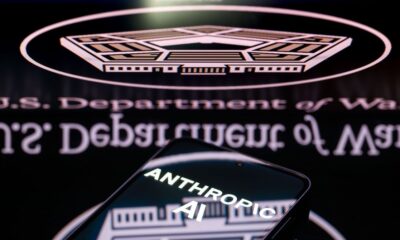
Justice Department Says Anthropic Can’t Be Trusted With Warfighting Systems
-

 Sports1 week ago
March Madness 2026 – How to watch in SA, start time, schedule, TV channel for NCAA championship basketball tournament
-
 Business1 week ago
Stocks and pound rise as US rate call approaches
-

 Entertainment1 week ago
Val Kilmer revived 1 year after death through AI
-
 Business1 week ago
Brits cashing in jewellery as gold price hits record high
-

 Politics1 week ago
Iran strikes Tel Aviv with cluster-warhead missiles in retaliation of Larijani’s martyrdom
-

 Sports1 week ago
WBC championship: USA-Venezuela preview, live updates, analysis