

Business
PSX continues to extend losses as KSE-100 closes 1,300 points lower | The Express Tribune

KARACHI:
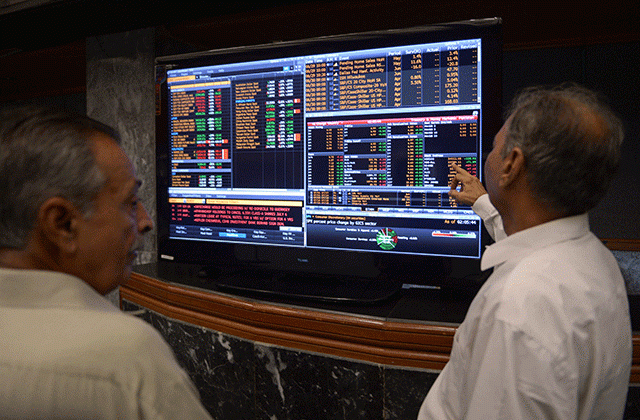
The Pakistan Stock Exchange (PSX) extended its downturn on Tuesday, with the benchmark KSE‑100 index falling 1,303.52 points to settle at 173,150.42, as persistent foreign corporate selling exacerbated bearish sentiment across key sectors.
After opening higher and briefly reaching 176,131.35, early gains were short‑lived as investors booked profits and reversed course. A modest midday rebound failed to sustain momentum, and renewed selling in the final hour dragged the index toward an intra‑day low of 171,693.40 before the close.
Market breadth remained weak, with declines evident in heavyweight sectors such as autos, banking, cement, oil and gas exploration, OMCs, and power generation. Analysts said persistent foreign corporate selling and a fragile investor outlook continued to weigh on sentiment, mirroring volatility seen in recent sessions.
Also Read: PSX plunges 2.9% on sharp sell-off
On Monday, the bourse experienced a broad‑based sell‑off that saw the KSE‑100 plunge sharply amid institutional liquidation and weak corporate results, highlighting ongoing market fragility.
Topline Securities noted that extended offloading in blue‑chip names kept upward momentum in check.
Pakistan State Oil (PSO), Habib Bank, Engro Holdings, United Bank, Fauji Fertiliser, and National Bank collectively eroded 892 points from the benchmark, while Oil & Gas Development Company, Pakistan Petroleum, Millat Tractors, and Bank of Punjab provided limited support, adding 359 points.
In corporate earnings news, PSO posted an unconsolidated profit of Rs2.7 billion in 2QFY26, with an earnings per share (EPS) of Rs5.82, below industry expectations due to inventory losses and a higher effective tax rate, according to Topline Securities.
Read More: Gold per tola slips to Rs514,762 after international losses
Overall trading activity declined as volumes fell to 716 million shares from Monday’s 773.2 million, with the total traded value at Rs40.4 billion. Of the 477 companies traded, 128 advanced, 293 declined and 56 ended unchanged. K‑Electric topped the volume chart with 122.6 million shares, closing at Rs7.82, down Rs0.31.
Investors will be watching macroeconomic cues and corporate results closely after recent volatility, as the market absorbed both external selling and domestic pressures that have kept confidence tentative.

Families on some benefits with three or more children will get an average rise of £4,100 a year.
Source link
Sir Keir Starmer says it is “deeply concerning” the rapper is set to headline a festival after recent antisemitic comments.
Source link
Business
Stock markets outlook: Dalal Street braces for swings as RBI MPC decision, war risks weigh on sentiment–Check key triggers – The Times of India

Domestic equities are expected to remain volatile this week as investors track the Reserve Bank’s monetary policy decision, global macroeconomic cues and evolving developments in the West Asia conflict, analysts said, according to PTI.Market participants will also keep a close watch on crude oil price movements and foreign fund flows, which continue to influence sentiment.Vinod Nair, Head of Research at Geojit Investments Ltd, said the RBI’s Monetary Policy Committee (MPC) meeting will be the key domestic trigger, with investors focusing on the central bank’s stance on inflation and growth.“A rate pause is near-certain consensus, the central bank walks a tightrope between crude-driven inflation risks and a four-year low Manufacturing PMI signalling a softening growth impulse. The governor’s commentary on the rate cycle trajectory and FY27 projections will be closely monitored.“Globally, the US March CPI reading will carry significant importance, as it buries residual Fed rate-cut hopes, strengthens the dollar and tightens financial conditions for emerging markets, including India,” Nair said.He added that geopolitical developments in West Asia will remain the dominant factor shaping market direction.“Indian markets return after a three-day gap and remain acutely vulnerable to weekend war developments, with crude trajectory and any credible ceasefire signal being the decisive variable that could either trigger a sharp relief rally or extend the current sell-on-rise mode,” he said.In the previous holiday-shortened week, the BSE Sensex declined 263.67 points, or 0.35%, while the NSE Nifty fell 106.5 points, or 0.46%.Siddhartha Khemka, Head of Research (Wealth Management) at Motilal Oswal Financial Services Ltd, said investor sentiment will remain closely linked to developments in the West Asia conflict.Brent crude prices have stayed elevated near $107 per barrel, fuelling concerns around imported inflation. Currency pressures have also intensified, with the rupee weakening sharply before recovering towards Rs 93 against the US dollar following RBI intervention, he noted.Foreign institutional investor (FII) outflows remain a key overhang, with March witnessing heavy selling of Rs 1.2 lakh crore, among the highest monthly outflows in recent years.“Investors will monitor the US Federal Open Market Committee (FOMC) meeting minutes, GDP data, and initial jobless claims for further cues on growth and the policy trajectory.“Overall, markets are expected to remain volatile as geopolitical developments, crude price movements, FII flows and global macro data continue to drive sentiment,” Khemka said.Analysts said any signs of de-escalation in the West Asia conflict could ease crude prices and stabilise the currency, offering relief to markets, while further escalation may prolong risk aversion and keep pressure on foreign flows.

‘It’s a massive help’: Benefits and pensions rise as two-child cap ends

‘Harry Potter’ movie star Bonnie Wright expecting second baby

Olivia Munn urges fans for ‘early’ cancer checkup

-

 Sports1 week ago
USMNT handed reality check by Doku, Belgium ahead of World Cup
-

 Sports1 week ago
2026 NCAA men’s hockey tournament: Schedule, results
-

 Fashion1 week ago
EU apparel imports slump 15.48% YoY in Jan; Bangladesh hardest hit
-

 Tech2 days ago
Our Favorite iPad Is $50 Off
-
Uncategorized6 days ago
[CinePlex360] Please moderate: “Further tariff
-
Uncategorized3 days ago
[CinePlex360] Please moderate: “Trump signals p
-

 Entertainment1 week ago
The Avett Brothers’ bassist explains why he wrote a book about John Quincy Adams
-
Uncategorized1 week ago
[CinePlex360] Please moderate: “Apple scrapping