

Business
PSX ends flat below 146.5k on profit-taking | The Express Tribune

KARACHI:
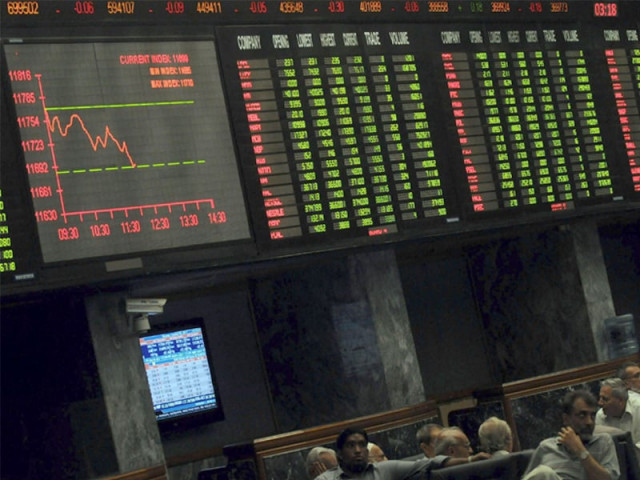
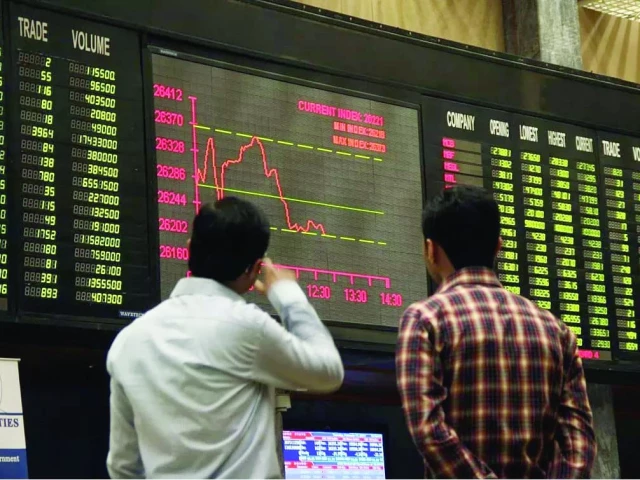
The Pakistan Stock Exchange (PSX) closed marginally lower on Friday as profit-taking in the latter half of the session erased early gains amid concerns over mounting losses of state-owned enterprises (SOEs), the International Monetary Fund’s (IMF) next review for loan tranche and the falling global crude oil prices.
The KSE-100 index, after touching intra-day high of 147,534, retreated to settle slightly below 146,500, down 38 points. Engro Fertilisers, Lucky Cement and Engro Holdings supported the index while Oil and Gas Development Company (OGDC), UBL and Pakistan Petroleum Limited (PPL) weighed on sentiment.
“Stocks closed flat amid concerns over SOE losses and next IMF review for the release of third tranche,” noted Ahsan Mehanti, MD of Arif Habib Corp. Worries about the unmet IMF conditions for provincial tax collection and falling global crude oil prices fueled the negative close at the PSX, he said.
At the end of trading, the benchmark KSE-100 index posted a decline of 37.67 points, or 0.03%, and settled at 146,491.63.
Arif Habib Limited (AHL), in its market review, noted that the KSE-100 closed the week flat on Friday, capping gains at 0.7% week-on-week. Some 49 stocks advanced and another 49 declined, where Engro Fertilisers (+3.25%), Lucky Cement (+2.31%) and Engro Holdings (+1.63%) were the top contributors to index gains. On the flip side, OGDC (-2.57%), UBL (-1.34%), and PPL (-2.13%) dragged the index lower, it said.
AHL mentioned that the Economic Coordination Committee had approved the setting up of an industrial estate on 4,800 acres of unused Pakistan Steel Mills’ land. For the coming week, the resistance for the index is seen near 148,000 with support around 145,000, it added.
Topline Securities, in its report, commented that the KSE-100 opened on a positive note and rose to intra-day high of 1,005 points. However, during the latter hours, profit-taking was observed as jittery investors booked profits before the weekend.
The top positive contribution to the index came from Engro Fertilisers, Lucky Cement, Engro Holdings, Meezan Bank and Airlink Communication as they contributed 512 points. On the other hand, OGDC, UBL, PPL, Hub Power and Mari Petroleum lost ground, pulling the index down by 499 points, it said.
Traded value-wise, Airlink (Rs3.38 billion), OGDC (Rs2.32 billion), PSO (Rs1.53 billion), Lucky Cement (Rs1.30 billion) and NBP (Rs1.11 billion) dominated the trading activity, Topline added.
Muhammad Hasan Ather of JS Global said that the KSE-100 closed 38 points down after trading within a tight range throughout the session. Activity remained range bound, driven by upbeat corporate earnings, and investor sentiment was underpinned by optimism about Pakistan’s improving macroeconomic indicators and recent credit rating upgrades, he said.
Despite intra-day volatility, the market held firm, reflecting growing confidence in fiscal reforms and economic recovery. Going forward, investor focus will remain on earnings season, policy continuity and external inflows, with expectations of a gradual upward trend in equities amid improving fundamentals, the analyst added.
Overall trading volumes were recorded at 473.6 million shares, compared with the previous tally of 647.1 million. The value of shares traded was Rs32.9 billion.
Shares of 479 companies were traded. Of these, 226 stocks closed higher, 219 fell and 34 remained unchanged.
Aisha Steel Mills was the volume leader with trading in 30 million shares, gaining Rs0.55 to close at Rs13.47. It was followed by Media Times with 21.7 million shares, gaining Rs0.39 to close at Rs3.62 and Airlink Communication with 19.9 million shares, gaining Rs9.76 to close at Rs168.04. Foreign investors sold shares worth Rs154 million, the National Clearing Company reported.






BP has warned it expects to book up to five billion dollars (£3.7 billion) in write-downs across its gas and low-carbon energy division as it also said oil trading had been weak in its final quarter.
The oil giant joined FTSE 100 rival Shell, after it also last week cautioned over a weaker performance from trading, which comes amid a drop in the cost of crude.
BP said Brent crude prices averaged 63.73 dollars per barrel in the fourth quarter of last year compared with 69.13 dollars a barrel in the previous three months.
Oil prices have slumped in recent weeks, partly driven lower due to US President Donald Trump’s move to oust and detain Venezuela’s leader and lay claim to crude in the region, leading to fears of a supply glut.
In its update ahead of full-year results, BP also said it expects to book a four billion dollar (£3 billion) to five billion dollar (£3.7 billion) impairment in its so-called transition businesses, largely relating to its gas and low-carbon energy division.
But it said further progress had been made in slashing debts, with its net debt falling to between 22 billion and 23 billion dollars (£16.4 billion to £17.1 billion) at the end of 2025, down from 26.1 billion dollars (£19.4 billion) at the end of September.
It comes after the firm’s surprise move last month to appoint Woodside Energy boss Meg O’Neill as its new chief executive as Murray Auchincloss stepped down after less than two years in the role.
Ms O’Neill will start in the role on April 1, with Carol Howle, current executive vice president of supply, trading and shipping at BP, acting as chief executive on an interim basis until the new boss joins.
Ms O’Neill’s appointment has made history as she will become the first woman to run BP – and also the first to head up a top five global oil company – as well as being the first ever outsider to take on the post at BP.
Shares in BP fell 1% in morning trading on Wednesday after the latest update.
Business
Budget 2026: Kolkata realtors seek tax relief, revised affordable housing cap; eye demand revival – The Times of India

Real estate developers in Kolkata have urged the Centre to use the Union Budget to recalibrate housing policies to reflect rising land and construction costs, calling for higher tax benefits for homebuyers and a long-pending revision of the affordable housing definition to revive demand, especially in the mid-income segment, PTI reported.With the Budget set to be tabled on February 1, industry players said measures such as revisiting price caps for affordable homes, rationalising GST on under-construction properties and easing approval processes could significantly improve affordability and sales momentum.Sushil Mohta, president of CREDAI West Bengal and chairman of Merlin Group, said reforms must align with current market realities. “Revisiting the affordable housing definition, rationalising housing loan interest deductions and streamlining GST rates will significantly improve affordability and demand, especially for middle-income homebuyers,” he told PTI, adding that a policy push for rental housing and wider access to formal housing finance is crucial amid rapid urbanisation.Mahesh Agarwal, managing director of Purti Realty, said continued policy support through tax rationalisation and infrastructure spending remains critical. “A re-evaluation of affordable housing price limits in line with rising land and construction costs, along with adjustments to GST on under-construction property, will enhance affordability,” he said, stressing that simpler tax frameworks and incentives for first-time buyers would help stabilise the market and speed up project execution.Echoing similar concerns, Merlin Group MD Saket Mohta pointed to sharp increases in construction costs since the introduction of GST in 2017, underscoring the need for further rationalisation. He also called for raising the affordable housing price cap from Rs 45 lakh to around Rs 80–90 lakh and expanding unit size norms. “Mid-income housing will be the key demand driver going into 2026, and supportive tax and policy measures are essential to sustain growth,” he said.Eden Realty MD Arya Sumant said the Budget must strike a balance between fiscal discipline and growth-oriented reforms. “Higher home loan interest deductions for mid-income and first-time buyers, an updated affordable housing definition, GST rationalisation and faster approvals will improve project viability and speed-to-market,” he said, adding that sustained urban infrastructure investment would unlock demand across residential and commercial segments.Sahil Saharia, CEO of Bengal Shristi Infrastructure Development Ltd, said policy focus should shift towards large, integrated developments. “Support for mixed-use townships, rental housing and commercial hubs, along with faster clearances and digital single-window mechanisms, can help create self-sustained urban ecosystems and improve execution efficiency,” he said.Developers said clear and stable policy signals in the Budget could help restore homebuyer confidence, attract long-term capital and ensure sustainable growth for the real estate sector in eastern India.

Circular debt in the power sector has increased in the first five months of the ongoing financial year (FY). Sources told that the debt shot up by Rs223 billion since July 2025 to reach Rs1,837 billion in November 2025 within two months of the signing of agreements to reduce the debt by Rs1225 billion.
Despite the fact that the government had signed agreements with banks in September last year to reduce the debt, it increased by Rs144 billion in October and November.
In September, the debt stood at Rs1,693 billion, while it was Rs1,614 billion in June 2025.
Sources informed that compared with November 2024, the debt in November 2025 came down by Rs544 billion.
It was Rs2,381 in November 2024, they added.

Want to go to the national championship game? Got (at least) $2,700?

Pro-Iran protests held in Indian-occupied Ladakh

Burberry celebrates Year of the Horse 2026 with Shanghai campaign

-

 Politics1 week ago
UK says provided assistance in US-led tanker seizure
-

 Entertainment1 week ago
Does new US food pyramid put too much steak on your plate?
-

 Entertainment1 week ago
Why did Nick Reiner’s lawyer Alan Jackson withdraw from case?
-
 Business1 week ago
Trump moves to ban home purchases by institutional investors
-

 Sports1 week ago
PGA of America CEO steps down after one year to take care of mother and mother-in-law
-

 Sports4 days ago
Clock is ticking for Frank at Spurs, with dwindling evidence he deserves extra time
-
 Business1 week ago
Bulls dominate as KSE-100 breaks past 186,000 mark – SUCH TV
-
Sports6 days ago
Commanders go young, promote David Blough to be offensive coordinator