Connect with us

Business

Rail security to be reviewed after train stabbings, says minister

Published

on

Rail security to be reviewed after train stabbings, says minister

Jennifer MeierhansBusiness reporter
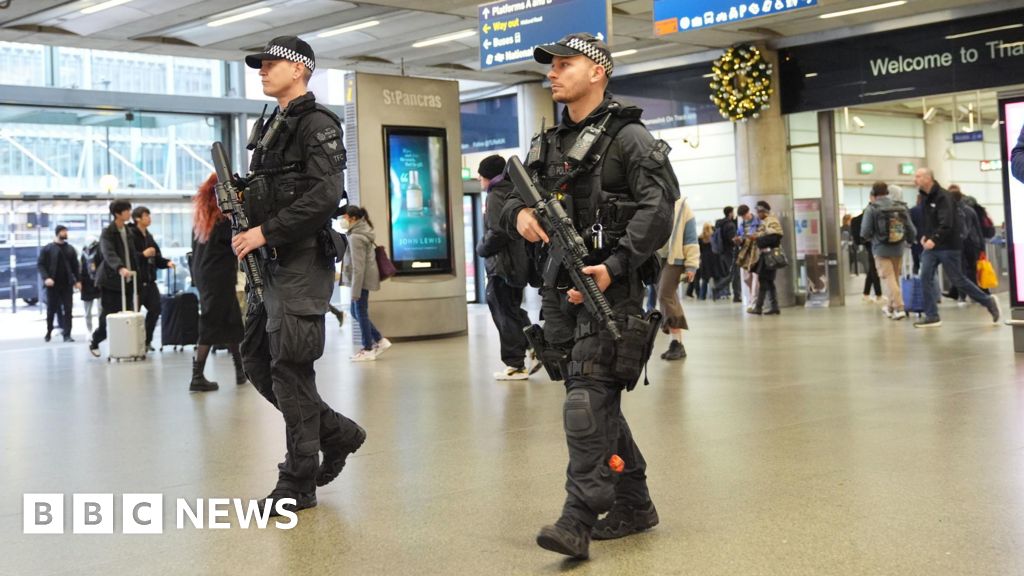
PA Media Two armed policemen walking through St Pancras International station, LondonPA Media

There will be increased visible patrols at mainline stations over the coming days, the Transport Secretary said

There will be a review of rail security in the UK following a mass stabbing on a train, Transport Secretary Heidi Alexander has said.

A man has been charged with 10 counts of attempted murder after the knife attack on a Doncaster to London service on Saturday night.

Alexander told the BBC the government would “review security arrangements” and respond “swiftly and in a proportionate way”.

But she did not think airport scanning technology “is the right solution for stations in the UK”.

Questions about passenger safety on the UK’s rail network have been raised after a a black British national, who boarded a train at Peterborough station, attacked passengers with a knife.

Eleven people were treated in hospital including a member of train staff who is said to be in a “critical but stable condition”.

Anthony Williams, 32, from Peterborough has been charged with 10 counts of attempted murder, one count of actual bodily harm and one count of possession of a bladed article, British Transport Police (BTP) said on Monday morning.

Alexander told BBC Breakfast that BTP officers would increase visible patrols at mainline stations over the coming days “because I do understand that people will want to feel reassured following what happened”.

“Thankfully incidents like this on the public transport network are very, very rare,” she added.

She said the rail network in the UK was a “low crime environment” and for every one million passenger journeys only 27 crimes were committed.

Asked what steps the government would take to improve security on trains, she said: “We are investing in improved CCTV in stations and the Home Office will soon be launching a consultation on more facial recognition technology which could be deployed in stations as well.”

Asked about luggage scanners similar to those used in some major train stations abroad she said: “At the moment that type of airport scanning technology I don’t think is the right solution for stations in the UK.”

Andy Trotter, former British Transport Police Chief Constable told BBC Breakfast Saturday’s attack illustrates “people’s real concerns about being trapped with an offender or with someone causing disorder”.

“I hope this results in a broader review of security, the need for more British Transport Police, the need for more security from the rail companies themselves.”

Senior Reform UK politician Zia Yusuf on Sunday said he would not like to see increased security at train stations.

He told the BBC’s Sunday With Laura Kuenssberg programme it would impose “enormous friction” on the lives of law-abiding people “as a result of the actions of a tiny minority”.

He argued for a significant increase in the use of stop-and-search powers “to saturation”, saying this would remove deadly weapons from circulation.

Official figures released last month show knife crime has fallen in the past year, while NHS admissions for assaults with a sharp object are down 10% compared with 2024.

Overall violent crime showed “no statistically significant change” from 2024, but remains a third lower than it was a decade ago and 75% down on its peak in 1995, while homicides have reached their lowest point since at least 2003.



Source link

Continue Reading
Click to comment

Leave a Reply

Your email address will not be published. Required fields are marked *

Business

Why Are Gold Prices Swinging? Nirmala Sitharaman Breaks It Down

Published

on

Why Are Gold Prices Swinging? Nirmala Sitharaman Breaks It Down


Source link

Continue Reading

Business

Trade deal done, says Trump; PM Modi thanks him for cutting tariff to 18% – The Times of India

Published

on

Trade deal done, says Trump; PM Modi thanks him for cutting tariff to 18% – The Times of India


Prime Minister Narendra Modi with US President Donald Trump (File photo)

NEW DELHI/ WASHINGTON: After months of bruising trade tensions, India and the US on Monday announced a bilateral trade deal that will see Washington slash additional tariffs on Indian imports to 18%, from the current 50%, making it more competitive for textiles, leather and seafood exporters.While PM Narendra Modi, in a post on X, which followed US President Donald Trump’s announcement on Truth Social, said he had a wonderful conversation with “dear friend” Trump and thanked him on behalf of 1.4 billion people for the reduced tariff of 18% on Indian goods, he did not mention the trade deal at all in his post on X that followed Trump’s “wonderful” announcement.

Modi and Trump

PM Modi and Trump

Modi also did not comment on Trump’s claim that in their conversation the PM had agreed to stop buying Russian oil and purchase much more energy from the US, and potentially Venezuela. Trump had said Modi had agreed to stop buying Russian oil and to buy much more from the US — $500 billion of energy, technology and farm products — a step that the President claimed would help end the war in Ukraine.According to the American President, Modi also agreed to bring down tariff and non-tariff barriers against the US to zero. A US embassy spokesperson confirmed that the final tariff now on India is 18%, down from the earlier 50%. This is a better deal for India than countries such Vietnam, Bangladesh, Indonesia, South Korea and China, which face higher tariffs. The Trump-Modi conversation coincided with the visit of EAM S Jaishankar to US for a critical minerals ministerial that will be chaired by Secretary of State Marco Rubio this week.The announcement came six days after India and the EU announced the completion of talks for a comprehensive trade agreement.Trump leadership vitalfor global peace: ModiThe deal had drawn sharp comments from some members of the Trump administration, including attacks on the EU.In his X post, PM said, “When two large economies and the world’s largest democracies work together, it benefits our people and unlocks immense opportunities for mutually beneficial cooperation”. He added that Trump’s leadership was vital for global peace, stability, and prosperity. India fully supports his efforts for peace. Modi said he was looking forward to working closely with Trump to take the partnership to unprecedented heights.Apart from reciprocal tariff, Trump had announced an additional 25% tariff on India for its purchase of Russian oil.Trump said the US had agreed to the trade deal with India out of friendship and respect for Modi, and at the latter’s request. “Our amazing relationship with India will be even stronger going forward. PM Modi and I are two people that GET THINGS DONE, something that cannot be said for mos,” he added.Trump in his social media post also said that it was an honour to speak with Modi whom he described as “one of my greatest friends and, a Powerful and Respected Leader of his Country”.

Ties set to get boost

Ties set to get boost

While the US had acknowledged in past few months that India had cut down its Russian purchase, it had not eliminated the additional tariff.Trump also said, “We spoke about many things, including Trade, and ending the War with Russia and Ukraine. He agreed to stop buying Russian Oil, and to buy much more from the US and, potentially, Venezuela. This will help END THE WAR in Ukraine, which is taking place right now, with thousands of people dying each and every week!”Following the announcement last week of the successful conclusion of FTA negotiations with EU, India had suggested that India and US might be close to finalising the trade agreement they have been discussing since Feb last year.Trump’s disclosure of the trade deal was preceded by two India-related posts a few hours before, one of which featured him and Modi on a magazine cover with the caption “The Mover and the Shaker”. Another post featured New Delhi’s India Gate, which Trump called “India’s beautiful Triumphal Arch” and said, “Ours will be the greatest of them all!” — referring to a similar monument he wants to build in Washington DC.


Source link

Continue Reading

Business

Union Budget 2026: Five changes in rules that could directly affect you

Published

on

Union Budget 2026: Five changes in rules that could directly affect you


New Delhi: Union Finance Minister Nirmala Sitharaman delivered presented the Budget 2026 on February 1 in Parliament. At first glance, the announcements seemed limited in impact for the average citizen. Closer analysis, however, reveals several changes that could have consequences across investment, property, digital assets and overseas remittances.

The tax slabs were not changed, but multiple announcements received attention for their long-term effects. One of the changes affects Sovereign Gold Bonds. The government removed the capital gains tax exemption on bonds purchased from secondary markets. Investors will now receive tax benefits only if the bonds were bought directly from the Reserve Bank of India during the primary issuance and held until maturity. Bonds purchased on exchanges and held beyond April 1, 2026, will attract tax on gains.

Another major announcement targets derivatives trading. The government increased the Securities Transaction Tax on futures and options. Futures transactions will now attract a 0.05 percent STT instead of 0.02 percent, while options will see the rate rise to 0.15 percent from 0.10 percent. This change increases the cost of each transaction and directly impacts profits on trading.

Add Zee News as a Preferred Source


The budget also eased property purchase procedures for non-resident Indians (NRIs). Indian buyers acquiring property from NRIs no longer need a separate Tax Deduction and Collection Account Number (TAN) for Tax Deducted at Source (TDS) payments. They can use their PAN number, similar to property purchases from domestic sellers. This simplification reduces paperwork and makes transactions smoother.

Cryptocurrency regulations were tightened. From April 1, 2026, failing to provide accurate crypto transaction information will result in a daily penalty of Rs 200. Providing incorrect data without correcting it can attract fines up to Rs 50,000. This move aims to ensure proper reporting and compliance for digital assets.

Overseas education and medical remittances received relief. The Tax Collected at Source (TCS) on funds sent under the Liberalised Remittance Scheme for education and medical needs exceeding Rs 10 lakh has been reduced from 5 percent to 2 percent. This measure lowers costs for students and patients sending funds abroad.

The TCS is collected by banks or authorised dealers when sending money abroad and is adjusted against the total tax liability during income tax filing. Excess payments are refunded. The Liberalised Remittance Scheme allows Indian residents to send up to $2.5 lakh per year for different purposes, including education, medical treatment, travel, gifts or foreign investment.

These five changes in Union Budget 2026 introduce new rules for gold bonds, derivatives, property purchases from NRIs, cryptocurrencies and foreign remittances. Each announcement has the potential to affect citizens and investors in meaningful ways, highlighting the government’s evolving focus on financial regulation, investment and cross-border transactions.


Source link

Continue Reading

Trending