Connect with us

Politics

Rights group slams treatment of viral Japanese monkey

Published

on

Rights group slams treatment of viral Japanese monkey
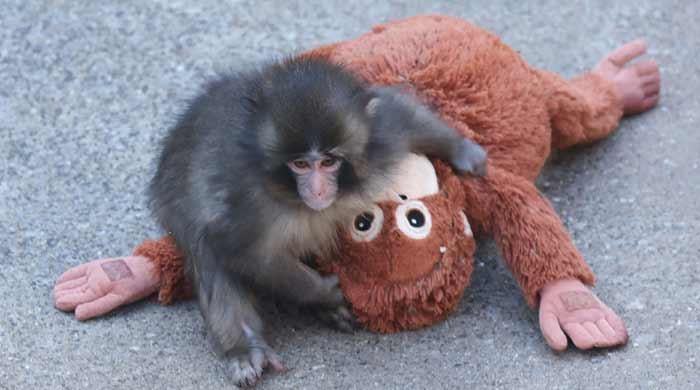

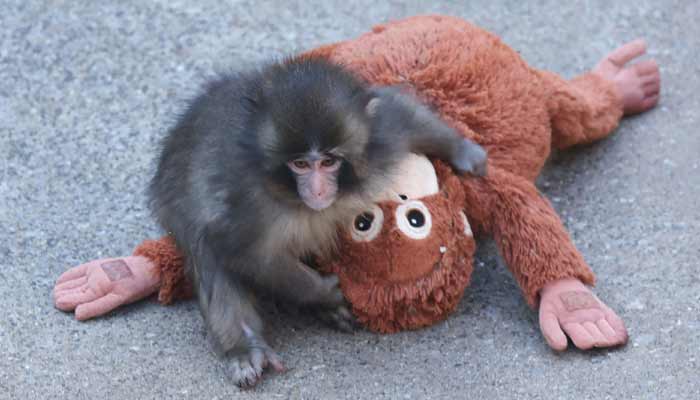
This photo taken on February 19, 2026 shows a 7 month-old male macaque monkey named Punch, who was abandoned by his mother shortly after birth, spending time with a stuffed orangutan toy at Ichikawa City Zoo and Botanical Gardens in Chiba Prefecture. — AFP

The plight of a baby monkey in Japan who has become an internet sensation shows the cruelty of zoos, an animal rights group said, as sales of the plush IKEA orangutan the animal clings to boomed.

Punch, a baby macaque abandoned by its mother, shot to stardom after being pictured getting bullied by other monkeys and seeking comfort from the orangutan toy at Ichikawa City Zoo outside Tokyo.

“Zoos are not sanctuaries — they are places where animals are confined, deprived of autonomy, and denied the complex environments and social lives they would have in the wild,” said People for the Ethical Treatment of Animals (Peta).

“What some are calling ‘cute’ is actually a glimpse into the trauma of a young, highly social primate coping with isolation and loss,” the group’s Asia director, Jason Baker, said in a statement.

“Until facilities stop treating sentient beings as attractions, animals like Punch will continue to suffer in captivity,” Baker said, calling for Punch to be moved to a “reputable sanctuary, where he could live in a more natural environment”.
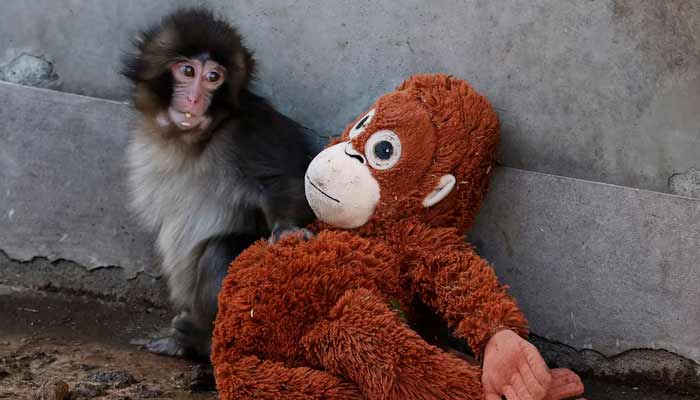
A baby Japanese macaque named Punch sits next to a stuffed orangutan at Ichikawa City Zoo, in Ichikawa, Chiba Prefecture, Japan, February 19, 2026.— Reuters
A baby Japanese macaque named Punch sits next to a stuffed orangutan at Ichikawa City Zoo, in Ichikawa, Chiba Prefecture, Japan, February 19, 2026.— Reuters 

Spurned by its mother, Punch was raised in an artificial environment after being born in July, and began training to rejoin his troop last month.

Punch’s predicament sparked huge interest online, spawning a devoted fanbase under the hashtag #HangInTherePunch, as large crowds thronged the zoo.

Meanwhile, Swedish interior furnishings giant IKEA, the maker of the orangutan soft toy, said it was seeing “unprecedented” interest and “significantly” higher sales than usual.

“As a result, the product is currently out of stock in some markets, including Japan and the United States,” Ingka Group, the holding company controlling most of IKEA’s stores, told AFP by email.

Over a long holiday weekend in Japan, fans queued for up to an hour to catch a glimpse of Punch, the Ichikawa zoo said in a post on X, with more than 5,000 visitors recorded on Monday.

The zoo said it had set up a “restricted zone” around part of the monkey enclosure to reduce stress for the animals.

A large number of people have asked how they can donate cash or goods, it added.

In an update on Punch’s plight on Sunday, the zoo said he “was meticulously groomed by two monkeys and is steadily fitting into the group”.


Source link

Continue Reading
Click to comment

Leave a Reply

Your email address will not be published. Required fields are marked *

Politics

Trump says he has solved many wars. Has he?

Published

on

Trump says he has solved many wars. Has he?


US President Donald Trump, flanked by Secretary of Commerce Howard Lutnick speaks during a press briefing at the White House in Washington, DC, US, February 20, 2026. — Reuters

US President Donald Trump says he should get the Nobel Peace Prize after wading into eight conflicts since taking office last January. But the issues that caused many remain unresolved and conflict has flared again in some of the regions, including the Democratic Republic of Congo and along the border between Cambodia and Thailand.

Here are some of the international disputes where Trump has intervened:

Armenia and Azerbaijan

Trump brought together the leaders of Armenia and Azerbaijan on August 8 last year to sign a joint declaration pledging to seek peaceful relations between nations that have been at odds since the late 1980s.

“I got to know them through trade,” Trump said later in a radio interview. “I was dealing with them a little bit, and I said, ‘Why you guys fighting?’ Then I said, ‘I’m not going to do a trade deal if you guys are going to fight. It’s crazy.'”

The two countries had committed to a ceasefire in 2023. In March, they said they had agreed on the text of a draft peace agreement, but that deal has not been signed.

The subsequent White House-brokered declaration falls short of a formal peace treaty that would place legally binding obligations on both sides. Issues remain, including whether an agreement requires Armenia to revise its constitution.

The leaders struck economic agreements with Washington that granted the US development rights to a strategic transit corridor through southern Armenia.

The Trump administration said this would allow for more energy exports. In documents released at the time, the corridor was named after Trump. US Vice President JD Vance visited both countries in February, signing a strategic partnership with Azerbaijan and a nuclear deal with Armenia.

Cambodia and Thailand

Tensions remain between Thailand and Cambodia despite the fragile ceasefire earlier brokered in part by Trump.

The US president had helped bring Thailand to the table for talks after long-simmering tensions with Cambodia spilled over in July into a five-day military conflict, the deadliest fighting between the two in more than a decade.

Trump had reached out to then-acting Thai Prime Minister Phumtham Wechayachai two days after fighting erupted along a stretch of the border. Trump withheld trade deals with both countries until the conflict ended.

The US president oversaw the signing of a ceasefire deal between the two countries in Malaysia in October, which broke down within a matter of weeks before a new ceasefire was reached on December 27.

Israel, Iran and the Palestinian territories

Trump chaired the first meeting of his Board of Peace initiative on Thursday, as part of a bid to direct a deal aimed at ending conflict in — and redeveloping — Gaza.

Israel and Hamas agreed in October to the first phase of a Trump-brokered hostage and ceasefire deal. Hostilities have continued.

But the agreement nonetheless marked a major step forward for efforts to end a two-year war in Gaza in which more than 67,000 Palestinians have been killed. Under the deal, Hamas handed over hostages. Both, however, have repeatedly accused each other of violating the truce.

Both sides remain far apart on major issues, including Hamas’ disarmament, the governance of post-war Gaza and the composition and mandate of an international security force in the enclave.

The US president has also been working to expand the Abraham Accords, an initiative from his first term aimed at normalising diplomatic ties between Israel and Arab nations.

The Republican initially pursued talks with Iran over its nuclear programme. Israel launched an aerial war on Iran on June 13 and pressed Trump to join in. He did on June 22, bombing Iranian nuclear sites. He then pressed Israel and Iran to join a ceasefire that Qatar mediated.

Trump said at the time that Iran’s key nuclear sites were obliterated and disputed reports that the programme had merely been set back.

But in recent weeks, Trump has threatened Iran over nuclear programme. He has ordered a huge buildup of forces in the Middle East and preparations for a potential multi-week air attack on the country.

Rwada and Democratic Republic of the Cango

The Rwanda-backed rebel group M23 staged a lightning offensive this year and now holds more territory than ever in the eastern Democratic Republic of Congo. Its recent advances have stirred fears of further regional spillover of fighting.

Under pressure from Trump, Rwanda and Congo signed a US-brokered peace agreement on June 27. It hasn’t been implemented.

Trump brought the leaders of Congo and Rwanda to a Washington event on December 4 at a peace institute that his administration unofficially renamed in honour of the US president. There, they signed more documents affirming their commitment to Trump’s peace plan.

But the fighting has continued. Congolese President Felix Tshisekedi has said that Rwanda is violating its commitments, as has US Secretary of State Marco Rubio. Rwanda has long denied backing M23, but UN experts and Congolese leaders disagree. Qatar has brokered separate talks between Congo and M23.

Meanwhile, the leader of a Congolese rebel coalition that includes the M23 group has said a deal on critical minerals signed in December between Congo and Washington was unconstitutional, raising doubts about its implementation.

The insurgency is the latest episode in a decades-old conflict with roots in the 1994 Rwandan genocide.

Trump has warned of “very severe penalties, financial and otherwise” if the agreement is violated. The US is seeking access to Congo’s vast array of critical minerals as it competes with China for control of natural resources.

Pakistan and India

US officials worried conflict could spiral out of control when nuclear-armed India and Pakistan clashed in May following an attack in India that Delhi blamed on Islamabad without providing any concrete evidence.

Consulting with Trump, Rubio and Vance pushed Indian and Pakistani officials to de-escalate the situation.

A ceasefire was announced on May 10 after four days of fighting. But it addressed few of the issues that have divided India and Pakistan, which have fought three major wars since their independence from the United Kingdom in 1947.

Days after the ceasefire, Trump said he used the threat of cutting trade with the countries to secure the deal. India disputed that US pressure led to the truce and that trade was a factor.

Egypt and Ethiopia

Egypt and Ethiopia have a long dispute over the Grand Ethiopian Renaissance Dam, which Cairo regards as a national security issue and fears will threaten its Nile River water supplies.

“We’re working on that one problem, but it’s going to get solved,” Trump said in July.

White House spokeswoman Karoline Leavitt later included Egypt and Ethiopia in a list of conflicts that “the president has now ended.”

It is unclear what Trump is doing on the issue, though he has said he wants to bring the parties together for talks. In public comments, Trump has largely echoed Cairo’s concerns.

Ethiopia’s Prime Minister Abiy Ahmed opened the dam in September despite objections from both Sudan and Egypt. Egypt’s president, Abdel Fattah al-Sisi, has vowed to protect his own country’s interests.

Serbia and Kosovo

Kosovo and Serbia maintain tense relations five years after agreements Trump brokered with both during his first term to improve their economic ties.

Without providing evidence, Trump said in June he “stopped” war between the countries during his first term and that “I will fix it, again,” in his second.

Kosovo declared independence in 2008, almost a decade after Nato bombed Serb forces during a 1998-1999 counter-insurgency war.

But Serbia still regards Kosovo as an integral part of its territory. The countries have signed no peace deal.

Kosovo’s prime minister, Albin Kurti, has sought to extend government control over the north, where about 50,000 ethnic Serbs live, many of whom refuse to recognise Kosovo’s independence.

Kosovo’s president, Vjosa Osmani, said in July that over “the last few weeks,” Trump had prevented further escalation in the region. She did not elaborate, and Serbian President Aleksandar Vucic denied that any escalation had been looming.

Russia and Ukraine

Trump, who said during the 2024 presidential campaign that he could solve the war in Ukraine in one day, has so far been unable to end the nearly four-year-old conflict that analysts say has left more than 1 million people dead or wounded.

“I thought this was going to be one of the easier ones,” Trump said on August 18. “It’s actually one of the most difficult.”

Trump’s views on how to best bring peace have swung from calling for a ceasefire to saying a deal could still be worked out while fierce fighting continued. He imposed sanctions on Russia’s two biggest oil companies in October.

More recently, Trump has attempted to press Ukrainian President Volodymyr Zelenskiy into accepting a deal to end the war that European leaders worry would favour Moscow and destabilise the continent. Talks in recent days have produced few signs of progress.

South Korea and North Korea

Trump has said he wants to meet North Korean leader Kim Jong Un and make another push towards peace.

“We’ll come back, and we’ll, at some point in the not-too-distant future, meet with North Korea,” Trump told reporters in October on a trip to South Korea.

Trump and Kim held three summits during Trump’s 2017-2021 first term. They also exchanged several letters that Trump called “beautiful” before the unprecedented diplomatic effort broke down over US demands that Kim give up his nuclear weapons.

North Korea has surged ahead with more and bigger ballistic missiles, expanded its nuclear weapons facilities, and gained new support from its neighbours in the years since. In his second term, Trump has acknowledged that North Korea is a “nuclear power.”

Kim said in September that there was no reason to avoid talks with Washington if it dropped its demands that his country give up nuclear weapons. Trump agreed to support Seoul’s pursuit of a nuclear-powered submarine for its own defence.


Source link

Continue Reading

Politics

North Korea’s Kim Jong-un re-elected General Secretary of Workers’ Party

Published

on

North Korea’s Kim Jong-un re-elected General Secretary of Workers’ Party


North Korea’s Kim Jong-un is re-elected by Congress as the General Secretary of the country’s ruling Workers’ Party for the third time.

State media reported on Monday that Kim, 42, was reelected to the top post with delegates at the Congress crediting him for bolstering the country’s nuclear arsenal and strengthening its regional standing.

Kim has created a military capable of handling “any threat of aggression” and “any form of war,” the Congress announced, adding that his brave leadership is “reliably guaranteeing” the country’s future and “boosting the pride and self-esteem” of North Koreans.

Kim was reelected as General Secretary of North Korea’s Workers’ Party with the “unshakable will and unanimous desire” of thousands of delegates on the fourth day of meetings Sunday, North Korea’s official Korean Central News Agency (KCNA) announced. He has held the party’s top post since 2016.

The Congress is held every five years to elect the general secretary to serve as the party’s top representative and leader.

Kim is expected to announce his major policies on the military, diplomacy, the economy, and other areas for the next five years at the Congress, which kicked off last Thursday.

Western political analysts believe Kim will likely use the assembly as a platform from which he will announce the nation’s new military goals, including strengthening conventional forces and integrating them with nuclear capabilities. He will also likely announce a new plan for economic “self-reliance” through mass mobilization, following gradual post-pandemic gains fueled by rebounding trade with China and arms exports to Russia.

In the meantime, Kim’s government has rejected dialogue offers from US President Donald Trump since the American president began his second term, urging Washington to drop its demand for North Korea’s denuclearization as a precondition for talks. Kim has declared the war-divided South Korea a permanent enemy of the North as long as it is under US influence.


Source link

Continue Reading

Politics

Iran nears deal to buy supersonic anti-ship missiles from China: report

Published

on

Iran nears deal to buy supersonic anti-ship missiles from China: report


A new hypersonic ballistic missile called Fattah with a range of 1400 km, unveiled by Iran, is seen in Tehran, Iran, June 6, 2023.— Reuters/File
A new hypersonic ballistic missile called “Fattah” with a range of 1400 km, unveiled by Iran, is seen in Tehran, Iran, June 6, 2023.— Reuters/File
  • Supersonic designed to evade shipborne defence.
  • Iran, China also in discussions for anti‑ballistic weapons.
  • Missiles’ transfer to defy UN’s weapons embargo.

Iran is close to a deal with China to purchase anti‑ship cruise missiles, according to six people with knowledge of the negotiations, just as the United States deploys a vast naval force near the Iranian coast ahead of possible strikes on the Islamic Republic.

The deal for the Chinese‑made CM‑302 missiles is near completion, though no delivery date has been agreed, the people said. The supersonic missiles have a range of about 290 kilometres and are designed to evade shipborne defences by flying low and fast. Their deployment would significantly enhance Iran’s strike capabilities and pose a threat to US naval forces in the region, two weapons experts said.

Negotiations with China to buy the missile weapons systems, which began at least two years ago, accelerated sharply after the 12‑day war between Israel and Iran in June, according to the six people with knowledge of the talks, including three officials who were briefed by the Iranian government as well as three security officials.

As talks entered their final stages last summer, senior Iranian military and government officials travelled to China, including Massoud Oraei, Iran’s deputy defence minister, according to two of the security officials. Oraei’s visit has not been previously reported.

“It’s a complete gamechanger if Iran has supersonic capability to attack ships in the area,” said Danny Citrinowicz, a former Israeli intelligence officer and now senior Iran researcher at Israel’s Institute for National Security Studies think tank. “These missiles are very difficult to intercept.”

Reuters could not determine how many missiles were involved in the potential deal, how much Iran had agreed to pay, or whether China would go through with the agreement now given heightened tensions in the region.

“Iran has military and security agreements with its allies, and now is an appropriate time to make use of these agreements,” an Iranian foreign ministry official told Reuters.

The Chinese delegation to the United Nations directed Reuters to seek comment from the Foreign Ministry in Beijing. The foreign and defense ministries did not respond to requests for comment.

The White House did not directly address the negotiations between Iran and China over the missile system when asked by Reuters. US President Donald Trump has been clear that “either we will make a deal or we will have to do something very tough like last time,” a White House official said, referring to the current standoff with Iran.

The missiles would be among the most advanced military hardware to be transferred to Iran by China and defy a United Nations weapons embargo that was first imposed in 2006. The sanctions were suspended in 2015 as part of a nuclear deal with the US and allies, and then reimposed last September.

US forces gathering near Iran

The potential sale would underscore deepening military ties between China and Iran at a moment of heightened regional tension, complicating US efforts to contain Iran’s missile programme and curb its nuclear activities. It would also signal China’s growing willingness to assert itself in a region long dominated by US military might.

While hosting Iranian President Masoud Pezeshkian for a military parade in Beijing in September, Chinese President Xi Jinping told the Iranian leader that “China supports Iran in safeguarding sovereignty, territorial integrity and national dignity.”

China joined Russia and Iran in a joint letter on October 18 to say they believed the decision to reimpose sanctions was flawed.

“Iran has become a battlefield between the US” on one side and Russia and China on the other, said one of the officials who was briefed by Iran’s government on the missile negotiations.

The deal comes as the US assembles an armada within striking distance of Iran, including the aircraft carrier USS Abraham Lincoln and its strike group. The USS Gerald R. Ford and its escorts are also heading to the region. The two ships together can carry more than 5,000 personnel and 150 aircraft.

“China does not want to see a pro-Western regime in Iran,” said Citrinowicz, the Israeli specialist on Iran. “That would be a threat to their interests. They are hoping that this regime will stay.”

Trump said on February 19 he was giving Iran 10 days to reach an agreement over its nuclear programme or face military action. The US is preparing for the possibility of sustained, weeks-long operations against Iran if Trump orders an attack, Reuters reported on February 13.

A depleted arsenal 

The CM-302 purchase would be a significant improvement in an Iranian arsenal depleted by last year’s war, said Pieter Wezeman, a senior researcher at the Stockholm International Peace Research Institute.

China’s state-owned China Aerospace Science and Industry Corporation (CASIC) markets the CM-302 as the world’s best anti-ship missile, capable of sinking an aircraft carrier or destroyer. The weapons system can be mounted on ships, aircraft or mobile ground vehicles. It can also take out targets on land.

CASIC did not respond to a request for comment.

Iran is also in discussions to acquire Chinese surface‑to‑air missile systems, so-called MANPADS, anti‑ballistic weapons, and anti-satellite weapons, the six people said.


Source link

Continue Reading

Trending