

Business
Save 13% On Your Wedding Hall Bookings With This Little-Known GST Trick


Last Updated:
Couples on a tight budget can save more by cutting food costs, opt for popular dishes and a smaller menu to significantly reduce wedding expenses

When booking separately, a GST of 18% is applied to the hall, and 5% to catering. (AI Generated/News18 Hindi)
As wedding season approaches, many couples are faced with the daunting task of managing wedding expenses, which begin to pile up once the invitations are printed. Major costs include attire, jewellery, decorations, entertainment, photography, catering, gifts, and the venue, with the latter often being the most significant expense.
Booking a banquet hall or resort for a single evening can range between Rs 1 lakh to Rs 2 lakh. During peak seasons, venue owners often hike their prices, making it seem like renting a palace.
However, there are ways to save on these costs. Instagram finance influencer Binge Wealth reveals that one can save up to 13% on hall bookings by opting for a combined service from the same vendor. When booking the hall and catering separately, a GST of 18% is applied to the hall, and 5% to catering. Yet, booking both services together counts as a ‘composite supply’, incurring only a 5% GST on the entire package.
To illustrate, consider a banquet hall with a base rent of Rs 5 lakh. Separate bookings would entail a GST of Rs 90,000 for the hall (18% of Rs 5,00,000) and Rs 10,000 for catering (5% of Rs 2,00,000), totalling Rs 1,00,000.
By booking both from one vendor, the composite supply GST on the combined amount of Rs 7 lakh (Rs 5 lakh for the hall and Rs 2 lakh for catering) would be Rs 35,000, resulting in direct savings of Rs 65,000. This translates to savings of around 13% (Rs 55,000) on a Rs 5 lakh hall and over Rs 1 lakh on a Rs 10 lakh hall.
Siddharth Maurya, founder and managing director of Vibhavangal Anukoolkara Private Limited, emphasises that the biggest savings in a wedding budget often come from tax structure optimisation.
Couples frequently overlook this aspect, but booking the hall and catering together can slash costs by 10-13%. For a typical wedding, this simple strategy can save thousands, if not lakhs, without additional effort.
For those desiring a grand celebration on a tight budget, further savings can be made by reducing the cost of food plates and selecting only the most popular dishes. Limiting the menu to fewer items can significantly cut costs, as a broader selection usually means higher expenses. Additionally, modest adjustments to hall decorations can prevent overspending on decor.
November 20, 2025, 18:57 IST
Read More

Business
Rs 20,000 crore gold, silver rush: What will people buy this Akshaya Tritiya? – The Times of India
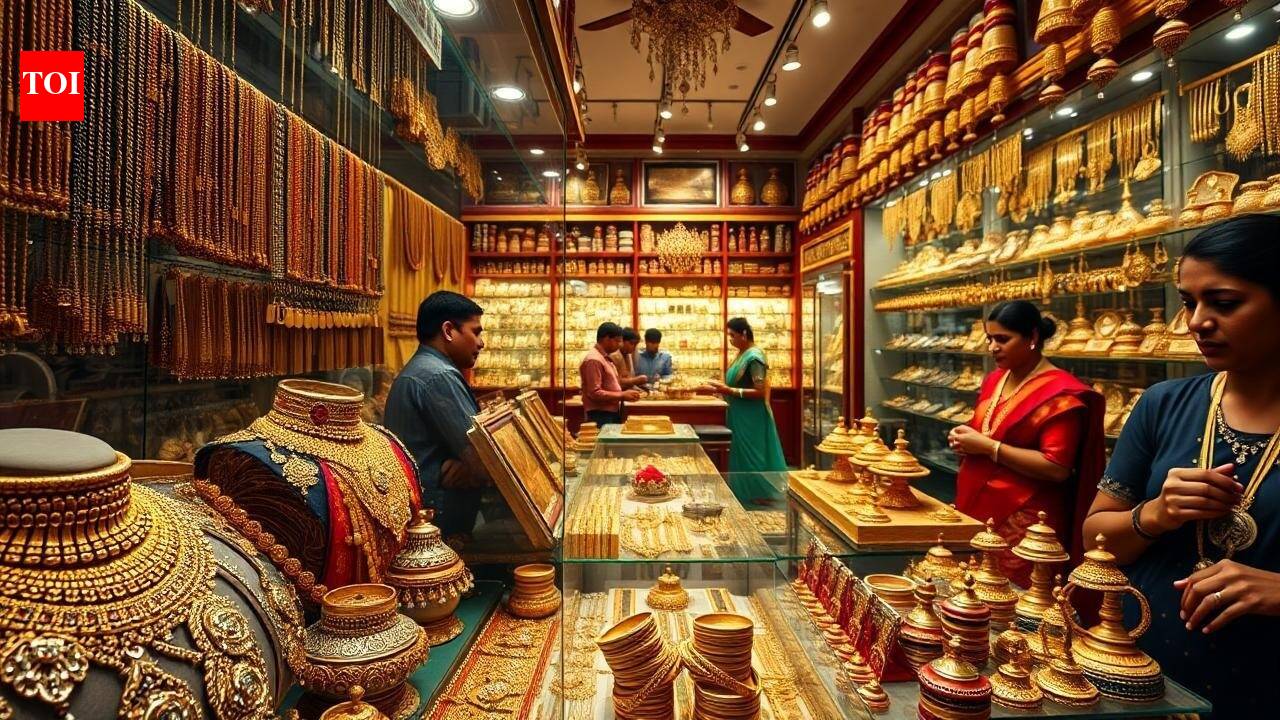
This Akshaya Tritiya, India’s gold and silver markets are heading for bumper purchases, with overall trade likely to cross Rs 20,000 crore even as record-high prices reshape buying patterns. The estimate, shared by the Confederation of All India Traders (CAIT), is higher than last year’s Rs 16,000 crore, signalling growth in value despite a sharp rise in bullion rates.Prices for the yellow metal have surged sharply over the past year, going from Rs 1,00,000 per 10 grams, to Rs 1.58 lakh. Meanwhile, silver has shown a steeper rally, jumping from Rs 85,000 per kilogram to Rs 2.55 lakh per kilogram. According to CAIT, this sharp escalation has not weakened demand, but is instead prompting consumers to make more deliberate and value-oriented purchases.Praveen Khandelwal, member of parliament from Chandni Chowk and secretary general of CAIT told ANI, “Akshaya Tritiya has traditionally been one of India’s most auspicious occasions for purchasing gold… While gold continues to dominate, the nature of purchasing is evolving significantly in response to steep price escalation.”Commenting on customer preference, CAIT national president BC Bhartia highlighted, “There is a clear shift towards lightweight, wearable jewellery, alongside a stronger focus on silver and diamond products. Attractive incentives such as reduced making charges and complimentary gold coins are also helping sustain consumer interest.”Despite the increase in overall trade value, the quantity of metals being sold tells a different story. Pankaj Arora, National President of the All India Jewellers and Goldsmith Federation (AIJGF), an associate of CAIT, explained that the projected Rs 16,000 crore gold trade amounts to nearly 10,000 kilograms (10 tonnes) at current rates. The value, spread across an estimated 2 to 4 lakh jewellers, translates to average sales of only 25 to 50 grams per jeweller, “clearly indicating a sharp decline in volume”.Meanwhile for silver, the estimated Rs 4,000 crore trade corresponds to around 1,56,800 kilograms (157 tonnes), resulting in average sales of about 400 to 800 grams per jeweller during the festival period. “These figures underline a critical shift: while the value of business is expanding due to rising prices, actual consumption is contracting,” Khandelwal said.This gap between value and volume is also reshaping consumer’s buying pattern, with smaller items and lightweight jewellery gaining popularity. At the same time, jewellers are facing challenges due to fluctuating prices, especially when it comes to managing inventory.Even so, festive demand remains steady, with markets witnessing healthy footfall. “Consumers are now adopting a more cautious and pragmatic approach, balancing traditional beliefs with financial discipline,” Khandelwal added.At the same time, it’s not just about physical gold anymore as consumers are increasingly exploring alternatives like digital gold, Sovereign Gold Bonds and gold ETFs, drawn by the promise of liquidity, safety and flexibility when prices are volatile.CAIT and AIJGF have urged jewellers to comply with mandatory hallmarking standards, including HUID certification, and advised buyers to verify the purity and authenticity of their purchases.

Lauren Elcock is among the young Londoners who say rising rents are forcing them to quit the capital.
Source link
As governments across the world restricted the movements of their citizens during Covid lockdowns from 2020, people spent more time online. We bought more online and socialised more online, and this brought us closer to the people who want to scam us. At the same time, realistic video impersonations, voices, websites, and texts became more commonplace, and scammers increased their use of social media including WhatsApp.

Rs 20,000 crore gold, silver rush: What will people buy this Akshaya Tritiya? – The Times of India

Prince Harry corrects blunder before peace with King Charles suffers again
The cost of rising rents: Working four jobs and pushed on to benefits

-

 Entertainment6 days ago
Palace left in shock as Prince William cancels grand ceremony
-

 Sports6 days ago
The case for Man United’s Fernandes as Premier League’s best
-

 Politics1 week ago
Chinese, Taiwanese will unite, Xi tells Taiwan opposition leader
-

 Entertainment1 week ago
Dua Lipa hits major career high ahead of wedding with Callum Turner
-
 Business1 week ago
100% road tax waiver for electric cars, new rules for 2, 3 and 4 wheelers – what Delhi govt’s draft EV policy says – The Times of India
-
 Business6 days ago
UK could adopt EU single market rules under new legislation
-
 Business1 week ago
The FAA wants gamers to apply for air traffic control jobs
-

 Fashion6 days ago
Energy emerges as biggest cost driver in textile margins