

Business
Sensex Gains 2,072 Points, Nifty Above 25,700; US-India Trade Deal Among Key Factors Behind Rally


Last Updated:
Indian benchmark indices staged a powerful rally, with the Nifty and Sensex surging up to 4.7% and 4.4% respectively; Know key reasons



Nifty50
Indian benchmark indices staged a powerful rally, with the Nifty and Sensex surging up to 4.7% and 4.4%, respectively, marking one of their strongest single-day advances. The sharp upswing followed the announcement of a long-awaited India–US trade agreement, which helped ease tariff-related worries that had weighed on domestic equities for months.
The benchmark BSE Sensex ended 2072.67 points higher or 2.54% to end at 83,739.13. The Nifty 50 climbed 639.15 points, or 2.55%, to end at 25,727.55 during the session.
Earlier in the day, the BSE Sensex jumped 5.1% during the session to hit an intraday peak of 85,871.73. Meanwhile, the Nifty 50 advanced by 1,252 points, or 5%, climbing to 26,341.2 as buying intensified across the board.
The sharp move also led to a massive rise in investor wealth. The combined market capitalisation of BSE-listed companies increased to Rs 467.35 lakh crore from ₹455 lakh crore in the previous session, translating into a gain of more than Rs 12.5 lakh crore in a single day as participation broadened across sectors.
Highlighting the reasons that are fueling the Indian stock market today, Santosh Meena, Head of Research at Swastika Investmart, said, “The Indian stock market today is in a bull trend due to the announcement of the India-US trade deal. The much-awaited trade deal has the potential to significantly improve sentiment across markets and among FIIs. After a strong gap-up opening during the Opening Bell, the possibility of the Nifty 50 index hitting fresh all-time highs in the near term cannot be ruled out. The Indian rupee is also expected to strengthen meaningfully.”
On segments that may benefit in upcoming sessions after the India-US trade deal, Santosh Meena of Swastika Investmart, said, “Export-oriented sectors are likely to be the key beneficiaries—textiles and apparel, gems & jewellery, leather, marine/seafood (shrimp), auto ancillaries, engineering goods, speciality chemicals, and select electronics and consumer goods. Pharma and IT/services may also witness an indirect sentiment boost.”
What’s driving the rally
India–US trade deal
After prolonged negotiations, India and the US sealed a trade agreement under which Washington cut reciprocal tariffs on Indian goods to 18% from 50%. In return, India will reduce tariffs and non-tariff barriers on American products. The breakthrough removes a major uncertainty that had kept foreign investors cautious and contributed to Indian equities’ underperformance. Through January, the Nifty had slumped over 1,000 points at its worst, even as foreign portfolio investors sold heavily.
Rupee strength adds comfort
A stronger rupee also supported sentiment, easing some pressure from global volatility. The currency opened at 90.40 against the dollar versus its previous close. Analysts believe the combined effect of the India–US deal, progress on the EU trade front and a growth-focused Budget could lift sentiment and revive risk appetite across markets.
FII short covering
Short covering by foreign institutional investors amplified the rebound. With bearish positions estimated to be close to 90%, traders rushed to unwind shorts as indices rebounded from oversold levels and the Nifty reclaimed the 26,000 mark. Anand James, Chief Market Strategist at Geojit Investments, said a sustained move above 25,000 opens the door to 25,800 and possibly 26,200, though failure to hold above 25,800 could trigger consolidation toward the 25,430–25,340 zone.
Heavyweights power gains
Large-cap stocks led from the front. Reliance Industries climbed nearly 4%, while Adani Ports surged about 8%, giving strong momentum to the benchmarks. HDFC Bank, L&T, Bajaj Finance, ICICI Bank, Infosys and Eternal gained up to 5%. Optimism around the Union Budget 2026’s capital expenditure push further strengthened expectations of better order flows.
Buzz for strong quarterly numbers
On how the India-US trade deal may benefit the Indian stock market in the medium to long term, Seema Srivastava, Senior Research Analyst at SMC Global Securities, said, “The India-US deal is expected to benefit export-oriented companies, especially the auto, IT, textile, pharma, gems and jewellery. So, companies from these segments are expected to report strong quarterly numbers in the upcoming quarters.” She said that the market would try to discount that buzz much before the companies start reporting such robust quarterly numbers.
Supportive global cues
Global markets also offered tailwinds. The Dow Jones rose roughly 515 points (1.05%), the S&P 500 gained 0.5%, and the Nasdaq advanced about 0.6%. Asian equities rallied, with Japan’s Nikkei jumping around 3% and South Korea’s Kospi soaring over 5%. Hong Kong’s Hang Seng and China’s CSI 300 posted modest gains, while Australia’s S&P/ASX 200 climbed 1.3% after the Reserve Bank of Australia raised its policy rate by 25 basis points to 3.85%, its first hike since November 2023.
Stocks to buy after India-US trade deal
On stocks to buy in the wake of the India-US trade deal and the reduction of Trump’s tariffs on India, Anuj Gupta, a SEBI-registered market expert, recommended 21 stocks to buy today from the auto, IT, pharma, textile, and defence sectors.
Pharma: Aurobindo Pharma, Cipla, and Glenmark Pharmaceuticals.
Defence: BEL, HAL, and Cochin Shipyard.
IT: TechM, HCL Tech, Wipro, and Infosys.
Textile: Trident and Welspun Living.
Auto and Auto Ancillary: Eicher Motors, Tata Motors, TVS Motor, Bajaj Auto, JBM Auto, Bosch, Amara Raja, and Exide Industries.
February 03, 2026, 11:30 IST
Read More





Business
FPI May trade: Foreign portfolio investiors withdrew Rs 14,231 crore from Indian equities – The Times of India
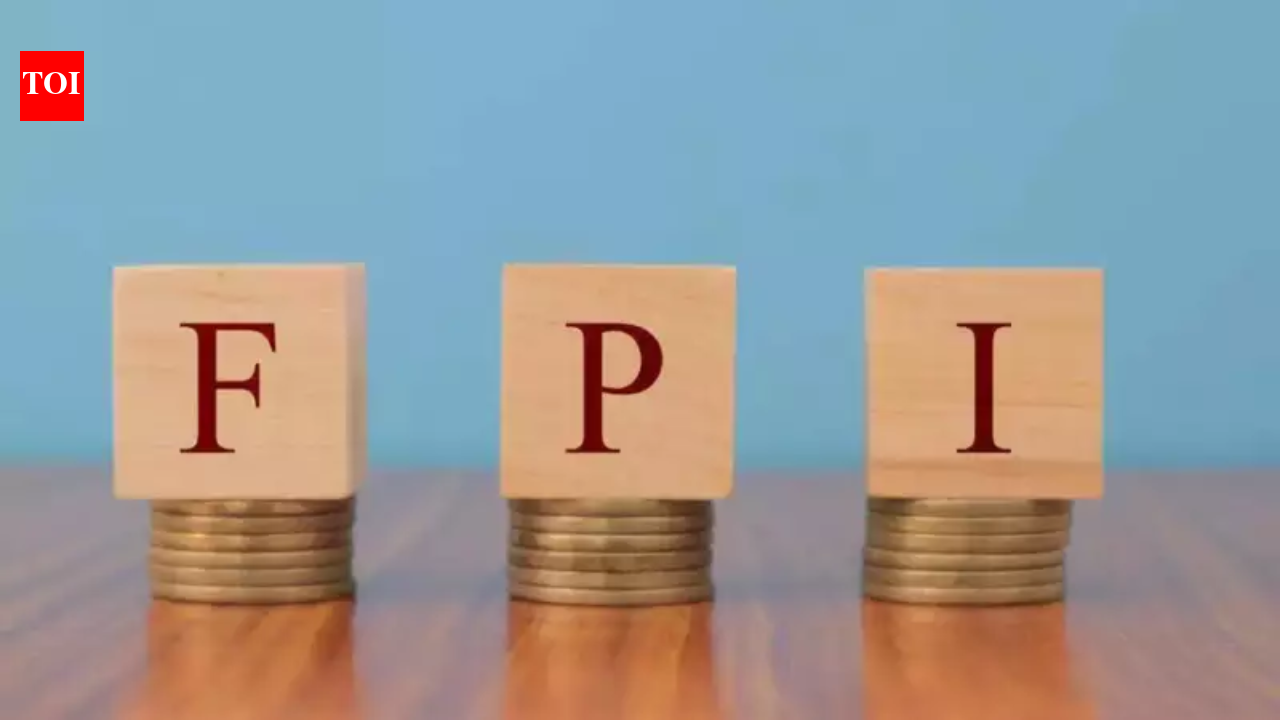
Foreign portfolio investors have extended their retreat from Indian equities in May, taking their total withdrawal from the market in 2026 beyond Rs 2 lakh crore as global economic concerns continue to drag down sentiment. Data from NSDL showed FPIs have pulled out Rs 14,231 crore so far this month, adding to a year marked by persistent selling pressure. The cumulative outflow this year has now surpassed the Rs 1.66 lakh crore foreign investors withdrew during the whole of 2025. The pattern through 2026 has largely remained negative, with February standing out as the lone exception. January opened with FPIs selling equities worth Rs 35,962 crore. In February, however, foreign investors briefly reversed course, bringing in Rs 22,615 crore, their biggest monthly investment in 17 months. That momentum did not last. March recorded the sharpest reversal, with a record Rs 1.17 lakh crore exiting Indian equities. April followed with another steep outflow of Rs 60,847 crore, while May has continued the same trajectory. “The selling was largely driven by persistent global macroeconomic uncertainties, particularly concerns around inflation, interest rates and geopolitical risks, which continued to weigh on sentiment toward emerging markets,” Himanshu Srivastava, Principal, Manager Research at Morningstar Investment Research India, said. According to Srivastava, uncertainty over how global interest rates will move remains central to foreign investor behaviour. High crude oil prices and unresolved geopolitical tensions, particularly in the Middle East, have kept inflation concerns elevated worldwide, forcing investors to reassess hopes of near-term rate cuts by major central banks. This backdrop has supported firm global bond yields, increasing the appeal of developed-market debt instruments while weakening investor appetite for emerging market equities such as India. He also said intermittent weakness in the Indian rupee has affected returns for overseas investors when measured in dollar terms. Even amid sustained selling, foreign investors have not completely stepped away from Indian markets. V K Vijayakumar, Chief Investment Strategist at Geojit Investments, said FPIs have shown selective interest in segments such as power, construction and capital goods. He noted that mid-cap and certain small-cap stocks with strong earnings and growth potential are also drawing investor attention. Vijayakumar said currency depreciation and concerns around India’s earnings growth have played a significant role in shaping FPI outflows this year. He added that markets like South Korea and Taiwan are currently seeing stronger FPI interest, supported by expectations of better earnings growth linked to the artificial intelligence boom.

Campaigners are calling for a ban on the use of the weedkiller over health concerns.
Source link
Business
Assam ships 20 tons of honey consignment to US, farmers get export market boost – The Times of India

In a major push to India’s agricultural exports and the government’s One District One Product (ODOP) initiative, APEDA has facilitated the first-ever export of 20 metric tonnes of honey from Assam’s Baksa district to the United States, ANI reported.According to the Commerce and Industry Ministry, the consignment was flagged off on May 9 and exported by APEDA-registered exporter M/s Salt Range Foods Pvt Ltd.“In a major boost to the diversification of India’s agricultural exports and furthering the One District One Product (ODOP) initiative, the first-ever export consignment of ODOP honey from Baksa, an Aspirational District in Assam, to the USA was flagged off on 09 May 2026 through the initiative of APEDA,” the ministry said in a release.The ministry said the 20-metric-tonne consignment was sourced from Baksa district, which has been identified under the ODOP programme for its strong honey production and export potential.“Sourced from eco-friendly and pesticide-free environments, honey from Baksa district is known for its high quality and near-organic characteristics, reflecting the region’s rich biodiversity and sustainable agricultural practices,” the release stated.The ministry noted that honey collection has traditionally been practised by indigenous communities such as the Karbi, Mishing and Bodo tribes, where honey has long been used for food, medicinal and cultural purposes.As per National Horticulture Board data cited in the release, Assam produced around 1,650 metric tonnes of honey during FY24. Major honey-producing districts in the state include Baksa, Kokrajhar, Chirang, Udalguri and Tamulpur in the Bodoland Territorial Region.The government said the export initiative is expected to significantly improve earnings for local beekeepers and farmers.“The initiative is expected to significantly benefit local beekeepers and farmers, with producers receiving nearly 43 per cent higher price realisation compared to prevailing local farm gate prices, thereby enhancing income opportunities and strengthening rural livelihoods in the region,” the ministry said.According to the release, APEDA supported the export process by facilitating infrastructure development and providing testing and laboratory equipment at the processing facility to ensure compliance with global food safety and quality standards.“The export initiative marks a significant milestone in integrating farmers from Aspirational Districts into global value chains, ensuring better price realisation and sustained market access,” the ministry added.The ODOP initiative seeks to promote district-specific products, strengthen local economies, encourage value addition and create employment opportunities by linking regional products with international markets.


Martha Stewart: How to make an omelet

Misse Beqiri reacts as Ryan Thomas pays tribute to late TOWIE star Jake Hall

‘Reservation Hijacking’ Scams Target Travelers. Here’s How to Stay Safe

-

 Politics7 days ago
Iran weighs US reply delivered via Pakistan as Trump signals opposition to deal terms
-

 Fashion1 week ago
US’ J.Jill, Inc. appoints Kimberly Wallengren as CMO
-

 Fashion1 week ago
AAFA pushes for swift US House passage of key anti-counterfeiting law
-

 Fashion1 week ago
US cotton export sales show strong recovery, Upland rise 36%
-

 Sports1 week ago
Sajid Ali Sadpara summits world’s fifth-highest peak
-

 Politics1 week ago
Two women die on migrant boat seeking to reach UK
-
 Business1 week ago
UK airlines to be allowed to cancel flights in advance over fuel shortages
-

 Fashion1 week ago
ICE cotton witnesses sharp rise on weaker dollar, strong exports